
l4py is a Python library that simplifies logging configuration with features like JSON formatting, file rotation, and dynamic log levels via environment variables. It integrates seamlessly with Django and leverages the Python standard logging module for easy customization.

Project description
l4py


██╗██╗  ██╗██████╗ ██╗   ██╗
██║██║  ██║██╔══██╗╚██╗ ██╔╝
██║███████║██████╔╝ ╚████╔╝
██║╚════██║██╔═══╝   ╚██╔╝
███████╗██║██║        ██║
╚══════╝╚═╝╚═╝        ╚═╝
l4pyis a Python library that simplifies logging configuration and enhances logging output with flexible formatting and output options. It offers an easy-to-use interface to configure both console and file logging with various customization features like JSON formatting, file rotation, and automatic log level handling. The library leverages the Python standard logging module and integrates seamlessly with Django's logging configuration.
Key Features:
- File Logging: Automatically handles file logging with customizable file names, maximum size, and retention count.
- JSON Support: Optionally format log messages in JSON for structured output, both in console and log files.
- Django Integration: Simplifies Django logging configuration with a pre-built function to create a LOGGING dict compatible with Django's settings.
- Customizable Logging Levels:
l4pyallows you to define log levels using environment variables, following the patternL4PY_LOG_LEVEL_{logger_name}andL4PY_LOG_LEVEL_ROOT. This enables dynamic configuration of log levels without the need to modify the code. - Utility Functions: Includes utility functions for app name retrieval and platform-specific log file naming.
- Testing Support:
@l4py_testfroml4py.testis a decorator to streamline testing and validation of logging behavior, ensuring precise control over loggers and outputs.l4py_entries_from_streamfroml4py.testis a helper function to extract and process log entries from streams for easy verification during tests.
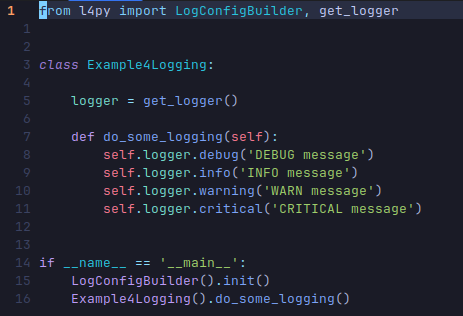
Example Code
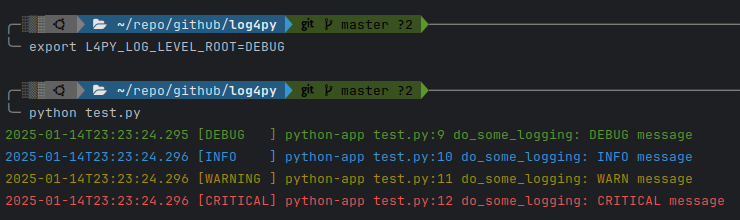
Default console output
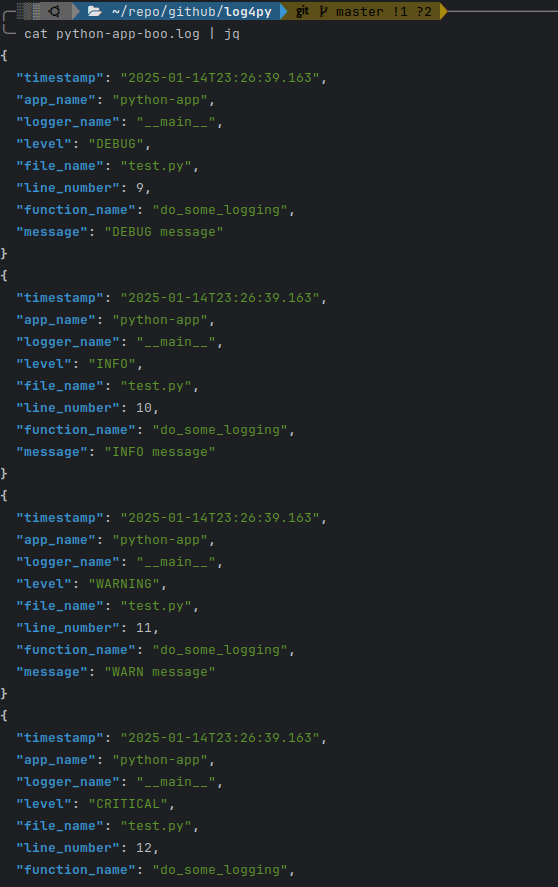
Default file output
Installation
pip install l4py
or from Github:
git clone https://github.com/roymanigley/l4py.git
cd l4py
pip install -r requirements.txt
python setup.py install
Usage
All th values set in the builder and the environment variables are the default values, and they don't have to be set explicit
Environment Variables:
L4PY_APP_NAMEdefault = 'python-app'L4PY_LOG_LEVEL_{logger_name}andL4PY_LOG_LEVEL_ROOT
from l4py import LogConfigBuilder, LogConfigBuilderDjango, get_logger, utils
import platform
import logging
import os

# Example of defining the loglevel using environment variables
os.environ.setdefault('L4PY_LOG_LEVEL_ROOT', 'INFO')
os.environ.setdefault('L4PY_LOG_LEVEL_module.class', 'INFO')

# Initializes the logging dict using `logging.config.dictConfig`
LogConfigBuilder()\
    .file(f'{utils.get_app_name()}-{platform.uname().node}.log')\
    .file_json(True)\
    .file_max_count(5)\
    .file_max_size_mb(5)\
    .console_json(False)\
    .add_logger('my.logger', logging.DEBUG)\
    .init()

# returns a logger config dict
config_dict = LogConfigBuilder()\
    .file(f'{utils.get_app_name()}-{platform.uname().node}.log')\
    .file_json(True)\
    .file_max_count(5)\
    .file_max_size_mb(5)\
    .console_json(False)\
    .add_logger('my.logger', logging.DEBUG)\
    .build_config()

# Add this to you django `settings.py`
LOGGING = LogConfigBuilderDjango()\
    .django_log_level(logging.INFO)\
    .show_sql(False)\
    .add_logger('my.logger', logging.DEBUG)\
    .build_config()

logger = get_logger()

logger.debug('This is a DEBUG Message')
logger.info('This is a INFO Message')
logger.warning('This is a WARN Message')
logger.critical('This is a CRITICAL Message')
logger.fatal('This is a FATAL message')
Testing
import json
import logging
import unittest

from l4py import LogConfigBuilder, utils
from l4py.test import l4py_test, l4py_entries_from_stream


class LoggerTest(unittest.TestCase):

    @l4py_test(
        env_vars={
            f'{utils.LOG_LEVEL_PREFIX}parent': logging.DEBUG,
            f'{utils.LOG_LEVEL_PREFIX}parent.child': logging.WARNING
        }, # optional,
        logger_name='parent', # optional
        builder=LogConfigBuilder(), # optional
    )
    def test_setting_parent_level__should_log_all_from_parent_but_only_warning_from_child(
            self,
            parent_logger: logging.Logger,
            streams
    ):
        # WHEN
        child_logger = logging.getLogger('parent.child')

        child_logger.critical('This is a CRITICAL Message from the child Logger')
        child_logger.warning('This is a WARN Message from the child Logger')
        child_logger.info('This is a INFO Message from the child Logger')
        child_logger.info('This is a DEBUG Message from the child Logger')

        parent_logger.critical('This is a CRITICAL Message from the parent Logger')
        parent_logger.warning('This is a WARN Message from the parent Logger')
        parent_logger.info('This is a INFO Message from the parent Logger')
        parent_logger.debug('This is a DEBUG Message from the parent Logger')

        # THEN
        console_entries = l4py_entries_from_stream(streams['console'])
        file_entries = l4py_entries_from_stream(streams['file'])

        [print(e) for e in console_entries]
        self.assertEqual(len(console_entries), 6)
        self.assertEqual(len(file_entries), 6)

        self.assertRegex(console_entries[0], r'^.+\[CRITICAL\].+from the child Logger')
        self.assertRegex(console_entries[1], r'^.+\[WARNING \].+from the child Logger')
        self.assertRegex(console_entries[2], r'^.+\[CRITICAL\].+from the parent Logger')
        self.assertRegex(console_entries[3], r'^.+\[WARNING \].+from the parent Logger')
        self.assertRegex(console_entries[4], r'^.+\[INFO    \].+from the parent Logger')
        self.assertRegex(console_entries[5], r'^.+\[DEBUG   \].+from the parent Logger')

        self.assertEqual(json.loads(file_entries[0])['level'], 'CRITICAL')
        self.assertEqual(json.loads(file_entries[0])['message'], 'This is a CRITICAL Message from the child Logger')
        self.assertEqual(json.loads(file_entries[1])['level'], 'WARNING')
        self.assertEqual(json.loads(file_entries[1])['message'], 'This is a WARN Message from the child Logger')
        self.assertEqual(json.loads(file_entries[2])['level'], 'CRITICAL')
        self.assertEqual(json.loads(file_entries[2])['message'], 'This is a CRITICAL Message from the parent Logger')
        self.assertEqual(json.loads(file_entries[3])['level'], 'WARNING')
        self.assertEqual(json.loads(file_entries[3])['message'], 'This is a WARN Message from the parent Logger')
        self.assertEqual(json.loads(file_entries[4])['level'], 'INFO')
        self.assertEqual(json.loads(file_entries[4])['message'], 'This is a INFO Message from the parent Logger')
        self.assertEqual(json.loads(file_entries[5])['level'], 'DEBUG')
        self.assertEqual(json.loads(file_entries[5])['message'], 'This is a DEBUG Message from the parent Logger')
ToDo
- Extend the tests
- format
- formatter
- filters
- disable handlers (
console,file) - log file
With l4py, logging configuration becomes intuitive and consistent across different environments, making it a great choice for developers looking for a flexible and easy-to-integrate logging solution in Python applications.
Release history Release notifications | RSS feed


Download files
Download the file for your platform. If you're not sure which to choose, learn more about installing packages.
Source Distribution
Built Distribution
Filter files by name, interpreter, ABI, and platform.
If you're not sure about the file name format, learn more about wheel file names.
Copy a direct link to the current filters
File details
Details for the file l4py-0.1.5.tar.gz.
File metadata
- Download URL: l4py-0.1.5.tar.gz
- Upload date:
- Size: 7.0 kB
- Tags: Source
- Uploaded using Trusted Publishing? No
- Uploaded via: twine/6.0.1 CPython/3.10.16
File hashes
| Algorithm | Hash digest | |
|---|---|---|
| SHA256 |
1e2ae0a7f31bb6518816ebc125d14fe9fe6ecccf774aed865957158ebce9a80d
|
|
| MD5 |
6071bbb428bc6a3f56889e04267db041
|
|
| BLAKE2b-256 |
78706a1f6e2b61e34c7a45ca831436e127929dba803d98661ad5751949d73515
|
File details
Details for the file l4py-0.1.5-py3-none-any.whl.
File metadata
- Download URL: l4py-0.1.5-py3-none-any.whl
- Upload date:
- Size: 7.4 kB
- Tags: Python 3
- Uploaded using Trusted Publishing? No
- Uploaded via: twine/6.0.1 CPython/3.10.16
File hashes
| Algorithm | Hash digest | |
|---|---|---|
| SHA256 |
b46388996fb39db9aeb069bb2fa8108149444b04d4523b9549bb4d60dd585430
|
|
| MD5 |
ca1f520164ae3e2808794b04da43e7d0
|
|
| BLAKE2b-256 |
540d5c0593f71cb80cf186e1b70e514c4501ad6e6721cc8b4d7b6184c29042c6
|






