
labelimage-tools
labelimage-tools is a small utility package for 2-D labeled tissue
segmentation images. It provides loading, validation, preprocessing, adjacency
and contact extraction, junction detection, graph coloring, contours, and
matplotlib plotting helpers.
Conventions
- Label images are 2-D NumPy arrays.
- Image coordinates are represented as
(y, x). - The default background label is
0. - Labels do not need to be consecutive.
- Integer label values are preserved unless a function explicitly documents a relabeling operation.
Installation
Light install
pip install labelimage-tools
The light install supports array-based preprocessing, adjacency/contact graph calculation, and native NPZ/JSON graph I/O.
TIFF image I/O
For label-image I/O, installing the tiff extra is recommended because most
scientific label images are TIFF files:
pip install "labelimage-tools[tiff]"
This installs tifffile, the recommended backend for scientific TIFF label
images.
Recommended scientific-image install
For most scientific label-image workflows, install TIFF support plus accelerated junction scanning:
pip install "labelimage-tools[recommended]"
Other optional features
pip install "labelimage-tools[pillow]"          # PNG/JPEG/general image I/O
pip install "labelimage-tools[plot]"            # plotting, contours, graph coloring
pip install "labelimage-tools[graph-standard]"  # GraphML/GEXF graph I/O
pip install "labelimage-tools[junctions-accelerated]"  # numba-accelerated junction scanning
pip install "labelimage-tools[all]"             # everything
| Feature | Install |
|---|---|
| Core array processing, adjacency, NPZ/JSON graph I/O | labelimage-tools |
| TIFF image I/O | labelimage-tools[tiff] |
| TIFF image I/O + accelerated junction scanning | labelimage-tools[recommended] |
| PNG/JPEG/general image I/O | labelimage-tools[pillow] |
| Plotting, contours, graph coloring | labelimage-tools[plot] |
| GraphML/GEXF graph I/O | labelimage-tools[graph-standard] |
| Everything | labelimage-tools[all] |
From a source checkout:
python -m pip install -e .
For tests:
python -m pip install -e '.[test]'
python -m pytest
Load and preprocess labels
Use these helpers directly from scripts or notebooks. The intended starting
point is load_image_pipeline(...): with its defaults, it crops foreground,
removes disconnected bits of repeated labels, and fills internal gaps. This
prepares the image so labels are clean, self-connected, unique regions that are
ready for adjacency, contour, and junction operations, with neighboring labels
touching across filled internal gaps rather than being separated by stray
background holes.
import labelimage_tools as lit

labels = lit.load_image_pipeline("segmentation.tif")
Adjacency and contact graph
Adjacency is computed by vectorized neighbor scanning. Contact values are neighboring pixel-pair counts, useful as weights but not exact geometric lengths. Original label IDs are preserved as graph node IDs.
neighbors, contacts, centroids, pixel_counts = lit.graph_from_labels(labels)

lit.save_label_graph(
    "label_graph.npz",
    neighbors,
    contacts=contacts,
    centroids=centroids,
    pixel_counts=pixel_counts,
    source_image="segmentation.tif",
)

neighbors, contacts, centroids, pixel_counts, metadata = lit.load_label_graph(
    "label_graph.npz"
)

# JSON is a readable alternative for smaller graphs or inspection.
lit.save_label_graph("label_graph.json", neighbors, contacts=contacts)
Junction detection
Junction pixels are pixels whose 3×3 neighborhood contains at least three
distinct labels. Connected junction pixels are clustered into Junction
objects with subpixel (y, x) centroids and the set of labels that meet there.
junction_label_image, junctions = lit.junctions_from_labels(
    labels,
    background=None,
    min_labels=3,
    connectivity=2,
)

for junction in junctions:
    print(junction.id, junction.yx, sorted(junction.labels))
Graph-colored plotting
Plotting helpers return matplotlib objects and never call plt.show(), so they
compose cleanly in notebooks.
fig, ax = lit.plot_label_image(
    labels,
    use_graph_coloring=True,
    K=8,
    seed=1,
    title="Graph-colored labels",
)

fig, ax = lit.plot_junctions(labels, junctions=junctions, ax=ax)
You can also use the lower-level coloring helper:
image, lut, ax = lit.show_map_with_colors(labels, K=8, seed=1)
Examples and cookbook
The examples/ directory contains script-style examples. Edit the constants at
the top of each script, run it, or copy sections into a notebook.
python examples/01_graph_coloring.py
python examples/02_preprocessing_gallery.py
python examples/03_junctions_and_contours.py
python examples/04_graph_io.py
The cookbook walks through the same workflows and embeds the generated images in the GitHub/local documentation.
- Examples: https://github.com/zen-laboratory/labelimage-tools/tree/main/examples
- Cookbook: https://github.com/zen-laboratory/labelimage-tools/blob/main/docs/cookbook.md
- Generated example plots: https://github.com/zen-laboratory/labelimage-tools/tree/main/examples/plots
Essential processing outputs
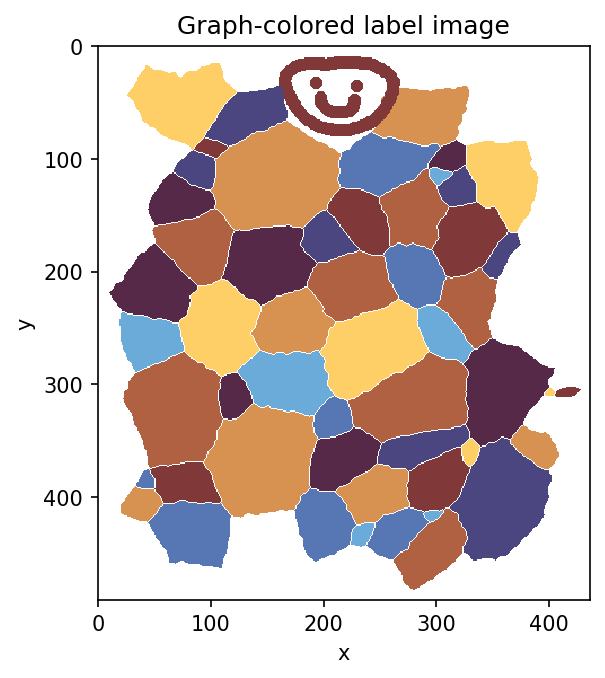
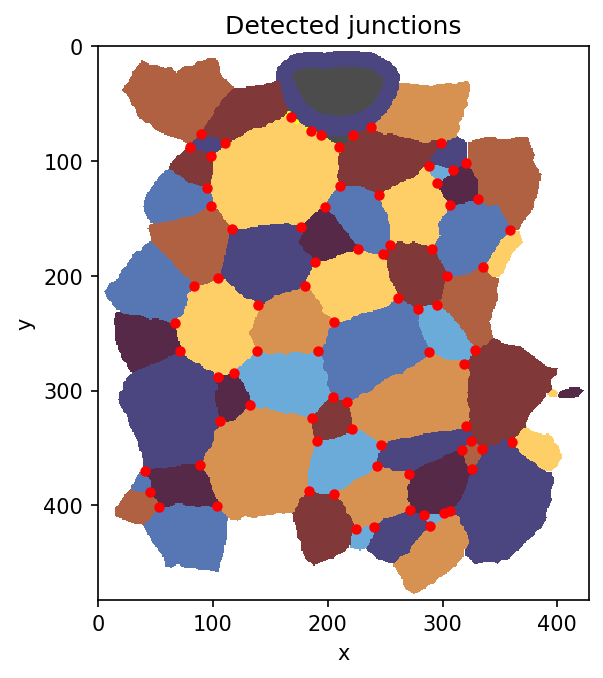
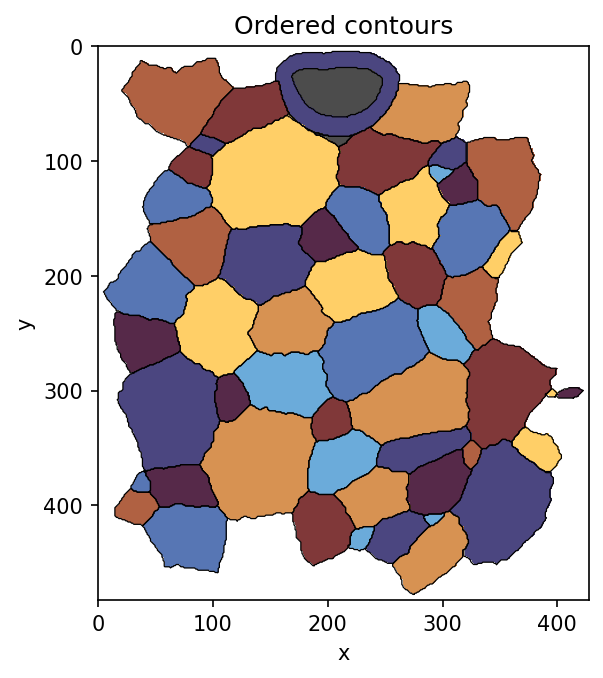
The GitHub README and cookbook show rendered images for the graph-colored label image, detected junctions, and ordered contours. For PyPI/TestPyPI, those local relative image embeds are replaced with repository links so the long description renders safely.
Graph-colored label image using the cyclic managua colormap:
labels = lit.load_image_pipeline("samples/test_cells2D.tif")

fig, ax = lit.plot_label_image(
    labels,
    use_graph_coloring=True,
    K=8,
    seed=4,
    cmap="managua",
    cyclic_cmap=True,
    title="Graph-colored label image",
)
Detected junctions:
labels = lit.load_image_pipeline("samples/test_cells2D.tif")
junction_label_image, junctions = lit.junctions_from_labels(
    labels,
    background=0,
    min_labels=3,
    connectivity=2,
)
fig, ax = lit.plot_label_image(labels, cmap="managua", cyclic_cmap=True)
lit.plot_junctions(junctions=junctions, junction_mask=junction_label_image > 0, ax=ax)
Ordered contours:
labels = lit.load_image_pipeline("samples/test_cells2D.tif")
contours = lit.ordered_contours_from_labels(labels, background=0)
fig, ax = lit.plot_label_image(labels, cmap="managua", cyclic_cmap=True)
lit.plot_contours(labels, ax=ax, background=0, color="black", linewidth=0.6)
1 maintainer

Metadata
1 maintainer
Release files for labelimage-tools 0.1.4
For a detailed explanation of source distributions (sdists) and built distributions (wheels), please see the package formats documentation.
Source distribution (sdist)
| File | Size | Uploaded | |
|---|---|---|---|
| labelimage_tools-0.1.4.tar.gz | 45.2 kB | Details |
Built distribution (wheel)
| File | Interpreter | ABI | Platform | Reset |
|---|---|---|---|---|
| labelimage_tools-0.1.4-py3-none-any.whl | Python 3 | none | any | Details |
Total release size: 86.3 kB
Release files / labelimage_tools-0.1.4.tar.gz
| Download URL | labelimage_tools-0.1.4.tar.gz |
|---|---|
| Size | 45.2 kB |
| Tags | Source |
|
SHA-256 checksum How to use checksums |
9c3a1804996284b37d67145dd2e937fd84182455b47b0031c98faaee516b3dcc
|
|
BLAKE2b-256 checksum How to use checksums |
362e13ec2d253a63712ac279faf7f52dc00e0b70b76179bee2d90c9c1ae7b558
|
| Upload date | |
|
Uploaded using Trusted Publishing? What is trusted publishing? |
Yes |
| Uploaded via |
twine/7.0.0 CPython/3.13.14
|
Provenance
Provenance describes where a file came from. On PyPI, provenance is shared via attestations, which provide a verifiable record of the build or publishing details. View details, limitations and caveats.


PyPI Publish Attestation
PyPI verified that this artifact, at this checksum, originated from the publisher listed below.
Signed by GitHub Actions, verified by PyPI on Sep 18, 2026.
Transparency logRelease files / labelimage_tools-0.1.4-py3-none-any.whl
| Download URL | labelimage_tools-0.1.4-py3-none-any.whl |
|---|---|
| Size | 41.1 kB |
| Tags | Python 3 |
|
SHA-256 checksum How to use checksums |
1ebc95e34259371c4e81a25931866125f27cc63853aa677159e1f2715a60ffb5
|
|
BLAKE2b-256 checksum How to use checksums |
b24fd0ea01b40847314034292627afc709300de86a4bacfef8918b3230f18d91
|
| Upload date | |
|
Uploaded using Trusted Publishing? What is trusted publishing? |
Yes |
| Uploaded via |
twine/7.0.0 CPython/3.13.14
|
Provenance
Provenance describes where a file came from. On PyPI, provenance is shared via attestations, which provide a verifiable record of the build or publishing details. View details, limitations and caveats.
PyPI Publish Attestation
PyPI verified that this artifact, at this checksum, originated from the publisher listed below.
Signed by GitHub Actions, verified by PyPI on Sep 18, 2026.
Transparency log













