
labgrid-mcp


Drive real embedded hardware from Claude, AI editors, and any MCP client.
labgrid is the open-source framework embedded teams use to share lab hardware: boards ("places") with remotely switchable power, serial consoles, USB muxes, and flashing tools. labgrid-mcp is a Model Context Protocol server that plugs any labgrid lab into the MCP ecosystem, so agents and dev tools can work with the lab directly:
"Acquire the rk3399 board, flash last night's image, power-cycle it, and tell me whether it reaches a login prompt. Paste the console log if it doesn't."
Not only for chat: any MCP client, scripted or human-driven, gets a policy-gated remote-control surface over labgrid's mature driver ecosystem, with the reservations and ownership arbitration ad-hoc device servers don't have.
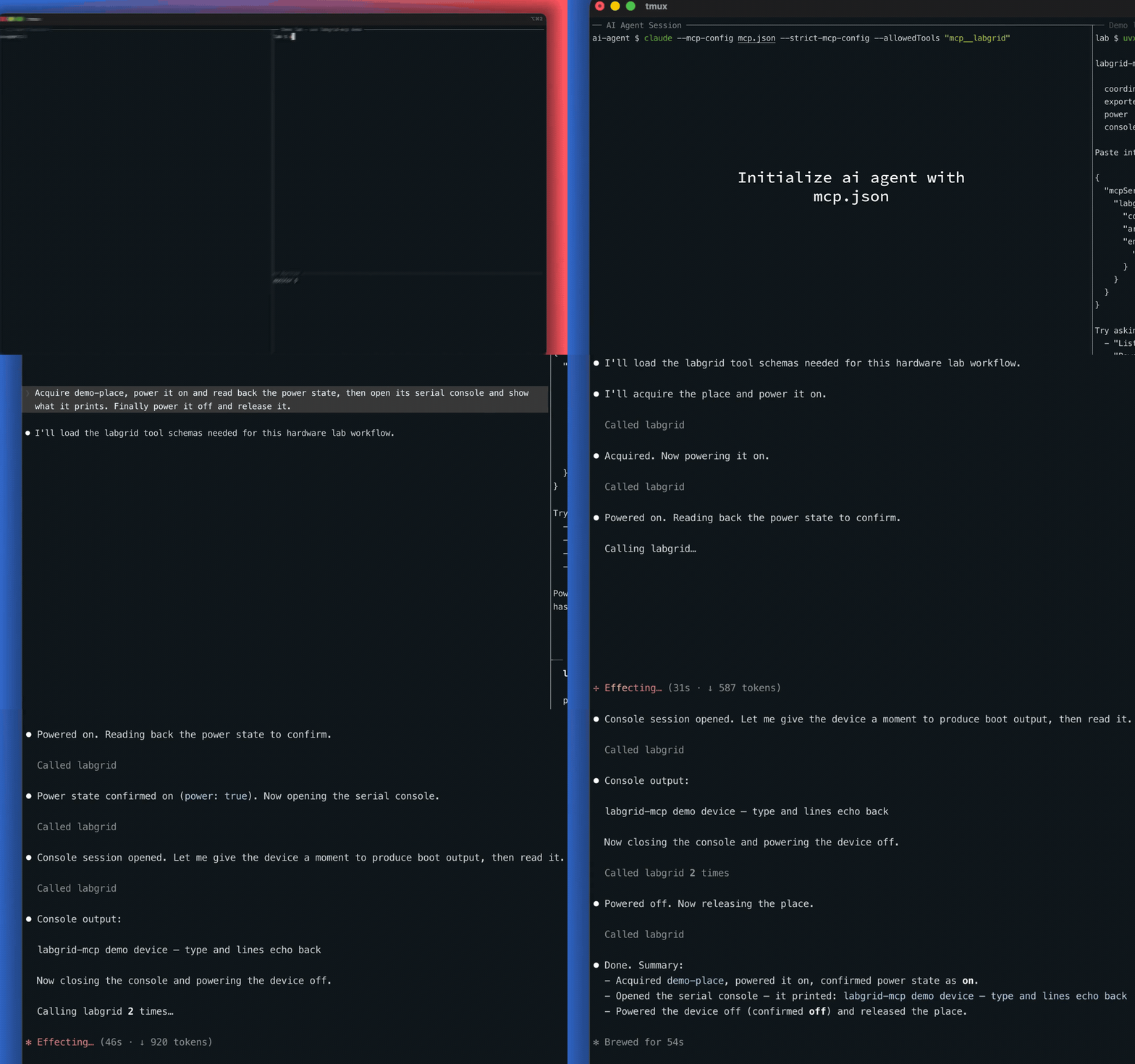
Claude driving the built-in demo lab — no hardware, one command: uvx labgrid-mcp demo
Features
- Full device lifecycle: discover, reserve, acquire, release; keepalive-backed so holds never expire mid-task
- Hardware control: power on/off/cycle, digital I/O, SD/USB mux switching
- Interactive serial console: open, read, send, close; ring-buffered
- SSH to the device: run commands, transfer files, tunnels in both directions
- Flashing (opt-in): DFU, fastboot, bootstrap loaders, image writing, all as background jobs with status/log polling
- Lab housekeeping: tags, aliases, comments, place management, change monitoring
- Safety gating: read-only mode and per-category allowlists; the irreversible families (flash, place deletion) are off by default
47 tools, 5 browseable labgrid:// resources, honest
readOnly/destructive annotations on every tool.
Try it in 5 minutes (no hardware needed)
Requires uv (its bundled uvx does the rest,
including provisioning Python):
uvx labgrid-mcp demo
This boots a complete fake lab on your machine: a real labgrid
coordinator and exporter, one demo board with a fake power switch and a fake
serial console. It prints a paste-ready .mcp.json snippet. Then ask
your agent:
- "List places, then acquire demo-place"
- "Power demo-place on and read its power state"
- "Open the console on demo-place and read its output"
Ctrl-C tears everything down.
Connect your lab
No separate install step — uvx fetches labgrid-mcp from PyPI the first
time it runs. (Prefer pip? pip install labgrid-mcp, then use
"command": "labgrid-mcp" with no args below.)
You need a running, gRPC-era labgrid coordinator (labgrid ≥ 24; tested against 26.x) reachable from this machine.
1. Register the server with your MCP client. The server definition is the
same everywhere — command uvx, args ["labgrid-mcp"], plus your LG_* env
vars — only the config file location and top-level key differ. Pick your
client:
Claude Code
Save as .mcp.json in your project root:
{
  "mcpServers": {
    "labgrid": {
      "command": "uvx",
      "args": ["labgrid-mcp"],
      "env": { "LG_COORDINATOR": "your-coordinator-host:20408" }
    }
  }
}
or one command: claude mcp add labgrid --env LG_COORDINATOR=your-coordinator-host:20408 -- uvx labgrid-mcp
Claude Desktop
Settings → Developer → Edit Config, then add under mcpServers in
claude_desktop_config.json:
{
  "mcpServers": {
    "labgrid": {
      "command": "uvx",
      "args": ["labgrid-mcp"],
      "env": { "LG_COORDINATOR": "your-coordinator-host:20408" }
    }
  }
}
Cursor
Save as .cursor/mcp.json (project) or ~/.cursor/mcp.json (global):
{
  "mcpServers": {
    "labgrid": {
      "command": "uvx",
      "args": ["labgrid-mcp"],
      "env": { "LG_COORDINATOR": "your-coordinator-host:20408" }
    }
  }
}
VS Code (Copilot)
Save as .vscode/mcp.json — note VS Code uses a servers key:
{
  "servers": {
    "labgrid": {
      "command": "uvx",
      "args": ["labgrid-mcp"],
      "env": { "LG_COORDINATOR": "your-coordinator-host:20408" }
    }
  }
}
Windsurf
Add under mcpServers in ~/.codeium/windsurf/mcp_config.json:
{
  "mcpServers": {
    "labgrid": {
      "command": "uvx",
      "args": ["labgrid-mcp"],
      "env": { "LG_COORDINATOR": "your-coordinator-host:20408" }
    }
  }
}
Any other MCP client / SDK
labgrid-mcp is a standard stdio MCP server: spawn uvx labgrid-mcp (or
labgrid-mcp after pip install labgrid-mcp) with LG_COORDINATOR set in
its environment, and speak MCP over stdin/stdout. Works with any client or
agent SDK that supports stdio servers.
2. Restart the client so it picks up the new server.
3. Confirm it's connected — ask your agent "List the labgrid places"; you should get your lab's boards back. You're ready.
Identity works exactly like labgrid-client: set LG_HOSTNAME /
LG_USERNAME, or omit them to use your real hostname/user. Security is
delegated to the network (VPN / SSH tunnel), same as labgrid-client.
(Running from a clone instead of PyPI? Use "command": "uv",
"args": ["run", "--directory", "/path/to/labgrid-mcp", "labgrid-mcp"].)
Run with Docker
Build and run the server as a container (locked-down hosts, or hosting it inside the lab network)
Build the image from the repo's Dockerfile:
git clone https://github.com/onurcelep/labgrid-mcp && cd labgrid-mcp
docker build -t labgrid-mcp .
Then point your MCP client at it:
{
  "mcpServers": {
    "labgrid": {
      "command": "docker",
      "args": ["run", "-i", "--rm",
               "-e", "LG_COORDINATOR=your-coordinator-host:20408",
               "labgrid-mcp"]
    }
  }
}
A useful pattern for labs: build and run the container on a host inside the lab network while your MCP client runs anywhere, one container per user so identity and ownership stay per-person:
{
  "mcpServers": {
    "labgrid": {
      "command": "ssh",
      "args": ["labhost", "docker", "run", "-i", "--rm",
               "-e", "LG_COORDINATOR=127.0.0.1:20408",
               "-e", "LG_USERNAME=your-name",
               "labgrid-mcp"]
    }
  }
}
Don't share one running server between users: each instance holds a single labgrid identity, so a shared instance would make everyone's acquisitions indistinguishable. One container per user/agent keeps the lab's ownership model intact. (Note: an image you build bundles labgrid, LGPL-2.1-or-later — fine to use anywhere; if you redistribute the image, the LGPL's terms apply to that copy, with labgrid's license texts already inside it.)
Your first session
Just ask in plain language — the agent maps it to the right tools. A typical first workflow:
- "Which places are free right now?"
- "Acquire board-7 for me."
- "Power it on, then open the serial console and show me the boot output."
- "SSH in and run
uname -a."- "Power it off and release the board."
Read-only asks ("list places", "who's holding board-7?") work immediately. Anything that changes hardware state is gated (see below), and the two irreversible families — flashing and place deletion — stay off until you explicitly enable them.
Configuration
| Env var | Default | Effect |
|---|---|---|
LG_COORDINATOR |
127.0.0.1:20408 |
Coordinator address |
LG_HOSTNAME / LG_USERNAME |
real host/user | Identity, as in labgrid-client |
LABGRID_MCP_READONLY |
off | 1 = only read-only tools are registered: the Read group plus wait_for_change and forward_list |
LABGRID_MCP_ALLOW |
unset | Comma list of categories to register; flash and place_delete must be listed explicitly; they're off even by default |
LABGRID_MCP_SSH_KEYFILE |
unset | Private key for the SSH tools; unset, they error clearly at call time |
LABGRID_MCP_ACQUIRE_TIMEOUT |
120 |
Max seconds acquire_place waits for allocation |
Safety in one paragraph: flashing and place deletion can do irreversible
damage, so each needs its own explicit LABGRID_MCP_ALLOW entry. SSH tools
are arbitrary command execution on the acquired board, the same trust class
as a console session; LABGRID_MCP_READONLY=1 drops them along with every
other gated tool (forward_list stays, since it only lists in-memory tunnel
state). And a labgrid caveat worth knowing: the coordinator enforces no
ownership guard on place metadata: this server refuses to edit an acquired
place without force=True, but nothing can protect a place nobody holds
(and an empty tag value in set_place_tags deletes that key, which is
labgrid's own semantics). Details: docs/DESIGN.md §4 and §11.12.
Tools
All 47 tools by group
| Group | Tools |
|---|---|
| Read | coordinator_info, list_places, show_place, who, list_resources, list_reservations |
| Acquisition / reservation | acquire_place, release_place, allow_place, release_from, reserve, cancel_reservation, reservation_wait |
| Drivers | get_power_state, set_power, get_io, set_io, get_sd_mux, set_sd_mux, set_usb_mux |
| Console | console_open, console_read, console_send, console_close |
| SSH / forward | ssh_run, put_file, get_file, forward_open, forward_remote_open, forward_close, forward_list |
| Flash (opt-in) | flash_dfu, flash_fastboot, flash_script, bootstrap, write_image, flash_status, flash_logs |
| Place metadata | add_place, add_place_alias, delete_place_alias, set_place_tags, set_place_comment, add_place_match |
| Place deletion (opt-in) | delete_place, delete_place_match |
| Change monitoring | wait_for_change |
Resources: labgrid://places, labgrid://places/{name},
labgrid://resources, labgrid://reservations, labgrid://sessions.
Per-tool arguments and behaviors are documented in each tool's own
description (visible in your MCP client) and in
docs/DESIGN.md §5/§11.
Limitations
- No video/audio/screen capture or USB instruments (need gstreamer + physical USB; no sane MCP surface)
- No live event stream;
wait_for_changelong-polling instead - Old crossbar coordinators (labgrid < 24) can't connect
- Authentication is network-level (VPN/tunnel), exactly labgrid's own model
- The real flash/mux driver step needs a real board: the job machinery is fully CI-tested against fakes, the silicon-touching step is not
Development
Working on labgrid-mcp itself
The integration suite runs the whole stack, including the demo, against
real coordinator/exporter processes with fake hardware, in CI on every PR,
plus a weekly canary against labgrid master:
git clone <this-repo> labgrid-mcp && cd labgrid-mcp
uv sync
uv run pytest              # unit
uv run pytest -m integration
Architecture, decision log, and a verified reference of labgrid's
internals: docs/DESIGN.md.
License
Apache-2.0. Copyright 2026 Onur Celep.
labgrid itself is LGPL-2.1-or-later and is used as a regular, unmodified dependency.
1 maintainer

Release files for labgrid-mcp 0.1.4
For a detailed explanation of source distributions (sdists) and built distributions (wheels), please see the package formats documentation.
Source distribution (sdist)
| File | Size | Uploaded | |
|---|---|---|---|
| labgrid_mcp-0.1.4.tar.gz | 7.4 MB | Details |
Built distribution (wheel)
| File | Interpreter | ABI | Platform | Reset |
|---|---|---|---|---|
| labgrid_mcp-0.1.4-py3-none-any.whl | Python 3 | none | any | Details |
Total release size: 7.4 MB
Release files / labgrid_mcp-0.1.4.tar.gz
| Download URL | labgrid_mcp-0.1.4.tar.gz |
|---|---|
| Size | 7.4 MB |
| Tags | Source |
|
SHA-256 checksum How to use checksums |
b8d8b11c409b9e4773e174fa0c87d8a896e11abef2fd5db4d4c08e37c13ee47c
|
|
BLAKE2b-256 checksum How to use checksums |
a06bfeba1193f8b9d809d107d3833164e21dbc032aa39446264730417be28098
|
| Upload date | |
|
Uploaded using Trusted Publishing? What is trusted publishing? |
Yes |
| Uploaded via |
twine/7.0.0 CPython/3.13.14
|
Provenance
Provenance describes where a file came from. On PyPI, provenance is shared via attestations, which provide a verifiable record of the build or publishing details. View details, limitations and caveats.


PyPI Publish Attestation
PyPI verified that this artifact, at this checksum, originated from the publisher listed below.
Signed by GitHub Actions, verified by PyPI on Aug 6, 2026.
Transparency logRelease files / labgrid_mcp-0.1.4-py3-none-any.whl
| Download URL | labgrid_mcp-0.1.4-py3-none-any.whl |
|---|---|
| Size | 87.8 kB |
| Tags | Python 3 |
|
SHA-256 checksum How to use checksums |
4663bed4d5a5ad4e7508353820646e2c343310e637395fc68cad723e6086ad4d
|
|
BLAKE2b-256 checksum How to use checksums |
8d9733142e89fc370719a977bc581582b74024f293233f6bb70e51a71c01a6f3
|
| Upload date | |
|
Uploaded using Trusted Publishing? What is trusted publishing? |
Yes |
| Uploaded via |
twine/7.0.0 CPython/3.13.14
|
Provenance
Provenance describes where a file came from. On PyPI, provenance is shared via attestations, which provide a verifiable record of the build or publishing details. View details, limitations and caveats.
PyPI Publish Attestation
PyPI verified that this artifact, at this checksum, originated from the publisher listed below.
Signed by GitHub Actions, verified by PyPI on Aug 6, 2026.
Transparency log













