
Cryptic binding pocket discovery in proteins, RNA and DNA, via conformational ensemble analysis.







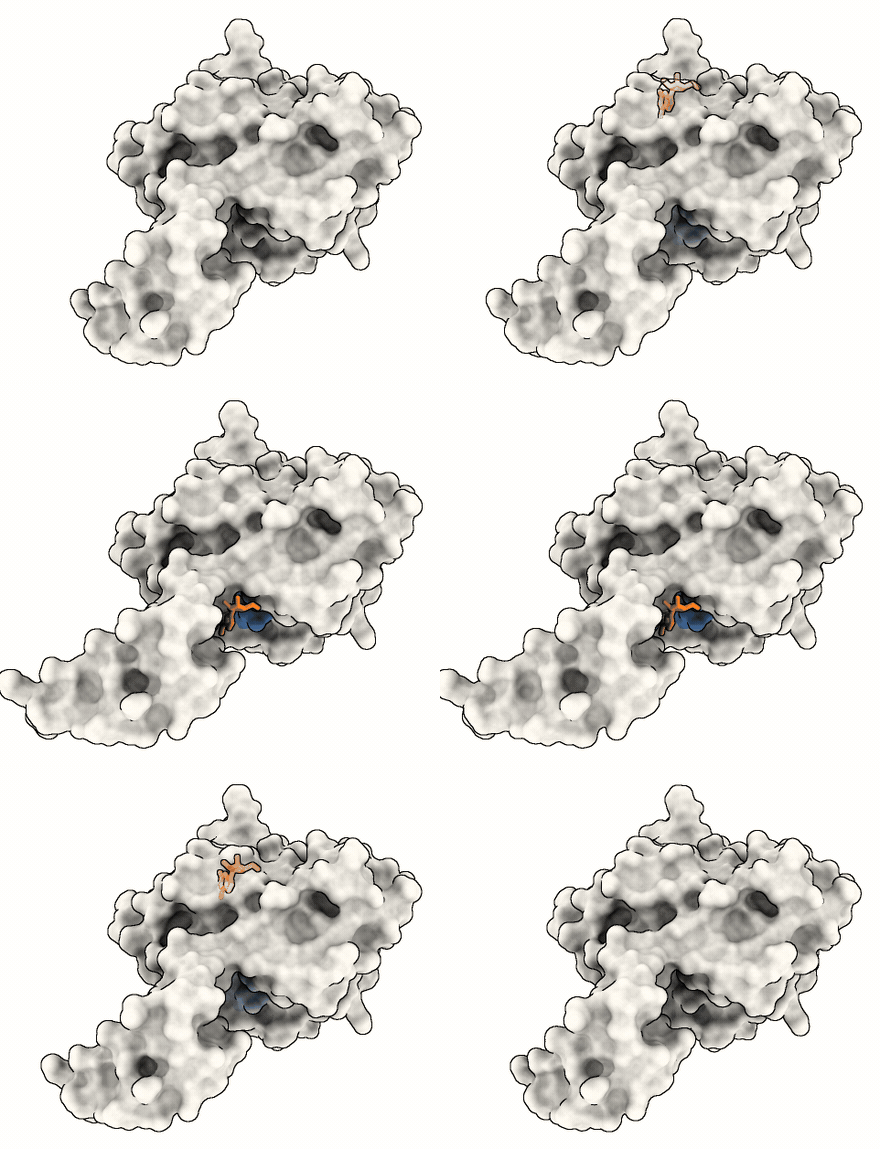
A protein breathes through Lacuna's conformational ensemble, and a cryptic pocket appears. Adenosine kinase along its lowest normal mode (Lacuna's NMA backend): as the interdomain cleft opens, the substrate pocket (blue) is exposed and 2-fluoroadenosine (orange, the crystallographic ligand from holo 2PKK) docks into it. The motion is Lacuna's own mode-0 ensemble; the ligand is shown at its bound pose.
Most protein structure predictors return one static conformation. But many disease-relevant proteins are called undruggable not because they are biologically intractable, but because no pocket is visible in their ground state. K-Ras was considered undruggable for thirty years until a transient cryptic pocket was found beneath its switch-II region. That pocket now backs sotorasib and adagrasib.
Lacuna finds those pockets. It generates a conformational ensemble from any input structure, detects pockets in every conformer, clusters them across the ensemble to surface sites that appear only transiently, and ranks them with a fitted model.
lacuna discover kras.pdb --conformers 20 --emit-boltz-constraints --emit-vina-boxes
RNA and DNA work the same way, with no extra flags. Nucleic-acid input is recognised from its residues, and the elastic network is built on nucleotide beads (C1', C2 and P) instead of CA atoms:
lacuna discover riboswitch.cif --conformers 20
Across 31 RNA structures from 12 independent BGSU equivalence classes, spanning 62 to 459 nucleotides, a single pass finds the ligand site for 87% of structures. On RNA sites with no detectable cavity in the input, the ensemble takes "found at all" from 44% to 73%, which is the case it exists for. Ranking is reported against the random-ordering baseline in docs/RANKING.md, because on a short RNA with few candidates a top-five hit is close to free and a bare percentage there says little. These nucleic-acid figures were measured with 1.3.0.
The same input gives the same report on every machine. Since 1.5.0 the
default NMA backend writes an identical pocket_report.json at any BLAS thread
count and on Windows and Linux, uses less than half the memory from 1,300
residues up (about a third at 3,700), and runs faster at the default 20
conformers. See Reproducibility.
Install
pip install lacuna-pockets
Optional extras, for better conformational sampling or the sequence-assisted ranker:
pip install "lacuna-pockets[openmm]"   # 100ps implicit-solvent MD
pip install "lacuna-pockets[plm]"      # PLM-assisted ranker (PyTorch, ESM-2)
pip install "lacuna-pockets[boltz]"    # Boltz-2 diffusion sampling (experimental, GPU)
pip install "lacuna-pockets[all]"      # everything
Requires Python 3.10+. The default backend needs no GPU, no force field and no model weights.
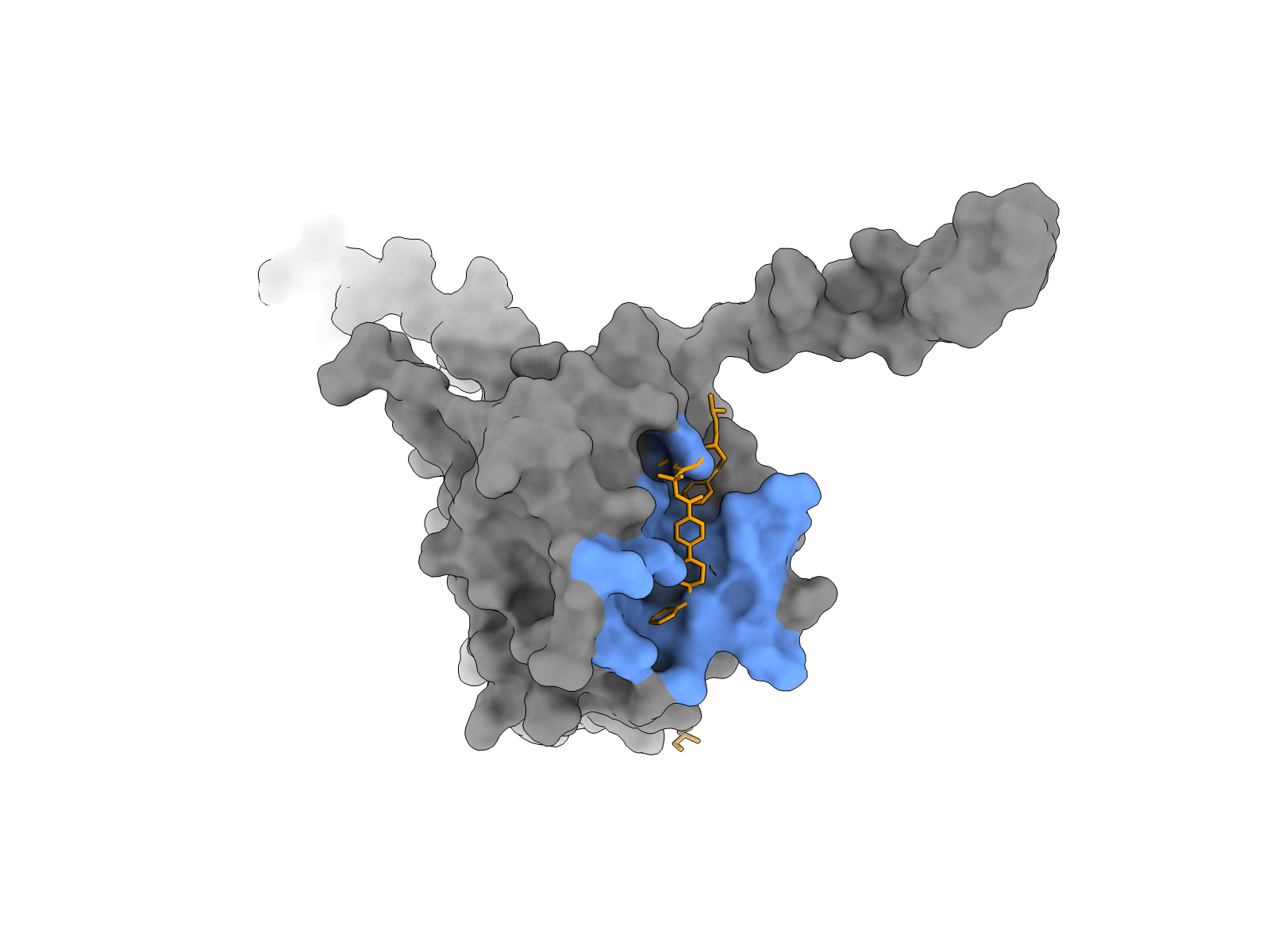
Apo BCL-XL (1LXL): a Lacuna-detected pocket (blue) opening onto the
groove where ABT-737 (orange, from the holo structure 2YXJ) binds, a site never shown to
the detector. With --detector surface-fusion and its sequence model this site
was recovered at rank 2, Jaccard 0.36, centroid 5.6 Å (measured with 1.4.0). The default
alpha detector finds it at rank 6 (Jaccard 0.52, centroid 4.8 Å), just outside
the top five, which is the case the surface-fusion detector is for.
Quick start
lacuna discover protein.pdb --conformers 20
Writes a ranked pocket_report.json plus, on request, Boltz YAML constraints
and AutoDock Vina boxes ready for docking. Full options in
docs/USAGE.md.
How it works
- Ensemble generation. N conformers from elastic-network normal mode analysis (default), OpenMM implicit-solvent MD, or Boltz-2 diffusion sampling.
- Pocket detection. Grid-based alpha-point analysis per conformer: distance transform, local maxima in the 1.4-5.5 A interaction zone, clustered into candidates.
- Cross-ensemble clustering. Greedy centroid merging matches corresponding pockets across every conformer, turning transient cavities into persistent sites with their own statistics.
- Druggability scoring. Gaussian volume reward centred at 300 A³, plus enclosure, hydrophobicity and aromaticity (Halgren 2009), scored per conformer.
- Ranking. A fitted linear model over 23 geometric and ensemble-derived features orders the sites. Each also carries a continuous crypticity score, its chain composition, and a flag for whether it sits at a chain interface.
- Per-residue propensity. The ranked pockets are collapsed back onto the sequence, giving every residue a score for how strongly it lines a high-ranking, persistently-open cavity. This is the form most cryptic-site predictors are evaluated in, so it is what to use when comparing Lacuna against them.
Documentation
| Usage | CLI, Python API, backends, output formats, worked example |
| Ranking | Ranking strategies, the fitted model, crypticity |
| Benchmarks | Full results, head-to-head comparisons, negative results |
| Paper | Analysis, per-candidate data, and scripts that regenerate every figure |
Results
On CryptoBench's designated test fold, Lacuna recovers 57.8% of known cryptic sites in its top five with the zero-dependency default and 66.1% with the optional PLM-assisted ranker, and the true site is present in the candidate set for up to 92% of structures.
Recovery by configuration
Cryptic-pocket recovery on CryptoBench's held-out test fold, under the size-robust criterion (Jaccard >= 0.25, or centroid within 4 A of the site).
| Configuration | Top-5 recovery | Site found (coverage) |
|---|---|---|
| Default (CPU-only, zero-dependency) | 57.8% | 72.8% |
| + PLM reranker | 66.1% | 73.7% |
surface-fusion detector |
73.9%¹ | 86.4%¹ |
| Union across detectors | n/a | 92.2% |
¹ Held-out surface-fusion evaluation at 5 conformers (n=184); the other rows use the 20-conformer cohort (n=180).
The default row was re-measured with 1.5.0 (104/180 in the top five, 131/180
covered). The PLM-reranker, surface-fusion and union rows were measured with
1.4.0. The 57.8% applies the Jaccard term alone, as in the head-to-head; with
the centroid term the same structures read 59.4% (107/180).
Per-residue recovery
Top-5 is what a user acts on, but most cryptic-site predictors are scored per-residue instead, so since v1.4.0 Lacuna reports that too. Same held-out CryptoBench fold, n=231 targets and 76,633 residues, re-measured with 1.5.0:
| scorer | AUROC | AUPRC |
|---|---|---|
| 20 conformers | 0.766 | 0.340 |
| input structure only | 0.697 | 0.249 |
| burial neighbour count | 0.586 | 0.115 |
| random expectation | 0.500 | 0.067 |
The second row is the one worth reading twice: the same scorer on the deposited coordinates alone reaches 0.249, so the conformational ensemble is doing real work rather than restating the input (paired over targets, +0.092 AUPRC, 95% CI +0.069 to +0.115). The third row is the control that matters, since a cavity-lining score could easily be a re-description of how buried a residue is. The propensity is +0.225 AUPRC above that row (0.340 against 0.115; the burial row does not use the ensemble and is carried over from 1.4.0).
Full results, including head-to-head comparisons and where Lacuna loses →
The more interesting result is not Lacuna's score. Across five candidate-generation methods evaluated in six configurations, coverage (whether a qualifying candidate is proposed at all) spans 14.5 points, while conversion (whether a method's own coverage reaches the top five) spans 36.7. fpocket has the highest coverage at 73.7% but the lowest top-5 recovery at 43.6%, while P2Rank converts 95.8% of the sites it covers. Two Lacuna rankers operating on the exact same candidate set differ by 10.6 points of top-5 recovery, isolating ranking directly.
Union coverage saturates at 92.2%, rising to 98.6% for annotated sites containing at least eight residues. Candidate competition is also causal: adding synthetic competitors while holding the true site, real candidate set, and ranker fixed reduces top-5 recovery by 16.8 points on the training folds and 17.0 points on the held-out test fold. Detector consensus provides no measurable gain at a budget of five candidates, but gains 11.8 points at a budget of twenty.
Moore CW. Cryptic binding sites are detected but not ranked: coverage, conversion, and the limits of detector consensus. bioRxiv 2026. doi:10.64898/2026.08.11.743381
Citation
If you use Lacuna, please cite the software paper:
@article{moore2026lacuna,
  author  = {Moore, Clayton W.},
  title   = {Lacuna: Cryptic Binding Pocket Discovery
             via Conformational Ensemble Analysis},
  journal = {bioRxiv},
  year    = {2026},
  doi     = {10.64898/2026.08.14.744956}
}
If you use the benchmark data or the coverage/conversion decomposition, please also cite the accompanying analysis:
@article{moore2026coverage,
  author  = {Moore, Clayton W.},
  title   = {Cryptic binding sites are detected but not ranked:
             coverage, conversion, and the limits of detector consensus},
  journal = {bioRxiv},
  year    = {2026},
  doi     = {10.64898/2026.08.11.743381}
}
To cite a specific software version, the archived releases carry their own DOIs under the concept DOI 10.5281/zenodo.20533638, which always resolves to the newest.
Acknowledgements
Lacuna is measured against, and builds on, work released openly by others: fpocket (Le Guilloux et al. 2009), P2Rank (Krivák & Hoksza 2018), IF-SitePred (Carbery et al. 2024) and MDpocket (Schmidtke et al. 2011). Evaluation uses the CryptoBench (Škrhák et al. 2025) and PocketMiner (Meller et al. 2023) datasets. Method credits: ANM (Atilgan et al. 2001), SiteMap druggability (Halgren 2009), enclosure scoring (Schmidtke & Barril 2010), ESM-2 (Lin et al. 2023).
Lacuna has also been evaluated by others. zPocket (Portnoi, Keys, DiFrancesco
& Gruver 2026, arXiv:2610.17696), winner of
the Octavian-Eugen Ganea Prize for Best Paper at MoML 2026, benchmarked
it on their PocketWatch dataset. In their Table A7 the surface-fusion variant
posted the highest ceiling of any single detector, 0.780, with the default
detector at 0.616; both convert that coverage into top ranks poorly, 0.599 for
the default against 0.971 for retrained VN-EGNN, though fpocket converts worse
still at 0.414. The ceilings are not like-for-like: Lacuna emits 57.5 to 64.9
centroids per protein against zPocket's 1.1, with this project's default report
cap of ten raised to 1,000 for the benchmark. That independently reproduced this
project's own coverage-versus-conversion finding, and it prompted the per-residue
residue_propensity output added in v1.4.0.
License
MIT, free to use, study, modify, share, and embed in closed-source or commercial work, with no copyleft obligation.
Versions 0.2.0 through 0.3.1 were released under AGPL-3.0 and remain available under those terms. MIT applies from 1.0.0 onward. Lacuna moved back to a permissive license because its central recommendation is to combine several detectors, and copyleft makes that combination harder for exactly the people the work is aimed at.
1 maintainer

Metadata
1 maintainer
Release files for lacuna-pockets 1.5.0
For a detailed explanation of source distributions (sdists) and built distributions (wheels), please see the package formats documentation.
Source distribution (sdist)
| File | Size | Uploaded | Provenance | Actions |
|---|---|---|---|---|
| lacuna_pockets-1.5.0.tar.gz | 36.1 MB | With provenance | Details for lacuna_pockets-1.5.0.tar.gz |
Built distribution (wheel)
| File | Interpreter | ABI | Platform | Actions Reset |
|---|---|---|---|---|
| lacuna_pockets-1.5.0-py3-none-any.whl | Python 3 | none | any | Details for lacuna_pockets-1.5.0-py3-none-any.whl |
Total release size: 37.1 MB
Release files / lacuna_pockets-1.5.0.tar.gz
| Download URL | lacuna_pockets-1.5.0.tar.gz |
|---|---|
| Size | 36.1 MB |
| Tags | Source |
|
SHA-256 checksum How to use checksums |
84cf822d25e58413b2b1ce77b9f83169b26cc3144974c0f32bd39825361970b0
|
|
BLAKE2b-256 checksum How to use checksums |
eeafd6935ad707daf161708946c01bbbfb53f78e41c352113f2fa3762a86d4e5
|
| Upload date | |
|
Uploaded using Trusted Publishing? What is trusted publishing? |
Yes |
| Uploaded via |
twine/7.0.0 CPython/3.13.16
|
Provenance
Provenance describes where a file came from. On PyPI, provenance is shared via attestations, which provide a verifiable record of the build or publishing details. View details, limitations and caveats.


PyPI Publish Attestation
PyPI verified that this artifact, at this checksum, originated from the publisher listed below.
Signed by GitHub Actions, verified by PyPI on Nov 15, 2026.
Transparency logRelease files / lacuna_pockets-1.5.0-py3-none-any.whl
| Download URL | lacuna_pockets-1.5.0-py3-none-any.whl |
|---|---|
| Size | 1.0 MB |
| Tags | Python 3 |
|
SHA-256 checksum How to use checksums |
8ac948f6caa3518153fb4d31fec618f90884c45177f375a0460147cc3c11cd8e
|
|
BLAKE2b-256 checksum How to use checksums |
0d6b52aa2cbc8ee335b5777f172941df28d411536ff2c3b99fa8fe21a234d49f
|
| Upload date | |
|
Uploaded using Trusted Publishing? What is trusted publishing? |
Yes |
| Uploaded via |
twine/7.0.0 CPython/3.13.16
|
Provenance
Provenance describes where a file came from. On PyPI, provenance is shared via attestations, which provide a verifiable record of the build or publishing details. View details, limitations and caveats.
PyPI Publish Attestation
PyPI verified that this artifact, at this checksum, originated from the publisher listed below.
Signed by GitHub Actions, verified by PyPI on Nov 15, 2026.
Transparency logSecurity for lacuna-pockets 1.5.0
Provenance
Provenance describes where a file came from. On PyPI, provenance is shared via attestations, which provide a verifiable record of the build or publishing details. View details, limitations and caveats.
Full provenance
Both files in this release have been uploaded with provenance metadata.
Attestation for lacuna_pockets-1.5.0.tar.gz
PyPI Publish Attestation
PyPI verified that this artifact, at this checksum, originated from the publisher listed below.
Signed by GitHub Actions, verified by PyPI on Nov 15, 2026.
Transparency logA note on package security
PyPI is a repository for distributing packages, not a service for auditing them. While third-party security researchers and our staff do their best to detect and remove malicious packages, PyPI cannot guarantee the quality, security or suitability of any given package.
To learn more about protecting yourself from malicious actors, visit our package security documentation.














