

LAIR-Net
A randomized network you can steer, and then see inside.





Documentation · Gallery · Notebooks · API
A shallow network fitted to your target supplies an anchor. A stack of fixed random layers is run with every layer pulled part-way back towards it, and a ridge readout is fitted at every depth. Nothing backpropagates through the stack — so it trains in seconds, and it tells you what it did.
pip install lairnet
from lairnet import LAIRNetRegressor

model = LAIRNetRegressor().fit(X_train, y_train)
model.predict(X_test)

# and then, unlike most randomized networks:
model.anchor_converged_      # did the anchor fit converge, per the optimiser?
model.layer_conditions_      # how well conditioned is each readout?
model.layer_predictions(X)   # what did every depth predict?
This package is not a frozen reproduction of the paper code. It keeps the LAIR idea and adds cleaner solvers, explicit convergence diagnostics, a measured backend policy, model-selection helpers, and a much larger user API.
What you get beyond a fitted model
Every figure in the gallery
is produced by python docs/make_gallery.py, which calls the same public
functions documented here. Nothing is drawn by hand.
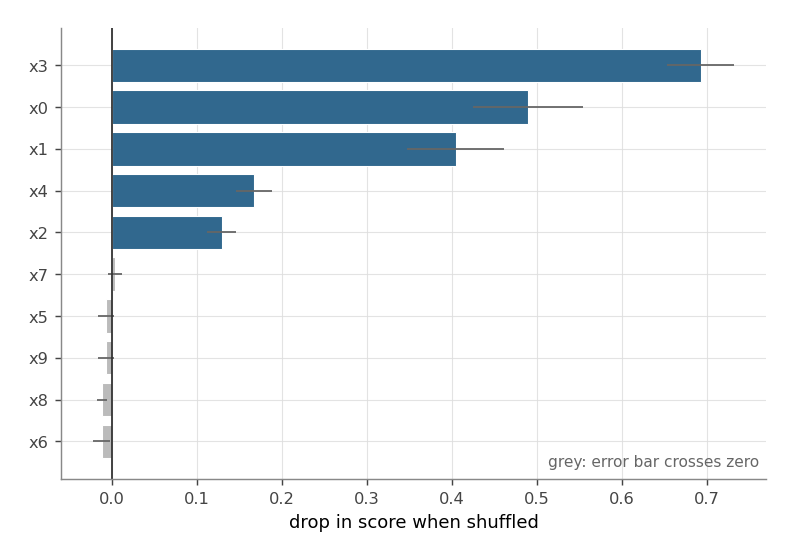
| Which features it uses | inspection.permutation_importance on held-out data. Bars whose error bar crosses zero are greyed out and labelled, because an importance not distinguished from noise should not be ranked confidently. |
| Whether depth is helping | inspection.depth_curve gives the score from aggregating the first k depths, for every k, in one forward pass rather than n_layers refits. |
| What the anchor is worth | inspection.align_sensitivity and inspection.anchor_contribution refit at align=0 and compare on the same held-out split. A flat curve means the target-aware component is doing nothing on your data. |
| How much the depths disagree | inspection.layer_agreement. Near-uniform high correlation is expected, not wrong — the alignment impulse makes the layers correlated, which is why median aggregation is a robustness choice and not a variance-reduction one. |
| Whether the numerics held | layer_conditions_ and layer_solvers_: a per-depth condition number, and which depths fell back from Cholesky to an eigendecomposition. |
| All of it at once | explain.explain_model(...).summary() — a readable report someone can paste straight into a write-up. |
from lairnet.explain import explain_model

print(explain_model(model, X_train, y_train, X_test, y_test).summary())
score on the evaluation data: 0.8369

features the model uses
  feature 3                +0.6931 +/- 0.0397
  feature 0                +0.4900 +/- 0.0644
  ...

depth
  best at depth 12 of 12
  aggregating all depths is worth +0.1069 over one
  depths correlate 0.942 on average, so aggregation recovers less variance
  than independent errors would give

anchor
  with anchor    0.8369
  without anchor 0.7472
  the anchor is worth +0.0897 here
Called without held-out data it still works, and says so — every score above the note is measured on the training data.
Quick start
from lairnet import LAIRNetRegressor
from sklearn.datasets import make_friedman1
from sklearn.model_selection import train_test_split
from sklearn.metrics import r2_score

X, y = make_friedman1(n_samples=600, noise=1.0, random_state=0)
X_train, X_test, y_train, y_test = train_test_split(X, y, random_state=0)

model = LAIRNetRegressor(
    n_layers=12,
    n_hidden=128,
    ridge=1e-2,
    anchor_backend="auto",
    random_state=0,
).fit(X_train, y_train)

print(r2_score(y_test, model.predict(X_test)))
Classification uses the same stack with a one-hot target representation:
from lairnet import LAIRNetClassifier
from sklearn.datasets import load_wine
from sklearn.model_selection import cross_val_score

X, y = load_wine(return_X_y=True)
clf = LAIRNetClassifier(n_layers=8, n_hidden=96, random_state=0)
print(cross_val_score(clf, X, y, cv=5).mean())
Hyperparameter search goes through LAIRNetCV, a thin wrapper around the
scikit-learn search classes with LAIR-specific defaults and delegation:
from lairnet import LAIRNetCV, LAIRNetRegressor

search = LAIRNetCV(
    LAIRNetRegressor(n_hidden=96, random_state=0),
    param_grid={"align": [0.0, 0.5], "ridge": [1e-3, 1e-2]},
    cv=3,
).fit(X_train, y_train)

print(search.best_params_)
print(search.align_profile())
Four executed notebooks walk through the rest: getting started, interpreting a fitted model, tuning and model selection, and backends and speed. They are committed with their outputs, so the numbers on those pages are what the code printed.
Speed
anchor_backend="auto" uses NumPy below 5000 samples and numba at or above
5000 when numba is installed. The threshold is read off a benchmark that runs at
the package's own settings, not at a tolerance the package never uses. Torch is
faster still on large CPU problems and is never selected automatically,
because it is a heavy dependency to acquire silently.
pip install lairnet[speed]    # numba
pip install lairnet[torch]    # torch
pip install lairnet[plots]    # matplotlib, for lairnet.plotting
Readouts are closed form: one Cholesky per depth on a Gram matrix whose fixed
[1, X] block is built once and reused for the whole stack, with an
eigendecomposition fallback and a reported condition number.
Fitted attributes
anchor_converged_   anchor_status_    anchor_message_       anchor_n_iter_
anchor_loss_        anchor_backend_   anchor_hit_max_iter_  anchor_n_func_evals_
layer_scores_       layer_conditions_ layer_solvers_        layer_state_deltas_
layer_anchor_distances_               feature_names_in_
feature_names_in_ follows the scikit-learn convention and is only set when you
fit with a DataFrame. anchor_status_ and anchor_message_ come from the
optimiser; the torch and sklearn paths report -1 and say so rather than
inventing a status.
anchor_converged_ is the optimiser's own verdict, not an inference from the
iteration count, and a capped anchor fit raises a ConvergenceWarning — a
capped fit is an unlabelled regularisation choice, and returning one silently is
the failure this package is built to avoid.
layer_predictions returns the per-depth predictions. prediction_band returns
a depth-disagreement band, not a calibrated interval: it carries no coverage
guarantee and will not widen for a sample outside the training range unless the
depths happen to disagree there.
Public API
| Module | Names |
|---|---|
lairnet |
LAIRNetRegressor, LAIRNetClassifier, LAIRNetCV, default_grid, AnchorNet |
lairnet.inspection |
permutation_importance, depth_curve, align_sensitivity, layer_agreement, anchor_contribution |
lairnet.explain |
explain_model |
lairnet.plotting |
plot_feature_importance, plot_depth_path, plot_layer_diagnostics, plot_anchor_alignment, plot_layer_agreement, plot_prediction_band |
lairnet (solvers) |
solve_ridge, solve_ridge_path, GramCache |
AnchorNet is public as an advanced diagnostic component and works as a
scikit-learn transformer on its own; most users should start with
LAIRNetRegressor, LAIRNetClassifier or LAIRNetCV.
Interpretability functions return structured results rather than drawing, so fitting never imports matplotlib. The plotting functions import it lazily and consume those results:
from lairnet.plotting import plot_feature_importance, plot_depth_path

explanation = explain_model(model, X_train, y_train, X_test, y_test)
plot_feature_importance(explanation.importance)
plot_depth_path(explanation.depth)
Inspection scorers use the metric signature scorer(y_true, y_pred), like
sklearn.metrics.r2_score. They do not accept scikit-learn scorer objects from
get_scorer, which use scorer(estimator, X, y).
Development
python -m pip install -e ".[dev,plots,docs]"
python -m pytest
python docs/check_styles.py          # a class named in a page with no CSS rule
python docs/check_numbers_agree.py   # pages quoting numbers the notebooks did not produce
sphinx-build -b html -W --keep-going docs docs/_build/html
The figures and notebook outputs are not produced by the Sphinx build. Run
python docs/make_gallery.py and python docs/make_notebooks.py with the same
interpreter — make_notebooks.py pins the kernel to sys.executable and aborts
if it does not get it, because a different scipy takes L-BFGS down a different
path and the published numbers stop agreeing.
Benchmark rules, learned the hard way: report repeated trials rather than one-off timings, prevent overlapping runs, compare time to a common objective value when optimisers converge at different rates, and do not document a speed claim until the benchmark records support it.
python -m build
twine check dist/*
1 maintainer

Metadata
1 maintainer
Release files for lairnet 0.1.0
For a detailed explanation of source distributions (sdists) and built distributions (wheels), please see the package formats documentation.
Source distribution (sdist)
| File | Size | Uploaded | |
|---|---|---|---|
| lairnet-0.1.0.tar.gz | 51.5 kB | Details |
Built distribution (wheel)
| File | Interpreter | ABI | Platform | Reset |
|---|---|---|---|---|
| lairnet-0.1.0-py3-none-any.whl | Python 3 | none | any | Details |
Total release size: 94.8 kB
Release files / lairnet-0.1.0.tar.gz
| Download URL | lairnet-0.1.0.tar.gz |
|---|---|
| Size | 51.5 kB |
| Tags | Source |
|
SHA-256 checksum How to use checksums |
3c1a49c87bca822d1861e10acc95c4111f420c0e9fd14e37532d26c36b2d2e40
|
|
BLAKE2b-256 checksum How to use checksums |
84dd7069d925d901b23a608d2d9c3e856962078ead96a3d86c111e1170fdabb9
|
| Upload date | |
|
Uploaded using Trusted Publishing? What is trusted publishing? |
Yes |
| Uploaded via |
twine/7.0.0 CPython/3.13.14
|
Provenance
Provenance describes where a file came from. On PyPI, provenance is shared via attestations, which provide a verifiable record of the build or publishing details. View details, limitations and caveats.


PyPI Publish Attestation
PyPI verified that this artifact, at this checksum, originated from the publisher listed below.
Signed by GitHub Actions, verified by PyPI on Oct 8, 2026.
Transparency logRelease files / lairnet-0.1.0-py3-none-any.whl
| Download URL | lairnet-0.1.0-py3-none-any.whl |
|---|---|
| Size | 43.3 kB |
| Tags | Python 3 |
|
SHA-256 checksum How to use checksums |
1eb80886ab69b7d57e2bd6e934d9587d66b6e47da7212c5c92feb5f569e2590d
|
|
BLAKE2b-256 checksum How to use checksums |
24648021989a151551861665cec525a8272e1367c951631d94aa6bf2b875a859
|
| Upload date | |
|
Uploaded using Trusted Publishing? What is trusted publishing? |
Yes |
| Uploaded via |
twine/7.0.0 CPython/3.13.14
|
Provenance
Provenance describes where a file came from. On PyPI, provenance is shared via attestations, which provide a verifiable record of the build or publishing details. View details, limitations and caveats.
PyPI Publish Attestation
PyPI verified that this artifact, at this checksum, originated from the publisher listed below.
Signed by GitHub Actions, verified by PyPI on Oct 8, 2026.
Transparency log












