
Repeated-Average-Rank Correlations Λ (Lambda): a family of robust, symmetric/asymmetric measures of monotone association based on pairwise rank slopes.

Project description
lambda_corr — Repeated-Average-Rank Correlation Λ (Lambda)
lambda_corr introduces and implements the Repeated-Average-Rank Correlation Λ (Lambda),
a new family of robust, symmetric, and asymmetric measures of monotone association
based on pairwise rank slopes. Compared with traditional rank-based measures
(Spearman’s ρ and Kendall’s τ [1,2]), Lambda is:
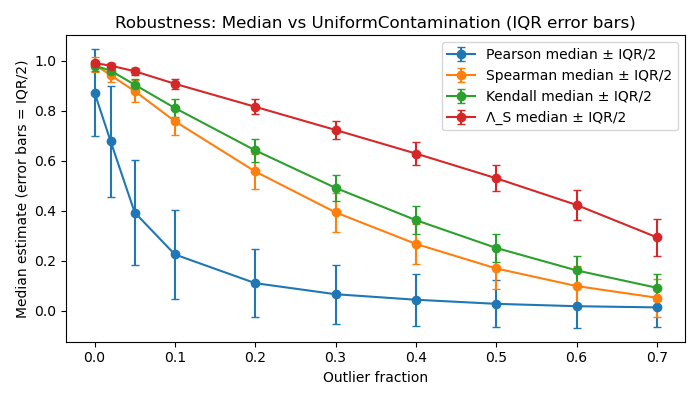
- Substantially more resistant to noise and outliers (see github /results/*Robustness*.png).
|
Robustness of Λ_s: |
|
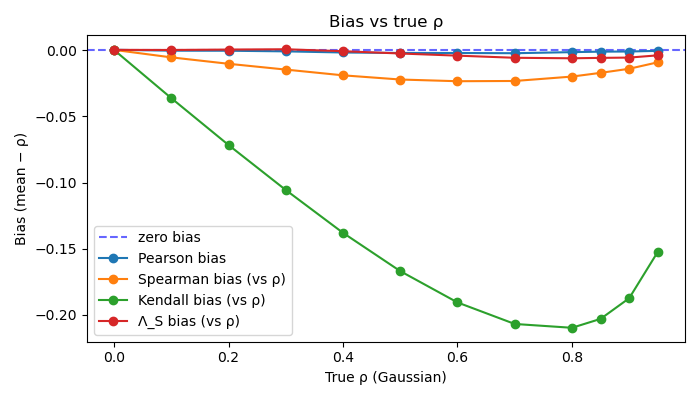
- Much less biased relative to Pearson’s r [3] linear correlation (see github /results/*bias*.png).
|
Bias of Λ_s vs ρ_true: |
|
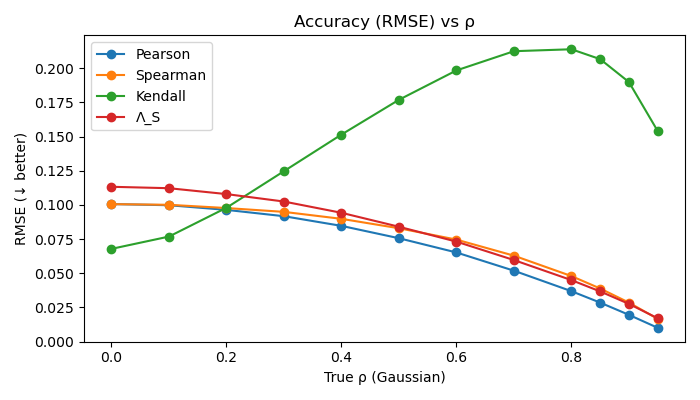
- Competitive or superior in accuracy, especially for moderate–strong signals (see github /results/*accuracy*.png).
|
Accuracy of Λ_s vs ρ_true: |
|
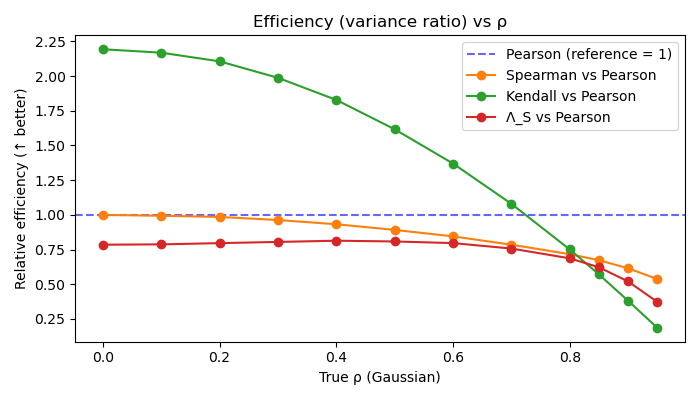
- Competitive in efficiency, for moderate–strong signals. Slightly less efficient asymptotically (~81% vs. ~91% for ρ and τ) for the null. See github /results/*efficiency*.png and github /results/*power*.png
|
Efficiency of Λ_s vs ρ_true: |
|
(code for figures is in github /tests/test_lambdacorr2.py )
The canonical statistic, Λ_s, combines a robust median-of-pairwise-slopes inner loop with an efficient outer mean (repeated-average, inspired by Seigel's repeated-median [4]), and uses a signed geometric-mean symmetrization, mirroring how:
- Kendall’s τ_b can be written as the signed geometric mean of Somers’ D(y|x) and D(y|x);
- Pearson’s r is the signed geometric mean of the two OLS slopes m_{y|x} = cov(x, y) / var(x) and m_{x|y} = cov(x, y) / var(y);
- Spearman’s ρ has the same construction applied to the rank-transformed variables (r_x, r_y).
Λ_s extends this same geometric-mean construction to robust repeated-average-rank correlations and ensures interpretability as a standard measure of monotonic trend/association.
Canonical Definition of Λ_s
Given paired samples (x_i, y_i), i = 1...n: symmetrize (via signed geometric mean) the asymmetric Λ_yx/xy = mean over i of ( median over j != i of slope(i, j) ) in standardized rank space.
- Compute average ranks:
rx = rankdata(x, method="average")
ry = rankdata(y, method="average")
- Standardize ranks to zero mean / unit variance:
rxt = (rx - np.mean(rx)) / np.std(rx)
ryt = (ry - np.mean(ry)) / np.std(ry)
Standardization doesn't affect Λ_s due to symmetrization. It affects the asymmetric Λ_yx/xy, especially when there are ties. Tests using Somers' D better agree on asymmetry when standardization is done, e.g., on binary data. Also, decreases the number of Λ_yx/xy sign disagreements for various scenarios (see github /tests/test_opposites.py)
- For each anchor point sample i, compute the median slope in rank space:
$$ b_i = \underset{j \ne i \ \text{,} \ rxt[j] \ne rxt[i]}{\mathrm{median}} \left( \frac{ryt[j] - ryt[i]}{rxt[j] - rxt[i]} \right) $$
- Compute the asymmetric rank-slope correlations as the outer mean over i slopes:
- Λ(y|x):
$$ \Lambda_{yx} = \frac{1}{n} \sum_i b_i $$
- Λ(x|y): repeat with x and y swapped.
- Define the symmetric Λ_s using the classical signed geometric mean method:
$$ \Lambda_s = \mathrm{sgn}(\Lambda_{yx}) \sqrt{\left|\Lambda_{yx}\Lambda_{xy}\right|} $$
If the asymmetric signs disagree (rare under the null), Λ_s = 0. Kendall's τ is on average approximately zero in these cases (see github /tests/test_opposites.py).
Properties
- Range: Λ_s ∈ [-1,1].
- Symmetric: Λ_s(x,y) == Λ_s(y,x).
- Invariant under strictly monotone transforms: Λ_s(x, y) is unchanged under x → f(x) or y → g(y) for any strictly monotone functions f, g.
- Robust: Very robust to outliers and noise; extremely high sign-breakdown point (median-of-slopes core) with adversarial contamination (see github /results/*Robustness*.png).
- Less biased: Much less biased than Spearman or Kendall relative to Pearson without transforms (see github /results/*bias*.png).
- Accurate: Competitive or superior in accuracy for moderate–strong signals.
- Efficiency: Asymptotic efficiency ~81% (ρ, τ ≈ 91%) with var_opt/var(Λ_s) = (1/N)/(1.112^2/N). (Siegel median of medians slope is ~41%). See github /results/*efficiency*.png and /results/*power*.png
- Null distribution: centered, symmetric, slightly heavier tails than Spearman.
- Fast asymptotic: Converges rapidly; within < 1% of the asymptotic null distribution by n ≈ 300 and essentially asymptotic for n ≳ 1000 (see /tests/find_limit.py).
Notes on the Non-Canonical Repeated-Average Correlations
-
A fully repeated-median Λ has maximal robustness but reduced asymptotic efficiency, while the mean-of-medians Λ_s recovers much of the efficiency at minimal loss of breakdown.
-
A mean-of-means Λ is Theil-Sen in rank-space and is essentially Spearman in both efficiency and null spread, but gives up most of the robustness advantage compared to the mean of medians.
-
Continuum of Λ variants' behavior (outside loop - inside loop):
Spearman (ρ) ≈ Λ_s^(mean-mean) <-> [Λ_s^(mean-median)] <-> Λ_s^(median-mean) <-> Λ_s^(median-median) ≈ Siegel's slope
Canonical choice: Λ_s^(mean-median) — best efficiency/robustness balance (especially at low statistics).
p-values
Lambda supports three p-value modes:
ptype="default" (recommended)
- n < 25 → Monte Carlo permutation test.
- n ≥ 25 → asymptotic Edgeworth approximation.
ptype="perm"
- Monte Carlo permutation p-values.
- Valid with ties or arbitrary marginals (conditional, see below).
- Early stopping when p-uncertainty <
p_tol. - Fresh RNG drawn every call so permutation p-values vary across runs. This can give the user an idea of the p-value uncertainty, if they wish.
ptype="asymp"
- Fast asymptotic p-values.
- Best for low ties or larger n. More ties -- less accurate (conditional, see below).
- Calibrated from very large unconditional Monte Carlo null distributions.
The permutation test samples from the conditional null distribution, generated by permuting the observed y-values while keeping x fixed. This distribution depends directly on the observed marginal distributions and tie structure. Therefore, when the underlying population is genuinely discrete, the permutation method can be more accurate because it automatically reflects the correct amount and pattern of ties.
In contrast, the asymptotic p-values approximate the unconditional null distribution of Λ, calibrated from extremely large Monte Carlo simulations. As a result, they tend to be more stable and often more accurate for moderate–large n, especially when the underlying population is continuous (even if the sample exhibits ties due to rounding, censoring, or finite precision) or when the data are skewed.
Returned values
Lambda_s, p_s, Lambda_yx, p_yx, Lambda_xy, p_xy, Lambda_a
Where:
- Λ_s — symmetric correlation.
- Λ(y|x) / Λ(x|y) — asymmetric directional correlations.
- p-values correspond to the chosen
alt = {"two-sided","greater","less"}. - Λ_a — normalized asymmetry index with range [0, 1].
$$ \Lambda_a = \frac{\bigl|\Lambda_{yx} - \Lambda_{xy}\bigr|} {\bigl|\Lambda_{yx}\bigr| + \bigl|\Lambda_{xy}\bigr|} $$
with Λ_a ∈ [0,1].
Installation
The library targets Python 3.8+ and uses NumPy and Numba for speed.
#Install lambda-corr from pypi with pip
pip install lambda-corr

#Or local install from source
pip install -e .

#Install optional test dependencies (SciPy)
pip install -e .[tests]

#Prerequisites if necessary
pip install numba numpy

#Optional: statistical tests make use of SciPy
pip install scipy

#Optional: for Numba fast math optimizations on Intel CPUs
pip install icc_rt
Requirements:
- Python ≥ 3.8
- NumPy ≥ 1.23
- Numba ≥ 0.61
- SciPy ≥ 1.9 (only needed for some validation tests)
Quick Example
Compute the symmetric Lambda correlation Λ_s and its directional components for a simple monotonic relationship:
import numpy as np
import math
from lambda_corr import lambda_corr

rng = np.random.default_rng(seed=0)

n = 50
rho = 0.5   # correlation strength
x = rng.standard_normal(n)
z = rng.standard_normal(n)
c = math.sqrt((1 - rho) * (1 + rho))
y = np.exp(rho * x + c * z)   # any monotonic transformation

# Compute Lambda correlations
Lambda_s, p_s, Lambda_yx, p_yx, Lambda_xy, p_xy, Lambda_a = lambda_corr(x, y)

# Nicely formatted output
print(f"Λ_s       = {Lambda_s: .4f}   (p = {p_s: .4g})")
print(f"Λ(y|x)    = {Lambda_yx: .4f}   (p = {p_yx: .4g})")
print(f"Λ(x|y)    = {Lambda_xy: .4f}   (p = {p_xy: .4g})")
print(f"Asymmetry = {Lambda_a: .4f}")

# Example output:
# Λ_s       =  0.4130   (p =  0.0087)     #Result will be close to rho
# Λ(y|x)    =  0.4145   (p =  0.008419)
# Λ(x|y)    =  0.4114   (p =  0.008988)
# Asymmetry =  0.0038
References
[1] Spearman, C. The proof and measurement of association between two things. American Journal of Psychology, 15(1), 72–101, 1904.
[2] Kendall, M.G., Rank Correlation Methods (4th Edition), Charles Griffin & Co., 1970.
[3] https://en.wikipedia.org/wiki/Pearson_correlation_coefficient
[4]Siegel, A.F., Robust Regression Using Repeated Medians, Biometrika, Vol. 69, pp. 242-244, 1982.
Citation
If you use lambda_corr in academic or scientific work, please cite:
Lundquist, J.P.  lambda_corr: Robust Repeated-Average-Rank Correlation Λ (Lambda).
GitHub repository: https://github.com/JonPaulLundquist/lambda_corr
@misc{lundquist2025lambda_corr,
  author       = {Lundquist, Jon Paul},
  title        = {lambda\_corr: Robust Repeated-Average-Rank Correlation (Λ)},
  year         = {2025},
  publisher    = {GitHub},
  howpublished = {\url{https://github.com/JonPaulLundquist/lambda_corr}},
  note         = {Version X.Y.Z. Accessed: YYYY-MM-DD}
}


Download files
Download the file for your platform. If you're not sure which to choose, learn more about installing packages.
Source Distribution
Built Distribution
Filter files by name, interpreter, ABI, and platform.
If you're not sure about the file name format, learn more about wheel file names.
Copy a direct link to the current filters
File details
Details for the file lambda_corr-0.1.2.tar.gz.
File metadata
- Download URL: lambda_corr-0.1.2.tar.gz
- Upload date:
- Size: 34.0 kB
- Tags: Source
- Uploaded using Trusted Publishing? No
- Uploaded via: twine/6.2.0 CPython/3.13.5
File hashes
| Algorithm | Hash digest | |
|---|---|---|
| SHA256 |
3e9aebae4319623ec99a6cac1857cdbf85a22d44c6d3d2cb9803bcbc22e9b4bf
|
|
| MD5 |
2ee7e68c39d1c0079516b941a096eade
|
|
| BLAKE2b-256 |
cb0b747a620ddb9e9614ad5cf3843261ed2c607cf5c0ff8ddfe8fab352377d4d
|
File details
Details for the file lambda_corr-0.1.2-py3-none-any.whl.
File metadata
- Download URL: lambda_corr-0.1.2-py3-none-any.whl
- Upload date:
- Size: 15.0 kB
- Tags: Python 3
- Uploaded using Trusted Publishing? No
- Uploaded via: twine/6.2.0 CPython/3.13.5
File hashes
| Algorithm | Hash digest | |
|---|---|---|
| SHA256 |
356dfae31a8b035cf2f28db53e361353a04ecdad598d1541ecb76dab1235f5a0
|
|
| MD5 |
1bfb2af3b4025ffc17c44da9ace3f8fd
|
|
| BLAKE2b-256 |
c696c33f2be9ec80a3743a6883457b68f66849e647875b11c6a820095aacf0a2
|






