
Landpy
Build small augmented-reality effects in Python: crop → edit → retrace.
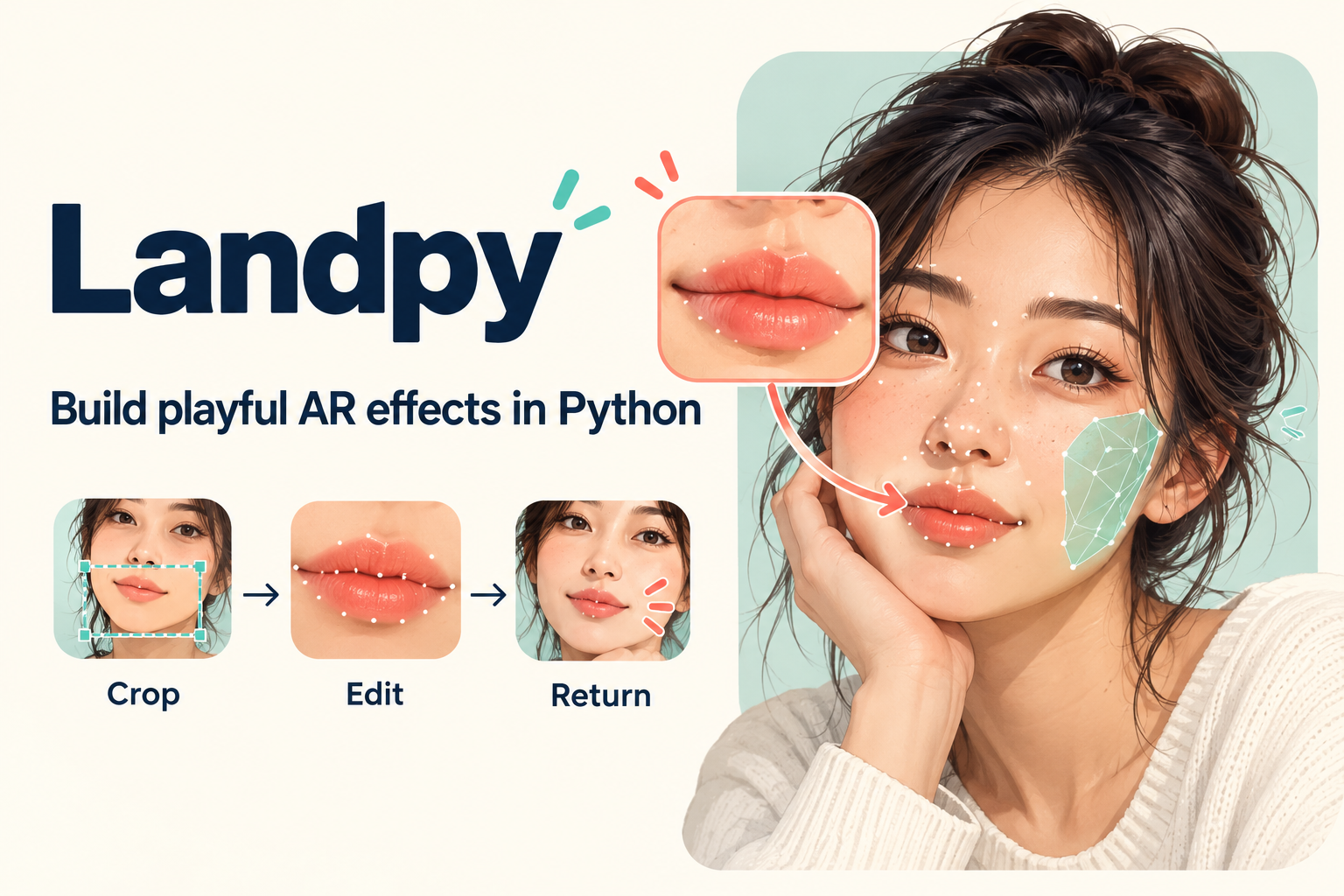
Landpy helps you place face filters and transparent overlays on images. Work on
a crop, use landmarks or masks to control the effect, then call retrace() to
bring the edited pixels back onto the original canvas. The crop remembers where
it came from, so you do not have to calculate the paste coordinates yourself.
Use checkpoints and undo() when you want to restore the exact earlier state.
Start the illustrated tutorial journey for a preview of the face effect, a project map, and your first runnable edit. The cover above is an AI-generated illustration; the notebooks show executed results. These examples operate on individual images; live tracking and temporal smoothing are outside the package's scope.
pip install landpy
# Optional face-model support (Python 3.10–3.13):
pip install 'landpy[tensorflow]'
Python 3.10+ is required for the core package. No weights are downloaded and
TensorFlow is not imported when you import landpy. Use a CPU runtime; a GPU
is not required. OpenCV is installed as the headless build for notebooks and
servers; don't install both OpenCV wheel variants in the same environment.
A first edit
import numpy as np
from landpy import ImageLand, SquareMarks, Filter

image = ImageLand(np.full((120, 180, 3), 180, dtype=np.uint8))
region = SquareMarks.relative(.2, .8, .25, .75, shape=image.shape)
image.make_checkpoint()
image.zoom(region, save_trace=True)
image.implant_filter(Filter('#d52e65', ratio=.5))
image.retrace()  # put the edited crop back into the original image
image.show()
image.undo()     # restore the exact original snapshot
Shapes are (height, width) and points are pixel (row, column) coordinates.
RGB arrays use [0, 255] for integers or [0, 1] for floats. Methods usually mutate
and return the same container; copy() and + produce independent objects.
get_image(), get_marks() and get_heat() expose mutable arrays.
Learn step by step
The eight numbered tutorials contain saved outputs and checks. Each has an Open in Colab link; no separate notebook hosting account is needed to open them. Start with 1. Images and coordinates.
| Class | Purpose |
|---|---|
Land |
Inverse stack and independent checkpoint history |
ImageLand |
RGB/RGBA images, crops, rotations, resizing and compositing |
MarksLand |
Pixel landmarks, set operations, polygon masks |
SquareMarks |
Axis-aligned rectangles, despite the historical name |
QuadMarks |
Convex quadrilaterals and perspective regions |
DualMarks |
Directed two-point vectors |
HeatLand |
Floating-point masks and heat algebra |
Filter |
Mask-weighted color blending or a custom function |
Debugger |
Categorized timing logs and visual snapshots |
Use Python's help(ImageLand.zoom) or the API guide for details.
History has two meanings
save_trace=True records a transform's inverse. retrace() applies that
inverse to the current data, which lets an edited crop return to its old
position. Image rotation/resizing inverses are approximate: resampling cannot
recover discarded pixels. Crop inverses preserve the surrounding saved canvas.
make_checkpoint() saves an exact copy before an edit. undo() restores
that snapshot; redo() restores the edited state. New operations invalidate
redo. Empty histories raise IndexError. Array writes through mutable getters
bypass operation tracking; checkpoint before them and don't rely on automatic
redo invalidation for direct writes.
Face models
from landpy import ImageLand
from landpy.pretrained_models import FaceTracker, FaceLandmarksDetector

photo = ImageLand('portrait.jpg')
faces = FaceTracker().detect_faces(photo, threshold=.5, top_k=1)
if faces:
    crop = photo.copy().zoom(faces[0].face_box.copy().expand(1.25))
    marks, presence = FaceLandmarksDetector().detect_face_landmarks(crop)
    (crop + marks).show()
The default mesh is the compatible 478-point MediaPipe Face Mesh V2 asset;
legacy 468-point weights remain supported with model_path=....
Model files are pinned to a verified companion repository revision.
Downloads go to ~/.cache/landpy/models; set LANDPY_MODEL_DIR to change it.
Each detector accepts model_path, cache_dir and sha256 keyword arguments.
See model contracts and provenance, especially the incomplete
provenance of the original segmentation and expression weights.
FaceTracker detects still images independently; it does not perform temporal
tracking. This is an experimental face-effects toolkit, not an accuracy or
latency claim. The core package contains no bundled weights or photos.
Development
python -m venv .venv
source .venv/bin/activate
python -m pip install -e '.[dev,tensorflow]'
python -m pytest
LANDPY_RUN_MODELS=1 python -m pytest -m integration
python scripts/execute_notebooks.py
python -m ruff check landpy tests scripts
python -m build
python -m twine check dist/*
Contributing · Migration and release notes · Release procedure · Original design audit
Code is MIT licensed. Third-party weights and the original example photo have separate provenance; see the model and asset documentation.
1 maintainer

Metadata
1 maintainer
Release files for landpy 0.1.1
For a detailed explanation of source distributions (sdists) and built distributions (wheels), please see the package formats documentation.
Source distribution (sdist)
| File | Size | Uploaded | Provenance | |
|---|---|---|---|---|
| landpy-0.1.1.tar.gz | 2.8 MB | With provenance | Details |
Built distribution (wheel)
| File | Interpreter | ABI | Platform | Reset |
|---|---|---|---|---|
| landpy-0.1.1-py3-none-any.whl | Python 3 | none | any | Details |
Total release size: 2.8 MB
Release files / landpy-0.1.1.tar.gz
| Download URL | landpy-0.1.1.tar.gz |
|---|---|
| Size | 2.8 MB |
| Tags | Source |
|
SHA-256 checksum How to use checksums |
eda409bfe2c81633656e354d3e7207e6e01bd6445a06f40050578543ca28553d
|
|
BLAKE2b-256 checksum How to use checksums |
a03ca0a5dcf2918a70e77a6e2046521306d1e06fc1b0ecda61ce236b97ebd3a0
|
| Upload date | |
|
Uploaded using Trusted Publishing? What is trusted publishing? |
Yes |
| Uploaded via |
twine/7.0.0 CPython/3.13.16
|
Provenance
Provenance describes where a file came from. On PyPI, provenance is shared via attestations, which provide a verifiable record of the build or publishing details. View details, limitations and caveats.


PyPI Publish Attestation
PyPI verified that this artifact, at this checksum, originated from the publisher listed below.
Signed by GitHub Actions, verified by PyPI on Oct 23, 2026.
Transparency logRelease files / landpy-0.1.1-py3-none-any.whl
| Download URL | landpy-0.1.1-py3-none-any.whl |
|---|---|
| Size | 34.5 kB |
| Tags | Python 3 |
|
SHA-256 checksum How to use checksums |
9120122423fbf98e4eeb5ab644871553970dc9c6e41369a343b833bb47f1b8ad
|
|
BLAKE2b-256 checksum How to use checksums |
837269fef2691e178953f90e115abcd2e96fcf7e23fcc4e44f21c7c2c5f851ca
|
| Upload date | |
|
Uploaded using Trusted Publishing? What is trusted publishing? |
Yes |
| Uploaded via |
twine/7.0.0 CPython/3.13.16
|
Provenance
Provenance describes where a file came from. On PyPI, provenance is shared via attestations, which provide a verifiable record of the build or publishing details. View details, limitations and caveats.
PyPI Publish Attestation
PyPI verified that this artifact, at this checksum, originated from the publisher listed below.
Signed by GitHub Actions, verified by PyPI on Oct 23, 2026.
Transparency logSecurity for landpy 0.1.1
Provenance
Provenance describes where a file came from. On PyPI, provenance is shared via attestations, which provide a verifiable record of the build or publishing details. View details, limitations and caveats.
Full provenance
All 2 files in this release have been uploaded with provenance metadata.
Attestation for landpy-0.1.1.tar.gz
PyPI Publish Attestation
PyPI verified that this artifact, at this checksum, originated from the publisher listed below.
Signed by GitHub Actions, verified by PyPI on Oct 23, 2026.
Transparency logA note on package security
PyPI is a repository for distributing packages, not a service for auditing them. While third-party security researchers and our staff do their best to detect and remove malicious packages, PyPI cannot guarantee the quality, security or suitability of any given package.
To learn more about protecting yourself from malicious actors, visit our package security documentation.














