
langchain-chain-of-verification
Based off CoVe CLI at https://github.com/ritun16/chain-of-verification , packaged (with uv) and updated for newer langchain versions for easier consumption.
langchain-chain-of-verification Can be used as CLI or library.
CoVe: https://arxiv.org/pdf/2309.11495
Enhanced by DuckDuckGo search (by ritun16)
Usage
CLI
# uvx --from langchain-chain-of-verification cove --help
$ cove --help

usage: cove [-h] --question QUESTION [--llm-name LLM_NAME] [--temperature TEMPERATURE] [--max-tokens MAX_TOKENS] [--show-intermediate-steps SHOW_INTERMEDIATE_STEPS]

Chain of Verification (CoVE) parser.

options:
  -h, --help            show this help message and exit
  --question QUESTION   The original question user wants to ask
  --llm-name LLM_NAME   The openai llm name
  --temperature TEMPERATURE
                        The temperature of the llm
  --max-tokens MAX_TOKENS
                        The max_tokens of the llm
  --show-intermediate-steps SHOW_INTERMEDIATE_STEPS
                        The max_tokens of the llm
Library
from langchain_chain_of_verification import create_cove_chain

def create_cove_chain(
    original_query: str,
    llm_name="gpt-4o",
    temperature=0.1,
    router_max_tokens=500,
    show_intermediate_steps=True,
) -> dict:
    """
    Creates a Chain of Verification (CoVE) using specified language models.

    Args:
        original_query (str): The original question to be processed.
        llm_name (str, optional): The name of the language model to use. Defaults to "gpt-4o".
        temperature (float, optional): The temperature setting for the language model. Defaults to 0.1.
        router_max_tokens (int, optional): The maximum number of tokens for the language model. Defaults to 500.
        show_intermediate_steps (bool, optional): Whether to show intermediate steps. Defaults to True.

    Returns:
        dict: The result (final answer) of the CoVE chain processing. See the example below, the dict between '###'s.

    Example:
        >>> result = create_cove_chain("What is the capital of France?")
        >>> print(result)
    """
    ...
Examples
cove --question 'name athletes born in raleigh'
Chain selected: WIKI_CHAIN

################################################################################

{'baseline_response': '1. Chasity Melvin\n'
                      '2. Ryan Jeffers\n'
                      "3. Devonte' Graham\n"
                      '4. Trea Turner',
 'final_answer': 'Based on the verification questions and answers, the refined '
                 'answer should only include athletes who were confirmed to be '
                 'born in Raleigh. Therefore, the final refined answer is:\n'
                 '\n'
                 '1. Ryan Jeffers\n'
                 "2. Devonte' Graham",
 'original_question': 'name athletes born in raleigh',
 'verification_answers': 'Question: 1. Was Chasity Melvin born in Raleigh? '
                         'Answer: No, Chasity Melvin was not born in Raleigh. '
                         'She was born in Roseboro, North Carolina.\n'
                         'Question: 2. Was Ryan Jeffers born in Raleigh? '
                         'Answer: Yes, Ryan Jeffers was born in Raleigh, North '
                         'Carolina.\n'
                         "Question: 3. Was Devonte' Graham born in Raleigh? "
                         "Answer: Yes, Devonte' Graham was born in Raleigh, "
                         'North Carolina.\n'
                         'Question: 4. Was Trea Turner born in Raleigh? '
                         'Answer: No, Trea Turner was not born in Raleigh. '
                         'According to the provided context, Trea Turner was '
                         'born on June 30, 1993, in Boynton Beach, Florida.\n',
 'verification_question_template': 'Was [athlete] born in [Raleigh]?',
 'verification_questions': '1. Was Chasity Melvin born in Raleigh?\n'
                           '2. Was Ryan Jeffers born in Raleigh?\n'
                           "3. Was Devonte' Graham born in Raleigh?\n"
                           '4. Was Trea Turner born in Raleigh?'}

################################################################################

Final Answer: Based on the verification questions and answers, the refined answer should only include athletes who were confirmed to be born in Raleigh. Therefore, the final refined answer is:

1. Ryan Jeffers
2. Devonte' Graham
Installation
To run without installing with uv, try uvx --from langchain-chain-of-verification cove --help.
pipx
This is the recommended installation method.
$ pipx install langchain-chain-of-verification
pip
$ pip install langchain-chain-of-verification
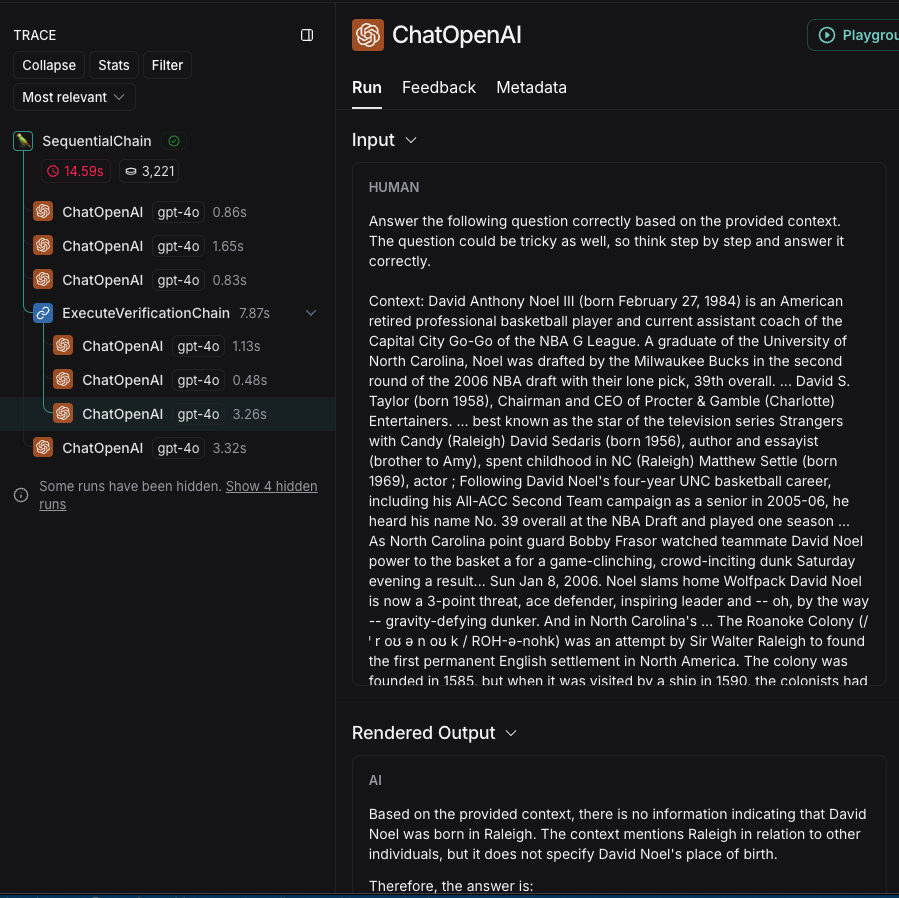
Screenshots
LangSmith
1 maintainer

Metadata
1 maintainer
Release files for langchain-chain-of-verification 0.1.11
For a detailed explanation of source distributions (sdists) and built distributions (wheels), please see the package formats documentation.
Source distribution (sdist)
| File | Size | Uploaded | Provenance | Actions |
|---|---|---|---|---|
| langchain_chain_of_verification-0.1.11.tar.gz | 70.5 kB | Without provenance | Details for langchain_chain_of_verification-0.1.11.tar.gz |
Built distribution (wheel)
| File | Interpreter | ABI | Platform | Actions Reset |
|---|---|---|---|---|
| langchain_chain_of_verification-0.1.11-py3-none-any.whl | Python 3 | none | any | Details for langchain_chain_of_verification-0.1.11-py3-none-any.whl |
Total release size: 82.1 kB
Release files / langchain_chain_of_verification-0.1.11.tar.gz
| Download URL | langchain_chain_of_verification-0.1.11.tar.gz |
|---|---|
| Size | 70.5 kB |
| Tags | Source |
|
SHA-256 checksum How to use checksums |
e45e788c58c4a30326b6686a7f8632a946dc0dd8f5ebde593d93a8a661e95ac8
|
|
BLAKE2b-256 checksum How to use checksums |
1934683eab77fb39f834270d6366ca2d7e3726e4f09cf2eb2ed5a0d50b3a0d70
|
| Upload date | |
|
Uploaded using Trusted Publishing? What is trusted publishing? |
No |
| Uploaded via |
twine/5.1.1 CPython/3.12.4
|
Release files / langchain_chain_of_verification-0.1.11-py3-none-any.whl
| Download URL | langchain_chain_of_verification-0.1.11-py3-none-any.whl |
|---|---|
| Size | 11.6 kB |
| Tags | Python 3 |
|
SHA-256 checksum How to use checksums |
eb875d286999873f9f7d2750c220e433579b6a1052199af942dc6923eaf7a1e9
|
|
BLAKE2b-256 checksum How to use checksums |
65ea9eeb4037b37803a9b2d09dedd0b1e49d62dd1bae00ed0c9a08646edaeca5
|
| Upload date | |
|
Uploaded using Trusted Publishing? What is trusted publishing? |
No |
| Uploaded via |
twine/5.1.1 CPython/3.12.4
|
Security for langchain-chain-of-verification 0.1.11
Provenance
Provenance describes where a file came from. On PyPI, provenance is shared via attestations, which provide a verifiable record of the build or publishing details. View details, limitations and caveats.
No provenance found
None of the files in this release were uploaded with provenance metadata.
A note on package security
PyPI is a repository for distributing packages, not a service for auditing them. While third-party security researchers and our staff do their best to detect and remove malicious packages, PyPI cannot guarantee the quality, security or suitability of any given package.
To learn more about protecting yourself from malicious actors, visit our package security documentation.














