
langchain-model-router





Send each request to the right model, by rules you control, from one LangChain chat model.
A community package, not affiliated with or endorsed by LangChain.
ChatRouter is a drop-in LangChain chat model. You give it a few named models and a strategy.
For each request, the strategy picks one of the models. The router returns that model's own
response, along with a note of which model answered and why.
What "the right model" means is up to you:
- Difficulty: a fast model for easy requests and a frontier model for hard ones.
- Topic: code questions to a coding model, and legal questions to a model tuned for them.
- Content: requests with images or documents to a model that can read them.
- Data: requests that touch sensitive data to a model you host yourself.
- Customer or experiment: each plan or A/B test group to its own model.
Whatever the policy, the router behaves the same way:
- Nothing else to change. It is a chat model, so
invoke,stream,batch, tools, structured output, agents and LangGraph all work unchanged. - Routing you can read. Every response says which model answered and why, and your LangSmith trace shows the same.
- Always answers. If the strategy can't decide, the default model answers and you get a warning.
- Nothing extra to run. No proxy, no service and no API key of its own. It needs only
langchain-core.
Get started
pip install langchain-model-router
It needs Python 3.10 or later and langchain-core 1.2.21 or later within 1.x (>=1.2.21,<2).
A route can be any LangChain chat model (a BaseChatModel) from any
provider, hosted or local. This first
router has two routes, a small model and a frontier one, and sends each question to one of them
depending on how hard it looks.
from langchain.chat_models import init_chat_model

from langchain_model_router import ChatRouter, HeuristicStrategy, routing_decision

router = ChatRouter(
    routes={
        "small": init_chat_model("google_genai:gemini-3.5-flash-lite"),
        "frontier": init_chat_model("google_genai:gemini-3.8-flash"),
    },
    default_route="small",
    strategy=HeuristicStrategy("small", "frontier"),  # cheapest first
)

for question in [
    "What's the capital of France?",
    "Compare the trade-offs of quicksort and mergesort on linked lists.",
]:
    response = router.invoke(question)
    print(f"{routing_decision(response).route:<8} {question}")
small    What's the capital of France?
frontier Compare the trade-offs of quicksort and mergesort on linked lists.
The simple fact question went to the small model. Comparing trade-offs takes reasoning, so that question went to the frontier model. Routing strategies explains how the difficulty is judged.
response is the chosen model's own answer, unchanged, so you read its text, tool calls and token
usage as usual. routing_decision(response) tells you which route answered and why.
How it works
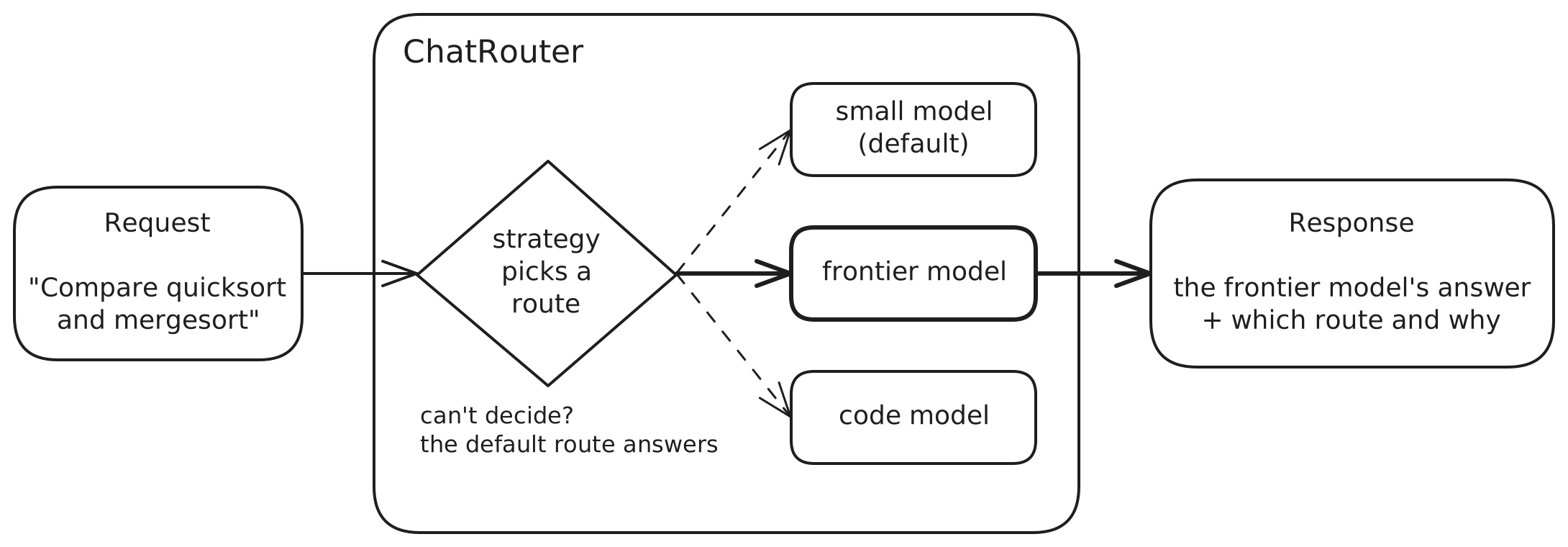
- The strategy looks at the current request, meaning the user's latest message. It ignores tool output and the rest of the conversation, so an agent's tool loop can't change the route.
- It names a route and gives a reason, or it abstains. If it abstains, the default route answers.
- The router calls that one model and returns its response, with the routing decision attached.
Choose a strategy
| Strategy | Decides by | Extra cost per request | Good for |
|---|---|---|---|
HeuristicStrategy |
A difficulty score: length, code, several questions, reasoning words, images | None | Cheap model for easy requests, strong model for hard ones |
KeywordStrategy |
Words in the request | None | Topics with telltale words, such as "SQL" or "invoice" |
ConfigurableStrategy |
Your rules, combining keywords, scores, media and tools | None | A policy with several conditions |
EmbeddingStrategy |
Similarity to example requests | One embedding call | Topics without telltale words |
ClassifierStrategy |
A small model reads route descriptions and picks one | One small-model call | Subtle distinctions, when accuracy matters most |
| Your own function | Your code | Whatever your code costs | Business rules, an existing classifier |
Start with a strategy that makes no extra call. Reach for embeddings or a classifier when words and rules can't tell your routes apart. They read meaning, but they add a call to every request.
Documentation
- Routing strategies covers how each strategy decides, with examples, tuning and how to write your own.
- Using the router covers reading the decision, streaming, tools, structured output, agents, forcing a route for A/B tests, tracing and cost, retries and caching.
- Examples has one runnable script per use case, each a small real-world scenario on the same models as these pages.
- Benchmark compares the strategies on cost and answer quality over a mixed workload, and shows how to rerun it with your own models.
- Design notes explain why the router is built the way it is. Read these before contributing.
- Changelog lists what changed in each release.
Scope
The router picks one model before the call, using a policy you define. It doesn't learn from
traffic, retry a weak answer on a stronger model, spend against a budget, or run as a proxy.
Inside create_agent, a choice that depends on agent state belongs in
@wrap_model_call middleware, which
can use the router as its model.
Provider prompt caching. Moving a conversation between models loses the prompt prefix that the provider has cached. For long conversations, you can keep each conversation on one route.
Contributing
Bug reports, ideas and pull requests are welcome. Development uses uv:
uv sync
make test   # offline unit tests
make lint   # ruff and mypy
CONTRIBUTING.md explains how to propose a change, and AGENTS.md describes the repository layout and conventions. Open work is in GitHub Issues. To report a security problem, follow SECURITY.md.
License
1 maintainer

Metadata
1 maintainer
Release files for langchain-model-router 0.1.0
For a detailed explanation of source distributions (sdists) and built distributions (wheels), please see the package formats documentation.
Source distribution (sdist)
| File | Size | Uploaded | |
|---|---|---|---|
| langchain_model_router-0.1.0.tar.gz | 79.1 kB | Details |
Built distribution (wheel)
| File | Interpreter | ABI | Platform | Reset |
|---|---|---|---|---|
| langchain_model_router-0.1.0-py3-none-any.whl | Python 3 | none | any | Details |
Total release size: 170.3 kB
Release files / langchain_model_router-0.1.0.tar.gz
| Download URL | langchain_model_router-0.1.0.tar.gz |
|---|---|
| Size | 79.1 kB |
| Tags | Source |
|
SHA-256 checksum How to use checksums |
92170f4d848604f7140b0294ef2b65725cfc4d6714b98267dc473d31330c7af8
|
|
BLAKE2b-256 checksum How to use checksums |
8a225925042d63749b43fe2c67ef69d60a294095e9400ee066ead528a8be3133
|
| Upload date | |
|
Uploaded using Trusted Publishing? What is trusted publishing? |
Yes |
| Uploaded via |
twine/7.0.0 CPython/3.13.14
|
Provenance
Provenance describes where a file came from. On PyPI, provenance is shared via attestations, which provide a verifiable record of the build or publishing details. View details, limitations and caveats.


PyPI Publish Attestation
PyPI verified that this artifact, at this checksum, originated from the publisher listed below.
Signed by GitHub Actions, verified by PyPI on Oct 5, 2026.
Transparency logRelease files / langchain_model_router-0.1.0-py3-none-any.whl
| Download URL | langchain_model_router-0.1.0-py3-none-any.whl |
|---|---|
| Size | 91.2 kB |
| Tags | Python 3 |
|
SHA-256 checksum How to use checksums |
d1a68d55ed973eea2a765cbc1697358df43bfac516b18991a7a3e0b7e2d8ecf9
|
|
BLAKE2b-256 checksum How to use checksums |
855682b5db4f10d4f323ba8e8d3a24313c2f87f649498ef3dfa12b2d4e9455bf
|
| Upload date | |
|
Uploaded using Trusted Publishing? What is trusted publishing? |
Yes |
| Uploaded via |
twine/7.0.0 CPython/3.13.14
|
Provenance
Provenance describes where a file came from. On PyPI, provenance is shared via attestations, which provide a verifiable record of the build or publishing details. View details, limitations and caveats.
PyPI Publish Attestation
PyPI verified that this artifact, at this checksum, originated from the publisher listed below.
Signed by GitHub Actions, verified by PyPI on Oct 5, 2026.
Transparency log












