
langdoctor 🩺
Scan your LangGraph/LangChain project for known CVEs, insecure configs, and production footguns — in seconds, offline, no API key.
brew doctor for your agent stack.




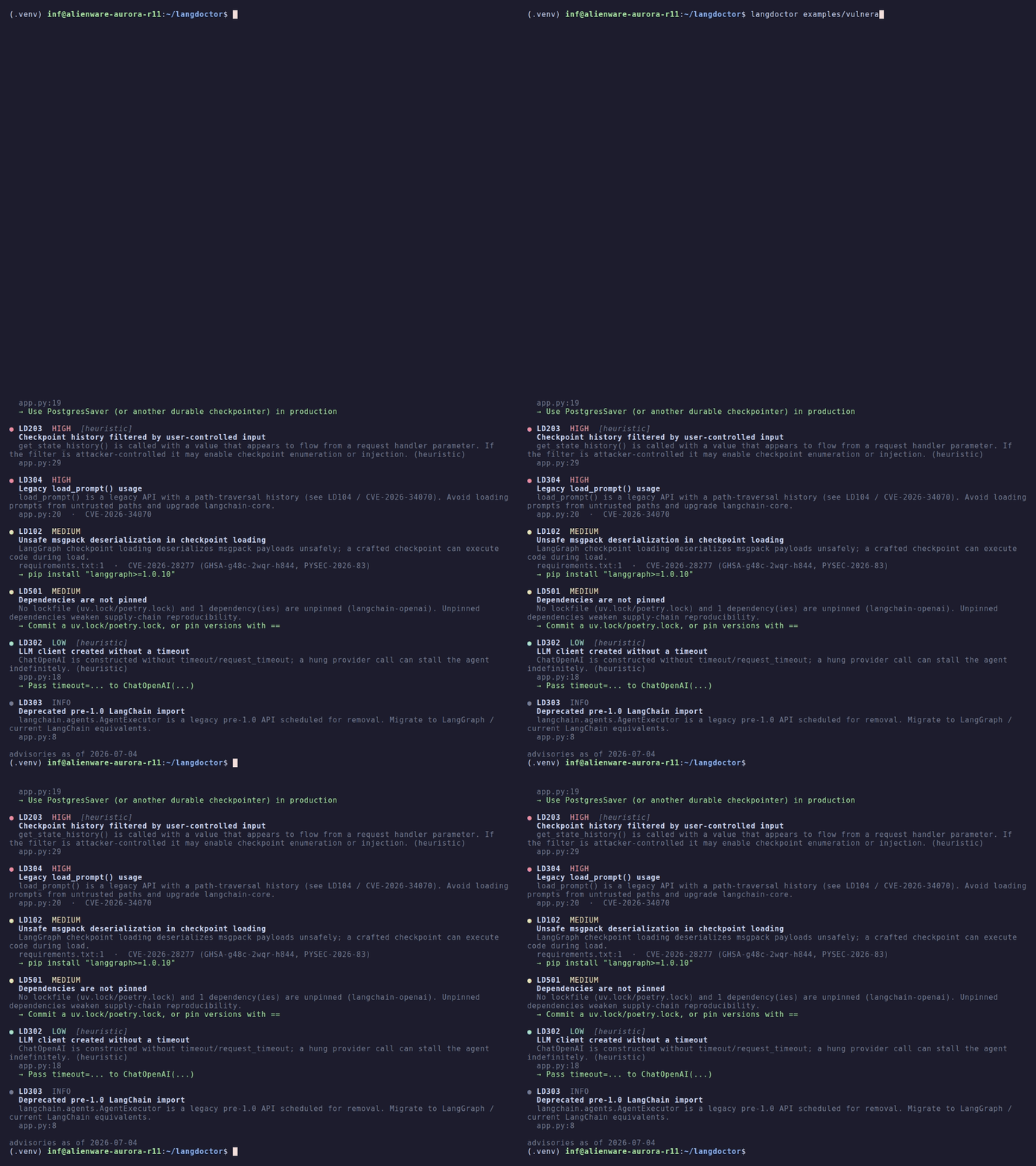
Quickstart
pipx run langdoctor # or: uvx langdoctor
Run it in your project directory. langdoctor reads your dependency files and source, reports issues grouped by severity, and exits non-zero when it finds something at or above your threshold.
langdoctor                 # scan the current directory
langdoctor path/to/project # scan a specific directory
langdoctor list-checks     # every check, with IDs and severities
langdoctor --version       # tool version + advisory DB date
Why
2026 has been a rough year for the agent stack:
- Langflow is under active attack.
CVE-2025-3248(unauthenticated RCE) was added to the CISA KEV catalog and exploited to deploy the Flodrix botnet;CVE-2026-5027(path-traversal → RCE) is being exploited across ~7,000 exposed instances. - LangGraph checkpointer CVEs — SQL injection and unsafe deserialization in the SQLite/base checkpointers can chain to RCE via forged checkpoint rows.
- Supply-chain attacks on the CI actions and packages the ecosystem depends on (the tj-actions and LiteLLM incidents) mean a pinned-to-a-tag action or an unpinned dependency is a real risk surface.
These are exactly the things a framework-specific linter can catch before you ship. langdoctor ships the CVE data with the package and runs fully offline.
What it checks
| ID | Category | Severity | What it catches |
|---|---|---|---|
LD101 |
Known CVEs | high | SQL injection via metadata filter key in SQLite checkpointer |
LD102 |
Known CVEs | medium | Unsafe msgpack deserialization in checkpoint loading |
LD103 |
Known CVEs | medium | Unsafe JSON deserialization in checkpoint loading |
LD104 |
Known CVEs | high | Path traversal in legacy load_prompt functions |
LD105 |
Known CVEs | critical | Serialization-injection secret extraction in dumps/loads |
LD106 |
Known CVEs | critical 🔴KEV | Unauthenticated RCE in /api/v1/validate/code (Langflow) |
LD107 |
Known CVEs | medium | BaseCache deserialization of untrusted data may lead to RCE |
LD108 |
Known CVEs | high | RCE in "json" mode of JsonPlusSerializer |
LD109 |
Known CVEs | high | SQL injection in the SQLite store implementation |
LD110 |
Known CVEs | high | SQL injection via filter key in SqliteStore |
LD111 |
Known CVEs | high 🔴KEV | Path traversal → RCE via /api/v2/files upload (Langflow) |
LD112 |
Known CVEs | medium | Unsafe URL path construction in the LangGraph SDK |
LD113 |
Known CVEs | high | Template injection via attribute access in prompt templates |
LD114 |
Known CVEs | medium | Path traversal and sandbox escape in file-search middleware |
LD115 |
Known CVEs | low | SSRF via image_url token counting |
LD116 |
Known CVEs | medium | Incomplete f-string validation in prompt templates |
LD117 |
Known CVEs | high | Unsafe deserialization via overly broad load() allowlists |
LD118 |
Known CVEs | medium | Namespace prefix matching crosses segments (SQLite store) |
LD119 |
Known CVEs | medium | Namespace prefix matching crosses segments (Postgres store) |
LD120 |
Known CVEs | high 🔴KEV | CORS + SameSite token hijack → account takeover (Langflow) |
LD121 |
Known CVEs | critical 🔴KEV | Unauthenticated RCE via exec_globals in validate (Langflow) |
LD122 |
Known CVEs | critical 🔴KEV | Unauthenticated RCE via build_public_tmp flow data (Langflow) |
LD123 |
Known CVEs | high 🔴KEV | IDOR in /api/v1/responses runs another user's flow (Langflow) |
LD124 |
Known CVEs | critical 🔴KEV | auto_login + validate/code chain → unauth RCE (Langflow) |
LD125 |
Known CVEs | critical | SSRF via unrestricted OpenAPI RequestsToolkit (community) |
LD126 |
Known CVEs | high | XXE in EverNoteLoader via unguarded iterparse() (community) |
LD127 |
Known CVEs | high | SSRF via nested sitemap entries in SitemapLoader (community) |
LD150 |
Known CVEs | high | Langflow older than the current secure baseline (1.11.0) |
LD201 |
Checkpointer & state | high | MemorySaver used in a production-bound project |
LD202 |
Checkpointer & state | medium | SqliteSaver may collapse under write concurrency |
LD203 |
Checkpointer & state | high (heuristic) | Checkpoint history filtered by user-controlled input |
LD204 |
Checkpointer & state | medium | Compiled graph with interrupts has no checkpointer |
LD301 |
Graph & runtime config | medium | No recursion_limit configured for a LangGraph run |
LD302 |
Graph & runtime config | low (heuristic) | LLM client created without a timeout |
LD303 |
Graph & runtime config | info | Deprecated pre-1.0 LangChain import |
LD304 |
Graph & runtime config | high | Legacy load_prompt() usage |
LD401 |
Secrets & exposure | critical | Hardcoded API key in source |
LD402 |
Secrets & exposure | high | .env file present but not gitignored |
LD403 |
Secrets & exposure | critical | Langflow auto-login not explicitly disabled |
LD501 |
Hygiene | medium | Dependencies are not pinned |
LD502 |
Hygiene | medium | GitHub Actions uses an unpinned third-party action |
Severities for CVE checks are derived from the CVSS score; 🔴KEV marks
Known-Exploited
vulnerabilities, which are always surfaced first.
A finding can arrive without a fix line. Some advisories have no released fix —
LD127 is patched upstream but no langchain-community release carries it yet —
and langdoctor reports those as affected with no upgrade to recommend rather than
inventing a version or staying quiet.
CI integration
GitHub Action
# .github/workflows/langdoctor.yml
name: langdoctor
on: [push, pull_request]
permissions:
  contents: read
  security-events: write   # to upload SARIF
jobs:
  scan:
    runs-on: ubuntu-latest
    steps:
      - uses: actions/checkout@v4
      - uses: elaz48/langdoctor@v1
        with:
          fail-on: high
      - uses: github/codeql-action/upload-sarif@v3
        if: always()
        with:
          sarif_file: langdoctor.sarif
Findings show up in your repo's Security → Code scanning tab.
pre-commit
# .pre-commit-config.yaml
repos:
  - repo: https://github.com/elaz48/langdoctor
    rev: v0.1.0
    hooks:
      - id: langdoctor
GitLab CI
langdoctor:
  image: python:3.12-slim
  script:
    - pip install langdoctor
    - langdoctor --format sarif > gl-langdoctor.sarif
  artifacts:
    reports:
      sast: gl-langdoctor.sarif
Configuration
Configure defaults in pyproject.toml; command-line flags take precedence.
[tool.langdoctor]
fail-on = "high"            # critical | high | medium | low | never
ignore  = ["LD203", "LD302"]
exclude = ["examples", "vendor"]
Suppress a single finding inline — by LD id, CVE, or any alias:
API_KEY = get_key() # langdoctor: ignore=LD401
langgraph==1.0.5 # langdoctor: ignore=LD102
Suppressed findings are always reported as a suppressed: N count so nothing
disappears silently.
Output formats
--format console (default) · json · sarif · markdown
- sarif — GitHub code scanning;
security-severitycarries the real CVSS. - markdown — paste straight into a PR or issue.
- json — machine-readable, with a per-severity summary.
Exit codes: 0 clean (or below --fail-on), 1 findings at/above threshold,
2 scan error. Heuristic checks never affect the exit code unless --strict.
What langdoctor is NOT
- ❌ Not a runtime guard. It scans code and dependencies; it does not sit in your request path.
- ❌ Not an LLM firewall. It does no prompt-injection or content analysis.
- ❌ Not a replacement for Semgrep/Snyk. It's the framework-specific layer those miss — LangGraph/LangChain/Langflow footguns, by ID, with fixes.
It is deterministic (no AI calls), offline (CVE data ships in the package), and zero-config.
Development
pip install -e ".[dev]"
pytest
ruff check .
Requires Python 3.10+. See CLAUDE.md for design principles, the
check-ID conventions, and the "advisories are data" model.
License
MIT © 2026 elaz48
Topics: langgraph · langchain · langflow · security · sast · ai-agents · llm-security · devsecops · cli
1 maintainer

Metadata
1 maintainer
Release files for langdoctor 0.1.5
For a detailed explanation of source distributions (sdists) and built distributions (wheels), please see the package formats documentation.
Source distribution (sdist)
| File | Size | Uploaded | |
|---|---|---|---|
| langdoctor-0.1.5.tar.gz | 903.2 kB | Details |
Built distribution (wheel)
| File | Interpreter | ABI | Platform | Reset |
|---|---|---|---|---|
| langdoctor-0.1.5-py3-none-any.whl | Python 3 | none | any | Details |
Total release size: 943.8 kB
Release files / langdoctor-0.1.5.tar.gz
| Download URL | langdoctor-0.1.5.tar.gz |
|---|---|
| Size | 903.2 kB |
| Tags | Source |
|
SHA-256 checksum How to use checksums |
5394ddb7120519e155c068a0fcd9e46dad9f29838f315a1f85acb81e6c3d2076
|
|
BLAKE2b-256 checksum How to use checksums |
593b8d1ec9766d00c6df52bb3a96951f9a2b56b295eb0e8ad50c91a44af95e36
|
| Upload date | |
|
Uploaded using Trusted Publishing? What is trusted publishing? |
Yes |
| Uploaded via |
twine/7.0.0 CPython/3.13.14
|
Provenance
Provenance describes where a file came from. On PyPI, provenance is shared via attestations, which provide a verifiable record of the build or publishing details. View details, limitations and caveats.


PyPI Publish Attestation
PyPI verified that this artifact, at this checksum, originated from the publisher listed below.
Signed by GitHub Actions, verified by PyPI on Aug 27, 2026.
Transparency logRelease files / langdoctor-0.1.5-py3-none-any.whl
| Download URL | langdoctor-0.1.5-py3-none-any.whl |
|---|---|
| Size | 40.6 kB |
| Tags | Python 3 |
|
SHA-256 checksum How to use checksums |
18e0046c2ae0ee128590808553ce173abf021de8f787fb94836f838c7243ea37
|
|
BLAKE2b-256 checksum How to use checksums |
f8ec8cb6acec0902ec0e0baebd895416f038bfff48295d5d74962fa0e84b6ff9
|
| Upload date | |
|
Uploaded using Trusted Publishing? What is trusted publishing? |
Yes |
| Uploaded via |
twine/7.0.0 CPython/3.13.14
|
Provenance
Provenance describes where a file came from. On PyPI, provenance is shared via attestations, which provide a verifiable record of the build or publishing details. View details, limitations and caveats.
PyPI Publish Attestation
PyPI verified that this artifact, at this checksum, originated from the publisher listed below.
Signed by GitHub Actions, verified by PyPI on Aug 27, 2026.
Transparency log













