
langgraph-preflight
English | 한국어
Check a LangGraph graph before it runs. langgraph-preflight app.py:graph finds nodes that write the same reducer-less key in one step, Send targets that do the same, and cycles that can never exit, without calling an LLM once. It imports your graph module but never executes a node.
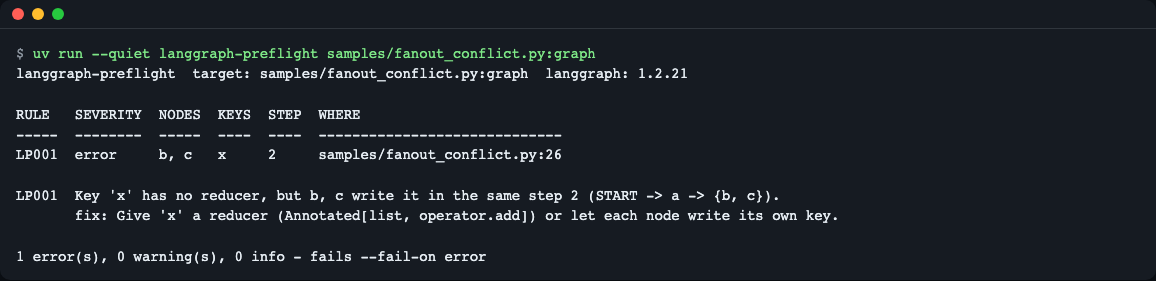
b and c run in the same step and both write x, which has no reducer. Exit code 1.
Why
StateGraph.compile() checks that edges point at real nodes. It does not check how your state is written. Three mistakes pass compile() and only fail during a run, after you have already spent tokens and time:
| Mistake | What you see at run time | Rule |
|---|---|---|
| Two nodes in the same step write one key that has no reducer | InvalidUpdateError: At key 'x': Can receive only one value per step |
LP001 |
A Send target writes a reducer-less key (fails only when 2 or more Sends run in one step, so a one-item test input passes) |
the same InvalidUpdateError, but only with enough input |
LP002 |
| A cycle of unconditional edges with no way out | GraphRecursionError after the default recursion_limit (10007 in the installed langgraph 1.2.21) |
LP003 |
Think of it as a circuit checker that reads the wiring diagram and finds the terminal where two wires are plugged in at once. "Same step" is what matters, not "same starting node": a short branch and a long branch can meet in the same step.
No API key, no network, no GPU. The sample nodes are plain functions standing in for LLM calls, so every output in this README was produced by running the real tool on real langgraph 1.2.21. There is no mock mode and no fake output.
Install
The tool imports your graph module, so install it in the same environment as your graph (an isolated uv tool install could not import your dependencies).
# install uv if you do not have it:  curl -LsSf https://astral.sh/uv/install.sh | sh
uv add --dev git+https://github.com/LeeGyeongPil/langgraph-preflight   # in your project
# or with pip:   pip install git+https://github.com/LeeGyeongPil/langgraph-preflight
# one-off run:   uv run --with git+https://github.com/LeeGyeongPil/langgraph-preflight langgraph-preflight app.py:graph
Requirements: Python 3.10+ and langgraph>=1.2.21,<2 (installed automatically). On a minimal Linux image you need git for the git+https install.
Quick start
Try the bundled samples from a clone of this repository:
git clone https://github.com/LeeGyeongPil/langgraph-preflight
cd langgraph-preflight
uv run langgraph-preflight samples/fanout_conflict.py:graph; echo "exit=$?"
langgraph-preflight  target: samples/fanout_conflict.py:graph  langgraph: 1.2.21

RULE   SEVERITY  NODES  KEYS  STEP  WHERE
-----  --------  -----  ----  ----  -----------------------------
LP001  error     b, c   x     2     samples/fanout_conflict.py:26

LP001  Key 'x' has no reducer, but b, c write it in the same step 2 (START -> a -> {b, c}).
       fix: Give 'x' a reducer (Annotated[list, operator.add]) or let each node write its own key.

1 error(s), 0 warning(s), 0 info - fails --fail-on error
exit=1
How to read it: NODES/KEYS say who writes what, STEP is the superstep where it happens, the path in parentheses is the route from START that gets there, and WHERE points at the node function. Exit code 1 means a finding at or above --fail-on (default error).
For your own graph, give file.py:name or package.module:name. name can be a compiled graph, a StateGraph, or a function with no arguments that returns one (create LLM clients inside that function so importing the module needs no key):
uv run langgraph-preflight agent/graph.py:graph
uv run langgraph-preflight myapp.agent:build_graph
Compare with the real run
Every sample can run directly, so you can see the prediction match reality (uv run python samples/fanout_conflict.py):

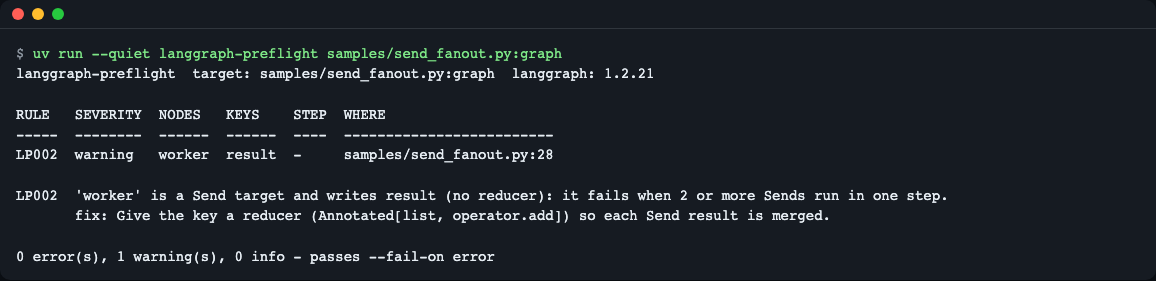
The Send case hides behind the input size (send_fanout.py 1 passes, 3 fails):

A closed cycle (closed_cycle.py) is reported with the installed default recursion_limit:
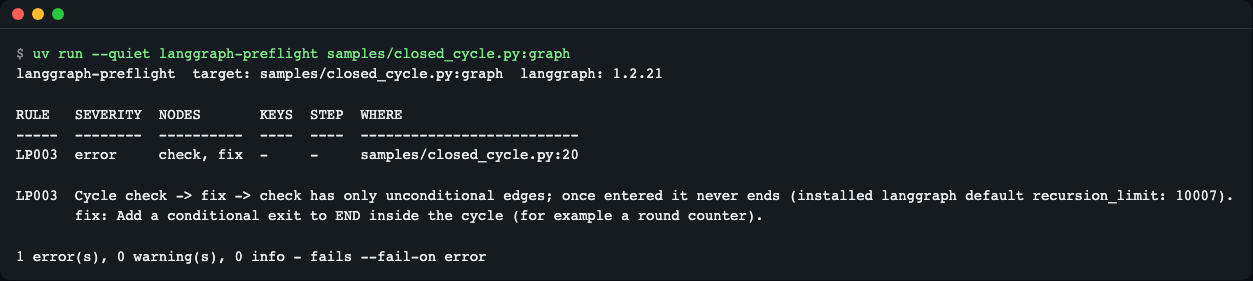
check -> fix -> check has only unconditional edges.
A Command(goto=["p", "q"]) list (command_fanout_conflict.py) runs both nodes in one step, so it is reported as LP001 too.
A clean graph passes with exit code 0:

Rules
| Rule | Severity | Meaning | Typical fix |
|---|---|---|---|
| LP001 concurrent-write | error | Nodes that can run in the same step write one key that has no reducer. Shows step number and branch path. | Add a reducer (Annotated[list, operator.add]) or give each node its own key |
| LP002 send-fanout-write | warning | A Send target writes a reducer-less key; fails with 2+ Sends in one step |
Add a reducer so each Send result is merged |
| LP003 closed-cycle | error | A cycle where every way forward stays inside the cycle (unconditional edges, or all destinations in the cycle). Shows the installed default recursion_limit (or unknown if unreadable). |
Add a conditional exit to END (for example a round counter) |
| LP004 unreachable-node | warning (info for Send/Command targets or nodes reachable only through a route with undeclared destinations) |
A node cannot be reached from START |
Add an edge or remove the node |
| LP005 opaque-route | warning | A conditional edge without path_map or a Literal return hint, or a node returning Command without a Command[Literal[...]] hint. An unknown name silently ends the run. |
Pass a path_map or add the Literal hint |
| LP006 analysis-gap | info | Something could not be analysed: written keys unknown, exploration truncated by --max-states, router returning a list of destinations, Command(goto=[...]) with non-literal items |
Informational; the unknown part is left out of LP001 |
A cycle with a conditional way out is not reported.
Usage
langgraph-preflight TARGET [--format table|json|sarif] [--output PATH]
                    [--fail-on error|warning|never] [--lang en|ko]
                    [--max-states N] [--debug] [--version]
| Option | What it does |
|---|---|
TARGET |
file.py:name or package.module:name (a single top-level name) |
--format |
table (default), json, or sarif (2.1.0) |
--output PATH |
Write the JSON/SARIF report to a file. A new path is created; an existing file is replaced only if it is an earlier langgraph-preflight report, otherwise exit 2 and the file is untouched. Not allowed with table. |
--fail-on |
Lowest severity that makes exit code 1 (default error) |
--max-states N |
Cap on explored step states (default 20000); beyond it you get an LP006 note |
--debug |
Full traceback when loading fails |
--lang |
Screen language, see Language |
Exit codes: 0 pass, 1 findings at or above --fail-on, 2 usage error, load failure, or refused output. Your sources are only read, never modified.
JSON (--format json) has tool, tool_version, langgraph_version, schema_version, target, summary and findings[] with rule, name, severity, message, message_id, args, nodes, keys, step, path, location. Messages are always English, so the file is the same whatever the screen language.
CI and pytest
SARIF for code scanning (the finding points at the node function's file and line):
uv run langgraph-preflight agent/graph.py:graph --format sarif --output preflight.sarif --fail-on error
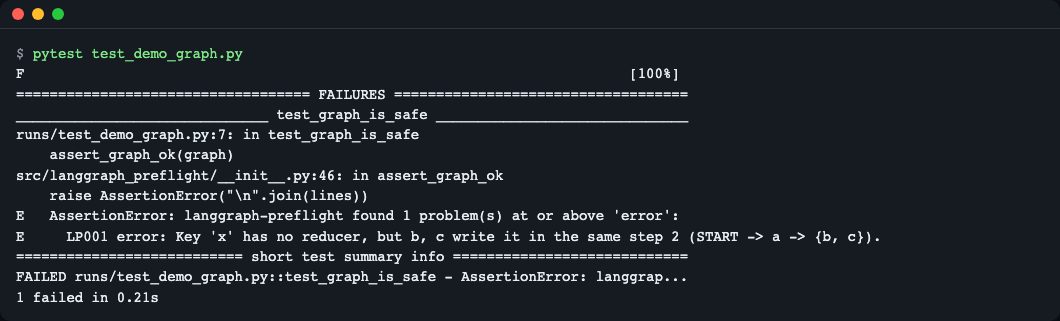
In pytest, pass an already imported graph:
from langgraph_preflight import assert_graph_ok, check

from samples.fanout_conflict import graph


def test_graph_is_safe():
    assert_graph_ok(graph)          # AssertionError listing rule, key and nodes

report = check(graph)               # Report: .findings, .max_severity, .to_json(), .to_sarif()
How it works
flowchart LR
  T["TARGET<br/>app.py:graph"] --> L[loader<br/>import only]
  L --> M[model<br/>nodes, edges, joins, branches, reducers]
  L --> W[ast<br/>written keys, Send targets]
  M --> S[simulate<br/>step states]
  S --> R[rules LP001-LP006]
  W --> R
  M --> R
  R --> O[table / JSON / SARIF]
  R --> E[exit code 0/1/2]
- The loader imports your module and takes the graph object by name. No node is executed.
- The model reads the compiled graph: nodes, plain edges, join edges (wait for all sources), possible destinations of conditional edges, and which state keys have a reducer.
- A separate pass reads each node function's source with
ast(neverexec) to estimate which keys it writes: dict literals,dict(k=...),Command(update=...),out["k"] = ...,out.update(...). Anything else (returning the whole state,**spreading, helper calls, lambdas, subgraphs) is marked unknown, reported as LP006, and left out of LP001 so errors come only from keys it is sure about. - A breadth-first search walks supersteps: plain edges always fire, a conditional edge or a single-destination
Commandis expanded one destination at a time (aCommandgoto list literal runs all listed nodes in the same step), and a join fires the step after all its sources finished. The shortest evidence path is kept. - The rules read the result. The search is possibility-based: it may report a branch combination your router never picks, so the message shows which picks are required.
Language
Screen text (table, help, load errors) is English or Korean. Order of precedence: --lang en|ko, then LANGGRAPH_PREFLIGHT_LANG, then LC_ALL / LC_MESSAGES / LANG (a value starting with ko means Korean), otherwise English. JSON, SARIF and exit codes never change with the language.
uv run langgraph-preflight samples/closed_cycle.py:graph --lang ko
Limits
- It reads LangGraph internals (
builder.edges,waiting_edges,branches,channels). Supported range is>=1.2.21,<2; if an attribute is missing it stops with exit 2 ("unsupported langgraph version") rather than guessing. CI also runs against the newest langgraph below 2. - Not modelled: subgraph nodes and prebuilt
ToolNode(treated as unknown writes),defer=True,RetryPolicy, interrupts, the functional API (@entrypoint), LangGraph.js. - Routers are assumed to pick one destination per step; a router returning a list is flagged LP006 and not expanded.
Command(goto=[...])with a list literal of node names is expanded as all of them running in the same step (so LP001 can fire); a list that is not all string literals is flagged LP006.- Written keys come from the
astpatterns listed above; the rest is unknown, never guessed. - It does not fix your code and does not run the graph.
Compared with
| Checks | Does not check | |
|---|---|---|
compile() in LangGraph |
edges to missing nodes, START edges, interrupt nodes | state write conflicts, cycles |
| langgraph-lint 0.1.0 (checked 2026-11-13) | reachability, path_map/Literal agreement |
parallel write conflicts, Send, closed cycles (per its README) |
| langgraph-preflight | step-level write conflicts, Send fan-out, closed cycles, plus an overlapping reachability check (LP004) | path_map/Literal agreement: use langgraph-lint for that |
They complement each other. Other tools change over time; check their own pages for current behaviour. Agent skills that review LangGraph code are prompts, so their result is not deterministic and gives no exit code; this tool is a script.
Roadmap
- Next: subgraph recursion and parent-key writes,
defer=Truestep shifts, routers that return lists, built-in write tables forToolNodeandcreate_react_agent, GitHub Actions annotations, a pre-commit hook example. - Later: a baseline file (
--baseline) to ignore known findings, a look at the functional API.
Plans can change; open an issue if one of these matters to you.
Troubleshooting
| Symptom | Cause | Fix |
|---|---|---|
Exit 2 and a one-line error such as file not found |
Wrong path or name is not a graph |
Use file.py:name where name is a compiled graph, StateGraph, or a no-argument factory; add --debug for the traceback |
| Import error for your own packages | Tool installed in a different environment than the graph | Install it into the graph's environment (see Install) |
| Import fails because a key is missing | Module builds an LLM client at import time | Build the client inside a factory function and target that |
| Exit 2 "unsupported langgraph version" | Internals changed in a langgraph release | Pin langgraph>=1.2.21,<2 or open an issue |
| LP006 "Exploration stopped after N states" | More step states than --max-states |
Raise --max-states |
| Exit 2 "this graph cannot be built (compile() would fail)" | The StateGraph itself is invalid (for example no edge from START) | Fix the graph so compile() succeeds, then rerun |
Development
uv run pytest -q
Tests run without network. Bugs and ideas: open an issue. Changes: CHANGELOG.md.
License
MIT, see LICENSE.
1 maintainer

Metadata
1 maintainer
Release files for langgraph-preflight 0.1.3
For a detailed explanation of source distributions (sdists) and built distributions (wheels), please see the package formats documentation.
Source distribution (sdist)
| File | Size | Uploaded | Provenance | Actions |
|---|---|---|---|---|
| langgraph_preflight-0.1.3.tar.gz | 39.9 kB | Without provenance | Details for langgraph_preflight-0.1.3.tar.gz |
Built distribution (wheel)
| File | Interpreter | ABI | Platform | Actions Reset |
|---|---|---|---|---|
| langgraph_preflight-0.1.3-py3-none-any.whl | Python 3 | none | any | Details for langgraph_preflight-0.1.3-py3-none-any.whl |
Total release size: 81.8 kB
Release files / langgraph_preflight-0.1.3.tar.gz
| Download URL | langgraph_preflight-0.1.3.tar.gz |
|---|---|
| Size | 39.9 kB |
| Tags | Source |
|
SHA-256 checksum How to use checksums |
374a56e0bf461afc356419c8c9b0f69128886748eb0cdc751c024497f9fead14
|
|
BLAKE2b-256 checksum How to use checksums |
91f6fa79aae8b5a53e90edb370ce8deae7f6fe0fbbe51beea06997745bea2d1c
|
| Upload date | |
|
Uploaded using Trusted Publishing? What is trusted publishing? |
No |
| Uploaded via |
uv/0.13.6 {"installer":{"name":"uv","version":"0.13.6","subcommand":["publish"]},"python":null,"implementation":{"name":null,"version":null},"distro":{"name":"macOS","version":null,"id":null,"libc":null},"system":{"name":null,"release":null},"cpu":null,"openssl_version":null,"setuptools_version":null,"rustc_version":null,"ci":null}
|
Release files / langgraph_preflight-0.1.3-py3-none-any.whl
| Download URL | langgraph_preflight-0.1.3-py3-none-any.whl |
|---|---|
| Size | 41.9 kB |
| Tags | Python 3 |
|
SHA-256 checksum How to use checksums |
a26759759678c823c326ea2ef106863b205ec564b310ac68dd01e41c72e3357f
|
|
BLAKE2b-256 checksum How to use checksums |
739ea946fae8f06e67038e024c0fabd899f24bb230509c0e9d795dcda17b7050
|
| Upload date | |
|
Uploaded using Trusted Publishing? What is trusted publishing? |
No |
| Uploaded via |
uv/0.13.6 {"installer":{"name":"uv","version":"0.13.6","subcommand":["publish"]},"python":null,"implementation":{"name":null,"version":null},"distro":{"name":"macOS","version":null,"id":null,"libc":null},"system":{"name":null,"release":null},"cpu":null,"openssl_version":null,"setuptools_version":null,"rustc_version":null,"ci":null}
|
Security for langgraph-preflight 0.1.3
Provenance
Provenance describes where a file came from. On PyPI, provenance is shared via attestations, which provide a verifiable record of the build or publishing details. View details, limitations and caveats.
No provenance found
None of the files in this release were uploaded with provenance metadata.
A note on package security
PyPI is a repository for distributing packages, not a service for auditing them. While third-party security researchers and our staff do their best to detect and remove malicious packages, PyPI cannot guarantee the quality, security or suitability of any given package.
To learn more about protecting yourself from malicious actors, visit our package security documentation.














