
ISO 11146 Calculation of Laser Beam Center, Diameter, and M²

Project description
by Scott Prahl






Do not use latest github code. It doesn’t work. Use the last released version v1.9.4.
Simple and fast calculation of beam sizes from a single monochrome image based on the ISO 11146 method of variances. Some effort has been made to make the algorithm less sensitive to background offset and noise.
This module also supports M² calculations based on a series of images collected at various distances from the focused beam.
Extensive documentation can be found at <https://laserbeamsize.readthedocs.io>
Using laserbeamsize
Install with pip:
pip install --user laserbeamsize
or run this code in the cloud using Google Collaboratory by selecting the Jupyter notebook that interests you.
use binder which will create a new environment that allows you to run Jupyter notebooks. This takes a bit longer to start, but it automatically installs laserbeamsize.
clone the laserbeamsize github repository and then add the repository to your PYTHONPATH environment variable
Determining the beam size in an image
Finding the center and dimensions of a good beam image:
import imageio
import numpy as np
import matplotlib.pyplot as plt
import laserbeamsize as lbs

beam = imageio.v2.imread("t-hene.pgm")
x, y, dx, dy, phi = lbs.beam_size(beam)

print("The center of the beam ellipse is at (%.0f, %.0f)" % (x,y))
print("The ellipse diameter (closest to horizontal) is %.0f pixels" % dx)
print("The ellipse diameter (closest to   vertical) is %.0f pixels" % dy)
print("The ellipse is rotated %.0f° ccw from horizontal" % (phi*180/3.1416))
to produce:
The center of the beam ellipse is at (651, 491)
The ellipse diameter (closest to horizontal) is 334 pixels
The ellipse diameter (closest to   vertical) is 327 pixels
The ellipse is rotated 29° ccw from the horizontal
A visual report can be done with one function call:
lbs.beam_size_plot(beam)
plt.show()
produces something like
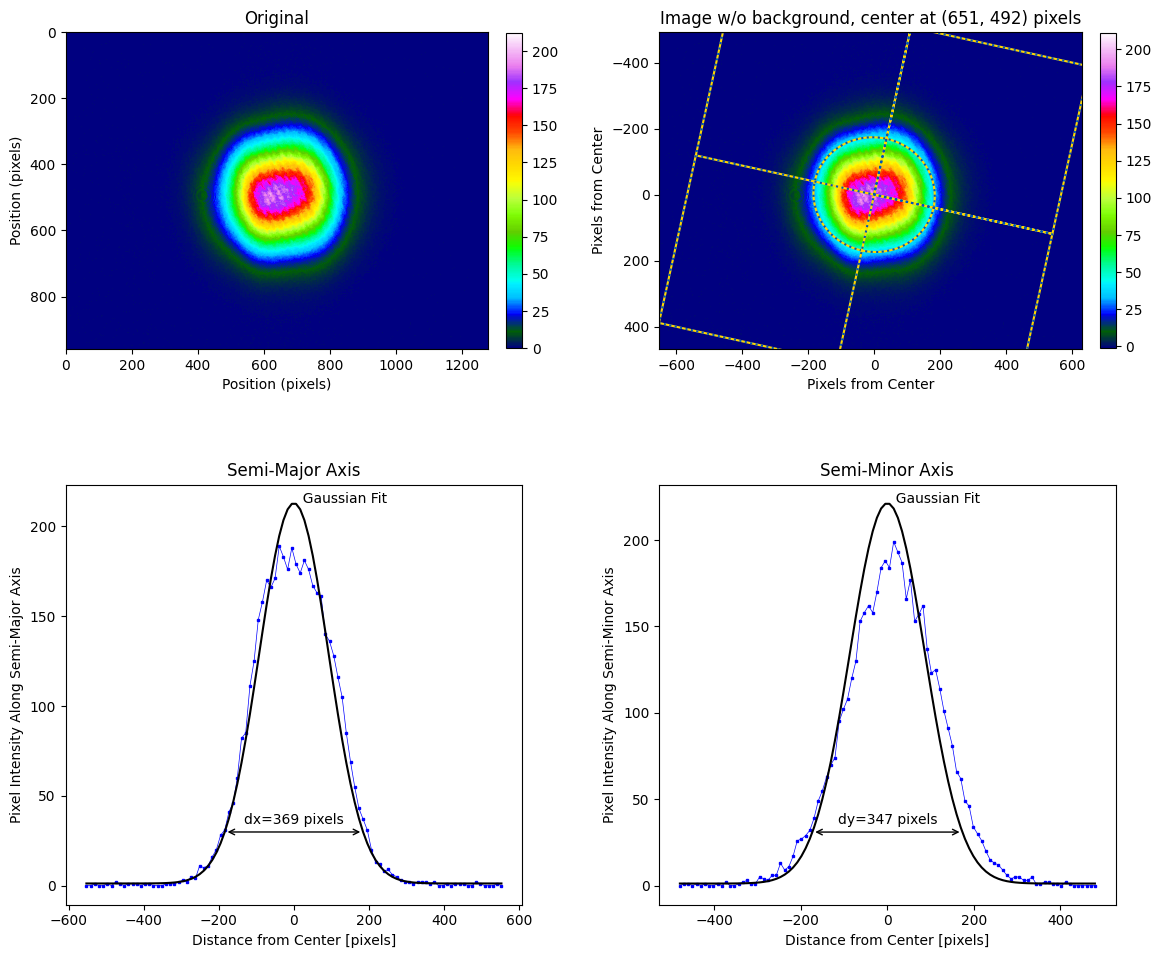
or:
lbs.beam_size_plot(beam, r"Original Image $\lambda$=4µm beam", pixel_size = 12, units='µm')
plt.show()
produces something like
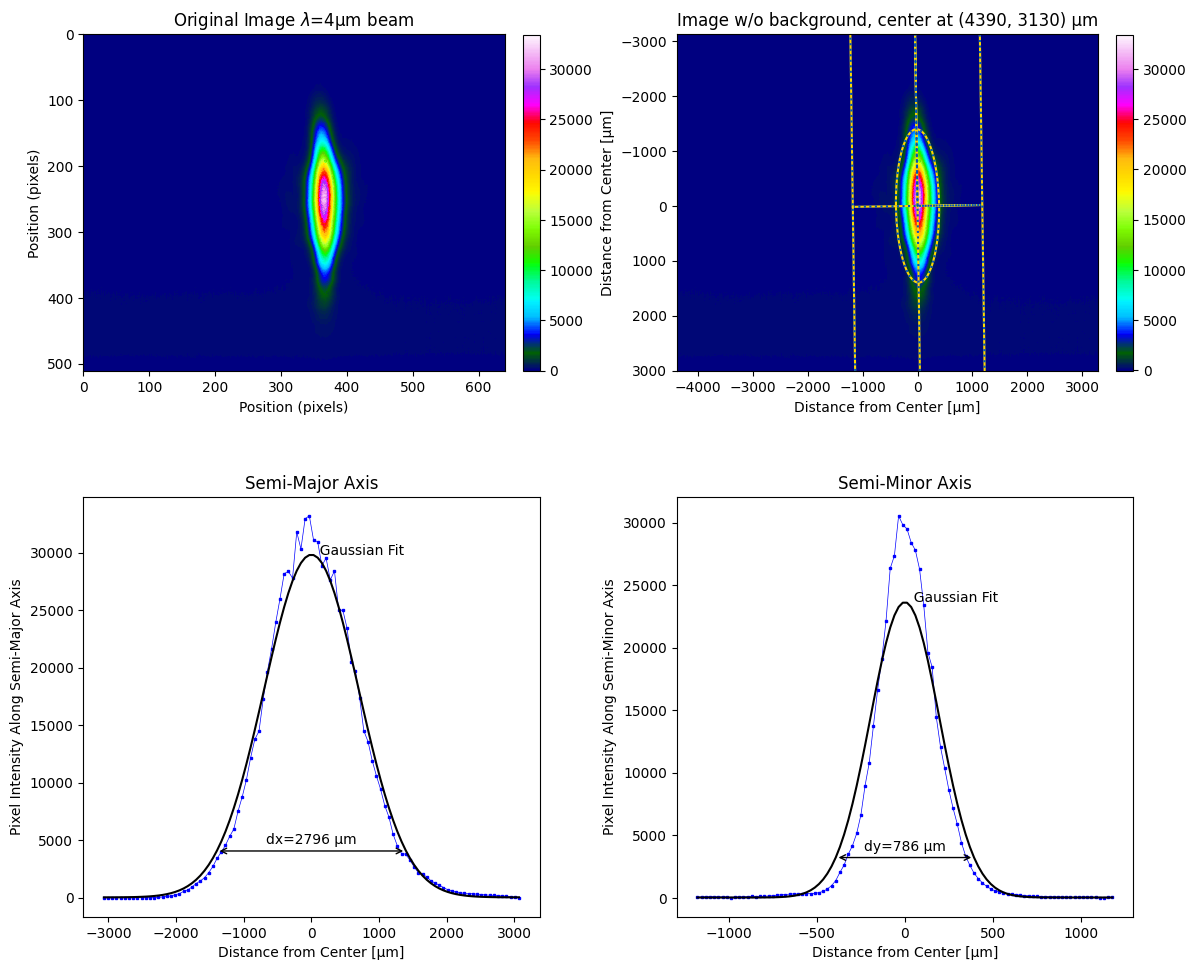
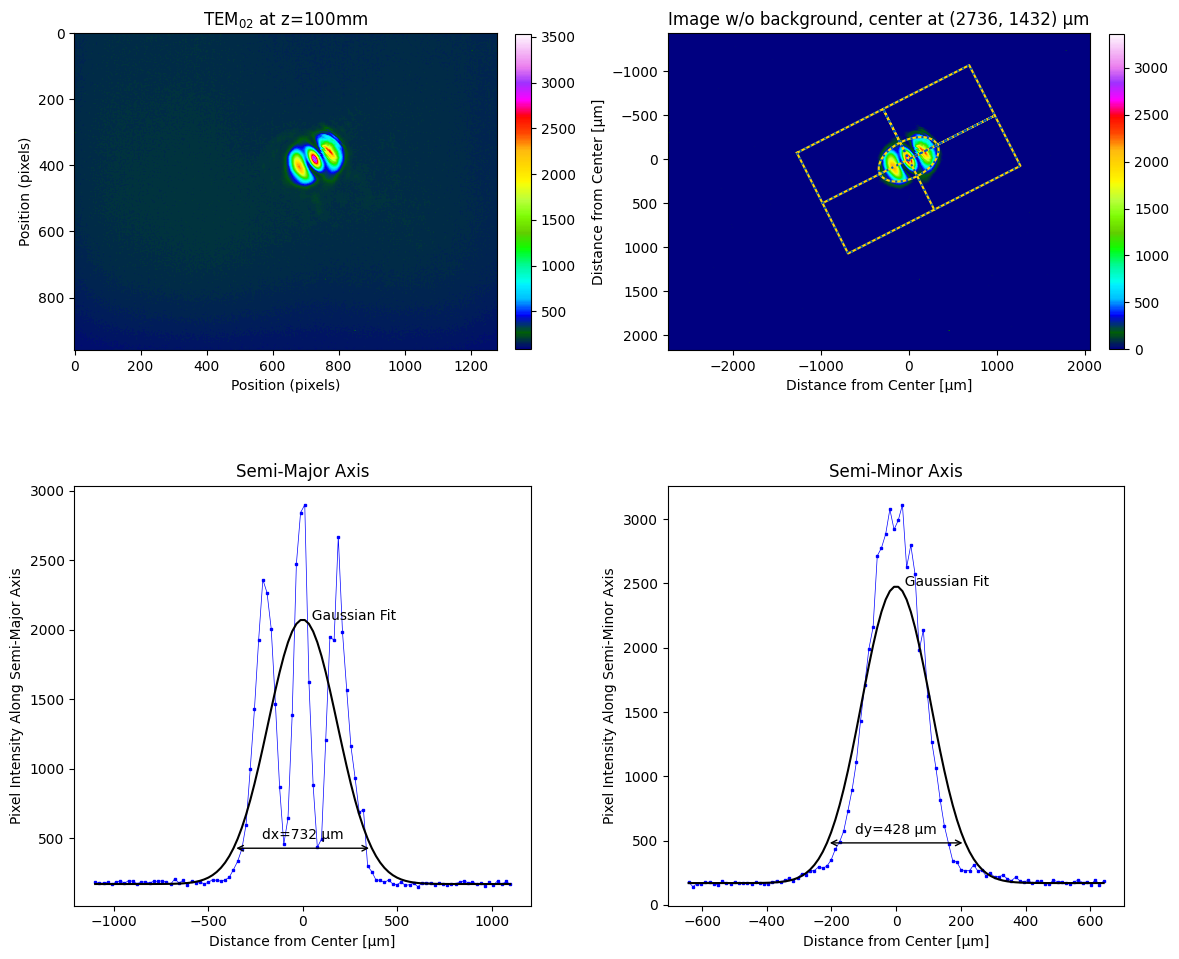
Non-gaussian beams work too:
# 12-bit pixel image stored as high-order bits in 16-bit values
tem02 = imageio.imread("TEM02_100mm.pgm") >> 4
lbs.beam_size_plot(tem02, title = r"TEM$_{02}$ at z=100mm", pixel_size=3.75)
plt.show()
produces
Determining M²
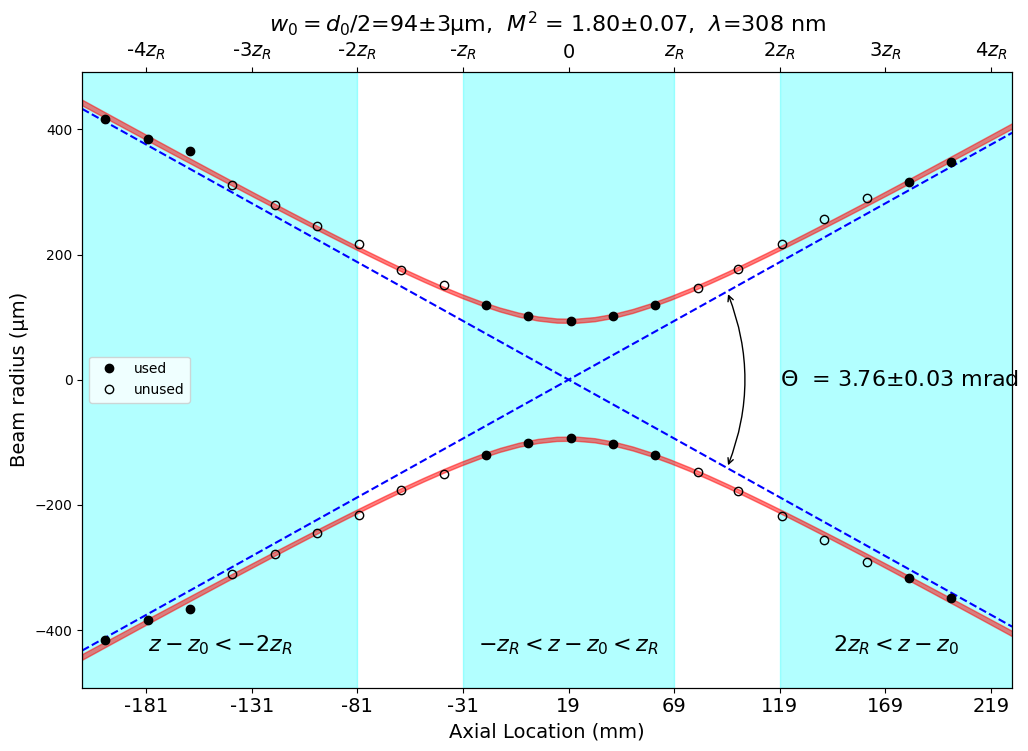
Determining M² for a laser beam is also straightforward. Just collect beam diameters from five beam locations within one Rayleigh distance of the focus and from five locations more than two Rayleigh distances:
lambda1=308e-9 # meters
z1_all=np.array([-200,-180,-160,-140,-120,-100,-80,-60,-40,-20,0,20,40,60,80,99,120,140,160,180,200])*1e-3
d1_all=2*np.array([416,384,366,311,279,245,216,176,151,120,101,93,102,120,147,177,217,256,291,316,348])*1e-6
lbs.M2_radius_plot(z1_all, d1_all, lambda1, strict=True)
plt.show()
produces
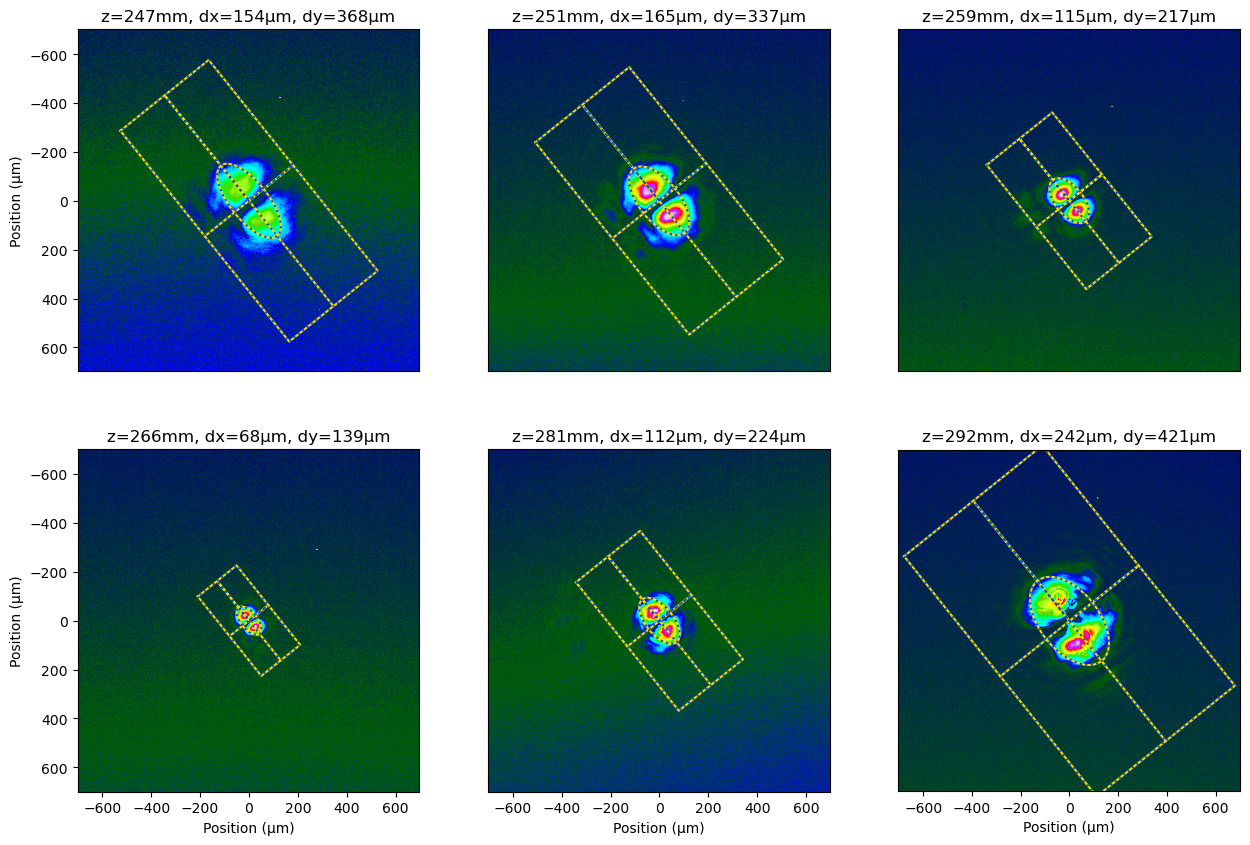
Here is an analysis of a set of images that do not meet the ISO 11146 requirements for determining M² (because the image locations are not taken in right locations relative to the focus). These beam images are from a HeNe laser with slightly misaligned mirrors to primarily lase in a TEM₀₁ transverse mode. The laser resonator had a fixed rotation of 38.7° from the plane of the optical table.:
lambda0 = 632.8e-9 # meters
z10 = np.array([247,251,259,266,281,292])*1e-3 # meters
filenames = ["sb_%.0fmm_10.pgm" % (number*1e3) for number in z10]

# the 12-bit pixel images are stored in high-order bits in 16-bit values
tem10 = [imageio.imread(name)>>4 for name in filenames]

# remove top to eliminate artifact
for i in range(len(z10)):
    tem10[i] = tem10[i][200:,:]

# find beam rotated by 38.7° in all images
fixed_rotation = np.radians(38.7)
options = {'pixel_size': 3.75, 'units': "µm", 'crop': [1400,1400], 'z':z10, 'phi':fixed_rotation}
dy, dx= lbs.beam_size_montage(tem10, **options)  # dy and dx in microns
plt.show()
produces
Here is one way to plot the fit using the above diameters:
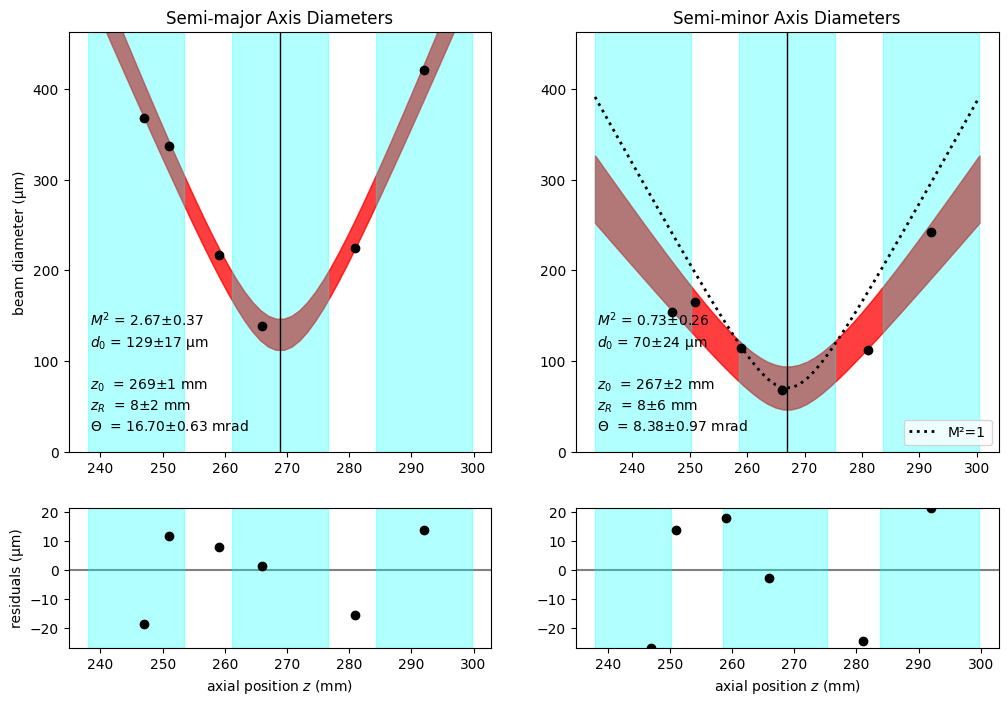
lbs.M2_diameter_plot(z10, dx*1e-6, lambda0, dy=dy*1e-6)
plt.show()
In the graph on the below right, the dashed line shows the expected divergence of a pure gaussian beam. Since real beams should diverge faster than this (not slower) there is some problem with the measurements (too few!). On the other hand, the M² value the semi-major axis 2.6±0.7 is consistent with the expected value of 3 for the TEM₁₀ mode.
License
laserbeamsize is licensed under the terms of the MIT license.
Release history Release notifications | RSS feed


Download files
Download the file for your platform. If you're not sure which to choose, learn more about installing packages.
Source Distribution
Built Distribution
Filter files by name, interpreter, ABI, and platform.
If you're not sure about the file name format, learn more about wheel file names.
Copy a direct link to the current filters
File details
Details for the file laserbeamsize-2.0.0.tar.gz.
File metadata
- Download URL: laserbeamsize-2.0.0.tar.gz
- Upload date:
- Size: 34.5 kB
- Tags: Source
- Uploaded using Trusted Publishing? No
- Uploaded via: twine/4.0.2 CPython/3.11.5
File hashes
| Algorithm | Hash digest | |
|---|---|---|
| SHA256 |
0484fb61caea6bc7d66224bb347e6859cf81753ebb98bfa5f3552628cc1a4825
|
|
| MD5 |
0bba13823fb4268c1798914a41bd1772
|
|
| BLAKE2b-256 |
2d52f3e29534818665d65fddb815a613ca006ebdb7af3bf337e9ab839bf9975f
|
File details
Details for the file laserbeamsize-2.0.0-py3-none-any.whl.
File metadata
- Download URL: laserbeamsize-2.0.0-py3-none-any.whl
- Upload date:
- Size: 31.6 kB
- Tags: Python 3
- Uploaded using Trusted Publishing? No
- Uploaded via: twine/4.0.2 CPython/3.11.5
File hashes
| Algorithm | Hash digest | |
|---|---|---|
| SHA256 |
671b1011dea9dcdc332841353743bac0ee4641b97b0fec70d1c6e4bdef5f9f47
|
|
| MD5 |
8b4b74421f791667ed9b28e280cb72cd
|
|
| BLAKE2b-256 |
12ae2f1dce612eeede6d7238d9cf7b3c321248dd64a51c97e4589f892d1610c5
|






