
Last Meadow Online Bot




An automation bot for Last Meadow Online, Discord's April 2026 DBMMIRPG (Discord-Based Massively Multiplayer Incremental Role Playing Game). This bot automates the full gameplay loop for the Ranger class with the Crafting skill, helping contribute damage to the community dragon boss "Grass Toucher."
I really don't get the point of this game, but I thought it would be trivial to automate it ... so I did!
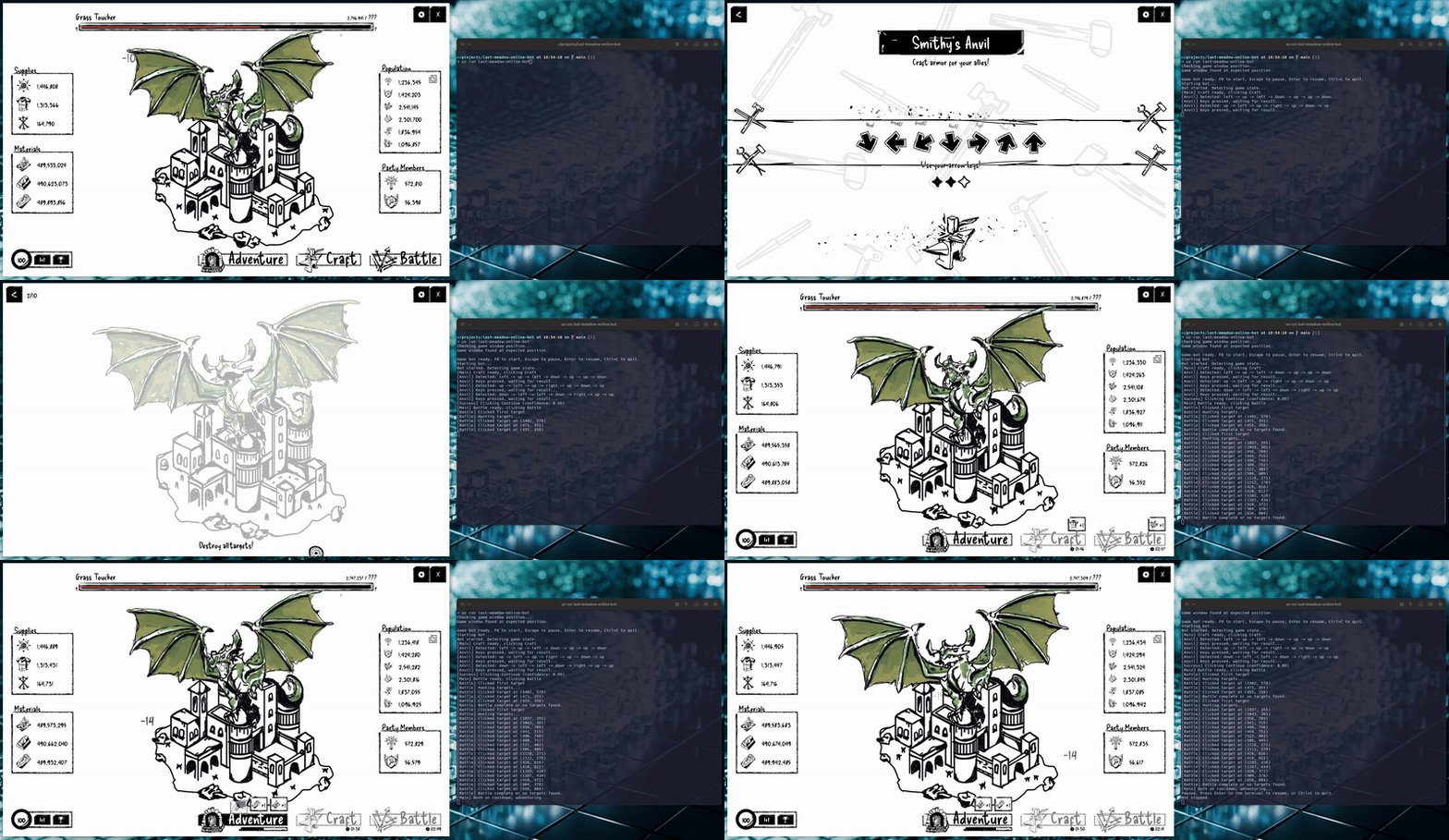
There's more extension needed to fully automate the other classes that I didn't play, but I'll leave that to someone who cares to contribute.
What It Automates
The bot runs a continuous loop across three activities:
- Adventuring -- rapid-clicks the Adventure button to gather resources and XP while waiting for cooldowns
- Crafting (Smithy's Anvil) -- uses OpenCV template matching to read the arrow key sequence displayed on screen, then presses the corresponding keys automatically
- Battling (Ranger Archery) -- detects the bullseye targets that appear on screen using circular blob detection and clicks them
After each craft or battle, the bot automatically clicks the Continue button on the success screen and returns to adventuring.
Requirements
- Python 3.11+
- uv for dependency management
Platform Compatibility
This bot was built and tested on Linux (X11). The underlying dependencies (pynput, PIL.ImageGrab, opencv-python-headless) are all cross-platform, so it should work on Windows and macOS with some adjustments:
| Platform | Input (pynput) |
Screen Capture (ImageGrab) |
Notes |
|---|---|---|---|
| Linux (X11) | X11 | X11 | Tested and working |
| Linux (Wayland) | Requires ydotool |
Requires alternative | Not supported as-is |
| Windows | Win32 API | Native | Run --calibrate to configure |
| macOS | Quartz | Native | Requires accessibility permissions (System Settings > Privacy & Security > Accessibility). Run --calibrate to configure. |
The bot adapts to any screen layout via its calibration wizard -- no hardcoded screen coordinates.
Setup
git clone git@github.com:captivus/last-meadow-online-bot.git
cd last-meadow-online-bot
uv sync
Or install from PyPI:
uv tool install last-meadow-online-bot
Calibration
Before first use, run the calibration wizard to tell the bot where your game window is:
last-meadow-online-bot --calibrate
The wizard walks you through 6 steps:
- Position your mouse at the top-left corner of the game area, press Enter
- Position your mouse at the bottom-right corner, press Enter
- Button templates are extracted directly from your live screen
- Detection is verified against the current screen
- Click Craft in the game -- arrow templates are extracted from the crafting screen
- Complete the craft -- Continue template is extracted from the success screen
Config and templates are saved to ~/.config/last-meadow-online-bot/. You only need to calibrate once. Re-run if you move or resize the game window.
Usage
last-meadow-online-bot
Or during development:
uv run last-meadow-online-bot
Controls
| Key | Action |
|---|---|
| F8 | Start the bot |
| Escape | Pause the bot |
| Enter | Resume the bot (in terminal) |
| Ctrl+C | Quit |
Automation Methodology
This section documents the general approach used to automate the game, including pitfalls I encountered and how I solved them. The same methodology can be applied to automate other class/skill combinations (Paladin with shield minigame, Priest with tile-matching, etc.).
1. Identify Game States
The game has a finite set of screens the player moves through. Each screen has unique visual markers that distinguish it from the others. I identified these states by screenshotting each screen during gameplay:
| State | Visual Marker | How It's Detected |
|---|---|---|
| Main screen | Adventure/Craft/Battle buttons at the bottom | Template match on the Craft button |
| Crafting (Anvil) | Row of arrow icons in the center | Template match on arrow icons (up/down/left/right) |
| Battle (Archery) | Back button "<" in top-left, no other UI | Dark pixel check in back button region |
| Success screen | "Continue" button | Template match on Continue button |
The main screen with the three action buttons and cooldown timer:

2. Map the State Machine
The game follows a predictable loop. I mapped each state to the action the bot should take and which state it transitions to:
stateDiagram-v2
    [*] --> MainScreen

    MainScreen --> AnvilScreen: Craft cooldown done\nClick Craft
    MainScreen --> BattleScreen: Battle cooldown done\nClick Battle
    MainScreen --> MainScreen: Both on cooldown\nRapid-click Adventure

    AnvilScreen --> SuccessScreen: Detect arrows\nPress keys

    BattleScreen --> SuccessScreen: Detect targets\nClick targets

    SuccessScreen --> MainScreen: Click Continue
Lesson learned -- state detection order matters. The battle success screen still has the back button "<" visible, which is also how we detect the active battle screen. If the battle check runs before the Continue check, the bot gets stuck on the success screen thinking it's still in battle. The solution: always check for Continue before checking for battle in the detection order.
3. Extract Templates from the Live Screen
For each visual element the bot needs to recognize, the calibration wizard extracts templates directly from the user's live screen. This ensures templates match the exact resolution, aspect ratio, and rendering of the user's setup.
The crafting screen showing the arrow sequence that individual arrow templates are extracted from:

Templates extracted during calibration:
up.png,down.png,left.png,right.png-- individual arrow icons, classified by direction using center-of-mass analysiscontinue.png-- the Continue button from the success screencraft_button.png-- the Craft button from the main screen bottom barbattle_button.png-- the Battle button from the main screen bottom bar
Lesson learned -- always extract templates from the live screen, not reference screenshots. My initial approach was to ship pre-cropped templates and scale them to match the user's resolution. This failed because the game doesn't maintain a fixed aspect ratio across different window sizes -- the internal layout adapts, so templates scaled by different X and Y factors didn't match the actual rendering. Extracting fresh templates during calibration from ImageGrab captures solved this completely.
4. Define Screen Regions
Rather than scanning the entire screen every frame, I defined tight bounding boxes for each area of interest. This improves performance and reduces false positives.
Regions are stored as relative coordinates (fractions of the game window dimensions) and converted to absolute pixel positions at runtime using the calibrated game window bounds. The reference values below are from the original 1720x1408 development setup:
| Region | Purpose | Reference Coordinates |
|---|---|---|
arrow |
Where arrow icons appear during crafting | (0.47, 0.55, 0.23, 0.73) |
continue |
Where the Continue button appears | (0.55, 0.69, 0.35, 0.64) |
craft_button |
Craft button in the bottom bar | (0.93, 1.00, 0.64, 0.83) |
craft_cooldown |
Timer text below Craft button | (0.98, 0.99, 0.78, 0.82) |
battle_button |
Battle button in the bottom bar | (0.93, 1.00, 0.81, 0.99) |
battle_cooldown |
Timer text below Battle button | (0.98, 0.99, 0.94, 0.99) |
battle_arena |
Where targets appear during battle | (0.05, 0.90, 0.03, 0.91) |
back_button |
Back button in top-left during minigames | (0.00, 0.04, 0.00, 0.03) |
Lesson learned -- account for window chrome. The game window has a title bar/tab bar at the top (32px in my setup). My initial attempt to detect the battle score counter in the top-left failed because the coordinates were based on the game screenshot (which doesn't include the title bar), not the actual screen position. The calibration wizard handles this by having the user point at the actual game content corners.
Lesson learned -- cooldown timer regions must be surgically precise. My first cooldown detection region captured part of the Craft button's border lines, which added ~7.5% dark pixels even when no timer was present. This caused the bot to think the cooldown was always active. The fix was to use a tiny region positioned entirely inside the button, below the text, where only the timer digits appear. The separation became clean: ~0% dark without timer, ~10-12% dark with timer.
5. Implement Detection Strategies Per Element
Different UI elements require different detection approaches:
Template matching (arrows, buttons) -- best for elements that appear at a consistent size and appearance. Crop a reference image, then use cv2.matchTemplate with TM_CCOEFF_NORMED and a confidence threshold (0.7).
Pixel darkness ratio (cooldown timers) -- best for detecting presence/absence of text in a known region. When the timer is visible, the region has ~10-18% dark pixels. When absent, ~0%. A threshold of 3% cleanly separates the two states.
Contour-based blob detection (battle targets) -- best for elements that change size or position. The bullseye target is circular, so we threshold the image, find contours, and filter for high circularity (>0.6), square aspect ratio, and minimum size. Detection thresholds scale proportionally with the game window size.
Battle targets appear at various positions and sizes, shrinking over time:


Lesson learned -- UI elements create false positive targets. Small circular elements (gear icon, decorative dots, text characters like "o") can pass the circularity filter. Three layers of defense were needed:
- Exclude the UI corners from the battle scan area by tightening the arena region
- Set minimum contour size high enough to filter small decorative elements while still catching real targets
- Detect when the bot clicks the same screen position repeatedly (a real target moves after being clicked, a false positive doesn't) and treat repeated same-spot clicks as misses
6. Handle Timing and Transitions
Key timing considerations:
- Adventure clicking runs in 2-second bursts, then checks if a cooldown has finished
- Arrow key presses have a 50ms delay between each key
- Battle target scanning runs as fast as possible (~50ms per frame) to catch targets before they shrink
- After actions (clicking Craft, pressing arrows, clicking Continue), a 1-1.5 second delay allows screen transitions to complete
- During battle, the bot checks for the Continue button every ~1 second to detect when the battle ends, regardless of whether targets are being found
7. Adapting for Other Classes
To automate a different class or skill combination:
- Screenshot each new minigame screen -- capture the unique visual elements
- Identify the minigame mechanic:
- Paladin (Shield) -- intercept falling projectiles by moving a shield. Would need motion tracking or rapid position detection.
- Priest (Tile Matching) -- match groups of three identical tiles. Would need tile recognition and grid position mapping.
- Extract new templates from live screen captures during calibration for any new UI elements
- Add a new state to
detect_state()with appropriate detection logic, being mindful of detection order to avoid state confusion - Implement the minigame handler (like
run_battle()for archery), making sure it checks for exit conditions (Continue button) to avoid getting stuck - Add new relative regions to
config.pyif the minigame uses different areas of the screen
The shared elements (Adventure button, cooldown detection, Continue button, state machine loop) remain the same across all class/skill combinations.
Reference Screenshots
These screenshots were captured during development to identify screen regions, extract templates, and calibrate detection thresholds.
Main Screen (adventuring)
The Adventure button is being clicked to grind resources while cooldowns are active.

Craft Success
After completing the arrow sequence, the success screen appears. The bot clicks Continue to return to the main screen. The battle success screen looks identical in layout.

Battle Success
After hitting all 10 targets, the battle success screen appears with the same Continue button.

Display Configuration
The bot uses a calibration system to adapt to any screen layout:
- Relative coordinates -- all UI regions are stored as fractions of the game window dimensions, not absolute pixel values. At runtime they're converted to screen pixels using the calibrated game bounds.
- Live template extraction -- during calibration, templates are captured directly from the user's screen at their native resolution and aspect ratio. No scaling or interpolation is needed.
- Proportional thresholds -- detection thresholds (e.g., minimum target size for battle) scale with the game window dimensions so they work at any resolution.
Config is stored at ~/.config/last-meadow-online-bot/. Re-run last-meadow-online-bot --calibrate if your game window changes.
Dependencies
opencv-python-headless-- template matching and contour detectionpillow-- screen capturepynput-- keyboard and mouse input simulation
1 maintainer

Metadata
1 maintainer
Release files for last-meadow-online-bot 0.2.3
For a detailed explanation of source distributions (sdists) and built distributions (wheels), please see the package formats documentation.
Source distribution (sdist)
| File | Size | Uploaded | Provenance | |
|---|---|---|---|---|
| last_meadow_online_bot-0.2.3.tar.gz | 55.0 kB | Without provenance | Details |
Built distribution (wheel)
| File | Interpreter | ABI | Platform | Reset |
|---|---|---|---|---|
| last_meadow_online_bot-0.2.3-py3-none-any.whl | Python 3 | none | any | Details |
Total release size: 112.6 kB
Release files / last_meadow_online_bot-0.2.3.tar.gz
| Download URL | last_meadow_online_bot-0.2.3.tar.gz |
|---|---|
| Size | 55.0 kB |
| Tags | Source |
|
SHA-256 checksum How to use checksums |
7cb49f1fd9c3ef85d2a7de044189fc16e9ceaae4dded2d57b48fe8477c816024
|
|
BLAKE2b-256 checksum How to use checksums |
a735e893a0e050c2fac1157cc8f17b76e31cbfc8ea64cec33c8eee0eff6a8275
|
| Upload date | |
|
Uploaded using Trusted Publishing? What is trusted publishing? |
Yes |
| Uploaded via |
uv/0.11.6 {"installer":{"name":"uv","version":"0.11.6","subcommand":["publish"]},"python":null,"implementation":{"name":null,"version":null},"distro":{"name":"Ubuntu","version":"24.04","id":"noble","libc":null},"system":{"name":null,"release":null},"cpu":null,"openssl_version":null,"setuptools_version":null,"rustc_version":null,"ci":true}
|
Release files / last_meadow_online_bot-0.2.3-py3-none-any.whl
| Download URL | last_meadow_online_bot-0.2.3-py3-none-any.whl |
|---|---|
| Size | 57.7 kB |
| Tags | Python 3 |
|
SHA-256 checksum How to use checksums |
6c6d71de4587612d32241cd6f0e46184d60408eabacbcea43cfbbd6c05fa077b
|
|
BLAKE2b-256 checksum How to use checksums |
a2aa5e76127579b29cb1e0a68f23174729f2f939a78d82f98b47bcd0259cd7f0
|
| Upload date | |
|
Uploaded using Trusted Publishing? What is trusted publishing? |
Yes |
| Uploaded via |
uv/0.11.6 {"installer":{"name":"uv","version":"0.11.6","subcommand":["publish"]},"python":null,"implementation":{"name":null,"version":null},"distro":{"name":"Ubuntu","version":"24.04","id":"noble","libc":null},"system":{"name":null,"release":null},"cpu":null,"openssl_version":null,"setuptools_version":null,"rustc_version":null,"ci":true}
|
Security for last-meadow-online-bot 0.2.3
Provenance
Provenance describes where a file came from. On PyPI, provenance is shared via attestations, which provide a verifiable record of the build or publishing details. View details, limitations and caveats.
No provenance found
None of the files in this release were uploaded with provenance metadata.
A note on package security
PyPI is a repository for distributing packages, not a service for auditing them. While third-party security researchers and our staff do their best to detect and remove malicious packages, PyPI cannot guarantee the quality, security or suitability of any given package.
To learn more about protecting yourself from malicious actors, visit our package security documentation.














