
The last few solves you'll ever pay for: a certified accelerator and identification layer over any black-box parametric solver, built on resona's effective-rank dial.

Project description
lastsolve
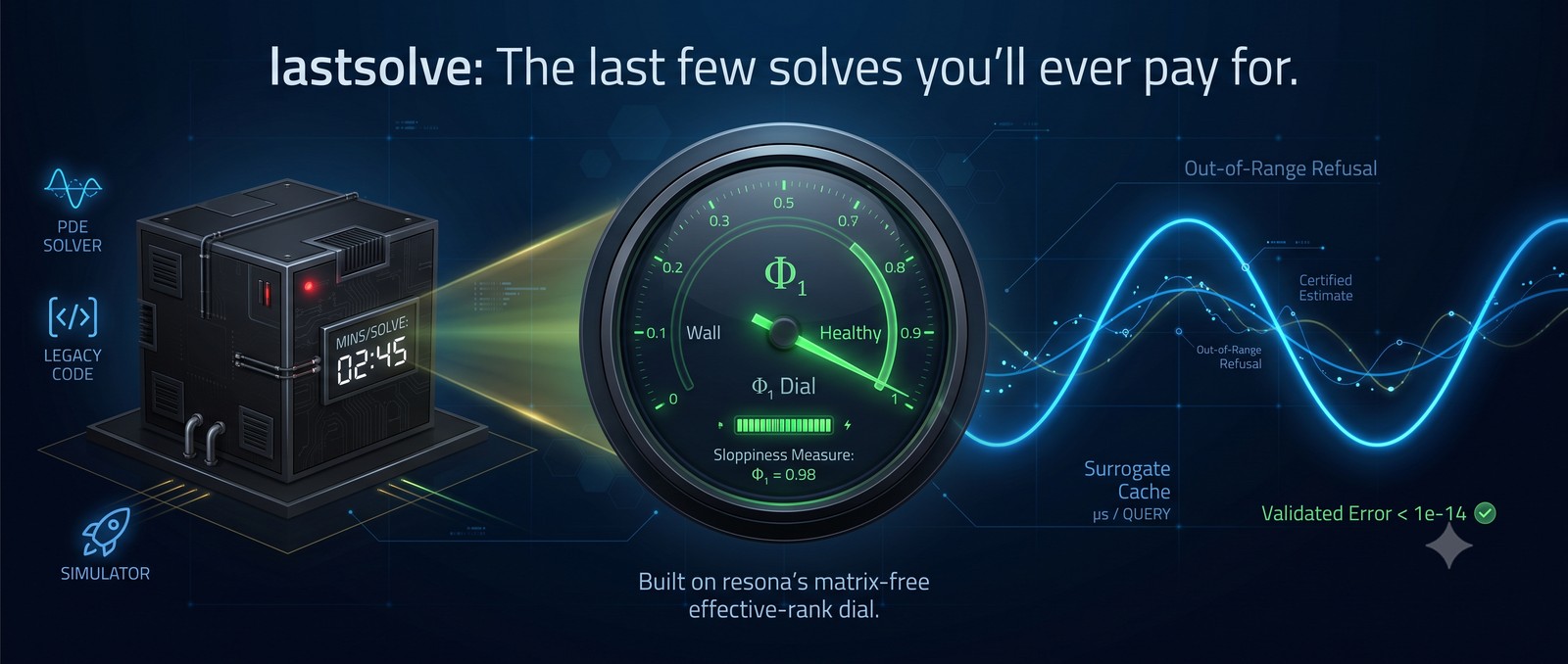
The last few solves you'll ever pay for.
lastsolve is a certified accelerator and identification layer over any black-box parametric solver. You bring an expensive function f(k) → field — a PDE solver, a legacy code behind a subprocess, a simulator you can't even import. lastsolve spends a handful of calls on Chebyshev nodes and hands back the whole price list:
In plain terms. You have a simulation that takes 2 minutes, and your workflow — a parameter sweep, a calibration loop, an MCMC — needs to call it 10,000 times.
lastsolveruns it ~10 times, learns how the answer depends on the parameter, and serves the other 9,990 calls in microseconds — with a validated error bar on every answer, and a typed exception instead of a guess whenever it can't keep that promise.
The contract: f(k) → 1-D numpy array (anything np.asarray-able; a scalar result is a length-1 array). Plain CPU NumPy in, plain NumPy out — no PyTorch/JAX tensors needed, no GPU, no training loops. The whole library is a few files of numpy + scipy + resona you can read in an evening.
Learn by doing: the COOKBOOK — ten paste-and-run recipes, each ending with the verbatim output it printed on this machine.
from lastsolve import accelerate, learn

@accelerate(warmup=5)        # watch 5 real calls, learn the range they live in,
def solve(k):                # then serve everything from the surrogate
    ...  # your expensive solver

solve(0.021)                 # microseconds, with a validated error and the Φ₁ dial
solve.stats                  # every real call counted

s = learn(solve_fn, (0.014, 0.026))          # one knob  → Surrogate
s = learn(solve_fn, [(a1,b1), (a2,b2)])      # several   → SurrogateND, same verbs
k_hat, crb = s.invert(y_obs)                 # rich Estimate, unpacks as a tuple
s.certify(n_cal=8)                           # Certificate(err ≤ 3.9e-15, ≥88.9%)
s.query(0.05)                                # OutOfRangeError — lastsolve refuses
                                             # to extrapolate; strict=False to
                                             # accept an uncertified answer knowingly
Built on resona's matrix-free effective-rank dial — the measuring instrument of the Spectra Without Matrices series. The philosophy in one line: measure the structure first, then pay accordingly.
What you get for ~10 solves
| API | What it does | The honest part |
|---|---|---|
@accelerate |
transparent surrogate cache: in-range calls served in µs at near machine precision | out-of-range calls fall through to the real solver — never extrapolates; .stats counts every real call |
Surrogate(f, krange) |
the core: query(k), deriv(k) (Fisher info), adaptive node ladder, transform='auto' discovers coordinates like 1/√k |
.val_err from held-out solves; .phi1 — resona's dial: ~1 healthy, ≫1 a wall, ~0 dead parameter |
.certify(n_cal, alpha) |
split-conformal error band | distribution-free finite-sample guarantee (and it tells you 8 calibration points buy 88.9%, not 90%) |
identify(f, data, krange) |
maximum-likelihood k̂ ± Cramér–Rao bar from one observation | verdict includes "the data do not contain this parameter" when they don't |
audit(f, x0, sigma, prior) |
field-level identifiability: how many independent numbers about N unknowns your dataset holds (matrix-free probes + resona) | reports the blind subspace no method can recover, before anyone reconstructs anything |
detect_break(f, krange) |
bifurcation alarm + blind localization via validation-error bisection | refuses to fit across broken physics instead of interpolating a lie |
classify_wall(f, krange) |
after the alarm: is the wall removable (a coordinate heals it) or genuine (Shor-class)? | resona's lift-rank saturation test — the Journey-I instrument, pointed at your family |
SurrogateND(f, box) |
several parameters, committee-disagreement adaptive design | 45 solves matched a 125-solve tensor grid on a 3-parameter family; sloppiness (Φ₁ ≈ 1–2 at p=3) is measured, not assumed |
CommandSolver + accelerate_command |
accelerate a solver you cannot import — any CLI/binary | every subprocess invocation counted |
TimePropagator(snapshots) |
learn the propagator from one trajectory (DMD/Koopman via resona.lift) | ships |λ|max stability verdict + held-out-tail validation; says when long prediction is dishonest |
identify_spectral(family, k0, λs) |
recover a parameter from a measured spectral fingerprint (resona.wkernel + rayleigh_polish) | uses several eigenvalues — one alone can be ambiguous, and the docstring says so |
normality_warning(A) |
non-normality check before trusting any spectral dial | "the spectrum lies about where this operator acts" is a measurable condition |
Why believe any of this
Because none of it is asserted — it was all run first. The methods were battle-tested on a zoo of 35 nonlinear PDE families (Burgers, KdV, Kuramoto–Sivashinsky chaos, NLS solitons, Camassa–Holm, fractional heat…), included here as lastsolve.zoo and exercised by the test suite:
- forward surrogates at ~5·10⁻¹⁵ over ±28% parameter ranges, ~570× faster queries;
- inversion saturating the Cramér–Rao bound (median error ≈ 0.7× the bound — the theoretical optimum is 0.674);
- conformal coverage measured at 88.4% against the exact 88.9% finite-sample guarantee;
- a pitchfork bifurcation localized blind to 3% of the range, zero false alarms on healthy physics.
The research trail with every number: The Price of an Answer (Journey II) and Never Quantum at All (Journey I).
Install & test
pip install numpy scipy resona   # the FULL dependency list — no ML frameworks,
pip install -e .                 # no CUDA, nothing to train
pytest tests/ -q                 # 26 tests, ~17 s, real PDEs inside
Honest limits (v1.1)
- Scalar-parameter surrogates are certified; multi-parameter (
SurrogateND) is adaptive least-squares — excellent in the sloppy regime (which is most of physics), but its validation is empirical, not conformal yet. - The surrogate is built per initial condition / configuration — it is a cache around a question family, not a general solver replacement.
- Smoothness is measured, not assumed: when the parametric manifold genuinely resists (a breathing soliton — Kolmogorov n-width), Φ₁ flags it and no node budget will help. The dial exists precisely so the library can refuse honestly.
resona.effective_rankis a stochastic (Hutchinson) estimate;lastsolveuses 128 probes, good to a few percent on the dial.
Design principles
- Never silently wrong — every answer is validated, certified, or refused.
- The dial before the fit — Φ₁ says whether a cheap surrogate exists at all.
- Everything is counted — the solver calls we spend are the price we quote.
MIT · Dmytro Sierikov · part of the Spectra Without Matrices series


Download files
Download the file for your platform. If you're not sure which to choose, learn more about installing packages.
Source Distribution
Built Distribution
Filter files by name, interpreter, ABI, and platform.
If you're not sure about the file name format, learn more about wheel file names.
Copy a direct link to the current filters
File details
Details for the file lastsolve-1.1.0.tar.gz.
File metadata
- Download URL: lastsolve-1.1.0.tar.gz
- Upload date:
- Size: 33.2 kB
- Tags: Source
- Uploaded using Trusted Publishing? No
- Uploaded via: twine/6.2.0 CPython/3.10.12
File hashes
| Algorithm | Hash digest | |
|---|---|---|
| SHA256 |
565b8636fa1f754825d857eb227b92a82d5adedd4e3e5af3836e1fc052356762
|
|
| MD5 |
8b123ec3c46730b8d66d5d90a35f948b
|
|
| BLAKE2b-256 |
29573c3b6ca57a53593a7a8793eb6b40000c0a411ff9dccf056104f0bf75072e
|
File details
Details for the file lastsolve-1.1.0-py3-none-any.whl.
File metadata
- Download URL: lastsolve-1.1.0-py3-none-any.whl
- Upload date:
- Size: 31.5 kB
- Tags: Python 3
- Uploaded using Trusted Publishing? No
- Uploaded via: twine/6.2.0 CPython/3.10.12
File hashes
| Algorithm | Hash digest | |
|---|---|---|
| SHA256 |
d1f38bb79cd09e4d710648e1cebdca0c0bf2835db913f5ef066bce9bb41cc88f
|
|
| MD5 |
95c0065ebc3c8cb94c54dd1b6d2e36b0
|
|
| BLAKE2b-256 |
588cbd068e07b05edb111743668a038d13c6721d8463f51094dd5972bf96fcb7
|






