

lauren
lauren framework: a metadata-first Python web framework. NestJS-style modules, Axum-style extractors, FastAPI-class ergonomics — resolved into an immutable execution graph at startup.












Documentation: https://lauren-py.dev
Source Code: https://github.com/lauren-framework/lauren-framework
For AI Agents & Coding Assistants
Install all skills in one command
# Claude Code, Cursor, Copilot, Continue, Codex CLI — auto-detected
npx skills add lauren-framework/lauren-framework
This copies all 60+ SKILL.md context packs into your agent's global skills
directory (~/.claude/skills/, ~/.cursor/skills/, etc.). The next time your
agent opens a Lauren project it has pre-loaded expertise on auth, database,
API patterns, observability, security, and more.
| Resource | What it contains |
|---|---|
lauren/llms.txt |
2 KB framework overview — start here |
lauren/llms-full.txt |
25 KB complete reference — all APIs, patterns, common errors |
AGENTS.md |
Agent rules, by-task lookup, file ownership, common errors, definition of done |
CLAUDE.md |
Conventions, commands, golden rules, pattern selection guide |
skills/ |
60+ copy-paste skill guides covering every common task |
Full install guide and skills index: docs/guides/agent-skills.md
lauren is a modern, high-performance Python web framework for building APIs that need to fail at startup, not in production. It is built on these core ideas:
- Metadata-first. Routes, dependency-injection bindings, module boundaries, lifecycle hooks, middleware, and guards are declared with decorators that attach metadata. They never rewrite your functions.
- Startup-validated, runtime-pure. Every misuse — circular DI, missing
module export, malformed extractor, conflicting routes — is rejected
inside
LaurenFactory.create(...), not on the first request. - No reflection on the request path. The whole graph is compiled into immutable structures at startup; serving a request is pure traversal.
- AI-ready by default. Public surface is mirrored in
llms.txt/llms-full.txtand exported in__all__— a CI hook keeps the two in lock-step.
Features
- Fast — Zero per-request reflection: routes, DI graph, extractors, and middleware are fully compiled at startup.
- Implicit extractors — Path params, query strings, and JSON bodies are
auto-detected from type annotations. Write
id: int,q: str,body: MyModelwithout boilerplate unless you need the explicit form.Query[T]andJson[T]support Pydantic models,msgspec.Struct, Pythondataclass, andTypedDicttypes. - Pydantic-free discriminated unions —
Discriminated[Cat | Dog, "kind"]routes tagged-union JSON bodies to the correct variant class using only stdlib. Works with@dataclass,TypedDict,msgspec.Struct, andpydantic.BaseModel. OpenAPI emitsoneOf+discriminator.mappingautomatically. - Three-scope DI —
SINGLETON,REQUEST, andTRANSIENTscopes with Protocol bindings, multi-bindings (list[T]), and NestJS-style custom providers (use_value/use_class/use_factory/use_existing). - Pipes — Post-extraction value transforms: validate, coerce, or enrich parameters before they reach the handler. Function-based, class-based, chainable, and DI-aware.
- Guards, Middleware & Interceptors — All three attachment points. Guards
run first (allow/deny); middleware wraps raw request/response bytes; interceptors
wrap handler execution for timing, caching, and response transforms.
@use_guardsand@use_interceptorswork on both HTTP@controllerand WebSocket@ws_controllerclasses natively. @propagate_metadata— Copy@use_guards,@use_interceptors,@use_middlewares,@use_encoder, and@set_metadataannotations from a source class or function to a target — thefunctools.wrapsequivalent for Lauren's decorator metadata.lauren.reflect— Full metadata introspection API: static readers (reflect_controller,reflect_routes,reflect_guards, …), app-level readers (get_all_routes,get_all_ws_gateways,get_route_metadata), and rich result types (ReflectedRoute,ReflectedController, …). All readers honour the own-class rule — no metadata inheritance.- WebSockets — First-class
@ws_controllergateways with typed validated frames, discriminated-union dispatch (Discriminated[A | B, "key"]),BroadcastGrouprooms, and native guard/interceptor enforcement viaWsConnectionContext. - Server-Sent Events —
EventStreamwith keep-alive heartbeats andLast-Event-IDresumability for AI token-streaming patterns. - Typed streaming —
StreamingResponse[T]auto-negotiates between SSE, NDJSON, and JSON Lines based on the client'sAcceptheader. - Custom responses & file delivery — Return your own
Responsesubclasses, stream downloads withawait Response.file(...), or emit XML withResponse.xml(...)while keeping the dispatch pipeline untouched. - Background tasks —
BackgroundTasksextractor fires work after the response is sent.TaskHandleexposes cancel/await. Signals notify on start, complete, and failure. - Sessions — first-class signed-cookie sessions via
LaurenFactory.create(..., sessions=SessionConfig(...)). A mutablesession: Sessionis injected into handlers at zero per-request cost; the pluggable asyncSessionStoreships with an in-memory backend and a statelessSignedCookieSessionStore. HMAC-signed,HttpOnly/Secure/SameSite=Laxby default, withregenerate_id()andinvalidate(). Unsafe configuration is rejected at startup. - Static files —
StaticFilesModule.for_root("/assets", directory="./public")with ETag caching,Cache-Control, and path-traversal protection. - Socket.IO — Engine.IO v4 / Socket.IO v5 adapter via
@socketio_controller. - OpenAPI 3.1 — Automatic schema generation from Pydantic models,
dataclasses,
TypedDict, andDiscriminatedunions. Swagger UI and ReDoc served out of the box. - Lifecycle signals —
SignalBuswithStartupBegin,StartupComplete,ShutdownBegin,RequestReceived,RequestComplete, and more. - Standards-based — Built on ASGI and
anyio. Pydantic is optional (
pip install "lauren[pydantic]").
Requirements
Python 3.11, 3.12, 3.13, and 3.14 are supported. Hard dependencies:
- anyio — async backend and thread-pool offload for sync handlers.
Optional extras:
pip install "lauren[pydantic]"— addspydantic>=2.0for Pydantic-backed validation andPydanticEncoder.pip install "lauren[msgspec]"— addsmsgspec>=0.18for struct-based serialisation.pip install "lauren[full]"— installs both.
Installation
pip install lauren
# with an ASGI server:
pip install "uvicorn[standard]"
# or granian (faster on CPython):
pip install granian
Quick start
from pydantic import BaseModel
from lauren import LaurenFactory, controller, get, post, module, use_guards
from lauren.types import ExecutionContext


class CreateUser(BaseModel):
    name: str
    age: int


class AdminGuard:
    async def can_activate(self, ctx: ExecutionContext) -> bool:
        return ctx.request.headers.get("x-role") == "admin"


@controller("/users", tags=["users"])
class UserController:
    @get("/{id}")
    async def get_user(self, id: int) -> dict:
        return {"id": id, "found": True}

    @post("/")
    async def create(self, body: CreateUser):
        return body.model_dump(), 201

    @get("/admin")
    @use_guards(AdminGuard)
    async def admin_only(self) -> dict:
        return {"access": "granted"}


@module(controllers=[UserController])
class AppModule:
    pass


app = LaurenFactory.create(AppModule, docs_url="/docs")
uvicorn main:app --reload
# → http://127.0.0.1:8000/docs  (Swagger UI)
Dependency injection
from lauren import injectable, post_construct, pre_destruct, Scope

@injectable(scope=Scope.SINGLETON)
class UserRepository:
    @post_construct
    async def warm(self) -> None:
        self.cache: dict[int, str] = {}

    @pre_destruct
    async def flush(self) -> None:
        self.cache.clear()

    async def find(self, user_id: int) -> str | None:
        return self.cache.get(user_id)

    async def upsert(self, user_id: int, name: str) -> None:
        self.cache[user_id] = name


@controller("/users")
class UserController:
    def __init__(self, repo: UserRepository) -> None:
        self.repo = repo

    @get("/{id}")
    async def get_user(self, id: int) -> dict:
        name = await self.repo.find(id)
        if name is None:
            return {"id": id, "found": False}, 404
        return {"id": id, "name": name}


@module(providers=[UserRepository], controllers=[UserController])
class AppModule:
    pass
Modules
Modules are the unit of feature composition. Each module declares what it provides, what it exports, and what it imports from other modules — similar to NestJS:
@module(
    imports=[DatabaseModule, AuthModule],
    controllers=[UserController, ProfileController],
    providers=[UserService, EmailService],
    exports=[UserService],
)
class UsersModule:
    pass
Circular dependency detection, missing export errors, and scope violations are all caught at startup — before your first request.
SSE / streaming
from lauren import EventStream, ServerSentEvent, get

@get("/events")
async def stream(self) -> EventStream:
    async def generate():
        for i in range(10):
            yield ServerSentEvent(data=f"tick {i}", event="tick")
            await asyncio.sleep(1)
        yield ServerSentEvent(data="done", event="close")
    return EventStream(generate(), keep_alive=15.0)
For typed, content-negotiated streams (SSE / NDJSON / JSON Lines):
from pydantic import BaseModel
from lauren import StreamingResponse

class Tick(BaseModel):
    seq: int

@get("/ticks")
async def ticks(self) -> StreamingResponse[Tick]:
    async def gen():
        for i in range(100):
            yield Tick(seq=i)
            await asyncio.sleep(0.05)
    return StreamingResponse(gen())
Static files
from lauren.static_files import StaticFilesModule

@module(imports=[StaticFilesModule.for_root("/assets", directory="./public")])
class AppModule:
    pass
Or mount any ASGI sub-app:
app = LaurenFactory.create(AppModule)
app.mount("/static", StaticFiles(directory="static"))
Sessions
from lauren import LaurenFactory, SessionConfig, Session, controller, get, post, module

@controller("/account")
class AccountController:
    @get("/visits")
    async def visits(self, session: Session) -> dict:
        session["visits"] = session.get("visits", 0) + 1
        return {"visits": session["visits"]}

    @post("/login")
    async def login(self, session: Session) -> dict:
        session.regenerate_id()        # session-fixation defence
        session["user_id"] = "u-42"
        return {"ok": True}

    @post("/logout")
    async def logout(self, session: Session) -> dict:
        session.invalidate()
        return {"ok": True}

@module(controllers=[AccountController])
class AppModule:
    pass

app = LaurenFactory.create(
    AppModule,
    sessions=SessionConfig(secret="a-long-random-secret"),
)
The cookie is HMAC-signed and secure by default (HttpOnly, Secure,
SameSite=Lax). Swap InMemorySessionStore for the stateless
SignedCookieSessionStore or a Redis-backed SessionStore in production.
Unsafe configuration fails inside LaurenFactory.create, not at runtime.
Performance
Runtime is pure traversal of pre-compiled structures — no
inspect.signature(...), no get_type_hints(...), no isinstance(...)
walking on the hot path. The DI graph, route table, extractor bindings, and
middleware pipeline are all resolved once at startup. Each request pays only
the cost of dispatching through the already-compiled graph.
Benchmarks
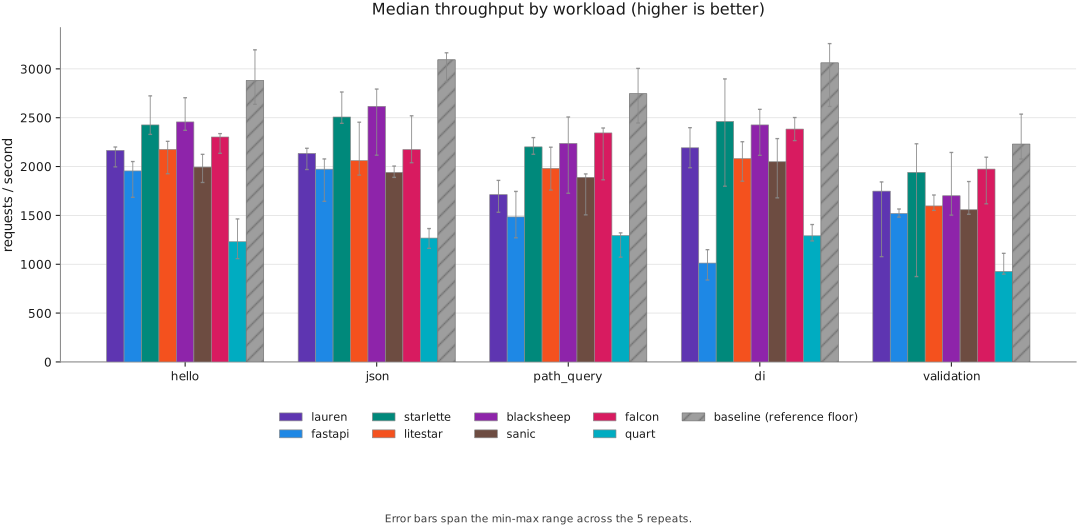
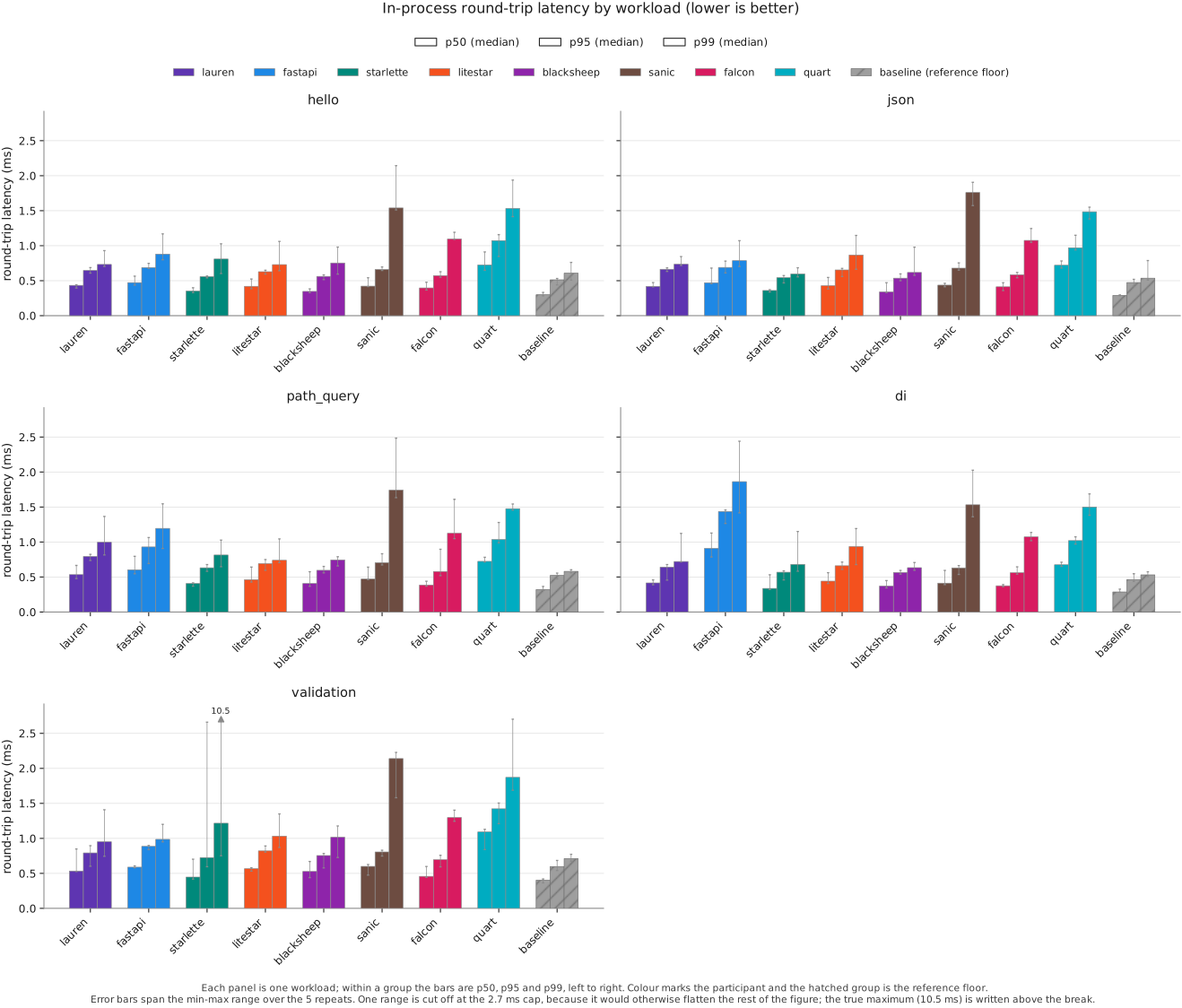
Cross-framework numbers are produced by a separate harness: benches/bench.py
drives every participant through the same workloads, one fresh process per
measurement, and writes benches/results/frameworks-inprocess.json. The figures
below are drawn straight from that committed artifact — median throughput
per workload, then the p50/p95/p99 round trip per participant — with error
bars spanning the min–max range across repeats, so the spread sits next to
the median instead of behind it. The latency error bars are capped at 2.7 ms so one
10.5 ms range cannot flatten the other workloads: that single range stops at the
cap and its true maximum is written above a break marker. The client calls
each application through
httpx.ASGITransport: no socket, no server process, no TLS. Read them as the
cost of the framework layer itself, not as a deployed-configuration number. The
full tables, the method and the pinned dependency set are on the
benchmark page.
Optional dependencies
| Package | Purpose |
|---|---|
uvicorn / hypercorn / granian |
ASGI server (none bundled — pick one) |
httpx |
Required for lauren.testing.TestClient |
orjson |
Faster JSON — auto-detected at import time |
msgspec |
Alternative fast JSON encoder via MsgspecEncoder |
python-multipart |
Required for Form[...] extractors |
Companion packages
| Package | Purpose |
|---|---|
lauren-middlewares |
CORS, rate-limit, GZip, security headers, request-id, trusted hosts, HTTPS redirect, body-size limit, timeout |
lauren-logging |
Structured logging module with processor pipeline, contextvars binding, pluggable backends (stdlib, structlog, file, fan-out) |
lauren-guards |
Auth guards: JWT bearer, API key, basic auth, OAuth2 introspection, session cookie, RBAC/ABAC, CSRF, IP allowlist |
Deployment
lauren is a standard ASGI application — deploy exactly like FastAPI or Starlette:
# Uvicorn
uvicorn main:app --host 0.0.0.0 --port 8000 --workers 4

# Granian (Rust-based, faster on CPython)
granian --interface asgi main:app --host 0.0.0.0 --port 8000

# Hypercorn (HTTP/2 + HTTP/3)
hypercorn main:app --bind 0.0.0.0:8000
Contributing
We welcome contributions of every size, from typo fixes to whole subsystems. Read first:
CONTRIBUTING.md— setup, branch & commit conventions, and the quality bar.AGENTS.md— the design invariants every PR must respect, whether the author is human or an AI agent.
uv tool install prek      # one-time
prek install              # wires up the git hook
nox                       # lint + tests + typecheck
License
MIT — see LICENSE.
1 maintainer

Metadata
1 maintainer
Release files for lauren 1.9.0
For a detailed explanation of source distributions (sdists) and built distributions (wheels), please see the package formats documentation.
Source distribution (sdist)
| File | Size | Uploaded | |
|---|---|---|---|
| lauren-1.9.0.tar.gz | 2.5 MB | Details |
Built distribution (wheel)
| File | Interpreter | ABI | Platform | Reset |
|---|---|---|---|---|
| lauren-1.9.0-py3-none-any.whl | Python 3 | none | any | Details |
Total release size: 2.8 MB
Release files / lauren-1.9.0.tar.gz
| Download URL | lauren-1.9.0.tar.gz |
|---|---|
| Size | 2.5 MB |
| Tags | Source |
|
SHA-256 checksum How to use checksums |
26dd10120e6e3974322ed350ea1ddb01a5cc633432f87c997bfa9df760e5c8f7
|
|
BLAKE2b-256 checksum How to use checksums |
88e8e705036aca5954ee79eb9e4571ebe7c56238e203e9c6b03da9da012a0105
|
| Upload date | |
|
Uploaded using Trusted Publishing? What is trusted publishing? |
Yes |
| Uploaded via |
twine/7.0.0 CPython/3.13.14
|
Provenance
Provenance describes where a file came from. On PyPI, provenance is shared via attestations, which provide a verifiable record of the build or publishing details. View details, limitations and caveats.


PyPI Publish Attestation
PyPI verified that this artifact, at this checksum, originated from the publisher listed below.
Signed by GitHub Actions, verified by PyPI on Oct 13, 2026.
Transparency logRelease files / lauren-1.9.0-py3-none-any.whl
| Download URL | lauren-1.9.0-py3-none-any.whl |
|---|---|
| Size | 314.6 kB |
| Tags | Python 3 |
|
SHA-256 checksum How to use checksums |
a34bbb514820566585fc103209952295389fa0a59186bb1a560c79d6c3aeeace
|
|
BLAKE2b-256 checksum How to use checksums |
a34dd344f212b99a8a951ec1b11bfb027a9f068148e592c10ed13a513775e76f
|
| Upload date | |
|
Uploaded using Trusted Publishing? What is trusted publishing? |
Yes |
| Uploaded via |
twine/7.0.0 CPython/3.13.14
|
Provenance
Provenance describes where a file came from. On PyPI, provenance is shared via attestations, which provide a verifiable record of the build or publishing details. View details, limitations and caveats.
PyPI Publish Attestation
PyPI verified that this artifact, at this checksum, originated from the publisher listed below.
Signed by GitHub Actions, verified by PyPI on Oct 13, 2026.
Transparency log













