
Automatic lazy import library - use common libraries without explicit import statements
Verified details
These details have been verified by PyPIProject links
GitHub Statistics
Maintainers

Project description
laziest-import




























Zero-Configuration Lazy Import Library
Import and use any installed(for the not installed, it uses pip to auto install if you permitted) module with a single line
A magical way to import Python modules - just use them!
Table of Contents
- Key Features
- Quick Start
- Installation
- Examples
- Configuration
- API Reference
- Troubleshooting
- How It Works
- Contributing
- License
Key Features
| Feature | Badge | Description |
|---|---|---|
| Lazy Loading |  |
Modules import only on first access |
| Background Index |  |
Symbol index builds in background thread |
| Auto-Correction |  |
Typo correction (nump → numpy) |
| Symbol Search |  |
Search symbols across all modules |
| Strict Mode |  |
AmbiguousSymbolError on symbol conflicts |
| Multi-Level Cache |  |
Three-tier caching for speed |
| Dependency Analysis |  |
Analyze module dependencies |
| Performance Benchmark |  |
Benchmark imports and functions |
| CLI Interface |  |
laziest-import freeze / init commands |
| 985+ Tests |  |
Comprehensive test coverage |
| 1000+ Aliases |  |
Predefined for common packages |
Installation
# Stable version
pip install laziest-import

# Pre-release version (latest features)
pip install --pre laziest-import

# From source (latest development)
pip install git+https://github.com/ChidcGithub/Laziest-import.git
Quick Start
Method 1: Wildcard Import (Recommended)
from laziest_import import *

# Data Science
arr = np.array([1, 2, 3]) # numpy
df = pd.DataFrame({'a': [1, 2]}) # pandas
plt.plot([1, 2, 3]); plt.show() # matplotlib

# Standard Library
print(os.getcwd()) # os
data = json.dumps({'key': 'value'}) # json
result = math.sqrt(16) # math

# Submodules (auto-loading)
svd_result = np.linalg.svd(matrix) # numpy.linalg.svd()
Method 2: Namespace Prefix (Recommended)
from laziest_import import lz

arr = lz.np.array([1, 2, 3])
df = lz.pd.DataFrame({'a': [1, 2]})
Method 3: Lazy Proxy (with Auto-Correction)
from laziest_import import lazy

# Automatic typo correction
arr = lazy.nump.array([1, 2, 3]) # nump -> numpy
df = lazy.pnda.DataFrame() # pnda -> pandas
arr2 = lazy.nupi.array([4, 5, 6]) # nupi -> numpy

# Submodule shortcuts
layer = lazy.nn.Linear(10, 5) # nn -> torch.nn
relu = lazy.F.relu(tensor) # F -> torch.nn.functional
Key Features
| Feature | Description |
|---|---|
| Modular architecture | Clean 13-module _api/ package for maintainability |
| Lazy loading | Modules import only on first access, reducing startup overhead |
| Lazy function loading | Symbol functions loaded on-demand for faster startup |
| Background index build | Symbol index builds in background thread |
| Symbol sharding | Large packages split into shards for faster access |
| Submodule support | np.linalg.svd() chains submodules automatically |
| Auto-discovery | Unregistered names search installed modules automatically |
| Typo correction | Misspelling auto-correction (nump → numpy, matplotlip → matplotlib) |
| Abbreviation expansion | 300+ abbreviations (nn → torch.nn, F → torch.nn.functional) |
| Fuzzy matching | Typo correction via Levenshtein distance algorithm |
| Strict mode | Raise AmbiguousSymbolError on symbol conflicts |
| CLI interface | laziest-import freeze and laziest-import init |
| Symbol location | lz.which() finds where symbols are defined |
| Auto-install | Optional: missing modules can be pip-installed automatically |
| Multi-level cache | Three-tier caching (stdlib/third-party/memory) for fast lookups |
| Cache persistence | Symbol index saved to disk with configurable TTL |
| Cache statistics | Track hits/misses and optimize performance |
| Version checking | Automatic compatibility warnings for aliases/mappings |
| Type hints support | LazySymbol.__class_getitem__ for generic type hints |
| Dependency tree analysis | lz.dependency_tree() - analyze module dependencies |
| Performance benchmarking | lz.benchmark() - benchmark functions and imports |
| Dependency pre-analysis | Scan code to predict required imports |
| Import profiler | Record module load times and memory usage |
| Environment detection | Detect virtual environments (venv/conda/virtualenv) |
| Conflict visualization | Find and display symbol conflicts across modules |
| Persistent preferences | Save/load user preferences to ~/.laziestrc |
| 1000+ aliases | Predefined aliases for common packages |
| 985+ tests | Comprehensive test coverage |
What's New
v0.1.0-pre12 (Current)
- Phase 3 — API Semantic Simplification: Flattened cache namespace —
lz.cache.clear_symbols(),lz.cache.file_info(),lz.cache.symbol_countreplace 3-level paths;lz.cache.statsnow returns a plain dict - Config Dataclass Caching: Dataclass instances (
lz.config.symbol_search,lz.config.cache, etc.) are now cached after first access with bidirectional sync to internal state - Fixed ConfigContext:
with lz.config.temp_config(debug=True):now correctly saves and restores state - 985+ tests: Comprehensive test coverage
v0.1.0-pre10
- Phase 2 —
__init__.pySlim: Collapsed from 965 to 741 lines (−23%) - Extracted
_hooks.py: Module-level hook API (add_pre_import_hook, etc.) moved to dedicated module - Extracted
_lazy_registry.py: Lazy function registration/replacement mechanism - Extracted
_analysis/: Analysis convenience functions (analyze_file,analyze_source,analyze_directory) - Simplified
__getattr__: Unified 5-step resolution chain (replaced 10-step chain) - 985+ tests: Comprehensive test coverage
v0.1.0-pre9
- Strict Mode:
lz.symbol.config.strict = True— raisesAmbiguousSymbolErroron symbol conflicts; uselz.symbol.prefer()to resolve - CLI Interface:
laziest-import freezescans source files to generateimports.laziest.json;laziest-import initcreates.laziestrc - Phase 1 API Merge: 2196-line
_api.pyrefactored into 13 files under_api/package;_public_api.pydeleted - Shorthand Alias Tests: 28 tests covering stdlib aliases, third-party aliases, bare-name lazy loading, and edge cases
- 985+ tests: Comprehensive test coverage
Examples
Symbol Search & Location
import laziest_import as lz

# Search for a symbol across all modules
results = lz.search_symbol('DataFrame')
for result in results:
 print(f"{result.module_name}.{result.symbol_name}")

# Find where a symbol is defined
loc = lz.which('sqrt')
print(f"Found at: {loc}") # numpy.sqrt

# Find all occurrences
locs = lz.which_all('sqrt')
for loc in locs:
 print(f"{loc.module_name}.{loc.symbol_name}")
Dependency Tree Analysis
import laziest_import as lz

# Analyze a module's dependency tree
tree = lz.dependency_tree('numpy', max_depth=2)
print(f"Total modules: {tree.total_modules}")
print(f"Stdlib: {tree.stdlib_count}, Third-party: {tree.third_party_count}")

# Print formatted tree
lz.print_dependency_tree(tree)
Performance Benchmarking
import laziest_import as lz

# Benchmark a function
result = lz.benchmark(
 lambda: sum(range(10000)),
 name="sum_test",
 iterations=100,
 warmup=10
)
print(f"Avg: {result.avg_time*1000:.4f}ms")
print(f"Min: {result.min_time*1000:.4f}ms")
print(f"Max: {result.max_time*1000:.4f}ms")

# Benchmark module imports
report = lz.benchmark_imports(['numpy', 'pandas', 'matplotlib'])
lz.print_benchmark_report(report)
Strict Mode (Symbol Conflict Detection)
from laziest_import import lz

# Enable strict mode
lz.symbol.config.strict = True

# Multiple modules define `sqrt` — raises AmbiguousSymbolError
# result = lz.sqrt  # Error: sqrt found in numpy, math, scipy, ...

# Use prefer() to resolve ambiguity
lz.symbol.prefer("sqrt", "numpy")
result = lz.sqrt(16)  # Now resolves to numpy.sqrt
CLI: Freeze & Init
# Scan project and freeze alias usage
laziest-import freeze

# Generate .laziestrc config file
laziest-import init
The freeze command produces imports.laziest.json — a manifest of all lazy imports used across your project, ideal for CI validation.
Auto-Install (Optional)
from laziest_import import *

# Enable auto-install
lz.enable_auto_install()

# Accessing uninstalled modules triggers installation
arr = np.array([1, 2, 3]) # If numpy missing, prompts to install
Configuration
User Configuration
import laziest_import as lz

# Create default config file
lz.create_rc_file()

# Load config
config = lz.load_rc_config()

# Get specific value
value = lz.get_rc_value('debug', default=False)

# Config info
info = lz.get_rc_info()
Cache Configuration
import laziest_import as lz

# Set custom cache directory
lz.set_cache_dir('./my_cache')

# Configure cache settings
lz.set_cache_config(
 symbol_index_ttl=3600, # Symbol index TTL: 1 hour
 stdlib_cache_ttl=2592000, # Stdlib cache TTL: 30 days
 max_cache_size_mb=200 # Max cache size: 200 MB
)

# Get cache statistics
stats = lz.get_cache_stats()
print(f"Hit rate: {stats['hit_rate']:.1%}")

# View cache status
info = lz.get_file_cache_info()
print(f"Cache size: {info['cache_size_mb']:.2f} MB")
API Reference
Alias Management
| Function | Description |
|---|---|
register_alias(alias, module_name) |
Register an alias |
register_aliases(dict) |
Register multiple aliases |
unregister_alias(alias) |
Remove an alias |
list_loaded() |
List loaded modules |
list_available() |
List all available aliases |
get_module(alias) |
Get module object |
clear_cache() |
Clear memory cache |
Symbol Search
| Function | Description |
|---|---|
enable_symbol_search() |
Enable symbol search |
disable_symbol_search() |
Disable symbol search |
search_symbol(name) |
Search for classes/functions |
rebuild_symbol_index() |
Rebuild symbol index |
which(symbol) |
Find symbol location |
which_all(symbol) |
Find all symbol locations |
Auto-Install
| Function | Description |
|---|---|
enable_auto_install() |
Enable auto-install |
disable_auto_install() |
Disable auto-install |
install_package(name) |
Install a package manually |
set_pip_index(url) |
Set mirror URL |
Cache Management
| Function | Description |
|---|---|
get_cache_version() |
Get cache version |
set_cache_config(...) |
Configure cache settings |
get_cache_config() |
Get cache configuration |
get_cache_stats() |
Get cache statistics |
reset_cache_stats() |
Reset cache statistics |
invalidate_package_cache(pkg) |
Invalidate package cache |
get_file_cache_info() |
Get file cache info |
clear_file_cache() |
Clear file cache |
set_cache_dir(path) |
Set cache directory |
Analysis & Profiling
| Function | Description |
|---|---|
analyze_file(path) |
Analyze Python file for imports |
analyze_source(code) |
Analyze source code string |
analyze_directory(path) |
Analyze all files in directory |
start_profiling() |
Start import profiler |
stop_profiling() |
Stop import profiler |
get_profile_report() |
Get profiling report |
print_profile_report() |
Print formatted report |
dependency_tree(module) |
Analyze module dependency tree |
print_dependency_tree(tree) |
Print dependency tree |
benchmark(func) |
Benchmark a function |
benchmark_imports(modules) |
Benchmark module imports |
detect_environment() |
Detect Python environment |
show_environment() |
Display environment info |
find_symbol_conflicts() |
Find symbol conflicts |
show_conflicts() |
Display conflicts table |
Preferences
| Function | Description |
|---|---|
set_symbol_preference(name, module) |
Set symbol preference |
get_symbol_preference(name) |
Get symbol preference |
clear_symbol_preference(name) |
Clear symbol preference |
save_preferences() |
Save preferences to file |
load_preferences() |
Load preferences from file |
apply_preferences(prefs) |
Apply loaded preferences |
clear_preferences() |
Clear all preferences |
Troubleshooting
Common Issues
Q: Module not found (AttributeError)
AttributeError: module 'laziest_import' has no attribute 'mymodule'
Solution: The module is not registered. Use lz.enable_auto_search() to enable auto-discovery, or register it manually:
lz.register_alias('mymodule', 'mypackage.mymodule')
Q: Slow first import The symbol index may be building. Check status with:
lz.is_index_building() # True if building
lz.wait_for_index(30) # Wait up to 30 seconds
Q: Typo correction not working Ensure the module is in the alias list:
lz.register_alias('nump', 'numpy') # Add misspelling
arr = lz.nump.array([1, 2, 3]) # Now works
Q: Symbol conflicts (same name in multiple modules) Use module hints or preferences:
lz.set_symbol_preference('DataFrame', 'pandas') # Prefer pandas
result = lz.DataFrame # Gets pandas.DataFrame
Debug Mode
Enable detailed logging:
lz.enable_debug_mode()
import laziest_import as lz
arr = lz.np.array([1, 2, 3]) # See import details in logs
Cache Issues
Clear caches if experiencing stale data:
lz.clear_cache() # Clear memory cache
lz.clear_file_cache() # Clear disk cache
lz.rebuild_symbol_index() # Rebuild symbol index
Performance Tips
- First run: ~2s to build index
- Cached run: ~0.003s (700x faster!)
- Use
lz.enable_background_build()to avoid blocking on first import - For CI/CD, set
LAZY_BG_BUILD=1to pre-build cache
How It Works
Architecture
- Proxy objects: Each alias maps to a
LazyModuleproxy - On-demand import: Real import triggers on first attribute access via
__getattr__ - Caching: Imported modules cache within the proxy object
- Chain proxies:
LazySubmodulehandles recursive lazy loading - Fuzzy search: Levenshtein distance algorithm for fault-tolerant matching
Multi-Level Cache Architecture
The library uses a three-tier caching system for optimal performance:
| Cache Level | Description | Default TTL |
|---|---|---|
| Stdlib cache | Standard library symbols | 7 days |
| Third-party cache | Installed package symbols | 24 hours |
| Memory cache | Hot cache for current session | Session |
Cache files are stored in ~/.laziest_import/cache/ and automatically:
- Expire based on TTL settings
- Clean up when exceeding size limit (default: 100 MB)
- Invalidate on Python version changes
Predefined Aliases
Data Science
np, pd, plt, sns, scipy
Machine Learning
torch, tf, keras, sklearn, xgboost, lightgbm
Deep Learning
transformers, langchain, llama_index
Web Frameworks
flask, django, fastapi, starlette
HTTP Clients
requests, httpx, aiohttp
Databases
sqlalchemy, pymongo, redis, duckdb
Cloud Services
boto3 (AWS), google.cloud, azure
Image Processing
cv2, PIL.Image, skimage
GUI
PyQt6, tkinter, flet, nicegui
DevOps
docker, kubernetes, ansible
NLP
spacy, nltk, transformers
Visualization
plotly, bokeh, streamlit, gradio
Contributing
We love contributions! Check out our Contributing Guide for more information.
How to Contribute
- Fork the repo and create your branch from
main - Read our Code of Conduct
- Make sure your code lints (
flake8) - Add tests for any new functionality
- Ensure the test suite passes (
pytest tests/) - Commit your changes
- Push to your branch and open a Pull Request!
Development Setup
# Clone the repo
git clone https://github.com/ChidcGithub/Laziest-import.git
cd Laziest-import

# Install in development mode
pip install -e ".[dev,test]"

# Run tests
pytest tests/ -v

# Run linting
flake8 laziest_import/
Good First Issues
Looking for a place to start? Check out:
- Good first issues: Issues labeled "good first issue"
- Help wanted: Issues labeled "help wanted"
Ways to Contribute
- Report bugs
- Propose new features
- Improve documentation
- Fix existing issues
- Add more tests
- Help with translations
- Design improvements
Contributors
Thanks goes to these wonderful people:

Made with contrib.rocks.
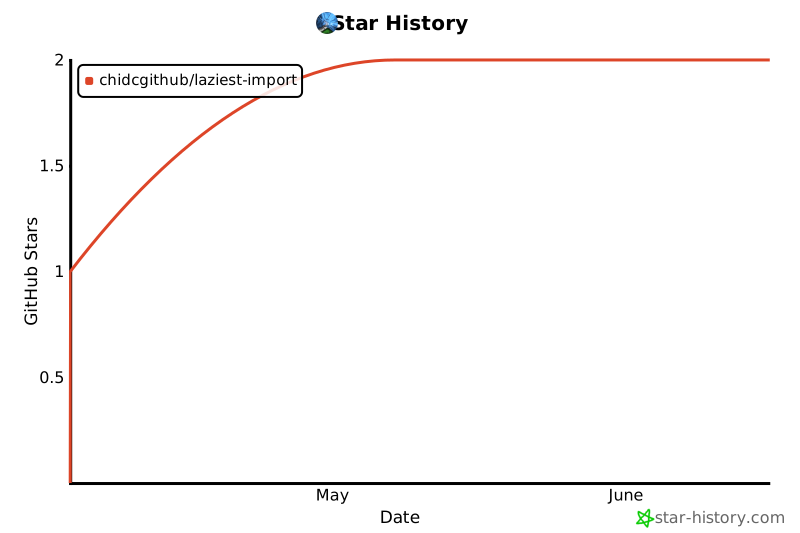
Star History
Get In Touch
- Email: (your email)
- GitHub: ChidcGithub/Laziest-import
- Discussions: GitHub Discussions
- Issues: GitHub Issues
Acknowledgments
- Thanks to all the contributors who have helped make this project better!
- Inspired by the Python community's love for clean, simple APIs
License
This project is licensed under the MIT License - see the LICENSE file for details.
Show Your Support
If you find this project useful, please consider:
- Starring this repo on GitHub
- Reporting bugs or suggesting features
- Sharing it with friends and colleagues
- Blogging about it if you use it
- Contributing to the project
Thank you!
Project details
Verified details
These details have been verified by PyPIProject links
GitHub Statistics
Maintainers
Release history Release notifications | RSS feed


Download files
Download the file for your platform. If you're not sure which to choose, learn more about installing packages.
Source Distribution
Built Distribution
Filter files by name, interpreter, ABI, and platform.
If you're not sure about the file name format, learn more about wheel file names.
Copy a direct link to the current filters
File details
Details for the file laziest_import-0.1.0rc12.tar.gz.
File metadata
- Download URL: laziest_import-0.1.0rc12.tar.gz
- Upload date:
- Size: 200.4 kB
- Tags: Source
- Uploaded using Trusted Publishing? Yes
- Uploaded via: twine/6.1.0 CPython/3.13.12
File hashes
| Algorithm | Hash digest | |
|---|---|---|
| SHA256 |
402265229e47d5619aca51590b46e3c2ae24bb84741e48ded0a13f79d7da7bed
|
|
| MD5 |
44feb24f91fe6aeff3126c6e4aecde27
|
|
| BLAKE2b-256 |
5be650949cbcc7a67049bd34b06e10ad0110516a2f2006219a80a7d43e50519c
|
Provenance
The following attestation bundles were made for laziest_import-0.1.0rc12.tar.gz:
Publisher:
build-publish.yml on ChidcGithub/Laziest-import
-
Statement:
-
Statement type:
https://in-toto.io/Statement/v1 -
Predicate type:
https://docs.pypi.org/attestations/publish/v1 -
Subject name:
laziest_import-0.1.0rc12.tar.gz -
Subject digest:
402265229e47d5619aca51590b46e3c2ae24bb84741e48ded0a13f79d7da7bed - Sigstore transparency entry: 1577116710
- Sigstore integration time:
-
Permalink:
ChidcGithub/Laziest-import@cc34e21a8ab1be9c9724ebd54ffa4fe5d5cbb82f -
Branch / Tag:
refs/tags/v0.1.0-pre12 - Owner: https://github.com/ChidcGithub
-
Access:
public
-
Token Issuer:
https://token.actions.githubusercontent.com -
Runner Environment:
github-hosted -
Publication workflow:
build-publish.yml@cc34e21a8ab1be9c9724ebd54ffa4fe5d5cbb82f -
Trigger Event:
push
-
Statement type:
File details
Details for the file laziest_import-0.1.0rc12-py3-none-any.whl.
File metadata
- Download URL: laziest_import-0.1.0rc12-py3-none-any.whl
- Upload date:
- Size: 160.3 kB
- Tags: Python 3
- Uploaded using Trusted Publishing? Yes
- Uploaded via: twine/6.1.0 CPython/3.13.12
File hashes
| Algorithm | Hash digest | |
|---|---|---|
| SHA256 |
f92b776121c534b5e6da379e06a3a0026180e7a99eec035592c2d6c9dcfc11a2
|
|
| MD5 |
0d62dd70197b4108ee480806fa5840e4
|
|
| BLAKE2b-256 |
d1301821fd2a1b442af5a3180d2e913479fa3f626da32233590997bbb686a55a
|
Provenance
The following attestation bundles were made for laziest_import-0.1.0rc12-py3-none-any.whl:
Publisher:
build-publish.yml on ChidcGithub/Laziest-import
-
Statement:
-
Statement type:
https://in-toto.io/Statement/v1 -
Predicate type:
https://docs.pypi.org/attestations/publish/v1 -
Subject name:
laziest_import-0.1.0rc12-py3-none-any.whl -
Subject digest:
f92b776121c534b5e6da379e06a3a0026180e7a99eec035592c2d6c9dcfc11a2 - Sigstore transparency entry: 1577116754
- Sigstore integration time:
-
Permalink:
ChidcGithub/Laziest-import@cc34e21a8ab1be9c9724ebd54ffa4fe5d5cbb82f -
Branch / Tag:
refs/tags/v0.1.0-pre12 - Owner: https://github.com/ChidcGithub
-
Access:
public
-
Token Issuer:
https://token.actions.githubusercontent.com -
Runner Environment:
github-hosted -
Publication workflow:
build-publish.yml@cc34e21a8ab1be9c9724ebd54ffa4fe5d5cbb82f -
Trigger Event:
push
-
Statement type:






