
Package Description


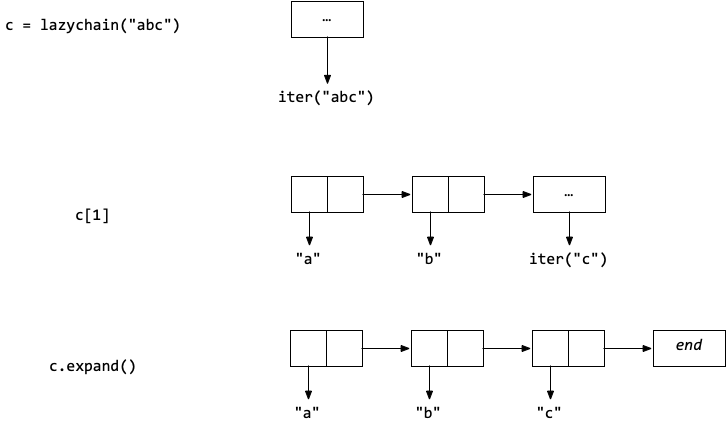
A Python library to provide "chains", which are Lisp-like singly linked lists that support the lazy expansion of iterators. For example, we can construct a Chain of three characters from the iterable "abc" and it initially starts as unexpanded, shown by the three dots:
>>> from lazychains import lazychain
>>> c = lazychain( "abc")
>>> c
chain([...])
We can force the expansion of c by performing (say) a lookup or by forcing the whole chain of items by calling expand:
>>> c[1]                   # Force the expansion of the next 2 elements.
True
>>> c
chain(['a','b',...])
>>> c.expand()             # Force the expansion of the whole chain.
chain(['a','b','c'])
Chain are typically a lot less efficient than using ordinary arrays. So, almost all the time you should carry on using ordinary arrays and/or tuples. But Chains have a couple of special features that makes them the perfect choice for some problems.
- Chains are immutable and hence can safely share their trailing segments.
- Chains can make it easy to work with extremely large (or infinite) sequences.
Expanded or Unexpanded
When you construct a chain from an iterator, you can choose whether or not it should be immediately expanded by calling chain rather than lazychain. The difference between the two is pictured below. First we can see what happens in the example given above where we create the chain using lazychain on "abc".

By contrast, we would immediately go to a fully expanded chain if we were to simply apply chain:
>>> from lazychains import chain
>>> c = chain( "abc" )
>>> c
chain(['a','b','c'])
>>>
1 maintainer

Metadata
1 maintainer
Release files for lazychains 0.3.1
For a detailed explanation of source distributions (sdists) and built distributions (wheels), please see the package formats documentation.
Source distribution (sdist)
| File | Size | Uploaded | Provenance | Actions |
|---|---|---|---|---|
| lazychains-0.3.1.tar.gz | 81.5 kB | Without provenance | Details for lazychains-0.3.1.tar.gz |
Built distribution (wheel)
| File | Interpreter | ABI | Platform | Actions Reset |
|---|---|---|---|---|
| lazychains-0.3.1-py3-none-any.whl | Python 3 | none | any | Details for lazychains-0.3.1-py3-none-any.whl |
Total release size: 100.1 kB
Release files / lazychains-0.3.1.tar.gz
| Download URL | lazychains-0.3.1.tar.gz |
|---|---|
| Size | 81.5 kB |
| Tags | Source |
|
SHA-256 checksum How to use checksums |
b20a097bcba7ffb8852802fc18a49fa8ddb1af0236729863c9dd3b615095b078
|
|
BLAKE2b-256 checksum How to use checksums |
3f5965beee97432892d6ba917a1fcb5f6a78768286314318aba212a3ac2471b4
|
| Upload date | |
|
Uploaded using Trusted Publishing? What is trusted publishing? |
Yes |
| Uploaded via |
uv/0.11.17 {"installer":{"name":"uv","version":"0.11.17","subcommand":["publish"]},"python":null,"implementation":{"name":null,"version":null},"distro":{"name":"Ubuntu","version":"24.04","id":"noble","libc":null},"system":{"name":null,"release":null},"cpu":null,"openssl_version":null,"setuptools_version":null,"rustc_version":null,"ci":true}
|
Release files / lazychains-0.3.1-py3-none-any.whl
| Download URL | lazychains-0.3.1-py3-none-any.whl |
|---|---|
| Size | 18.6 kB |
| Tags | Python 3 |
|
SHA-256 checksum How to use checksums |
38450b85c8e81cb30fc4c6c4b0836a5d1683ea777738fa9f04c20e10a92108e8
|
|
BLAKE2b-256 checksum How to use checksums |
87541f86564e669bfa598a043a9f4d24db098e840481597ad923da1593f9d82d
|
| Upload date | |
|
Uploaded using Trusted Publishing? What is trusted publishing? |
Yes |
| Uploaded via |
uv/0.11.17 {"installer":{"name":"uv","version":"0.11.17","subcommand":["publish"]},"python":null,"implementation":{"name":null,"version":null},"distro":{"name":"Ubuntu","version":"24.04","id":"noble","libc":null},"system":{"name":null,"release":null},"cpu":null,"openssl_version":null,"setuptools_version":null,"rustc_version":null,"ci":true}
|
Security for lazychains 0.3.1
Provenance
Provenance describes where a file came from. On PyPI, provenance is shared via attestations, which provide a verifiable record of the build or publishing details. View details, limitations and caveats.
No provenance found
None of the files in this release were uploaded with provenance metadata.
A note on package security
PyPI is a repository for distributing packages, not a service for auditing them. While third-party security researchers and our staff do their best to detect and remove malicious packages, PyPI cannot guarantee the quality, security or suitability of any given package.
To learn more about protecting yourself from malicious actors, visit our package security documentation.














