



Laplace-Dirichlet Rule-Based (LDRB) algorithm for assigning myocardial fiber orientations
A software for assigning myocardial fiber orientations based on the Laplace Dirichlet Ruled-Based algorithm.
Bayer, J.D., Blake, R.C., Plank, G. and Trayanova, N.A., 2012. A novel rule-based algorithm for assigning myocardial fiber orientation to computational heart models. Annals of biomedical engineering, 40(10), pp.2243-2254.(https://www.ncbi.nlm.nih.gov/pmc/articles/PMC3518842/)
# Decide on the angles you want to use
angles = dict(
    alpha_endo_lv=30,  # Fiber angle on the LV endocardium
    alpha_epi_lv=-30,  # Fiber angle on the LV epicardium
    beta_endo_lv=0,  # Sheet angle on the LV endocardium
    beta_epi_lv=0,  # Sheet angle on the LV epicardium
    alpha_endo_sept=60,  # Fiber angle on the Septum endocardium
    alpha_epi_sept=-60,  # Fiber angle on the Septum epicardium
    beta_endo_sept=0,  # Sheet angle on the Septum endocardium
    beta_epi_sept=0,  # Sheet angle on the Septum epicardium
    alpha_endo_rv=80,  # Fiber angle on the RV endocardium
    alpha_epi_rv=-80,  # Fiber angle on the RV epicardium
    beta_endo_rv=0,  # Sheet angle on the RV endocardium
    beta_epi_rv=0,  # Sheet angle on the RV epicardium
)

# Choose space for the fiber fields
# This is a string on the form {family}_{degree}
fiber_space = "P_2"

# Compute the microstructure
fiber, sheet, sheet_normal = ldrb.dolfin_ldrb(
    mesh=mesh, fiber_space=fiber_space, ffun=ffun, markers=markers, **angles
)
# Store files using a built in xdmf viewer that also works for functions
# defined in quadrature spaces
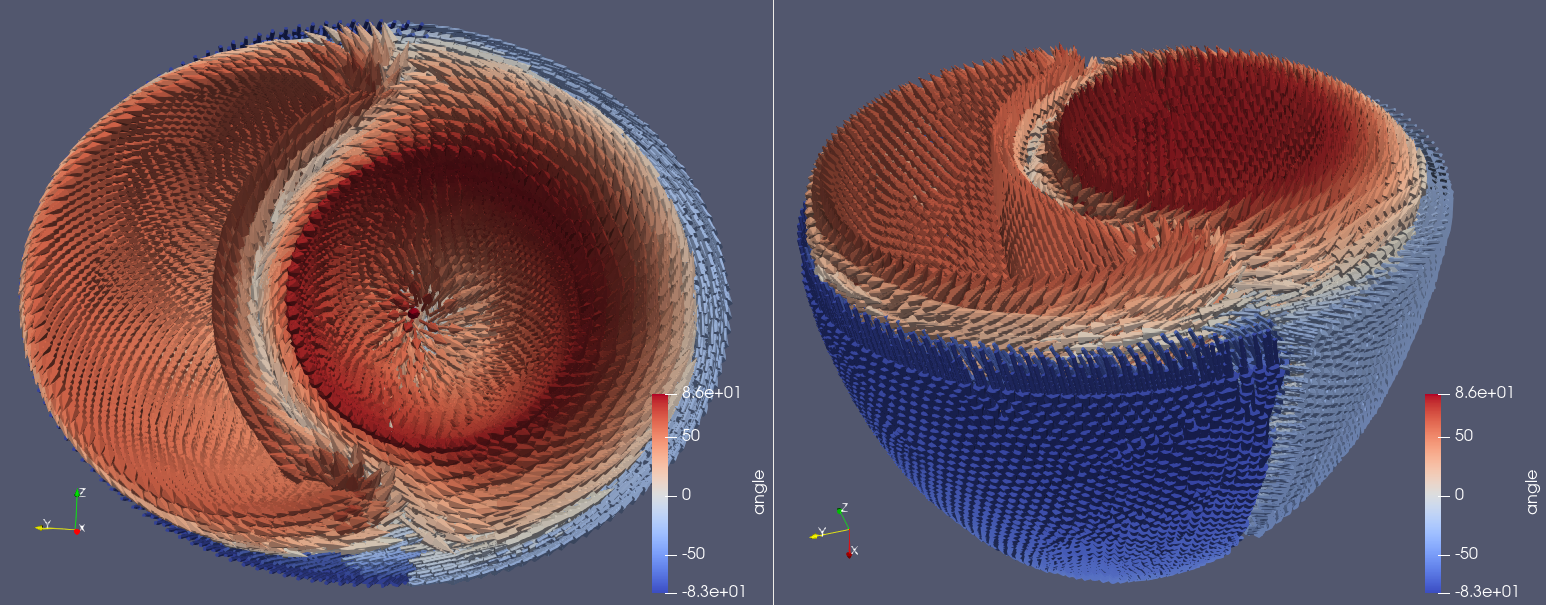
ldrb.fiber_to_xdmf(fiber, "fiber")
# And visualize it in Paraview
Installation
Install with pip
In order to install the software you need to have installed FEniCS (versions older than 2016 are not supported)
The package can be installed with pip.
python -m pip install ldrb
or if you need the most recent version you can install the source
python -m pip install git+https://github.com/finsberg/ldrb.git
Documentation
Documentation is hosted at http://finsberg.github.io/ldrb
Getting started
Check out the demos
License
ldrb is licensed under the GNU LGPL, version 3 or (at your option) any later version.
ldrb is Copyright (2011-2019) by the authors and Simula Research Laboratory.
Contributors
Henrik Finsberg (henriknf@simula.no)
1 maintainer

Metadata
1 maintainer
Release files for ldrb 2023.2.0
For a detailed explanation of source distributions (sdists) and built distributions (wheels), please see the package formats documentation.
Source distribution (sdist)
| File | Size | Uploaded | Provenance | Actions |
|---|---|---|---|---|
| ldrb-2023.2.0.tar.gz | 21.8 kB | Without provenance | Details for ldrb-2023.2.0.tar.gz |
Built distribution (wheel)
| File | Interpreter | ABI | Platform | Actions Reset |
|---|---|---|---|---|
| ldrb-2023.2.0-py3-none-any.whl | Python 3 | none | any | Details for ldrb-2023.2.0-py3-none-any.whl |
Total release size: 41.5 kB
Release files / ldrb-2023.2.0.tar.gz
| Download URL | ldrb-2023.2.0.tar.gz |
|---|---|
| Size | 21.8 kB |
| Tags | Source |
|
SHA-256 checksum How to use checksums |
83d993abc44f9cec20d87c6286e7c6a6f9a05f05a37760fb973441735670c14f
|
|
BLAKE2b-256 checksum How to use checksums |
960f9443cc87b925b02c5a30f4948bd6f7049969dea1f708eea6e89df368fdc6
|
| Upload date | |
|
Uploaded using Trusted Publishing? What is trusted publishing? |
No |
| Uploaded via |
twine/4.0.2 CPython/3.10.8
|
Release files / ldrb-2023.2.0-py3-none-any.whl
| Download URL | ldrb-2023.2.0-py3-none-any.whl |
|---|---|
| Size | 19.6 kB |
| Tags | Python 3 |
|
SHA-256 checksum How to use checksums |
44af67bdbf19f2a3f17c4a089dbbf47d92daaacac61ee27f7efed1072e170b07
|
|
BLAKE2b-256 checksum How to use checksums |
195582af83ec2e9a2a308b3dc9e9780bfa429d45873050dea9e2839cc633c4e8
|
| Upload date | |
|
Uploaded using Trusted Publishing? What is trusted publishing? |
No |
| Uploaded via |
twine/4.0.2 CPython/3.10.8
|
Security for ldrb 2023.2.0
Provenance
Provenance describes where a file came from. On PyPI, provenance is shared via attestations, which provide a verifiable record of the build or publishing details. View details, limitations and caveats.
No provenance found
None of the files in this release were uploaded with provenance metadata.
A note on package security
PyPI is a repository for distributing packages, not a service for auditing them. While third-party security researchers and our staff do their best to detect and remove malicious packages, PyPI cannot guarantee the quality, security or suitability of any given package.
To learn more about protecting yourself from malicious actors, visit our package security documentation.














