
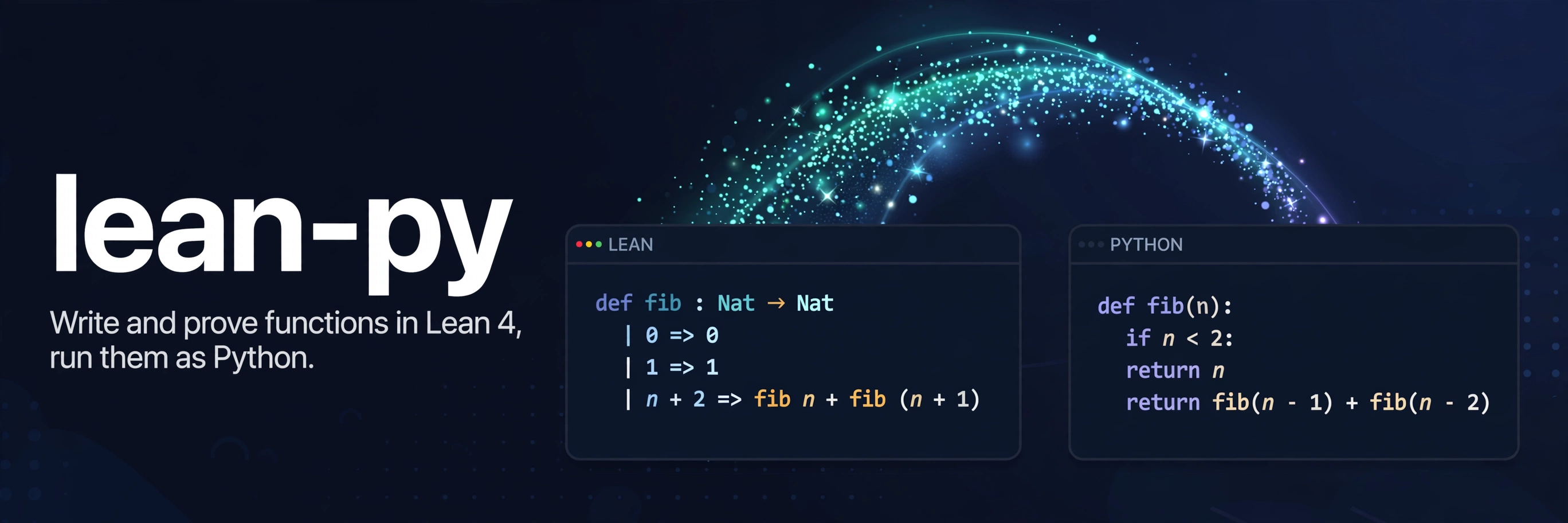
Write and prove functions in Lean 4, run them as Python





Install · Lean blocks · Values · Verifying Python functions · Examples · Performance · PyPI
leanfran
leanfran lets you write functions in Lean 4, prove theorems about them, and call them from Python
with pydantic models as arguments and results. The PyPI distribution is leanfran; you import
it as leanfran.
from pydantic import BaseModel, Field
from leanfran import lean


class LineItem(BaseModel):
    sku: str
    qty: int = Field(ge=1)
    unitPrice: int = Field(ge=0)


pricing = lean("pricing", r"""
inductive Discount where
  | none
  | percent (p : Nat) (h : p ≤ 100)
  | fixed (amount : Nat)

def subtotal (items : List LineItem) : Nat :=
  items.foldl (fun acc i => acc + i.qty * i.unitPrice) 0

def total (items : List LineItem) (d : Discount) : Nat :=
  match d with
  | .none => subtotal items
  | .percent p _ => subtotal items - subtotal items * p / 100
  | .fixed a => subtotal items - a

theorem total_le (items : List LineItem) (d : Discount) : total items d ≤ subtotal items := by
  unfold total; split <;> omega
""", models=[LineItem])

items = [LineItem(sku="a", qty=2, unitPrice=100)]
pricing.total(items, pricing.Discount.percent(p=10))  # 180
pricing.Discount.percent(p=150)                       # pydantic.ValidationError: p: Input should be less than or equal to 100
leanfran syncchecks the proofs with Lake and compiles the Lean code from Lean's IR to plain Python. It writes the generated modules to<package>/_lean/, and they ship with your package. To run them you need theleanfranwheel and pydantic. You do not need Lean.- The generated Python computes what the C backend computes. A diff test runs the same Lean
programs natively and as Python and compares the output byte for byte. The generated code keeps
reference counting, so
Arrayupdates happen in place as in C. - Lean structures and inductive types become pydantic models. A proof field (
h : p ≤ 100) becomes a validator that runs a decision procedure compiled from the proposition, so every value that reaches Lean satisfies the invariants the proofs rely on. A comparison with a constant also becomes an annotated-types constraint (Le(100)) that pydantic-core checks and the JSON Schema shows. The JSON of the models is the JSON of Lean'sderiving ToJson, FromJson. - Lean code can use your own pydantic models (
models=[...]). Their field constraints (ge,gt,le,lt,min_length,max_length) become proof fields that Lean proofs may assume. - The models work wherever pydantic does:
TypeAdapter,model_validate_json, JSON Schema, FastAPI request and response types. @modelbinds a plain Python function to Lean specifications.leanfran checktranslates the function to Lean and judges your proofs (Verifying Python functions).
Install
The Python package and the Lean CLI:
uv add leanfran                            # the runtime, lean(), leanfran sync
nix profile install 'github:conao3/lean-leanfran?dir=Python'   # the Lean CLI `leanfran-python`
leanfran sync also needs lake and the Lean toolchain of lean-toolchain (v4.35.0) on PATH.
Lean blocks
lean(name, source, *, imports=(), uses=(), models=()) defines a Lean block of the calling module,
which must belong to a package. The block's definitions live in the namespace
LeanPythonEmbed.<module>.<name>. The returned module exposes them under their names relative to it
(Discount.percent, total).
leanfran sync --package src/myapp
leanfran sync imports every module of the package, writes each block to a Lake workspace in
.leanfran/workspace/, builds it, and generates src/myapp/_lean/<module>__<name>.py and
src/myapp/_lean/blocks.json. Lean errors point at the Python file:
leanfran: src/myapp/m.py:6: error: (lean block m, Lean 4:28) Tactic `rfl` failed: ...
Add .leanfran/ to .gitignore and commit <package>/_lean/.
At run time lean(...) compares a hash of the block (its source, imports, uses, the Lean structures
of its models and the generator version) with blocks.json. If the block changed since the last
sync, it raises LeanBlockStale. With LEANFRAN_PYTHON_AUTO_SYNC=1 it runs leanfran sync instead.
imports=["Std.Data.HashMap"]: Lean modules to import.uses=["geometry"]: other blocks of the module (or"pkg.mod:name") to import and open. The block shares their types and does not generate them again.models=[LineItem]: pydantic models available as Lean structures (below).
Values
| Lean | Python |
|---|---|
Nat |
int (leanfran.types.Nat = Annotated[int, Ge(0)]) |
Int |
int |
UInt8 … UInt64, USize, Int8 … Int64 |
int with the range as Ge/Le |
Fin n |
Annotated[int, Ge(0), Lt(n)] |
Bool |
bool |
Char |
str of one character |
String |
str |
Float, Float32 |
float |
Unit |
None |
Option α |
α | None |
List α, Array α |
list[α] |
α × β |
tuple[α, β] |
{x : α // p x} |
Annotated[α, AfterValidator(p)] |
| structure | a frozen, strict pydantic model |
| inductive type, constructors without arguments | enum.StrEnum |
| other inductive type | a model per constructor, subclasses of the type's class |
IO α |
α; an IO.Error is raised as LeanIOError (an OSError) |
The generated functions check arguments while they convert them: pub.double(-1) raises
ValidationError with the location of the bad value. Constants are functions without arguments
(answer()).
Constructors and structures take keyword arguments (Shape.rect(width=1, height=2)); unnamed
constructor arguments are a0, a1, …. Inductive values work with match:
match shape:
    case geometry.Shape.rect(width=w, height=h):
        ...
JSON
The JSON of a generated model is the JSON of Lean's derived ToJson: a structure is an object, a
constructor without arguments is its name ("dot"), a constructor with named arguments is
{"rect": {"width": 1, "height": 2}}, with unnamed arguments {"num": 7} or {"pair": [1, "x"]}.
tests/test_json.py compares the generated models with a native Lean program that prints toJson.
Your pydantic models in Lean
models=[LineItem] writes a Lean structure for each model (and the models its fields use) to the
namespace LeanPythonModels.<python module>, and the block opens that namespace:
structure LineItem where
  sku : String
  qty : Nat
  qty_ge : 1 ≤ qty
  unitPrice : Nat
int with a lower bound of at least 0 becomes Nat; the other bounds and min_length/max_length
become proof fields. Field types:
int,bool,str,float,list[T],tuple[...],T | None, other models- enums: an inductive type
LeanPythonModels.<module>.<Enum>with a constructor per member Literal["a", "b"]:LeanPythonLiterals.<module>.<Model>_<field>- unions of models:
LeanPythonUnions.<module>.<Model>_<field>, a constructor per model holding it asval
Lean proofs cannot assume multiple_of, pattern or validators; the structure's docstring lists
them. Generated functions take and return your classes. Values that skipped validation
(model_construct) go through validation again on the way to Lean.
Verifying Python functions
@model binds a typed, pure Python function to specifications written in a Lean block. The function
stays ordinary Python. leanfran check translates it to Lean and checks your proofs, and
check_model runs the same specifications as a Hypothesis property test.
from leanfran import lean
from leanfran.verify import model

spec = lean("spec", r"""
def clampSpec (x lo hi : Int) : Int := max lo (min hi x)
def ordered (_x lo hi : Int) : Bool := lo ≤ hi
def inRange (_x lo hi : Int) (r : Int) : Bool := lo ≤ r && r ≤ hi
""")

@model(refines=spec.clampSpec, requires=spec.ordered, ensures={"in_range": spec.inRange})
def clamp(x: int, lo: int, hi: int) -> int:
    if x < lo:
        return lo
    if x > hi:
        return hi
    return x
leanfran check --package calc writes the translation and one obligation per specification:
def LeanPythonModel.calc.calc.clamp (x : Int) (lo : Int) (hi : Int) : Int := Id.run do
  if ((decide (x < lo))) then
    return lo
  if ((decide (x > hi))) then
    return hi
  return x

abbrev LeanPythonModel.calc.calc.clamp.obligation.refines : Prop :=
  ∀ (x : Int) (lo : Int) (hi : Int), ordered x lo hi = true → clamp x lo hi = clampSpec x lo hi
Then it judges the theorems <function>.proof.<label> of lean/Proofs/*.lean next to
pyproject.toml:
import LeanPythonModel.calc.calc
open LeanPythonEmbed.calc.spec.spec
namespace LeanPythonModel.«calc».«calc»

theorem clamp.proof.refines : clamp.obligation.refines := by
  intro x lo hi h
  simp only [ordered, decide_eq_true_eq] at h
  simp only [clamp, clampSpec]
  split <;> (try split) <;> simp_all <;> omega
proved     calc.calc:clamp refines
proved     calc.calc:clamp in_range
sorry      calc.calc:sum_to refines
missing    calc.calc:sum_abs nonneg
Under simp, a for loop over a list becomes List.foldl (forIn_pure_yield_eq_foldl), so you
prove a loop by induction on the list (tests/verify/lean/Proofs/Calc.lean proves sum_abs).
The states:
| state | meaning |
|---|---|
proved |
the theorem holds |
sorry |
the proof uses sorry |
axioms |
the proof uses non-standard axioms |
failed |
the proof file does not build |
missing |
no theorem for the obligation |
mismatch |
the theorem states something else |
unextracted |
the obligation's statement is not defined |
With --require proved, leanfran check exits with 254 unless every obligation is proved. It
writes the result to leanfran.lock with a hash of each function's source. leanfran status
reads the lock file without Lean and marks changed functions stale.
refines=s:f x = s x(Except.ok (s x)for a function that may fail);requires=p:p x = true →before each obligation;ensures={"label": q}:q x (f x) = true. A function annotated-> Natalso getsreturns_nat(0 ≤ f x).- The translation:
intisInt(aNatparameter is aNatconverted toInton entry); statements become Leandonotation (let mut,for,while,break,continue, earlyreturn); indexing,//,%,assertandraisemake the function returnPy.M α = Except Py.Exc α, with Python's negative indices and floor division (LeanPythonLib.Py). Supported:int,bool,str,float,list,tuple,T | None, pydantic models (as the Lean structures ofmodels=),len,abs,min,max,sum, list comprehensions,appendon local lists, and calls of other@modelfunctions of the module. check_model(f)/check_module(m)generate arguments from the annotations (pydantic constraints included), skip those failingrequires, and compare withrefinesandensures.
Examples
samples/ holds Python packages with Lean
blocks. make samples syncs each one, runs it, and compares the output with its expected.txt.
| sample | shows |
|---|---|
| word-count | strings and lists, a proof by induction |
| roman-numerals | a round-trip theorem checked for every number below 1000 (decide +kernel) |
| todo-cli | an invariant over a list kept by every operation, JSON storage, tampered JSON rejected |
| pricing-api | FastAPI with a pydantic model and a Lean inductive type as request body, 422 for invalid input |
samples/steps/ introduces one
feature at a time, from functions on Nat (01) to types shared between blocks with uses= (09).
The CLI
The Python package installs leanfran:
leanfran sync --package <dir> [--leanfran-python <path>]
leanfran check --package <dir> [--leanfran-python <path>] [--require proved]
leanfran status --package <dir>
--leanfran-python defaults to $LEANFRAN_PYTHON_CLI, then leanfran-python on PATH. The Lean CLI
leanfran-python does the compilation:
leanfran-python module generate --module-name <Name> [--roots <Name> ...] [--namespace <Name>]
  [--import <Name> ...] [--search-path <dir> ...] [--output-file <path>] [--internal-only]
  [--output json|text] [--type-module <Name>=<module> ...] [--model-module <Name>=<module> ...]
  [--batch <file>]
leanfran-python obligations check --modules <Name> ... --obligations <file> [--search-path <dir> ...]
leanfran-python --version | --generator-version | help
module generate writes one Python module with the IR of the roots and of everything they call
(Init and Std included), and public functions and types for the roots. It reports the definitions it
cannot expose (polymorphic functions, functions over functions) as skipped. Both CLIs use the exit
codes 0 success, 252 invalid parameters, 254 input that cannot be converted, 255 other errors.
Performance
make bench (CPython 3.14, x86_64; the native column is the C backend):
| workload | n | Python (s) | native C (s) |
|---|---|---|---|
Array.push, set!, sum |
10⁴ | 0.017 | 0.005 |
Array.push, set!, sum |
10⁵ | 0.179 | 0.006 |
Array.push, set!, sum |
10⁶ | 1.796 | 0.017 |
fib (loop) |
10⁵ | 0.176 | 0.074 |
naiveFib |
25 | 0.149 | 0.005 |
String.push |
10⁴ | 0.012 | 0.005 |
String.push |
10⁵ | 0.227 | 0.006 |
Array.qsort |
10⁵ | 1.929 | 0.020 |
Passing 10⁴ models to a Lean function takes 0.036 s (pydantic's TypeAdapter(list[Model]) validates
10⁴ dicts in 0.009 s).
Development
nix develop -c make check   # treefmt, the diff tests against the C backend, pytest, the samples
nix develop -c make bench
LeanPython/EmitPy.lean: IR → Python.LeanPython/Marshal.lean,LeanPython/Generate.lean: public types and functions.LeanPython/Check.lean:obligations check.Main.lean: the CLI.src/leanfran/runtime.py,io_externs.py: the runtime (lean_*are the C names of Lean's externs).marshal.py,types.py: pydantic types.embed.py,sync.py,models.py,cli.py:lean(...)andleanfran sync.verify.py,translate.py,check.py:@modelandleanfran check;lean/LeanPythonLib/Py.leanholds Python's semantics in Lean.LeanPythonTest/: Lean programs of the tests;test-diff.shrunsVectorsandIonatively and as Python.
Limitations
- leanfran does not expose polymorphic functions, functions taking or returning functions, or
Thunk/Task/IO.Ref/ByteArrayin public signatures. They still run inside Lean code. Tasks run synchronously.- Building a
StringwithString.pushcopies the string each time (Pythonbytes), so it grows quadratically. - The translation of Python functions covers the subset above; the guarantee is partial correctness.
License
1 maintainer

Metadata
1 maintainer
Release files for leanfran 0.6.0
For a detailed explanation of source distributions (sdists) and built distributions (wheels), please see the package formats documentation.
Source distribution (sdist)
| File | Size | Uploaded | Provenance | Actions |
|---|---|---|---|---|
| leanfran-0.6.0.tar.gz | 50.0 kB | With provenance | Details for leanfran-0.6.0.tar.gz |
Built distribution (wheel)
| File | Interpreter | ABI | Platform | Actions Reset |
|---|---|---|---|---|
| leanfran-0.6.0-py3-none-any.whl | Python 3 | none | any | Details for leanfran-0.6.0-py3-none-any.whl |
Total release size: 105.5 kB
Release files / leanfran-0.6.0.tar.gz
| Download URL | leanfran-0.6.0.tar.gz |
|---|---|
| Size | 50.0 kB |
| Tags | Source |
|
SHA-256 checksum How to use checksums |
865914e5a43af87788f298682a9bf9911205499ca4c71532b49c7fcbba33fbb9
|
|
BLAKE2b-256 checksum How to use checksums |
29d40db9137245e322ef5461e28d76f6dfa33870e181b453a57b7d5c14435222
|
| Upload date | |
|
Uploaded using Trusted Publishing? What is trusted publishing? |
Yes |
| Uploaded via |
twine/7.0.0 CPython/3.13.16
|
Provenance
Provenance describes where a file came from. On PyPI, provenance is shared via attestations, which provide a verifiable record of the build or publishing details. View details, limitations and caveats.


PyPI Publish Attestation
PyPI verified that this artifact, at this checksum, originated from the publisher listed below.
Signed by GitHub Actions, verified by PyPI on Nov 13, 2026.
Transparency logRelease files / leanfran-0.6.0-py3-none-any.whl
| Download URL | leanfran-0.6.0-py3-none-any.whl |
|---|---|
| Size | 55.5 kB |
| Tags | Python 3 |
|
SHA-256 checksum How to use checksums |
9717912ee04adf86fa72cd3258001cf60b802e7e93a4d00a1dfa2b952acaeaa3
|
|
BLAKE2b-256 checksum How to use checksums |
31545799e15dcd8bafffd25828e92fccd09202a73db2eaa5a6018e0653621d00
|
| Upload date | |
|
Uploaded using Trusted Publishing? What is trusted publishing? |
Yes |
| Uploaded via |
twine/7.0.0 CPython/3.13.16
|
Provenance
Provenance describes where a file came from. On PyPI, provenance is shared via attestations, which provide a verifiable record of the build or publishing details. View details, limitations and caveats.
PyPI Publish Attestation
PyPI verified that this artifact, at this checksum, originated from the publisher listed below.
Signed by GitHub Actions, verified by PyPI on Nov 13, 2026.
Transparency logSecurity for leanfran 0.6.0
Provenance
Provenance describes where a file came from. On PyPI, provenance is shared via attestations, which provide a verifiable record of the build or publishing details. View details, limitations and caveats.
Full provenance
Both files in this release have been uploaded with provenance metadata.
Attestation for leanfran-0.6.0.tar.gz
PyPI Publish Attestation
PyPI verified that this artifact, at this checksum, originated from the publisher listed below.
Signed by GitHub Actions, verified by PyPI on Nov 13, 2026.
Transparency logA note on package security
PyPI is a repository for distributing packages, not a service for auditing them. While third-party security researchers and our staff do their best to detect and remove malicious packages, PyPI cannot guarantee the quality, security or suitability of any given package.
To learn more about protecting yourself from malicious actors, visit our package security documentation.













