
learnc: auto-tune the magic numbers in your C code


Every C codebase is full of hand-picked constants: thresholds, tables, weights, cutoffs. learnc tunes them from data and gives you back the same C file with better numbers. No rewrite, no runtime library, no neural network in production. Just a smaller diff.
learnc tune score.c --data examples.pt --tune encoder.h:YQT,UVQT --out tuned/
Results on real, unmodified C code
| Code | What learnc tuned | Result on data it never saw |
|---|---|---|
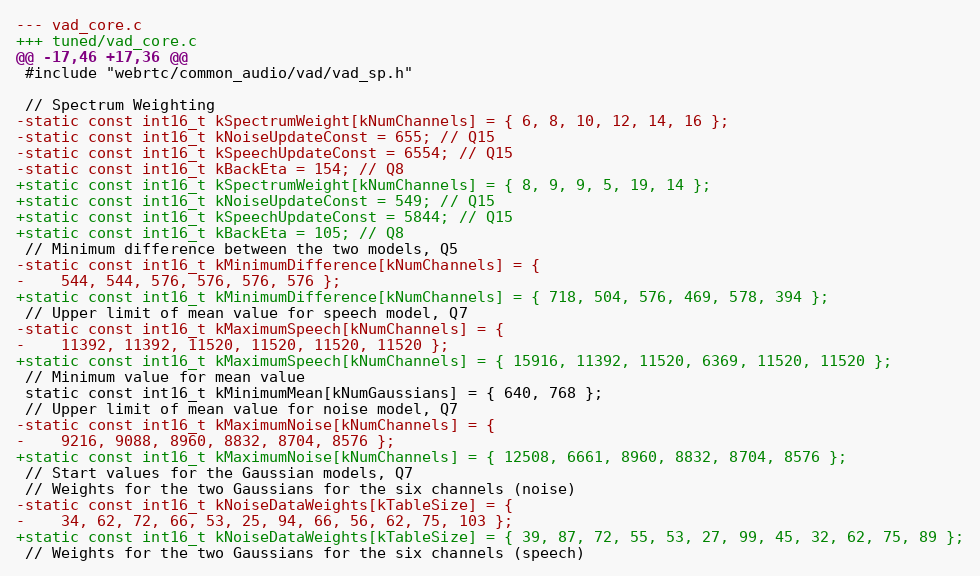
| JPEG encoder (stb_image_write.h) | 128 numbers in its quantization tables | 9.1% smaller files at equal quality (SSIM), vs 2.7% for mozjpeg's tables. Standard JPEG: every decoder reads it |
| Google's WebRTC voice activity detector | every constant in vad_core.c |
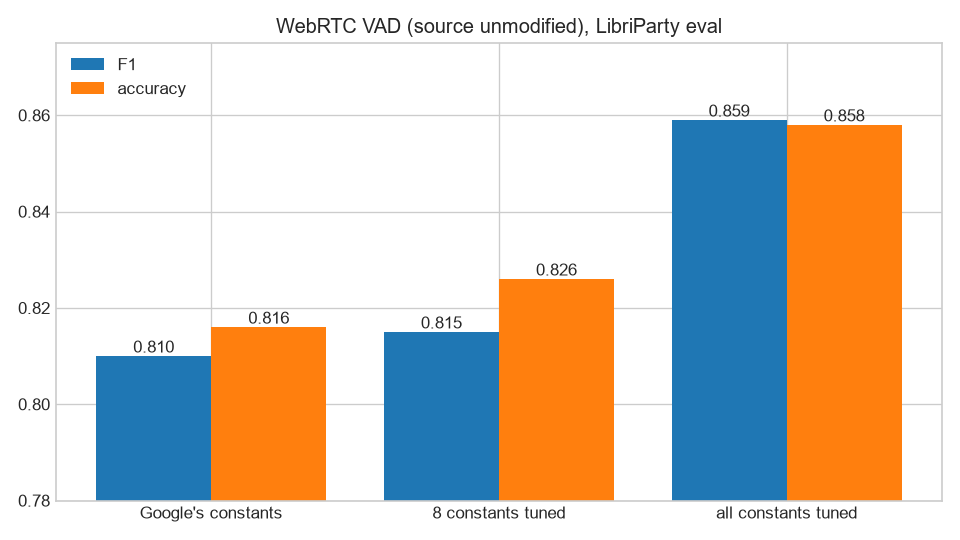
F1 0.810 to 0.859, accuracy 0.816 to 0.858 on LibriParty |
| A 2x2 matrix product | 84 coefficients | rediscovers a 7-multiplication Strassen-type algorithm from examples alone |
| Sorting networks | which elements each step compares | finds provably optimal networks for 4 and 5 inputs |
Each result runs on a laptop CPU in minutes and is reproducible from examples/.
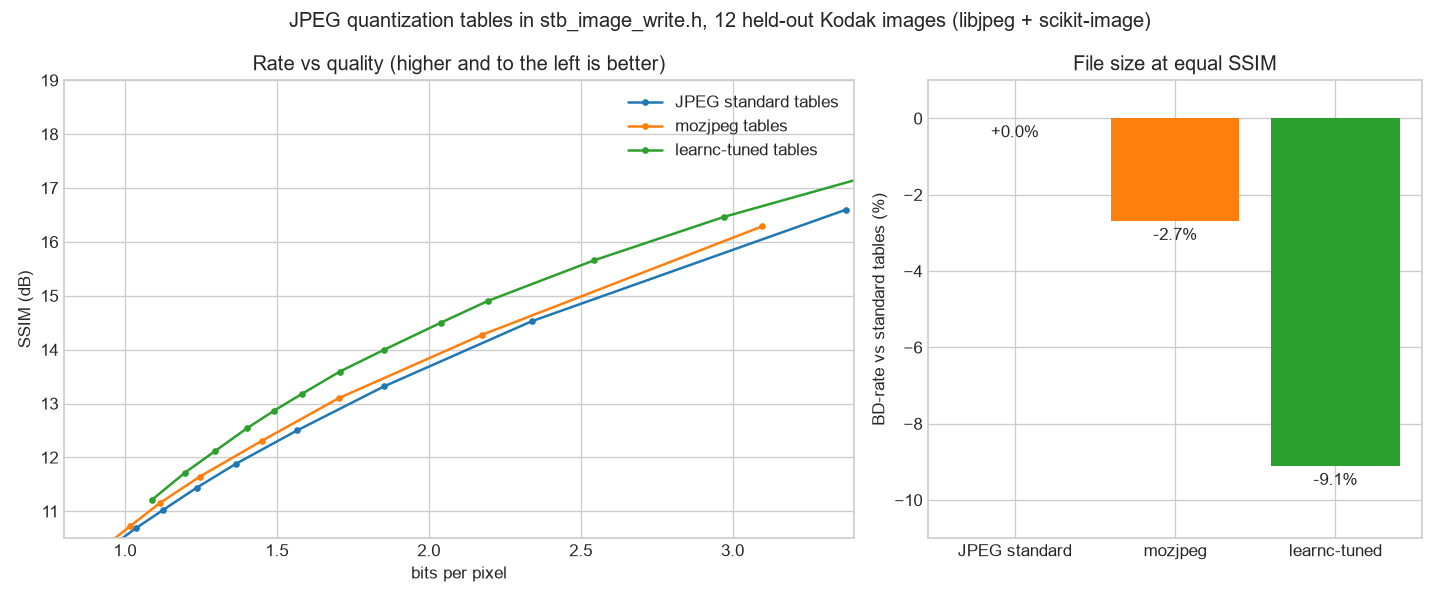
The output is your own file with new numbers. Here is the start of the diff learnc wrote for Google's WebRTC VAD:
Why learnc
- Works on code you already have. Point it at constants by name: file-level,
staticinside a function, or in a header. Your files are never touched; tuned copies differ only in the numbers that changed. - Any C that compiles. Pointers, structs,
malloc, files,qsortcallbacks,sscanf, libraries without source. If clang and gcc can build it, learnc can tune it. - Optimise what you actually care about. Your score function returns a number: an error rate, a file size, a latency, a match against expected outputs. learnc minimises it.
- Safe for production. Held-out validation with early stopping, a pull toward the original values, and a final pass that reverts every change that doesn't help. The diff holds only what matters.
- Zero runtime cost. The output is plain C with constants. Ship it with any compiler, on any platform.
Use cases
- Compression: JPEG/WebP quantization tables, zlib match parameters, codec rate-control constants
- Audio and signal processing: voice activity detection thresholds, noise suppression, filter coefficients
- Heuristics: cache sizes, cutoffs in sort and search, scoring weights, retry and backoff constants
- Control: PID gains, physics and simulation parameters
- Embedded and fixed-point code: Q-format constants tuned as whole numbers, kept in their original types
- Small models written as C: rules, decision structures and tiny networks that compile to dependency-free C
Install
pip install learnc
learnc also needs clang, llvm-link and gcc on your system:
sudo apt install clang llvm gcc        # Debian / Ubuntu
brew install llvm gcc                  # macOS (add $(brew --prefix llvm)/bin to PATH)
Python 3.10+. PyTorch and NumPy are installed with it. To work on learnc itself:
git clone https://github.com/devanmolsharma/learnc && cd learnc
pip install -e ".[dev]" && pytest
Quick start: tune existing code
-
See what can be tuned:
learnc constants encoder.c --cflags "-I include"
-
Write a score function that takes ONE example and returns a number to minimise (or a result to match):
#include "encoder.h"
double score(const unsigned char image[256 * 256 * 3], int quality) {
    return compressed_size(image, quality) / reference_size(image, quality);
}
-
Tune and review the diff:
learnc tune score.c --data train.pt --tune encoder.c:kTable,kThreshold --source encoder.c --out tuned/
diff encoder.c tuned/encoder.c
From Python:
import learnc
r = learnc.tune("score.c", [images, qualities], sources=["encoder.c"],
                constants={"encoder.c": ["kTable", "kThreshold"]})     # or "all"
print(r.report())               # held-out loss before and after, every changed constant
r.write("tuned/")               # your files with the new numbers, plus TUNING_REPORT.txt
Every run ends with a report of what changed and how much it helped on held-out data (WebRTC VAD, all constants):
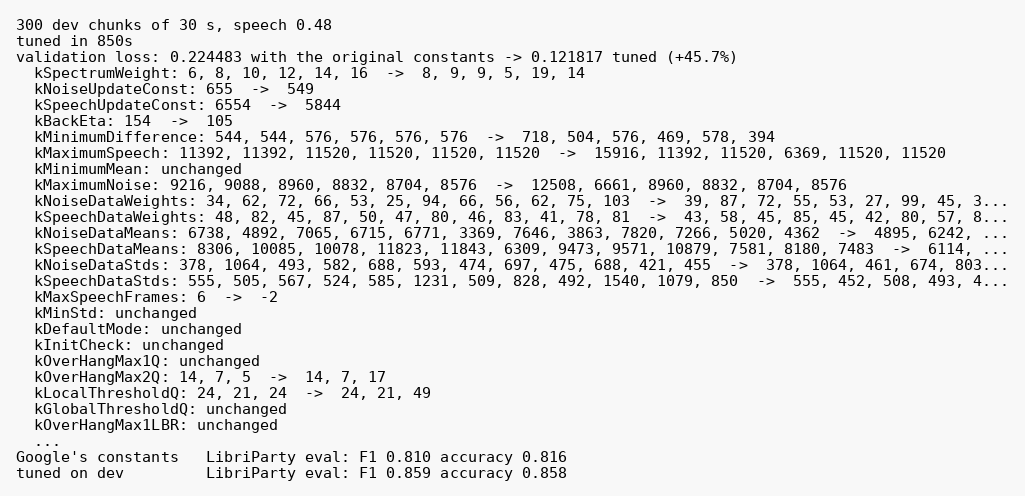
Read the diff before you ship it. learnc optimises exactly what you score. In the WebRTC example it set
kMaxSpeechFrames to -2, which makes the detector always use its long hangover. That is valid C and it helped on
held-out data, but it is a change in behaviour.
Quick start: write programs with learned values
Mark the values you can't work out by hand as learned, and learnc fits them to input/output examples:
#include <learnc.h>

learned float w1[32][784];                   // numbers to learn
learned float b1[32];
learned float w2[10][32];
learned float b2[10];

int classify(const float px[784]) {          // the structure is just C
    float h[32];
    for (int j = 0; j < 32; j++) {
        float s = b1[j];
        for (int i = 0; i < 784; i++) s += w1[j][i] * px[i];
        h[j] = s > 0 ? s : 0;
    }
    int best = 0; float best_score = -1e30f;
    for (int d = 0; d < 10; d++) {
        float s = b2[d];
        for (int j = 0; j < 32; j++) s += w2[d][j] * h[j];
        if (s > best_score) { best_score = s; best = d; }
    }
    return best;
}
learnc fit mlp.c --data train.pt --val test.pt     # writes mlp.trained.c
gcc -O2 -c mlp.trained.c                           # learnc is no longer needed
96.4% on MNIST after 2.4 minutes on a CPU, and the gcc build of mlp.trained.c gives the same answer as the
trained model on all 10,000 test images.
| Declaration | Learns |
|---|---|
learned float w[...] |
real numbers: weights, thresholds, coefficients |
learned_num int k = 8; |
a whole number tuned smoothly and rounded: sizes, counts, fixed-point constants |
learned_in(lo, hi) int k[...] |
a choice among lo..hi: an index, a count, a switch case. This learns which operation, input or rule to use |
learned_of(1, 2, 4, 8) int k; |
a choice from a list of numbers |
learned_op(ADD, SUB, MUL) op[3]; |
operators (ADD, SUB, MUL, DIV, MAX, MIN, LEFT, RIGHT), applied with learnc_apply(op[k], a, b) |
Examples
| Example | What is learned | Result |
|---|---|---|
tune_jpeg/ |
JPEG quantization tables of the unmodified stb encoder | 9.1% smaller at equal SSIM (libjpeg, held-out Kodak); 12.2% at equal PSNR |
tune_webrtc_vad/ |
constants of Google's unmodified WebRTC VAD | F1 0.810 to 0.859 on LibriParty eval |
mnist/ |
7,850 or 25,450 weights | 92.3% (linear) and 96.4% (MLP) on MNIST |
count/ |
a counting rule, trained on lengths 1 to 10 | 97.1% exact on lengths 40 to 64; a neural network on the same data gets 0% |
rules/ |
which features a 2-of-3 rule reads, directions, thresholds | recovers the hidden rule |
formula/ |
inputs and operators of a formula | recovers (x3 + x0) * (x1 - x2) exactly in 11 s |
discover/ |
Strassen-type matrix product, sorting networks | finds exact and optimal algorithms |
More detail on JPEG, including the results by bitrate: examples/tune_jpeg. The gain is at medium and high quality (1 to 4 bits per pixel); at very low bitrates there is none.
How it works
- Compile to LLVM IR. clang compiles your program and any sources it uses.
- Pick an engine.
Programchooses automatically, andp.native_reasontells you why:- Differentiable runner: the IR executes in PyTorch with one example per lane, so gradients are exact. Branches, loops and recursion run per example; fixed loop nests run vectorised.
- Flat memory runner: adds byte-addressed memory per example for pointers in data, linked structures,
malloc, structs and function pointers. Gradients are still exact. - Native engine: for anything else that compiles. Your program is built and run as is; gradients are estimated from native runs (central differences, antithetic random perturbations, sampling for choices) in forked worker processes, so a crash in C becomes an error message.
- Fit. Adam or L-BFGS for real values. Comparisons that depend on learned values become soft while training,
and an
ifthat depends on them runs both sides and blends them. Whole-number choices are relaxed or sampled, then polished exactly. - Write C. The values are written back into a copy of your file.
The runners are checked against the natively compiled program example by example, including floating-point sums.
Command line
learnc constants lib.c                   # constants of existing code that can be tuned
learnc tune entry.c --data d.pt --tune lib.c:NAME,NAME --source lib.c [--minimize] [--out tuned/]
learnc show prog.c                       # entry function and learned variables
learnc fit prog.c --data train.pt [--val test.pt] [--steps N --lr X --batch B]
learnc run prog.c --data test.pt
Data is a .pt file (torch.save) holding a dict with one tensor per parameter of the entry function, examples
along the first dimension, plus output with the expected results when there is something to match.
Limits
- The native engine suits tens to a few hundred constants, not neural-network-sized weight sets.
- Coupled constants can stall. When two constants compensate for each other, the tuner can settle where
neither alone improves. More
restartshelp. #defineconstants can't be tuned yet, because they are not variables. Constants declared as variables (static const int k = ...) can.- In the differentiable runners, gradients don't pass through float-to-int conversions or branches that never rejoin, and loops with data-dependent branches run step by step, which is slower.
- Discovery needs several starts and works for small cases.
FAQ
Does learnc change my source files? No. It writes tuned copies to the folder you choose.
Is there a runtime dependency? No. The output is plain C with different constants.
Is this a neural network? No. Your program keeps its structure; only the numbers you name change. You can
also write small models in C with learned variables when you want one.
How is overfitting handled? 20% of your examples are held out by default, the best values on them are kept, and any change that doesn't help on them is reverted.
License
1 maintainer

Metadata
1 maintainer
Release files for learnc 0.1.1
For a detailed explanation of source distributions (sdists) and built distributions (wheels), please see the package formats documentation.
Source distribution (sdist)
| File | Size | Uploaded | |
|---|---|---|---|
| learnc-0.1.1.tar.gz | 74.5 kB | Details |
Built distribution (wheel)
| File | Interpreter | ABI | Platform | Reset |
|---|---|---|---|---|
| learnc-0.1.1-py3-none-any.whl | Python 3 | none | any | Details |
Total release size: 139.5 kB
Release files / learnc-0.1.1.tar.gz
| Download URL | learnc-0.1.1.tar.gz |
|---|---|
| Size | 74.5 kB |
| Tags | Source |
|
SHA-256 checksum How to use checksums |
a7568d8b0351418d3aab8b5ebcbe8a98acc356548417a1b761aed718bc2dbe54
|
|
BLAKE2b-256 checksum How to use checksums |
90d357cbd29c3f7d828ad5db7d851eb326d7f691e060d341153dcf065c970bda
|
| Upload date | |
|
Uploaded using Trusted Publishing? What is trusted publishing? |
No |
| Uploaded via |
twine/7.0.0 CPython/3.13.6
|
Release files / learnc-0.1.1-py3-none-any.whl
| Download URL | learnc-0.1.1-py3-none-any.whl |
|---|---|
| Size | 65.0 kB |
| Tags | Python 3 |
|
SHA-256 checksum How to use checksums |
66a38589b5541a5909780a6edfaee0884f7de3bfcf91c7acfe0193e6fe0e69c9
|
|
BLAKE2b-256 checksum How to use checksums |
c803329574a9c7561391df95a7435209da831ad4bb1e6b7aa878ad9a85d16363
|
| Upload date | |
|
Uploaded using Trusted Publishing? What is trusted publishing? |
No |
| Uploaded via |
twine/7.0.0 CPython/3.13.6
|














