
Kapso
A Knowledge-grounded framework for Autonomous AI/ML Program Synthesis and Optimization
Learn more · Join Discord · Website




If you like this project, please support us by giving it a star ⭐
News
-
🏆 IOAI² Grand Master Trophy at IOAI 2026: competing fully autonomously in the AI Model Track of the International Olympiad in AI, Kapso surpassed the best human contestant and ranked top 3 among all AI system participants, a field spanning major AI labs and startups.
-
Beats the best foundation model on RelBench: on Stanford's benchmark for predictive ML over enterprise data, Kapso passes KumoRFM-v2 in outcome prediction and forecasting, and the best reported results in recommendations. Published results live on the official RelBench leaderboard.
-
Leeroopedia MCP Integration: Kapso now connects to Leeroopedia MCP — your ML & Data Knowledge Wiki. Learnt by AI, built by AI, for AI. A centralized playbook of best practices and expert-level knowledge for Machine Learning and Data domains. Kapso agents use it during ideation and implementation to search knowledge, build plans, diagnose failures, and more.
-
Moltbook Agents 🦞: Build AI agents that optimize other agents and debate on Moltbook! Get started →
-
Technical Report: Our technical report is now available! Read the paper
-
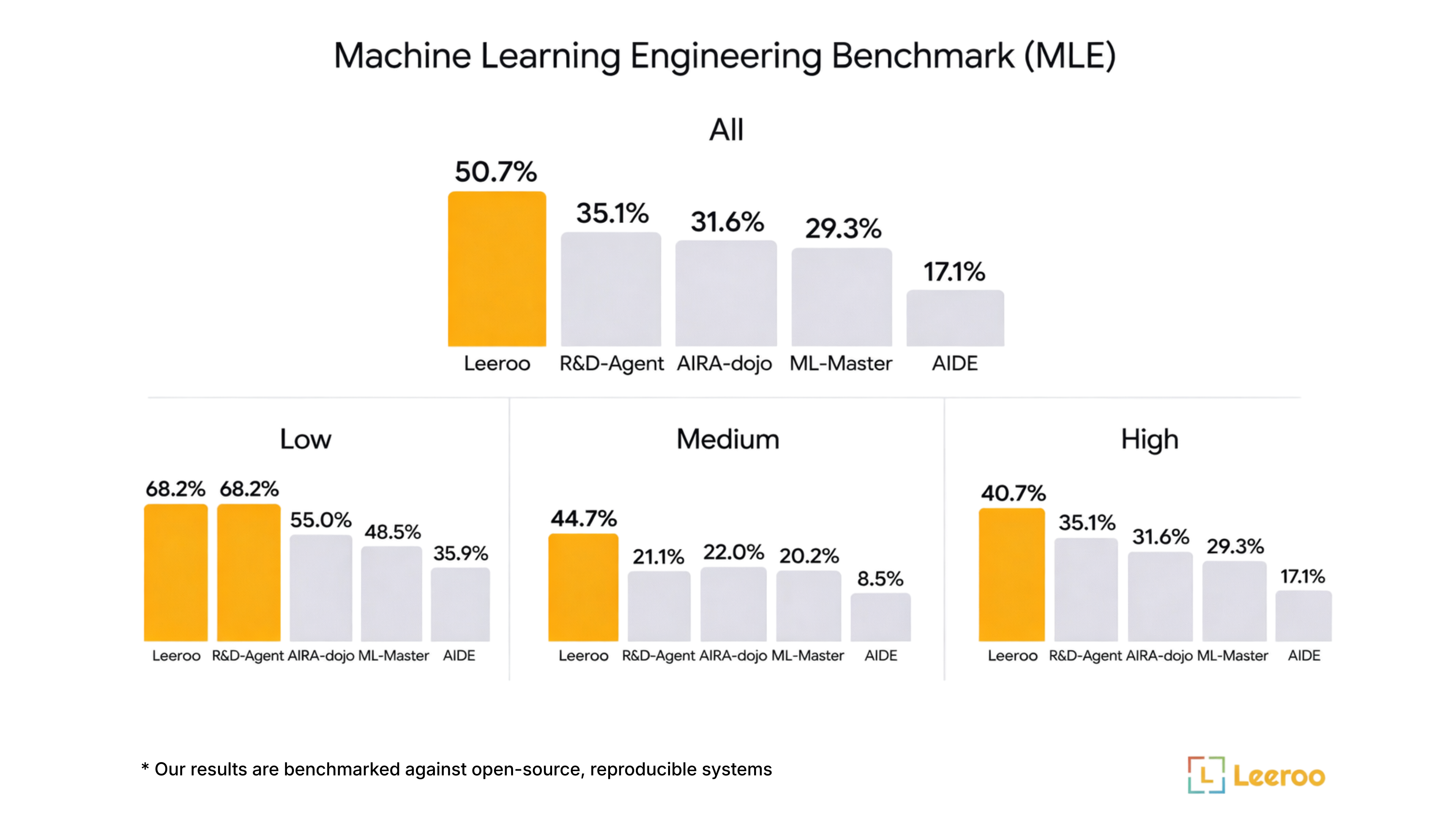
#1 on MLE-Bench: KAPSO achieved top ranking among open-source systems on Kaggle ML competitions (MLE Benchmark).
-
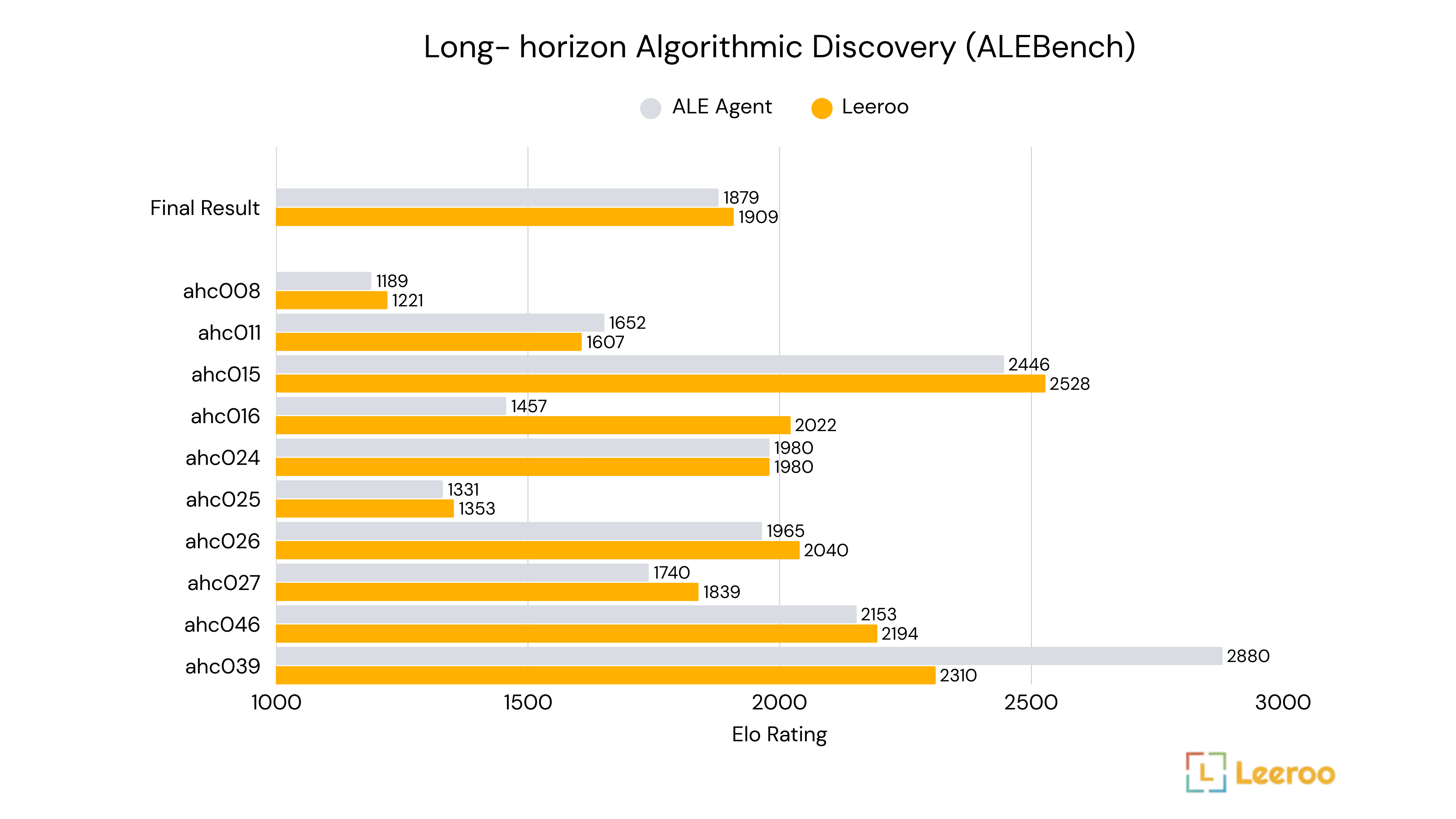
#1 on ALE-Bench: KAPSO achieved top ranking on long-horizon algorithmic discovery problems (ALE Benchmark).

What is KAPSO?
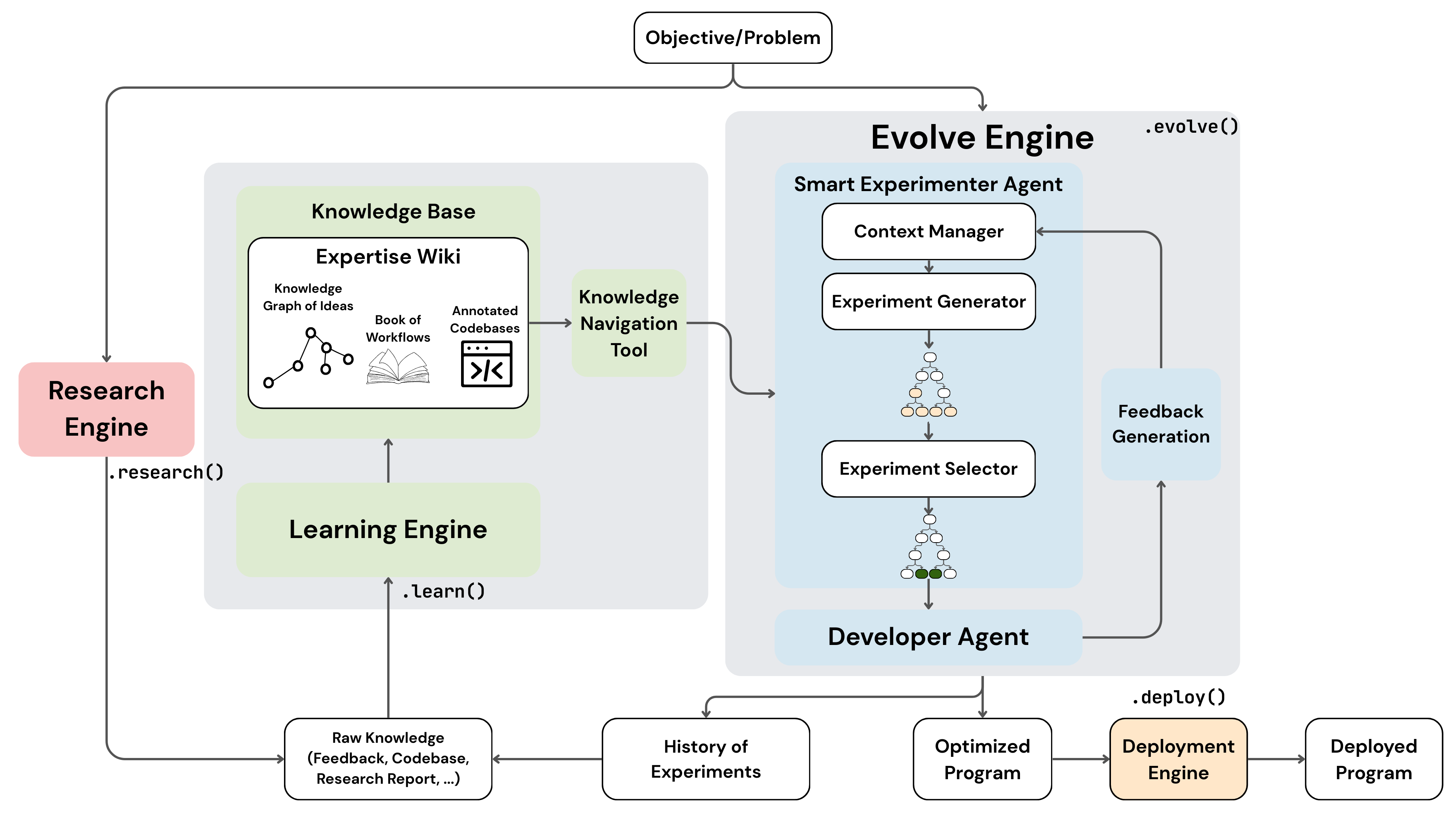
KAPSO combines iterative experimentation with a knowledge base of best practices and tricks to discover ML/AI code improvements.
It automates the cycle of designing, testing, and refining algorithms, eventually adapting the optimized solution for deployment on your chosen infrastructure.
The Four Pillars
| Pillar | Method | Description |
|---|---|---|
| Evolve | .evolve() |
Run iterative experiments to build software for a goal. Uses tree search, coding agents, and KG context to generate and refine solutions. |
| Learn | .learn() / .learn_knowledge() |
Two memories: learn() mines your own finished campaigns into evidence-priced knowledge cards (experience); learn_knowledge() ingests repositories and research into the Knowledge Graph (imported knowledge). |
| Research | .research() |
Run deep web research to gather ideas and implementation references. Returns structured findings you can feed into the knowledge base or use as context for evolving solutions. |
| Deploy | .deploy() |
Turn a solution into running software. Supports local execution, Docker containers, or cloud platforms like Modal. |
🚀 Quickstart
Installation
1. Prerequisites. Kapso runs its inference through coding-agent CLIs (there is no direct-API fallback), so you need Node.js and both agent CLIs logged in before anything works:
# Node.js 18+ (https://nodejs.org), then:
npm install -g @openai/codex            # research, judging, utilities
codex login

npm install -g @anthropic-ai/claude-code  # ideation + implementation (default mode)
claude auth login
Add an OpenAI key for embeddings (memory and knowledge-search indexing):
echo 'OPENAI_API_KEY=sk-...' >> .env
2. Install the package (Python 3.10+):
pip install leeroo-kapso
3. Verify the setup:
kapso doctor
doctor checks the CLIs, their logins, and the key, and tells you the
exact fix for anything missing. The optional items it reports (docker,
Weaviate, Neo4j) matter only for the knowledge-graph features below.
Knowledge-graph backends (optional) — learn_knowledge() and
kg_index store into local Weaviate + Neo4j. From a source checkout:
bash scripts/start_infra.sh # starts both via docker
From source (for development)
git clone https://github.com/leeroo-ai/kapso.git
cd kapso

conda create -n kapso python=3.12 && conda activate kapso
pip install -e .
The legacy aider adapter is an extra (pip install "leeroo-kapso[aider]",
Python <3.13); the default claude/codex agents need no extras.
Leeroopedia MCP (optional) — connect Kapso to Leeroopedia, a curated ML/AI knowledge base. Sign up at leeroopedia.com for an API key, then:
pip install leeroopedia-mcp
echo 'LEEROOPEDIA_API_KEY=kpsk_your_key_here' >> .env
Basic Usage
The core loop needs nothing beyond the prerequisites above:
from kapso import Kapso

kapso = Kapso()   # no knowledge graph needed to start

# Evolve: build a solution through experimentation. The campaign prints
# `status: <path>` at launch — watch it live from another terminal with
#     kapso watch ./campaign
solution = kapso.evolve(
    goal="Optimize the model in train.py; target accuracy > 0.80 on evaluate.py",
    initial_repo="./my_project",         # or omit to start from scratch
    output_path="./campaign",
    time_budget_minutes=120,
)
print(solution.explain())

# Learn from the campaign you just ran: mine the trajectory, grade the
# lessons, and bank evidence-priced knowledge cards.
lesson = kapso.learn(solution)
print(lesson.explain())

# Evolve again — with `learning.serving.enabled: true` in your config,
# the next campaign is served the cards it just earned.
solution2 = kapso.evolve(goal="...", output_path="./campaign2")
With the knowledge-graph backends running, you can also import outside knowledge and serve it to campaigns:
from kapso import Kapso, Source

kapso = Kapso()

# Research the web, then ingest findings + a repository into the KG
findings = kapso.research(
    "RLHF and DPO fine-tuning for legal contract analysis",
    mode=["idea", "implementation"],
)
kapso.learn_knowledge(
    Source.Repo("https://github.com/huggingface/trl"),
    findings.ideas,
    findings.implementations,
    wiki_dir="data/wikis",
)

# Campaigns on this Kapso now consult the knowledge graph automatically
solution = kapso.evolve(goal="Fine-tune Llama-3.1-8B for clause risk classification")
And to turn a solution into running software:
from kapso import DeployStrategy

deployed = kapso.deploy(solution, strategy=DeployStrategy.LOCAL)
result = deployed.run({"input": "data"})
deployed.stop()
For detailed integration steps, see the Quickstart and Installation guides.
Examples
| Example | Description |
|---|---|
| CUDA Optimization | Optimize CUDA kernels for GPU performance |
| PyTorch Optimization | Cut wall-clock and memory — fuse ops, kill sync points and host-device chatter, saturate the GPU without changing numerics |
| ML Model Development | End-to-end delivery of prediction models — data prep, features, training, and validation evolved into a deployable artifact |
| Harness Optimization | Evolve the harness around a model — prompts, decoding, parsing, and scoring tuned against a measurable target |
| Agent Optimization | Agents improving agents — workflows, tools, and prompts evolved until the metric climbs |
Supported Benchmarks
| Benchmark | Description |
|---|---|
| MLE-Bench | OpenAI's ML-engineering benchmark — full competitions across tabular, vision, text, and audio, from raw data to graded submission |
| ALE-Bench | Sakana AI's algorithmic-optimization benchmark — design, implement, and iterate contest heuristics over hours-long searches |
| RelBench | Stanford's benchmark for predictive ML over enterprise data — forecasting, classification, and recommendation straight from the multi-table databases of SAP, Amazon, H&M, and more |
| IOAI 2026 | Timed olympiad ML across vision, language, and optimization — expert-set tasks, contest hardware, zero human help |
📚 Documentation & Support
- Full Documentation: docs.leeroo.com
- Community: Discord
- Website: leeroo.com
Contributing
We welcome contributions! Please see our Contributing Guide for details on how to get started.
Citation
If you use Kapso in your research, please cite:
@misc{nadaf2026kapsoknowledgegroundedframeworkautonomous,
      title={KAPSO: A Knowledge-grounded framework for Autonomous Program Synthesis and Optimization},
      author={Alireza Nadafian and Alireza Mohammadshahi and Majid Yazdani},
      year={2026},
      eprint={2601.21526},
      archivePrefix={arXiv},
      primaryClass={cs.AI},
      url={https://arxiv.org/abs/2601.21526},
}
1 maintainer

Release files for leeroo-kapso 0.3.4
For a detailed explanation of source distributions (sdists) and built distributions (wheels), please see the package formats documentation.
Source distribution (sdist)
| File | Size | Uploaded | |
|---|---|---|---|
| leeroo_kapso-0.3.4.tar.gz | 1.3 MB | Details |
Built distribution (wheel)
| File | Interpreter | ABI | Platform | Reset |
|---|---|---|---|---|
| leeroo_kapso-0.3.4-py3-none-any.whl | Python 3 | none | any | Details |
Total release size: 2.8 MB
Release files / leeroo_kapso-0.3.4.tar.gz
| Download URL | leeroo_kapso-0.3.4.tar.gz |
|---|---|
| Size | 1.3 MB |
| Tags | Source |
|
SHA-256 checksum How to use checksums |
832e37feb0e8af70665a43e4097fb9a123a6b593aba347102ff8dab8faec41c8
|
|
BLAKE2b-256 checksum How to use checksums |
8003016a12529102420b4119b65eb8f73d64efec1a1a0262a17c427feba3f8b5
|
| Upload date | |
|
Uploaded using Trusted Publishing? What is trusted publishing? |
No |
| Uploaded via |
twine/7.0.0 CPython/3.12.12
|
Release files / leeroo_kapso-0.3.4-py3-none-any.whl
| Download URL | leeroo_kapso-0.3.4-py3-none-any.whl |
|---|---|
| Size | 1.5 MB |
| Tags | Python 3 |
|
SHA-256 checksum How to use checksums |
ad604b1ab455612e6f68442d69c3723152cac0d9d2a7b3c1989170fac627b052
|
|
BLAKE2b-256 checksum How to use checksums |
d450a0ae43c11a53a9a2286b4b1796ee6ce1fbfe95413aa314fdf014469f64af
|
| Upload date | |
|
Uploaded using Trusted Publishing? What is trusted publishing? |
No |
| Uploaded via |
twine/7.0.0 CPython/3.12.12
|














