
$\texttt{lenscat}$




A public and community-contributed catalog of known strong gravitational lenses.
Quickstart
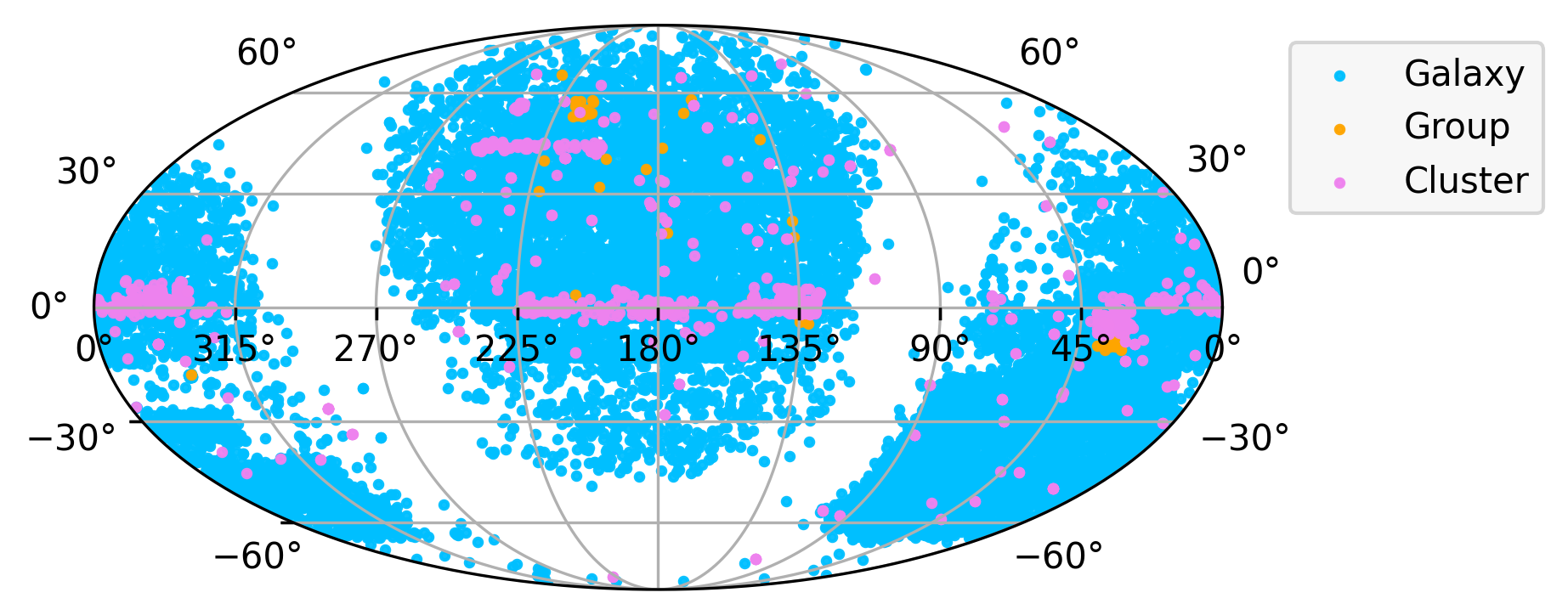
The catalog is available as a plain csv file under lenscat/data/catalog.csv. Alternatively, one can interact with the catalog using a web app (mobile-friendly).
We also provide a python package lenscat, available in pypi. Simply do
pip install lenscat
to install the latest version. Here we adopt the continuous deployment paradigm (similar to astroquery). Whenever there is a change in the catalog content, or a major change in the code, a new release will be available instantaneously on both GitHub and PyPI.
The code converts the catalog in the csv file into a custom Catalog object that is inherited from the Table object in astropy. To access the catalog, simply run
import lenscat; lenscat.catalog
and this will show a formatted table to the output. For example,
<Catalog length=32838>
                                       name                                            RA      DEC                zlens               type   grading
                                                                                      deg      deg
                                      str479                                        float64  float64              str234              str7     str9
---------------------------------------------------------------------------------- --------- -------- ------------------------------ ------ ---------
                                                                        J0011-0845   2.83435  -8.7643                              - galaxy confident
                                                                        J0013+5119  3.348077  51.3183                              - galaxy confident
                                                                               ...       ...      ...                            ...    ...       ...
                          SDSS J153713.2+655621 | SDSS J1537+6556 | SDSSJ1537+6556   234.305 65.93913        0.251 | 0.2595 | 0.2595  group  probable
HERMES J105750.9+573026 | 5438733 | DESI-164.4623+57.5071 | HERMESJ105751.1+573027 164.46256 57.50734 0.6 | 0.64259666 | 0.643 | nan  group  probable
Note that the code will try to assign the unit for each of the columns inferred from its name, and that it will hide the 'ref' column by default. One can show or hide the 'ref' column by calling .show_ref() and .hide_ref() on the Catalog object respectively.
Every Catalog object supports three features: basic searching with .search(), crossmatching with a skymap with .crossmatch(), and visualizing with .plot(). Note that these function will return a Catalog object, and hence they can be composed together (e.g., .crossmatch().search()).
Basic searching
This feature is implemented as .search(). One can search/filter by any combination of
- ranges of right ascension (specified as
RA_range=(RA_min, RA_max)) - ranges of declination (specified as
DEC_range=(DEC_min, DEC_max)) - ranges of lens redshift if available (specified as
zlens_range=(zlens_min, zlens_max)) - type of the lenses (specified as
lens_type) - grading of the lenses (specified as
grading)
For example, to get a list of the cluster-scale lenses which are confidently identified and with a redshift $z_{\mathrm{lens}} \geq 1$ together with the reference, run
import lenscat, numpy
lenscat.catalog.search(grading="confident", lens_type="cluster", zlens_range=(1,numpy.inf)).show_ref()
The output would be something like
<Catalog length=5>
      name            RA         DEC      zlens    type   grading                                                 ref
                     deg         deg
     str479        float64     float64    str234   str7     str9                                                str1587
---------------- ----------- ------------ ------ ------- --------- -------------------------------------------------------------------------------------------------
   021118-042729   32.827087    -4.458069   1.02 cluster confident https://arxiv.org/abs/2004.00634 https://arxiv.org/abs/1109.1821 https://arxiv.org/abs/1504.05587
   023100-062139     37.7516      -6.3608   1.17 cluster confident                                                                  https://arxiv.org/abs/2002.01611
   220859+020655    332.2495       2.1153   1.04 cluster confident                                                                  https://arxiv.org/abs/2002.01611
SPT-CLJ0356-5337 59.08672611 -53.63073944 1.0359 cluster confident                                              Moustakas et al. (2012) - adsabs:2012hst..prop12833M
IDCSJ1426.5+3508   216.63729     35.13989   1.75 cluster confident                                              Moustakas et al. (2012) - adsabs:2012hst..prop12833M
Crossmatching with a skymap
This feature is implemented as .crossmatch(). This function is simply a wrapper to the crossmatch() function in ligo.skymap which performs the cross-matching of a gravitational-wave (GW) skymap with a given list of coordinates. For example, to cross-match the GW skymap of GW170814 (download from here) with only galaxy-scale lenses in the lenscat catalog, simply run
import lenscat
lenscat.catalog.search(lens_type="galaxy").crossmatch("GW170814_skymap.fits.gz")
Running this will give
<CrossmatchResult length=31755>
         name             RA       DEC       zlens      type  grading  searched probability   searched area
                         deg       deg                                                             deg2
        str479         float64   float64     str234     str7    str9         float64             float64
--------------------- --------- --------- ------------ ------ -------- -------------------- ------------------
DESI-047.5128-44.2451  47.51275 -44.24506        0.278 galaxy probable 0.019409452342101355  0.383583423787917
DESI-047.1501-45.3903  47.15012 -45.39029        0.683 galaxy probable  0.03333914444622844 0.6720906143292572
                  ...       ...       ...          ...    ...      ...                  ...                ...
  NSCS J145222+081201 223.09342   8.20025 not measured galaxy probable   0.9999999999999997  41252.96124941707
DESI-225.5679+15.1661 225.56792   15.1661     0.551534 galaxy probable   0.9999999999999997  41252.96124941707
The cross-matching can be done to the sky localization from any type of transients as long as it is in the FITS format. For example, to cross-match the localization of GRB 240229A (download from here), simply run
import lenscat
lenscat.catalog.crossmatch("glg_healpix_all_bn240229588.fit")
In this case, the output would be
<CrossmatchResult length=32838>
         name              RA         DEC        zlens      type   grading  searched probability   searched area
                          deg         deg                                                               deg2
        str479          float64     float64      str234     str7     str9         float64             float64
--------------------- ----------- ----------- ------------ ------ --------- -------------------- ------------------
DESI-199.7131+16.3005   199.71308    16.30045        0.783 galaxy  probable   0.0780098544673723 3.1473511695418765
DESI-199.0121+15.7349   199.01208    15.73486        0.336 galaxy  probable  0.08790310861826113 3.5669979921474595
                  ...         ...         ...          ...    ...       ...                  ...                ...
           J0113+4549    18.26925    45.81806 not measured galaxy  probable                  1.0  41038.10207619734
            Q0957+561 0.336666667 55.89705556        0.356 galaxy confident                  1.0  41038.10207619734
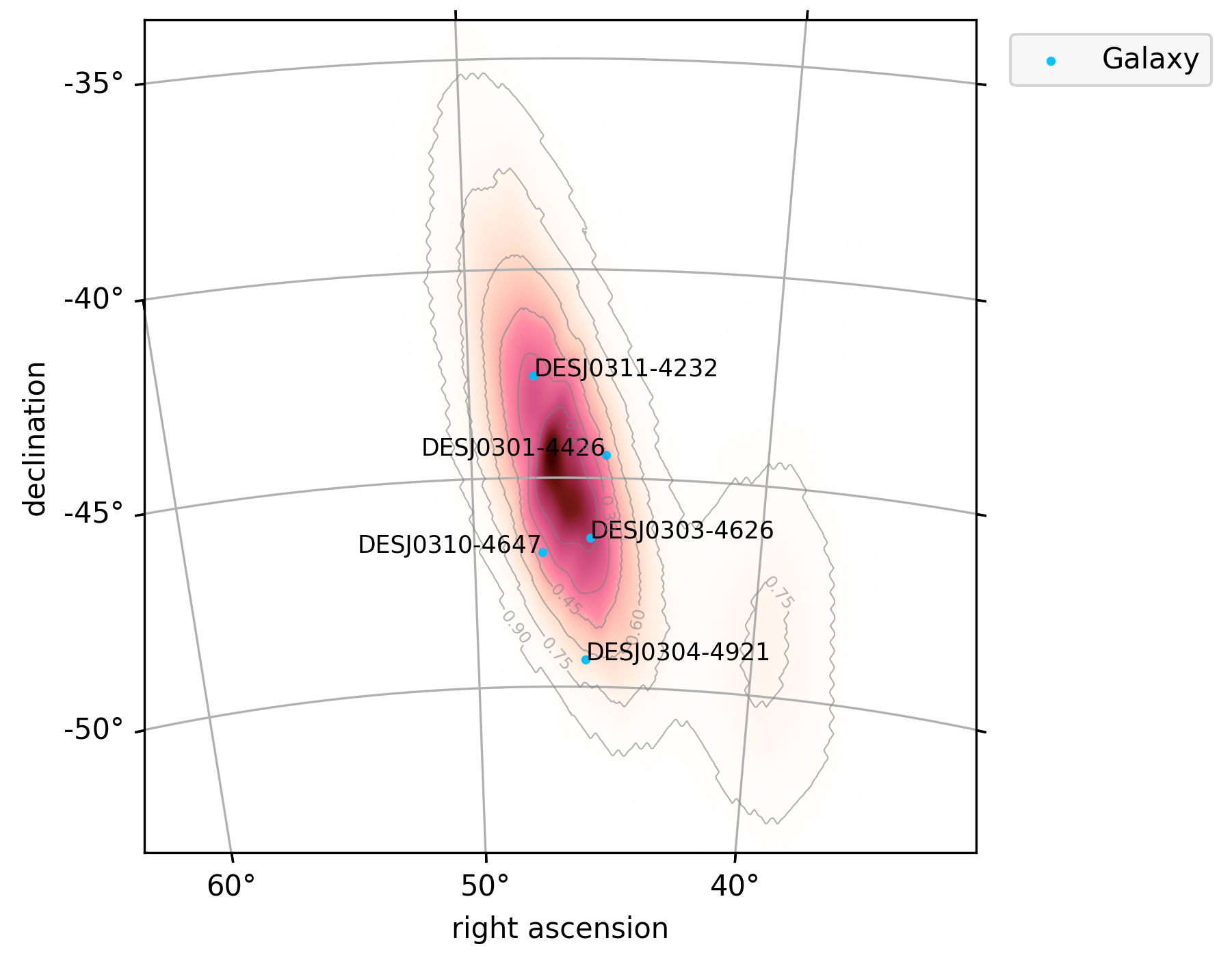
To generate a visualization of a crossmatching result, simply invoke .plot() to a crossmatching result. For example,
import lenscat
lenscat.catalog.crossmatch("GW170814_skymap.fits.gz").plot(searched_prob_threshold=0.7)
will generate a figure like this
Format
| Column name | Description |
|---|---|
name |
Names of galaxies/galaxy clusters |
RA [deg] |
Right ascension in dergees |
DEC [deg] |
Declination in degress |
zlens |
Lens redshift (if known) |
type |
Type of lens (i.e. galaxy or galaxy cluster). Eithergalaxy, group or cluster. |
grading |
Grading whether it is a confidently identified lens or a probable lens (see individual references for internal grading systems). Either confident or probable. |
ref |
Reference to the corresponding catalog or study |
References
lenscat makes use of the LaStBeRu catalog, which should be cited as “R. Alves de Oliveira, J. P. C. França, M. Makler, The Last Stand Before Rubin: a consolidated sample of strong lensing systems in wide-field surveys, in prep.".
This catalog also contains the known strong lenses from the following studies:
-
(COSMOS) LensFlow: A Convolutional Neural Network in Search of Strong Gravitational Lenses
-
Survey of Gravitationally-lensed Objects in HSC Imaging (SuGOHI) Candidate List
See also
How to cite
If you have used this code in your research that leads to a publication, please cite the following article:
@article{Vujeva:2024scq,
    author = "Vujeva, L. and Lo, R. K. L. and Ezquiaga, J. M. and Chan, J. C. L.",
    title = "{lenscat: a Public and Community-Contributed Catalog of Known Strong Gravitational Lenses}",
    journal = {Philosophical Transactions of the Royal Society A: Mathematical, Physical and Engineering Sciences},
    volume = {383},
    number = {2294},
    pages = {20240168},
    year = {2025},
    doi = {10.1098/rsta.2024.0168},
    eprint = "2406.04398",
    archivePrefix = "arXiv",
    primaryClass = "astro-ph.GA",
}
Acknowledgements
This project was supported by the research grant no. VIL37766 and no. VIL53101 from Villum Fonden, and the DNRF Chair program grant no. DNRF162 by the Danish National Research Foundation.
This project has received funding from the European Union's Horizon 2020 research and innovation programme under the Marie Sklodowska-Curie grant agreement No 101131233.
We would also like to thank Jonah Kanner for introducing us the amazing streamlit service that hosts the web app for lenscat.
1 maintainer

Metadata
1 maintainer
Release files for lenscat 1.1.3
For a detailed explanation of source distributions (sdists) and built distributions (wheels), please see the package formats documentation.
Source distribution (sdist)
| File | Size | Uploaded | |
|---|---|---|---|
| lenscat-1.1.3.tar.gz | 649.6 kB | Details |
Built distribution (wheel)
| File | Interpreter | ABI | Platform | Reset |
|---|---|---|---|---|
| lenscat-1.1.3-py3-none-any.whl | Python 3 | none | any | Details |
Total release size: 1.3 MB
Release files / lenscat-1.1.3.tar.gz
| Download URL | lenscat-1.1.3.tar.gz |
|---|---|
| Size | 649.6 kB |
| Tags | Source |
|
SHA-256 checksum How to use checksums |
ee3587ae88f70ff5d988d8dcaf6451553c103447f0ff9700d3eda9e9163c88d3
|
|
BLAKE2b-256 checksum How to use checksums |
cb99ec78f176c9c41696d36c9e13f9c157f81d34755beb3468d7be2b4064c70b
|
| Upload date | |
|
Uploaded using Trusted Publishing? What is trusted publishing? |
Yes |
| Uploaded via |
twine/6.1.0 CPython/3.12.9
|
Provenance
Provenance describes where a file came from. On PyPI, provenance is shared via attestations, which provide a verifiable record of the build or publishing details. View details, limitations and caveats.


PyPI Publish Attestation
PyPI verified that this artifact, at this checksum, originated from the publisher listed below.
Signed by GitHub Actions, verified by PyPI on May 13, 2025.
Transparency logRelease files / lenscat-1.1.3-py3-none-any.whl
| Download URL | lenscat-1.1.3-py3-none-any.whl |
|---|---|
| Size | 660.1 kB |
| Tags | Python 3 |
|
SHA-256 checksum How to use checksums |
c0575ce25e53328f627f3799e943a453ac9f4e44f093097fdf78c5fcf0041ccb
|
|
BLAKE2b-256 checksum How to use checksums |
feeb2d16ccab0837b5b63516ab04394b962da47e77ea95d8681ec8090bfd6c89
|
| Upload date | |
|
Uploaded using Trusted Publishing? What is trusted publishing? |
Yes |
| Uploaded via |
twine/6.1.0 CPython/3.12.9
|
Provenance
Provenance describes where a file came from. On PyPI, provenance is shared via attestations, which provide a verifiable record of the build or publishing details. View details, limitations and caveats.
PyPI Publish Attestation
PyPI verified that this artifact, at this checksum, originated from the publisher listed below.
Signed by GitHub Actions, verified by PyPI on May 13, 2025.
Transparency log













