
lesiondiffusion-mlx
Add synthetic lesions to CT with native MLX, with controls for organ, size, placement and phenotype.
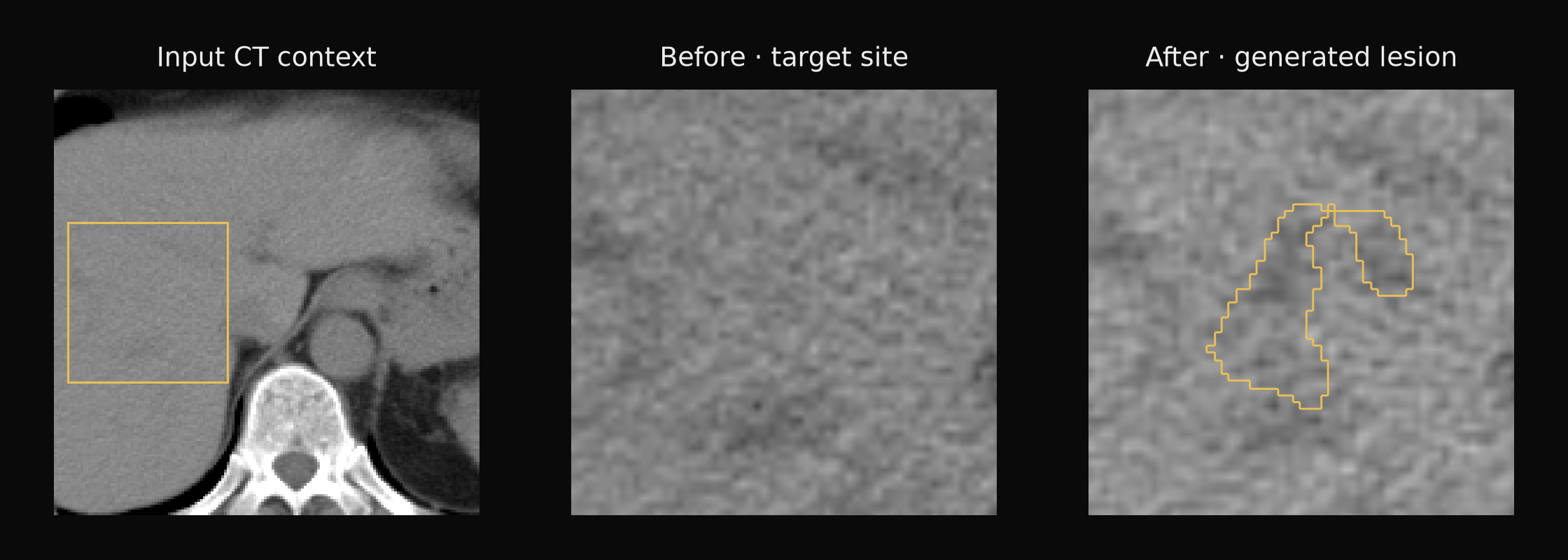
Liver CT before and after lesion generation; the contour marks the generated lesion.
| Input | Output |
|---|---|
| CT + aligned binary organ mask | Synthetic CT and lesion mask |
Apple Silicon · Metal · Python 3.13 / 3.14 · uv
Quick start
uv venv --python 3.13
source .venv/bin/activate
repo="https://github.com/MedMLX/lesiondiffusion-mlx"
uv pip install \
  "lesiondiffusion-mlx[conversion] @ git+$repo" \
  huggingface-hub
Get LMNet.ckpt, LINet.ckpt and VQ.ckpt from the upstream weights folder. Convert once, then generate:
from pathlib import Path

from huggingface_hub import hf_hub_download
from lesiondiffusion_mlx import write_conversion

tokenizer = hf_hub_download("microsoft/BiomedCLIP-PubMedBERT_256-vit_base_patch16_224", "tokenizer.json")
write_conversion(
    checkpoints={"lmnet": Path("LMNet.ckpt"), "linet": Path("LINet.ckpt"), "vq": Path("VQ.ckpt")},
    tokenizer_path=Path(tokenizer),
    output_dir=Path("lesiondiffusion-weights"),
)
from lesiondiffusion_mlx.medmlx import run

result = run(
    image_path="ct_1mm_ras.nii.gz",
    organ_mask_path="liver_mask.nii.gz",
    weights_path="lesiondiffusion-weights",
    output_dir="out",
    organ="liver",
    lesion_type="tumor",
    bbox_size_mm=[30, 30, 20],
    placement="inside_parenchyma",
)
print(result["outputs"]["synthetic_image"])
Inputs must support the documented crop sizes. Outputs use a RAS 1 mm grid; voxels outside the lesion can change. Synthetic output is not ground truth.
License
Apache-2.0. See third-party notices. Model weights retain their publisher terms.
For research and education. Outputs require human review.
Metadata
Release files for lesiondiffusion-mlx 0.2.2
For a detailed explanation of source distributions (sdists) and built distributions (wheels), please see the package formats documentation.
Source distribution (sdist)
| File | Size | Uploaded | Provenance | Actions |
|---|---|---|---|---|
| lesiondiffusion_mlx-0.2.2.tar.gz | 51.3 kB | Without provenance | Details for lesiondiffusion_mlx-0.2.2.tar.gz |
Built distribution (wheel)
| File | Interpreter | ABI | Platform | Actions Reset |
|---|---|---|---|---|
| lesiondiffusion_mlx-0.2.2-py3-none-any.whl | Python 3 | none | any | Details for lesiondiffusion_mlx-0.2.2-py3-none-any.whl |
Total release size: 109.1 kB
Release files / lesiondiffusion_mlx-0.2.2.tar.gz
| Download URL | lesiondiffusion_mlx-0.2.2.tar.gz |
|---|---|
| Size | 51.3 kB |
| Tags | Source |
|
SHA-256 checksum How to use checksums |
8d443cde99b76235b76fb53d67c7358b1fc367b425e7f59228d99c4b46567f31
|
|
BLAKE2b-256 checksum How to use checksums |
2c9be605ee35f14c266293b097177f87b0674977012a4aa4181dae513f778bf3
|
| Upload date | |
|
Uploaded using Trusted Publishing? What is trusted publishing? |
No |
| Uploaded via |
twine/7.0.0 CPython/3.13.5
|
Release files / lesiondiffusion_mlx-0.2.2-py3-none-any.whl
| Download URL | lesiondiffusion_mlx-0.2.2-py3-none-any.whl |
|---|---|
| Size | 57.8 kB |
| Tags | Python 3 |
|
SHA-256 checksum How to use checksums |
cf9c0235dd37012eeba11e4dd05a806b9de33b53fd2f4f392002d80ad9d934de
|
|
BLAKE2b-256 checksum How to use checksums |
baece9e3bed21c0642ab4a7c889b74cd6e99c7649dd34c911fda86bfc7bb79b5
|
| Upload date | |
|
Uploaded using Trusted Publishing? What is trusted publishing? |
No |
| Uploaded via |
twine/7.0.0 CPython/3.13.5
|
Security for lesiondiffusion-mlx 0.2.2
Provenance
Provenance describes where a file came from. On PyPI, provenance is shared via attestations, which provide a verifiable record of the build or publishing details. View details, limitations and caveats.
No provenance found
None of the files in this release were uploaded with provenance metadata.
A note on package security
PyPI is a repository for distributing packages, not a service for auditing them. While third-party security researchers and our staff do their best to detect and remove malicious packages, PyPI cannot guarantee the quality, security or suitability of any given package.
To learn more about protecting yourself from malicious actors, visit our package security documentation.














