
lesiontrack

Longitudinal multiple sclerosis lesion evolution from two or more MRI timepoints: which lesions are new, enlarging, shrinking, stable or resolved, and which are slowly expanding lesions (SELs) by the Jacobian definition of Elliott et al. 2019, with a synthetic backtest gate that has to pass before a real number is reported.
Nothing in this repository is evidence about multiple sclerosis. It is research software. It is not a medical device, it has not been validated against histology or clinical outcome, and it makes no diagnostic claim.
Why this exists
Every MS clinic that pays for follow-up MRI analysis gets lesion-level change and, in trials, SEL counts. In the open there was one SEL implementation, bound to a GUI, needing FreeSurfer and ANTs, taking hours per subject and carrying its authors' own warning not to use it. There is no public SEL ground truth, and the field's thresholds were set by visual assessment. This package is the missing open engine, and the backtest is the missing check.
- one dependency for registration: greedy, installed as a wheel, x86-64 and arm64, CPU only
- minutes per subject pair, not hours
- every threshold in one file with its citation (
lesiontrack/config.py) - every output a plain NIfTI or TSV, on the baseline grid, ready for any viewer
Method
- Halfway space. Rigid registration of the follow-up T1w to the baseline T1w, then the square root of that transform moves both scans into an unbiased midpoint space (Nakamura et al.; Elliott et al. 2019).
- Deformable registration driven by T1w and FLAIR jointly (normalised cross correlation, step 0.7, update smoothing 2 voxels), baseline fixed, follow-up moving.
- Jacobian determinant of the deformation field, converted to local percent volume
change per year:
(det J - 1) * 100 / years. - SEL candidates (Elliott 2019): voxels inside baseline lesions expanding at
= 12.5 %/year seed 18-connected components; each seed grows by hysteresis into neighbours expanding at >= 4 %/year, competing so distinct expansions stay distinct (marker watershed on the expansion map); candidates under 10 voxels are dropped. Not Elliott's: candidates whose mean expansion over the whole interval is under 10 % are dropped too (
--min-mean-total;--min-mean 0gives the published rule). The backtest is why, see Results. - Scores (Elliott 2019 as described by Vanden Bulcke et al. 2025): concentricity
is the robust slope of mean expansion per 1-voxel shell against depth from the
candidate edge; constancy is the normalised residual of a robust linear fit of
expansion over the intermediate timepoints (needs three or more scans). Both are
z-scored across the cohort;
S = z(concentricity) - z(constancy);S >= 0is a definite SEL. Because the z-scores are cohort-relative, the definite/possible split is a ranking within your cohort, not an absolute threshold; raw values are kept. Candidates with no interior voxel have no concentricity and are marked unscorable. - Lesion tracking from the binary masks: connected components at baseline and
follow-up are matched on the bipartite overlap graph, so merges and splits are
explicit. Volume change is annualised and classified as enlarging or shrinking beyond
+/-9 %/year, stable within +/-4 %/year, and trend_up / trend_down between (bands of
Vanden Bulcke et al. 2025). A follow-up component with no baseline overlap is new if
it clears the 1-voxel-dilated baseline mask and adjacent_fragment if it touches it;
a baseline component with no follow-up overlap is resolved. New and resolved calls
rest on two segmentations, so each is checked against the images:
flair_supportedsays whether FLAIR intensity there rose (new) or fell (resolved) by at least one robust z.
The backtest gate
lesiontrack backtest takes a real baseline (T1w, FLAIR, lesion mask), picks lesions,
expands each by a known volume factor (1.15, 1.25, 1.40, or your own with --factors
and --dt-years) with a smooth radial
deformation, perturbs the whole head rigidly, rescales intensities and adds noise, then
runs the full pipeline on the pair and reports:
- sensitivity: expanded lesions that receive a SEL candidate
- false positive rate: untouched lesions that receive one
- recovery fraction: robust slope of measured against true expansion (1.0 = exact)
- the noise floor inside untouched lesions and, per candidate, how well its mean rate separates injected from spurious candidates
It is the only place the pipeline is checked against a known answer. Run it on your own data, at the rates and interval you care about, before trusting a count.
Install
pip install lesiontrack
Python 3.10+. Wheels for greedy exist for Linux x86-64 and arm64 and macOS. This README
describes 0.3.0 (lesiontrack --version); 0.2.0 saved rounded warps and had no mean-rate
floor, so upgrade before comparing numbers.
Use
Write a tab-separated manifest, one row per scan, paths relative to the manifest:
subject	session	time_years	t1	flair	mask	brainmask
P1	T1	28.09	P1/T1/T1.nii.gz	P1/T1/FLAIR.nii.gz	P1/T1/MASK.nii.gz	P1/T1/brain.nii.gz
P1	T2	28.51	P1/T2/T1.nii.gz	P1/T2/FLAIR.nii.gz	P1/T2/MASK.nii.gz
P1	T3	29.49	P1/T3/T1.nii.gz	P1/T3/FLAIR.nii.gz	P1/T3/MASK.nii.gz
time_years is any consistent clock (age, or years since baseline). Masks come from
whatever segmenter you trust (LST-AI, SAMSEG, nnU-Net, manual); the brain mask is
optional and only restricts the registration metric.
lesiontrack run manifest.tsv --out derivatives          # every subject
lesiontrack run manifest.tsv --out derivatives --subject P1
lesiontrack cohort --out derivatives                    # z-scores and S across subjects
lesiontrack backtest --t1 T1.nii.gz --flair FLAIR.nii.gz --mask MASK.nii.gz --out backtest
Two deformable engines
The linear step (similarity since 0.3.0: rigid plus one global scale), the halfway frame
and the reslicing are greedy in both cases; --engine
picks what runs on the halfway-space images. greedy (default) needs nothing extra.
ants uses SyN through antspyx, cross-correlation on
T1 and FLAIR jointly, and is how the original SEL studies registered:
pip install 'lesiontrack[ants]'
lesiontrack run manifest.tsv --out derivatives_ants --engine ants
lesiontrack backtest --t1 T1.nii.gz --flair FLAIR.nii.gz --mask MASK.nii.gz --out backtest_ants --engine ants
Both engines write the same files, so the backtest compares them on identical inputs. The Jacobian determinant is computed by lesiontrack from the warp, in the image's voxel frame, for either engine; see "The Jacobian is ours" below for why.
Per subject you get, on the baseline grid in halfway space:
| file | content |
|---|---|
expansion_<tp>_pct_per_year.nii.gz |
Jacobian-derived local volume change |
sel_candidates.nii.gz, sel_candidates.tsv |
candidate labels; size, peak and mean expansion, concentricity, constancy |
baseline_lesion_labels.nii.gz, lesion_labels_<tp>.nii.gz |
lesion components |
lesion_tracking.tsv |
one row per matched group with class, volumes, rate, merge/split flags, flair_dz, flair_supported |
new_or_enlarging_<tp>.nii.gz |
follow-up lesion voxels outside the dilated baseline |
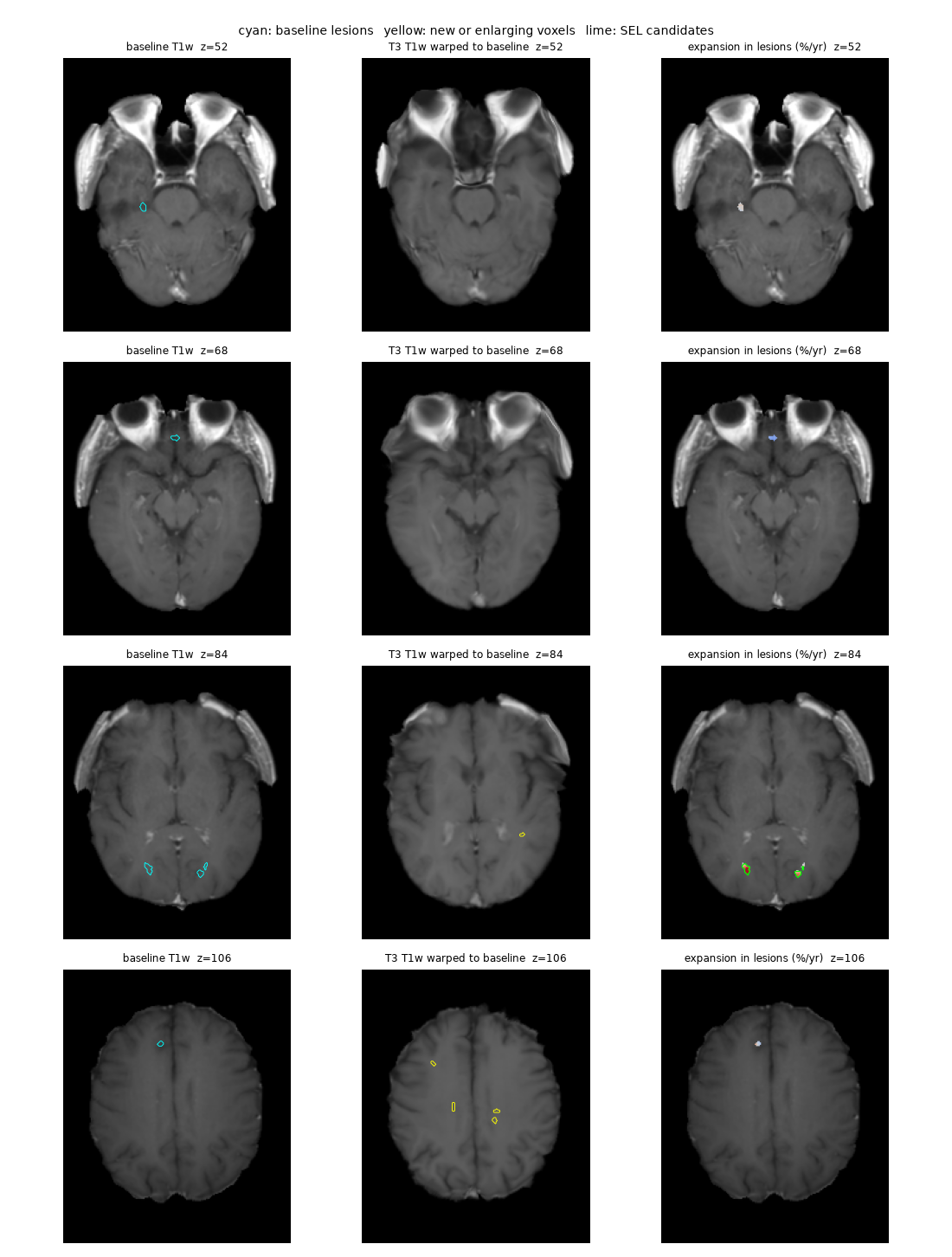
overview_<tp>.png |
four axial slices: baseline, warped follow-up, expansion with SEL outlines |
summary.json |
counts, volumes, intervals, every parameter used |
lesiontrack cohort adds sel_cohort.tsv with z_concentricity, z_constancy,
score_S and definite_sel.
Results on public data
Current numbers, lesiontrack 0.3.0, greedy engine. Every earlier version's numbers, the ANTs comparison and the per-patient tables are in docs/VALIDATION.md.
Backtest: injected expansion of 15 to 40 % over one year
MSLesSeg patients P1 to P3, three seeds each, scans at 0, 0.5 and 1 year; 72 expanded and 150 untouched lesions per condition. Lesion-level sensitivity / false positive rate:
| condition | Elliott candidate | definite S >= 0 | default (mean rate floor) |
|---|---|---|---|
| no scanner change | 1.00 / 0.15 | 0.57 / 0.04 | 0.99 / 0.03 |
| 0.5 % scale change | 1.00 / 0.12 | 0.54 / 0.03 | 0.99 / 0.03 |
| 1 % scale change | 1.00 / 0.14 | 0.54 / 0.05 | 0.99 / 0.03 |
| FLAIR at 3 mm slices | 0.99 / 0.23 | 0.58 / 0.07 | 0.96 / 0.05 |
| Lesjak 03, 06, 07 (0.72 x 0.72 x 3 mm) | 0.97 / 0.08 | 0.61 / 0.03 | 0.96 / 0.03 |
Over seven MSLesSeg patients (P1 P2 P3 P12 P13 P19 P22, picked before any result was seen; median and range):
| quantity | value |
|---|---|
| recovery fraction (measured / injected, robust slope) | 1.17 |
| candidate false positive rate, Elliott thresholds | 0.27 (0.04 to 0.59) |
| noise floor: median peak per-voxel rate in untouched lesions | 8.9 %/yr (5.1 to 14.4) |
| candidate AUC, injected against spurious: mean rate | 0.99 (0.87 to 1.00) |
| candidate AUC: S / constancy residual / concentricity | 0.76 / 0.76 / 0.62 |
What the gate showed:
- The Jacobian recovers the injected expansion, slightly over on small lesions.
- Elliott's candidate rule is noise-limited on large lesions. One voxel over 12.5 %/yr, grown by hysteresis to 4 %/yr, makes a candidate; S >= 0 removes most of those and about 40 % of the true ones with them.
- The candidate's mean rate separates best, which is why
runapplies a floor on it.
Backtest: slow expansion
The design above injects 11 to 25 %/yr inside the lesion, and the floor was first chosen
on it. SELs are defined by slow expansion, so the backtest was repeated at nominal 3, 5
and 8 %/yr with scans at 0, 1 and 2 years (scripts/run_slow.sh). P1 and P2, three seeds
each, 48 expanded and 51 untouched lesions, share of lesions with a candidate (2026-11-23):
| injected rate | Elliott candidate | floor 5 %/yr (default at 2 years) | fixed 10 %/yr (0.3.0.dev0) |
|---|---|---|---|
| 3 %/yr (n = 18) | 0.22 | 0.22 | 0.06 |
| 5 %/yr (n = 18) | 0.33 | 0.33 | 0.11 |
| 8 %/yr (n = 12) | 0.92 | 0.92 | 0.50 |
| untouched (false positive rate) | 0.02 | 0.02 | 0.00 |
Two things follow. A fixed floor in %/yr is wrong for longer intervals: noise in %/yr about halves over two years (mean rate of untouched lesions, SD 2.0 against 3.7 %/yr), and a 10 %/yr floor removed half the lesions expanding at 8 %/yr to remove one false positive. The default is therefore a floor on total change, 10 % over the interval. And uniform expansion at 3 to 5 %/yr is mostly missed by Elliott's rule itself on this registration: few such lesions hold a voxel at the 12.5 %/yr seed. The lesion's mean Jacobian rate still separates expanded from untouched lesions (AUC 0.94), so the signal is in the map more than in the candidates. P3 and the one-year series are added to docs/VALIDATION.md as they finish.
Cohorts with the defaults
Measured with 0.3.0.dev0 (fixed 10 %/yr floor; the re-run with the floor on total change is in docs/VALIDATION.md). MSLesSeg, 24 patients, baseline against last scan, median interval 1.5 years: 232 SEL candidates, median 6 per patient, 68 definite; Elliott's rule without a floor gave 484 and 16 on 0.2.0, and the literature reports about 2 to 4 SELs per patient over two years. Mask-based against Jacobian volume change per subject: Spearman 0.40. One patient (P49) is refused by the input gate: its follow-up T1 is 0.1 % nonzero.
Lesjak et al. 2016, 20 patients, LST-AI masks, scored against expert masks of lesion
change (there is no SEL ground truth, so this tests tracking): tracked groups called
changed have sensitivity 0.95 and specificity 0.08, because 1,426 of 2,020 groups are new
or resolved by the masks against 282 expert-confirmed. The churn is the segmenter's.
flair_supported is the answer to it: the FLAIR change separates expert-confirmed from
unconfirmed new lesions at AUC 0.83 (resolved 0.70), and at the default threshold keeps
0.84 of the confirmed new lesions while dropping 0.65 of the unconfirmed. The threshold
was chosen on these same 20 patients.
Data used
- MSLesSeg (Guarnera et al. 2025, Sci Data 12:920, CC BY): 25 patients with 2 to 4
timepoints, already in MNI152 1 mm space with a lesion mask per timepoint.
scripts/make_manifest_mslesseg.pybuilds the manifest; intervals are age differences. - Lesjak et al. 2016 longitudinal database (CC BY): 20 patients, 2 timepoints, expert masks of lesion change. It has no lesion masks, so they come from LST-AI; see "Validation beyond P1".
The Jacobian is ours
Until 0.2.0 the Jacobian came from greedy's -rj in the reslice command. That option
differentiates the composed warp while it is still in physical (LPS, millimetre) units,
along voxel index axes, without the image direction matrix, so it is only right for
images whose voxel axes are LPS-aligned at 1 mm. On a phantom with an identity (RAS)
affine, a sphere growing from radius 8 to 10 voxels (volume ratio 1.95) came back as det
0.68; with a LAS affine, as used by the MSLesSeg scans, as 1.18. For a radial stretch
1+k the true determinant is (1+k)^3; each flipped axis turns one factor into (1-k), so
RAS (two flips) reports (1-k)^2 (1+k), which is below 1 for any expansion, and LAS (one
flip) reports (1-k)(1+k)^2, roughly a third of the true volume change for small k. greedy's standalone -jac converts the warp first and is
correct; the reslice path does not (found 2026-09-27, draft report in
docs/upstream/greedy_rj_direction.md).
A second loss of precision sat in the warp file itself: greedy writes it rounded to 0.1
voxel by default (-wp 0.1), which put every rate on steps of about 5 %/yr. Since 0.3.0
the warp is written unrounded (-wp 0, found 2026-11-21).
lesiontrack now computes det(I + grad u) itself from the warp file, after taking the
vectors LPS -> RAS -> voxel units through the inverse affine, and tests/test_jacobian.py
checks it under four orientations and anisotropic spacing. Registrations cached under an
older record are not redone; their Jacobian is recomputed from the stored warp.
Limitations, stated plainly
- The Jacobian sees any local volume change, including registration error at lesion edges, atrophy, and interpolation. The backtest measures the pipeline's own noise floor on untouched lesions; report it with your SEL counts.
- Two-timepoint studies cannot score constancy; S then rests on concentricity alone and is labelled so.
- Thresholds are Elliott's, set by eye in 2019 on 3D scans resampled to 1x1x3 mm. Vanden Bulcke et al. 2025 found only weak lesion-level agreement (Dice about 0.4) between SEL masks from different segmenters or resolutions. Subject-level counts were stable; lesion-level identity was not. Expect the same here.
- Slow uniform expansion is missed. Elliott's seed needs a voxel at 12.5 %/yr; lesions injected at 3 to 5 %/yr over two years got a candidate in about a quarter of cases. The injected expansion is a uniform scaling, not the centre-weighted pattern SELs are described by, so real SELs may fare better or worse; nothing public can tell.
- The mean-rate floor is this package's, not Elliott's, and it was chosen on synthetic
expansion.
--min-mean 0reports the published rule. - Masks are taken as given. A segmenter that hallucinates at follow-up will produce
"new" lesions; the class is kept and
flair_supportedsays whether the images agree. On Lesjak with LST-AI masks the unfiltered call has specificity 0.08 for "changed". - Since 0.3.0 the linear step absorbs a global scale, including real whole-brain atrophy: lesion expansion is relative to the brain. The simulated scanner change is a pure linear scale; a real scanner change also distorts non-linearly, and that is not tested.
- Every SEL number here comes from synthetic expansion injected into real scans. No public dataset has SEL ground truth; the backtest measures the pipeline, not the biology.
References
- Elliott C, et al. Slowly expanding/evolving lesions as a magnetic resonance imaging marker of chronic active multiple sclerosis lesions. Mult Scler 2019;25:1915-1925.
- Vanden Bulcke C, et al. Do slowly expanding lesions correspond to chronic active multiple sclerosis lesions? An integrated imaging analysis study. medRxiv 2025, doi:10.64898/2025.12.03.25341192.
- Guarnera F, et al. MSLesSeg: baseline and benchmarking of a new Multiple Sclerosis Lesion Segmentation dataset. Sci Data 2025;12:920.
- Yushkevich PA, et al. Fast automatic segmentation of hippocampal subfields and medial temporal lobe subregions in 3 Tesla and 7 Tesla T2-weighted MRI (greedy). 2016.
License
MIT. Written by Cedric Conday with Claude (Anthropic) as coding partner.
1 maintainer

Metadata
1 maintainer
Release files for lesiontrack 0.3.0
For a detailed explanation of source distributions (sdists) and built distributions (wheels), please see the package formats documentation.
Source distribution (sdist)
| File | Size | Uploaded | Provenance | Actions |
|---|---|---|---|---|
| lesiontrack-0.3.0.tar.gz | 55.8 kB | Without provenance | Details for lesiontrack-0.3.0.tar.gz |
Built distribution (wheel)
| File | Interpreter | ABI | Platform | Actions Reset |
|---|---|---|---|---|
| lesiontrack-0.3.0-py3-none-any.whl | Python 3 | none | any | Details for lesiontrack-0.3.0-py3-none-any.whl |
Total release size: 101.0 kB
Release files / lesiontrack-0.3.0.tar.gz
| Download URL | lesiontrack-0.3.0.tar.gz |
|---|---|
| Size | 55.8 kB |
| Tags | Source |
|
SHA-256 checksum How to use checksums |
ca3dcd3110734b498ddc5a7b011aa9b3acda7fac92f1d54b27f91d9161cf0c04
|
|
BLAKE2b-256 checksum How to use checksums |
d0e361a22688e4f9de7cf39e37c4652c85c19306ddd21f8dfe0ed018aa767804
|
| Upload date | |
|
Uploaded using Trusted Publishing? What is trusted publishing? |
No |
| Uploaded via |
twine/7.0.0 CPython/3.12.3
|
Release files / lesiontrack-0.3.0-py3-none-any.whl
| Download URL | lesiontrack-0.3.0-py3-none-any.whl |
|---|---|
| Size | 45.3 kB |
| Tags | Python 3 |
|
SHA-256 checksum How to use checksums |
ca4a8e7706a716e0a8ca5a8cfe83669a3dc9b7c474799b4b80e64ff61e7ad8d4
|
|
BLAKE2b-256 checksum How to use checksums |
4025e467d1b956f182ddd8f73fbd306fe7b5433f499b0377b9909a5e1bc0c46e
|
| Upload date | |
|
Uploaded using Trusted Publishing? What is trusted publishing? |
No |
| Uploaded via |
twine/7.0.0 CPython/3.12.3
|
Security for lesiontrack 0.3.0
Provenance
Provenance describes where a file came from. On PyPI, provenance is shared via attestations, which provide a verifiable record of the build or publishing details. View details, limitations and caveats.
No provenance found
None of the files in this release were uploaded with provenance metadata.
A note on package security
PyPI is a repository for distributing packages, not a service for auditing them. While third-party security researchers and our staff do their best to detect and remove malicious packages, PyPI cannot guarantee the quality, security or suitability of any given package.
To learn more about protecting yourself from malicious actors, visit our package security documentation.














