
LF2I: Likelihood-Free Frequentist Inference


Getting Started
What is LFI?
lf2i is a Python package for likelihood-free inference; that is, inference on the parameters $\boldsymbol{\theta}$ of a statistical model $F_{\boldsymbol{\theta}}$ in a setting where the likelihood $\mathcal{L}(\boldsymbol{\theta}; \mathcal{D}):=p(\mathcal{D}|\boldsymbol{\theta})$ cannot be evaluated but is implicitly encoded by a high-fidelity simulator for $F_{\boldsymbol{\theta}}$. In other words, one can simulate data in batches of size $n$, $\mathcal{D}=(X_1, \dots, X_n)$, for any given $\boldsymbol{\theta}$ in the parameter space.
What does LF2I do?
lf2i constructs confidence regions for internal parameters with correct coverage across the whole parameter space, that is, sets $\mathcal{R}(\mathcal{D})$ satisfying $\mathbb{P}({\boldsymbol{\theta}} \in \mathcal{R}(\mathcal{D})) = 1 - \alpha\text{ } \text{ }\forall\theta\in\Theta$, where $(1 − \alpha) \in (0, 1)$ is a prespecified confidence level.
Coverage is guaranteed regardless of
- the prior distribution over the parameters of interest;
- the true value of the parameters of interest: the coverage guarantee holds point-wise over the parameter space (i.e., not only on average); and
- the size of the observed sample: the coverage guarantee holds even for finite sample sizes, including for the case of one observation, i.e. $n=1$.
Structure of LF2I
lf2i is based on the equivalence of confidence sets and hypothesis tests. It leverages supervised machine learning methods to efficiently execute the Neyman construction of confidence sets. The framework has three separate modules for estimating
- test statistics (such as ACORE, BFF, Waldo, etc...);
- critical values for a level $\alpha$ test; and
- empirical coverage
across the entire parameter space. See the figure below for a schematic diagram.
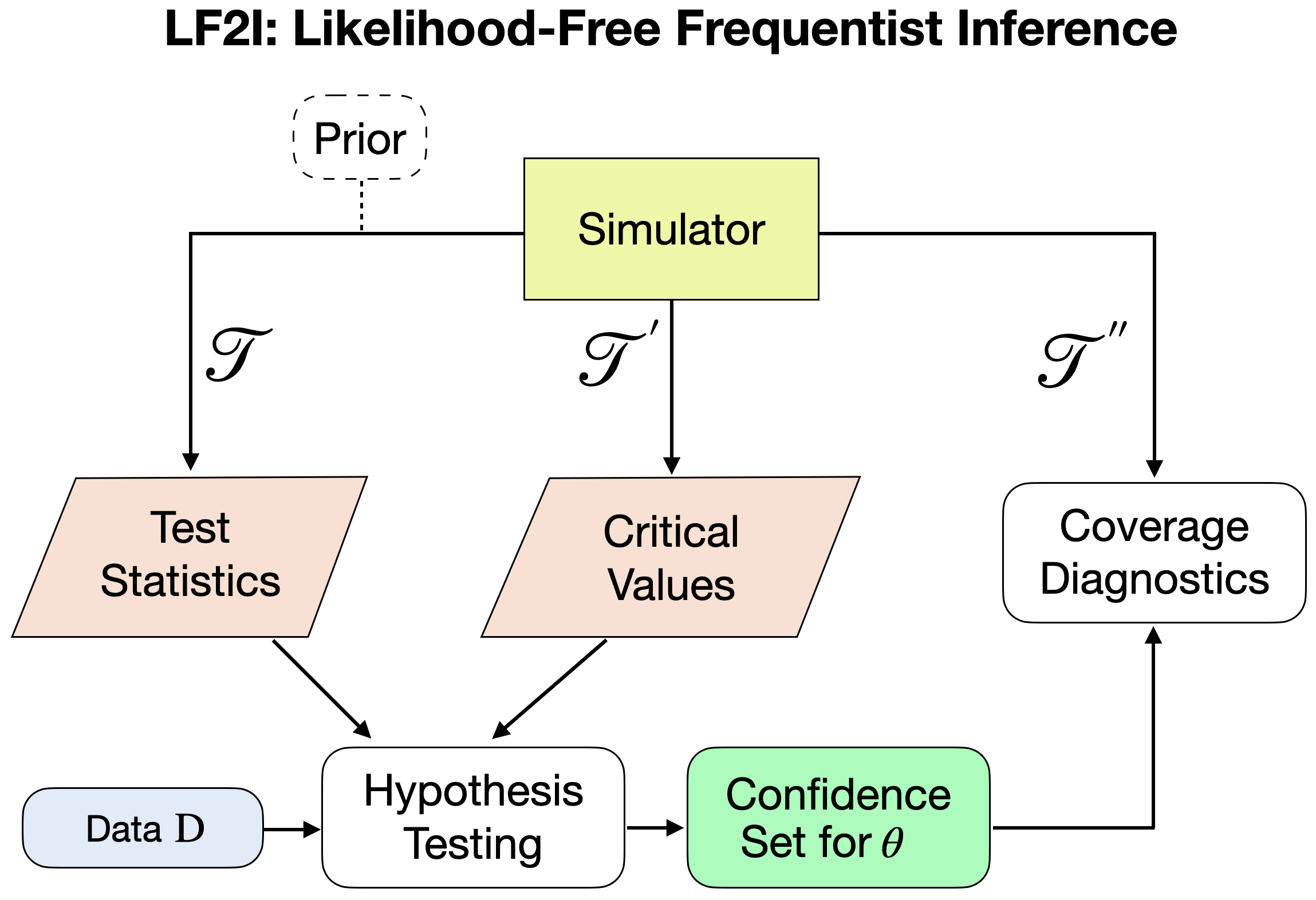
While 1. and 2. are used to construct the confidence sets, 3. is an independent diagnostic tool that can be used to check whether a given parameter region (such as, lf2i confidence sets, posterior credible regions, prediction sets, etc …) has the right conditional coverage. Because lf2i is modular, users can construct valid confidence sets using any test statistic of their choice.
Usage
lf2i offers a simple interface that allows you to get started quickly. The entry point is the LF2I class in the lf2i.inference module, which contains classes to wrap the different functionalities. The method inference merges steps 1. and 2. to return confidence sets with correct coverage. The method diagnostics performs step 3. as an independent check of empirical coverage of the constructed parameter regions.
Check the website for the full documentation, complete of tutorials on the Waldo test statistics. Tutorials on likelihood-based test statistics like ACORE and BFF are coming soon!
Install
The package is under active development, and is available on PyPI at this link. It can be installed using pip:
pip install lf2i
The diagnostics module leverages smoothing splines implemented in R, which is assumed to be installed along with the mgcv package.
Feedback and Contributions
We strongly encourage users to leave feedback and report bugs either by using the Issues tab, or by contacting us directly. The current maintainer can be reached here.
If you want to contribute, feel free to open an issue and/or a pull request.
References
LF2I is based on the following research articles:
- Confidence sets and hypothesis testing in a likelihood-free inference setting (ICML 2020)
- Likelihood-Free Frequentist Inference: Bridging Classical Statistics and Machine Learning for Reliable Simulator-Based Inference (2021)
- Simulation-Based Inference with Waldo: Confidence Regions by Leveraging Prediction Algorithms and Posterior Estimators for Inverse Problems (AISTATS 2023)
3 maintainers


Metadata
3 maintainers
Release files for lf2i 0.3.1
For a detailed explanation of source distributions (sdists) and built distributions (wheels), please see the package formats documentation.
Source distribution (sdist)
| File | Size | Uploaded | |
|---|---|---|---|
| lf2i-0.3.1.tar.gz | 43.3 kB | Details |
Built distribution (wheel)
| File | Interpreter | ABI | Platform | Reset |
|---|---|---|---|---|
| lf2i-0.3.1-py3-none-any.whl | Python 3 | none | any | Details |
Total release size: 98.4 kB
Release files / lf2i-0.3.1.tar.gz
| Download URL | lf2i-0.3.1.tar.gz |
|---|---|
| Size | 43.3 kB |
| Tags | Source |
|
SHA-256 checksum How to use checksums |
704e61f72c21f787613db65171c3a2606f14c91b2204f96fd7c5e409c66f5bc5
|
|
BLAKE2b-256 checksum How to use checksums |
e0c5cb6409b349cd2b43fb1e9f13c0a2f125a6e6b9ea122c6072368c5a479a47
|
| Upload date | |
|
Uploaded using Trusted Publishing? What is trusted publishing? |
No |
| Uploaded via |
twine/4.0.1 CPython/3.9.0
|
Release files / lf2i-0.3.1-py3-none-any.whl
| Download URL | lf2i-0.3.1-py3-none-any.whl |
|---|---|
| Size | 55.2 kB |
| Tags | Python 3 |
|
SHA-256 checksum How to use checksums |
a3215c56d9f115c69191a8da97ef4ad63869b42237251fa9eac561d186c381f8
|
|
BLAKE2b-256 checksum How to use checksums |
a3a937e8b708a24acd9be1daba85b26ede85d6991525c5aa26122a3db5de5bef
|
| Upload date | |
|
Uploaded using Trusted Publishing? What is trusted publishing? |
No |
| Uploaded via |
twine/4.0.1 CPython/3.9.0
|














