
a python framework to build, learn and reason about probabilistic circuits and tensor networks
Verified details
These details have been verified by PyPIProject links
GitHub Statistics
Maintainers


Project description




What is Cirkit? :electric_plug:
cirkit is a framework for building, learning and reasoning about probabilistic machine learning models, such as circuits and tensor networks, which are tractable ( ⬆️ ) and expressive ( ➡️ ).
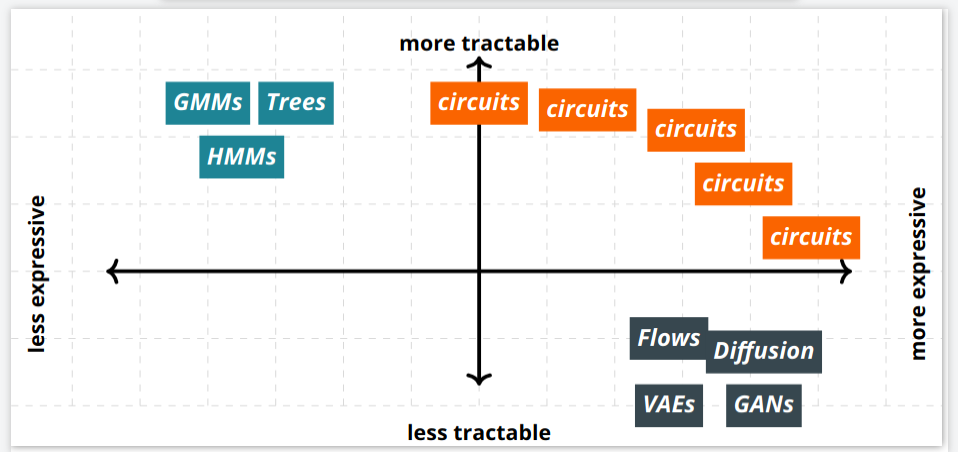
Main Features
- ⚡ Exact and Efficient Inference : Support for tractable operations that are automatically compiled to efficient computational graphs that run on the GPU.
- Compatible: Seamlessly integrate your circuit with deep learning models; run on any device compatible with PyTorch.
- Modular and Extensible: Support for user-defined layers and parameterizations that extend the symbolic language of cirkit.
- Templates for Common Cases : Templates for constructing circuits by mixing layers and structures with a few lines of code.
Supported Model Families and Inference
| Model Family | Queries | Notebook |
|---|---|---|
| 📈 Monotonic Circuits | mar, con, sam, exp | Region Graphs |
| 📷 PICs Circuits | mar, con, sam, exp | PICs |
| 🆘 SoS Circuits | mar, con, exp | SoS |
Supported Queries
The supported queries are tabulated below.
| Abbreviation | Query | Math | Symbolic | PyTorch |
|---|---|---|---|---|
| mar | marginal | $\int p(\mathbf{x}, \mathbf{z}) d\mathbf{z}$ | integrate | integrate query |
| con | conditional | $p(\mathbf{x} \mid \mathbf{z})$ | integrate and evidence | integrate query |
| sam | sample | $\mathbf{x} \sim p(\mathbf{x})$ | - | sampling query |
| exp | expectation | $\mathbb{E}_{\mathbf{x} \sim p(\mathbf{x})}\left [ f(\mathbf{x}) \right ] = \int p(\mathbf{x})f(\mathbf{x}) d\mathbf{x}$ | multiply and integrate | - |
Symbolic vs PyTorch
Queries can be implemented either symbolically, i.e. by constructing a new circuit which implements the query 1, or by directly applying a query to a compiled circuit in PyTorch. In the latter case, the query is evaluated using a forward pass of the existing circuit.
Project Structure :open_file_folder:
.
├── cirkit              Main Code
│   ├── backend         Circuits to Numerical Operations (Currently via PyTorch backend)
│   ├── symbolic        Circuits / Layers / Operators / Compilation
│   ├── templates       APIs for easy use (e.g. region graphs, data modalities)
│   └── utils
├── docs
├── notebooks           Start here: Examples
└── tests
How to Install the Library
cirkit currently requires Python 3.10 and PyTorch 2.3 or above versions. Install the latest release version via pip.
pip install libcirkit
For the latest development version, install from github after cloning this repository locally. To install the required dependencies in development mode.
pip install -U pip        # update pip
pip install -e ".[dev]"
This will install not only the core dependencies of the library itself (e.g., PyTorch) but also additional dependencies useful for development (e.g., PyTest). It also installs other development tools, such as Black, PyLint and MyPy.
Additional Requirements for Jupyter Notebooks
If you want to execute the Jupyter notebooks in the notebooks/ directory, then install the additional dependencies with:
pip install ".[notebooks]"
Documentation 📘
For more details see the Documentation here.
Development 🛠️
Build Documentation Locally
Whenever you write documentation, you can check how it would look like by building HTML pages locally. To do so, install the dependencies for building documentation:
pip install ".[docs]"
Then, run the following at the root level of the repository directory.
mkdocs serve
After waiting a few seconds, you can then navigate the rendered documentation at the link http://127.0.0.1:8000/.
Automatic Code Formatting
We try to follow a consistent formatting across the library. If you want to automatically format your code, then you should run the following script.
bash scripts/format.sh
Linting and Static Code Checks
Locate youself in the repository root. Then, run the following for executing the linters and other static code checkers.
bash scripts/check.sh [--tool linting-tool] [file ...]
Optionally,
- Specify
--toolto select the linting tool to use. If no one is given, then all of them will be run, i.e., black, isort, pydocstyle, pylint, mypy. - Add files to lint part of the repo. If none is specified then, all tracked directiories will be checked.
Run Unit Tests and Check the Coverage
Locate youself in the repository root. Then, rn the following script.
bash scripts/coverage.sh [--FORMAT] [pytest_arg ...]
Optionally,
- Use a
--FORMAT(e.g.--xml) flag for exporting converage to file. - Pass additional args to pytest (files to test etc.).
Papers :scroll:
If you want to learn more about the internals of cirkit, a good starting point is What is the Relationship between Tensor Factorizations and Circuits (and How Can We Exploit it)?.
Papers Implemented in Cirkit
Citation
If you use cirkit in your publications, please cite:
@software{The_APRIL_Lab_cirkit_2024,
author = {{The april Lab}},
license = {GPL-3.0},
month = oct,
title = {{cirkit: a python framework to build, learn and reason about probabilistic circuits and tensor networks}},
url = {https://github.com/april-tools/cirkit},
version = {0.1},
year = {2024}
}
-
Symbolic queries are especially useful when you want to combine the resulting circuit with other circuits. ↩
Project details
Verified details
These details have been verified by PyPIProject links
GitHub Statistics
Maintainers


Download files
Download the file for your platform. If you're not sure which to choose, learn more about installing packages.
Source Distributions
Built Distribution
Filter files by name, interpreter, ABI, and platform.
If you're not sure about the file name format, learn more about wheel file names.
Copy a direct link to the current filters
File details
Details for the file libcirkit-0.3.1-py3-none-any.whl.
File metadata
- Download URL: libcirkit-0.3.1-py3-none-any.whl
- Upload date:
- Size: 179.6 kB
- Tags: Python 3
- Uploaded using Trusted Publishing? Yes
- Uploaded via: twine/6.1.0 CPython/3.13.12
File hashes
| Algorithm | Hash digest | |
|---|---|---|
| SHA256 |
74329f2da8fb012b5667a02a3f2bffad95eafc7066747f4e9f7e80a75588c421
|
|
| MD5 |
0ca6b589b262b8e86e2dddbb188b98d3
|
|
| BLAKE2b-256 |
9ae396420313e05b61569dbd7914ccf4189f28f47055065e1023010bc8fb3303
|
Provenance
The following attestation bundles were made for libcirkit-0.3.1-py3-none-any.whl:
Publisher:
python-publish.yml on april-tools/cirkit
-
Statement:
-
Statement type:
https://in-toto.io/Statement/v1 -
Predicate type:
https://docs.pypi.org/attestations/publish/v1 -
Subject name:
libcirkit-0.3.1-py3-none-any.whl -
Subject digest:
74329f2da8fb012b5667a02a3f2bffad95eafc7066747f4e9f7e80a75588c421 - Sigstore transparency entry: 2168125704
- Sigstore integration time:
-
Permalink:
april-tools/cirkit@aa7c78c3da676638e9b26ba4b7754171922c0327 -
Branch / Tag:
refs/tags/0.3.1 - Owner: https://github.com/april-tools
-
Access:
public
-
Token Issuer:
https://token.actions.githubusercontent.com -
Runner Environment:
github-hosted -
Publication workflow:
python-publish.yml@aa7c78c3da676638e9b26ba4b7754171922c0327 -
Trigger Event:
release
-
Statement type:






