
LibriScribe 📚✨





🌟 Overview
LibriScribe revolutionizes book writing through a sophisticated multi-agent system. Specialized AI agents collaborate seamlessly to assist you from initial brainstorms and worldbuilding to draft generation, interactive editing, and local publication.
With our latest integration updates, LibriScribe supports OpenRouter routing, project-customizable external YAML editor prompts, automated LLM cost tracking, and a self-healing JSON parser for unmatched writing reliability.
🏗️ Multi-Agent Architecture
LibriScribe orchestrates specialized agents guided by your configuration, loading prompts externally and logging execution costs automatically:
graph TD
    User([User CLI / Prompt]) --> PM[Project Manager Agent]
    PM --> PL[Prompt Loader]
    PL -. Loads YAML Templates .-> Templates[(prompts/templates/)]

    PM --> SR[Style Research Agent]
    SR -. populates .-> SP[(style_profile in PKB)]
    SP -. injected into .-> OL
    SP -. injected into .-> CW

    PM --> CG[Concept Generator]
    PM --> OL[Outliner]
    PM --> CH[Character Generator]
    PM --> WB[Worldbuilder]
    PM --> CW[Chapter Writer]
    PM --> ED[Editor]

    CW --> IC[Invariant Checker]
    IC -. reads .-> NG[(narrative_graph.json)]
    CW --> NGB[Narrative Graph Builder]
    NGB -. writes .-> NG
    CW --> CQA[Content Quality Agent]
    CQA -. Option A style hints .-> CW
    CQA -. Option B rewrite loop .-> CW
    CQA -. saves .-> QR[(quality_chapter_N.json)]

    CW --> PA[Pacing Agent]
    PA -. PACING GUIDANCE .-> ED
    PA -. saves .-> PR[(pacing_report.json)]

    CW & ED --> LLM[Unified LLM Client]
    LLM --> CT[Cost Tracker]
    CT --> Log[(llm_usage.jsonl)]

    PM --> FA[Optimized Formatting Agent]
    FA -. Local Compilation .-> Manuscript([manuscript.md / PDF])

    style PM fill:#2563EB,stroke:#1D4ED8,color:#FFFFFF,stroke-width:2px
    style FA fill:#059669,stroke:#047857,color:#FFFFFF,stroke-width:2px
    style CT fill:#DC2626,stroke:#B91C1C,color:#FFFFFF,stroke-width:2px
    style IC fill:#7C3AED,stroke:#6D28D9,color:#FFFFFF,stroke-width:2px
    style NGB fill:#7C3AED,stroke:#6D28D9,color:#FFFFFF,stroke-width:2px
    style CQA fill:#7C3AED,stroke:#6D28D9,color:#FFFFFF,stroke-width:2px
    style SR fill:#D97706,stroke:#B45309,color:#FFFFFF,stroke-width:2px
    style PA fill:#0891B2,stroke:#0E7490,color:#FFFFFF,stroke-width:2px
✨ Features
1. Unified LLM & OpenRouter Routing 🤖
- Multi-Provider Support: Run on OpenAI, Anthropic Claude, Google Gemini, DeepSeek, Mistral, OpenRouter, AWS Bedrock, or Bedrock Mantle.
- Intelligent Auto-Formatting: Built-in JSON post-processing wrapper guarantees clean responses when routing through diverse models.
- Full Backward Compatibility: Swap models dynamically without breaking existing templates or agent behaviors.
2. External YAML Prompt Templates 📝
- Project-Customizable Editor Prompt: Customize the production editing prompt in
prompts/templates/editor.ymlwithout editing Python code. - Packaged Defaults and Overrides: Templates ship with the package, while a project-level
prompts/templates/copy orLIBRISCRIBE_PROMPTS_DIRoverride takes precedence. - Genre-Specific Personas: Easily configure suspense, scientific accuracy, or business tones directly inside templates.
3. LLM Cost Optimization & Tracking 💰
- Automatic Usage Logging: Track execution metrics in
llm_usage.jsonl. Logs timestamps, providers, selected models, precise input/output token counts, and USD cost calculations. - Cost-Optimized Formatting Agent: The compiler works entirely locally using local Markdown parsing and title-page assembly. This bypasses expensive LLM formatting calls, saving ~$2.40 per manuscript!
- Suggested Models Tiers: Define high, medium, or low-cost model suggestions right inside prompt template settings.
4. Enterprise-Grade JSON Robustness 🔐
- Self-Healing AI Responses: Automated prompt-repair attempts logic if raw JSON parse initially fails, ensuring agents heal malformed responses.
- f-String Safe Templates: Fixed escaping issues to prevent code integration errors during runtime formatting.
5. Creative Writing & QA Suite 🎨
- Automated Outlining & Concept Creation: Turn standard premises into rich narrative blueprints.
- Worldbuilding & Character Generation: Generate complex multi-dimensional character profiles and coherent cultures.
- Chapter Writing & Refining: Continuous draft-review cycles via an expert editing loop.
6. Local Retrieval & Knowledge Search 🔍
- Automatic Parsing & Chunking: Auto-extracts character profiles, worldbuilding, summaries, and full chapters into searchable tokens.
- Exact Tag-Based Filters: Constrain queries to specific documents using exact filters.
- Robust Fallback Keyword Search: Sub-linear TF-IDF pure-Python fallback if
rank-bm25is not installed — zero ML dependencies. - Optional Local Semantic & Hybrid Search: Sentence-transformers runs embeddings on-device; keyword search remains the default and requires no embedding package or model.
- Confined Project Indexes: Search indexes remain under the project directory, with traversal and symlink escapes rejected.
- Automatic Cross-Reference Graphing: Dynamically indexes co-occurrences of key characters and locations across all chapter chunks.
7. Narrative Quality Layer 📖
- NarrativeGraphBuilder: After each chapter, extracts structured facts (entity, predicate, value) into a persistent
narrative_graph.json. - InvariantChecker: Before each scene, detects hard and soft invariant violations (dead characters, destroyed locations) and injects
NARRATIVE CONSTRAINTS:into the scene prompt. - ContentQualityAgent (Preventive): Injects prior-chapter quality flags as
STYLE CONSTRAINTS:into the next chapter's scene prompts. - ContentQualityAgent (Reactive): Scores each scene across 5 prose axes. Fires a targeted rewrite pass when overall score < 0.65.
- PacingAgent: Analyses all written chapters across 5 arc axes. Injects
PACING GUIDANCE:into the Editor prompt when axes score below 0.70.
8. Style Research Agent 🎨
- Pre-Pipeline Style Extraction: When
inspired_byis set, runs a focused LLM pass before outlining to extract eight concrete style attributes (POV, sentence length, pacing, dialogue, tone, structure, themes, what to avoid). - Deterministic Style Profile: Stored as a
StyleProfilein the PKB and injected as aSTYLE REFERENCEblock into every outliner and scene-writer prompt. - Resumed-Run Safe: If a profile already exists in the PKB, the agent is skipped — no extra LLM call.
9. Full Pipeline Context Propagation 🔗
- User intent preserved end-to-end: Original book description is never overwritten by LLM-generated summaries.
- Advanced-mode fields reach all prompts:
inspired_by,key_takeaways,research_question, and genre-specific Q&A are injected into outline and scene prompts. - Character & worldbuilding context in scene writing: Full profiles and key worldbuilding fields are prepended to every scene prompt.
Local MCP integrations
LibriScribe also provides a local MCP server and plugins for Claude Code and Codex. See the local integrations guide for installation, configuration, and tool usage.
🚀 Quickstart
1. Installation
Install LibriScribe from PyPI with the provider you plan to use. For OpenAI-compatible providers (OpenAI, OpenRouter, Bedrock Mantle):
python -m pip install "libriscribe[openai]"
Other optional provider extras are anthropic, google, and bedrock. Install all-providers to include all provider SDKs. The base package keeps keyword retrieval and local MCP utilities available without provider SDKs. Add semantic (for example, libriscribe[openai,semantic]) only if you want on-device embeddings; the embedding model is a separate, explicit download. Provider API usage may incur charges from the selected provider.
2. Configuration
Create a .env file in the root directory and enter your API keys for the providers you wish to use:
# Standard Providers
OPENAI_API_KEY=your_openai_key_here
OPENAI_MODEL=gpt-4o-mini

GOOGLE_AI_STUDIO_API_KEY=your_google_key_here
GOOGLE_AI_STUDIO_MODEL=gemini-2.5-flash

CLAUDE_API_KEY=your_claude_key_here
CLAUDE_MODEL=claude-3-opus-20240229

DEEPSEEK_API_KEY=your_deepseek_key_here
DEEPSEEK_MODEL=deepseek-coder-6.7b-instruct

MISTRAL_API_KEY=your_mistral_key_here
MISTRAL_MODEL=mistral-medium-latest

# OpenRouter Configuration
OPENROUTER_API_KEY=your_openrouter_key_here
OPENROUTER_BASE_URL=https://openrouter.ai/api/v1
OPENROUTER_MODEL=anthropic/claude-3-haiku

# AWS Bedrock (explicit keys optional — falls back to instance profile / env AWS_* vars)
BEDROCK_REGION=us-east-1
BEDROCK_MODEL=us.anthropic.claude-sonnet-4-6
BEDROCK_ACCESS_KEY_ID=your_access_key_id
BEDROCK_SECRET_ACCESS_KEY=your_secret_access_key
# BEDROCK_SESSION_TOKEN=your_session_token  # only needed for temporary credentials

# Bedrock Mantle
BEDROCK_MANTLE_API_KEY=your_api_key_here
BEDROCK_MANTLE_BASE_URL=https://bedrock-mantle.us-east-1.api.aws/v1
BEDROCK_MANTLE_MODEL=qwen.qwen3-coder-next

# Optional global fallback chain
# Entries may be provider names (use that provider's .env default),
# provider/model pairs, or model IDs for the current provider.
FALLBACK_CHAIN=claude,openrouter/anthropic/claude-3-haiku
LibriScribe reads these model values as provider defaults. In guided setup, Simple mode uses the .env default automatically, while Advanced mode lets you either keep the .env default or enter one custom model ID for the project.
Advanced mode can also optionally prompt you for a project fallback chain and per-agent fallback chains, giving guided setup parity with Expert mode without requiring a config file.
If FALLBACK_CHAIN is set, LibriScribe will try those routes when it hits a recoverable provider/model failure such as a timeout, 429, provider 5xx, empty response, or invalid JSON that could not be repaired.
3. Launch
To start the interactive prompt runner:
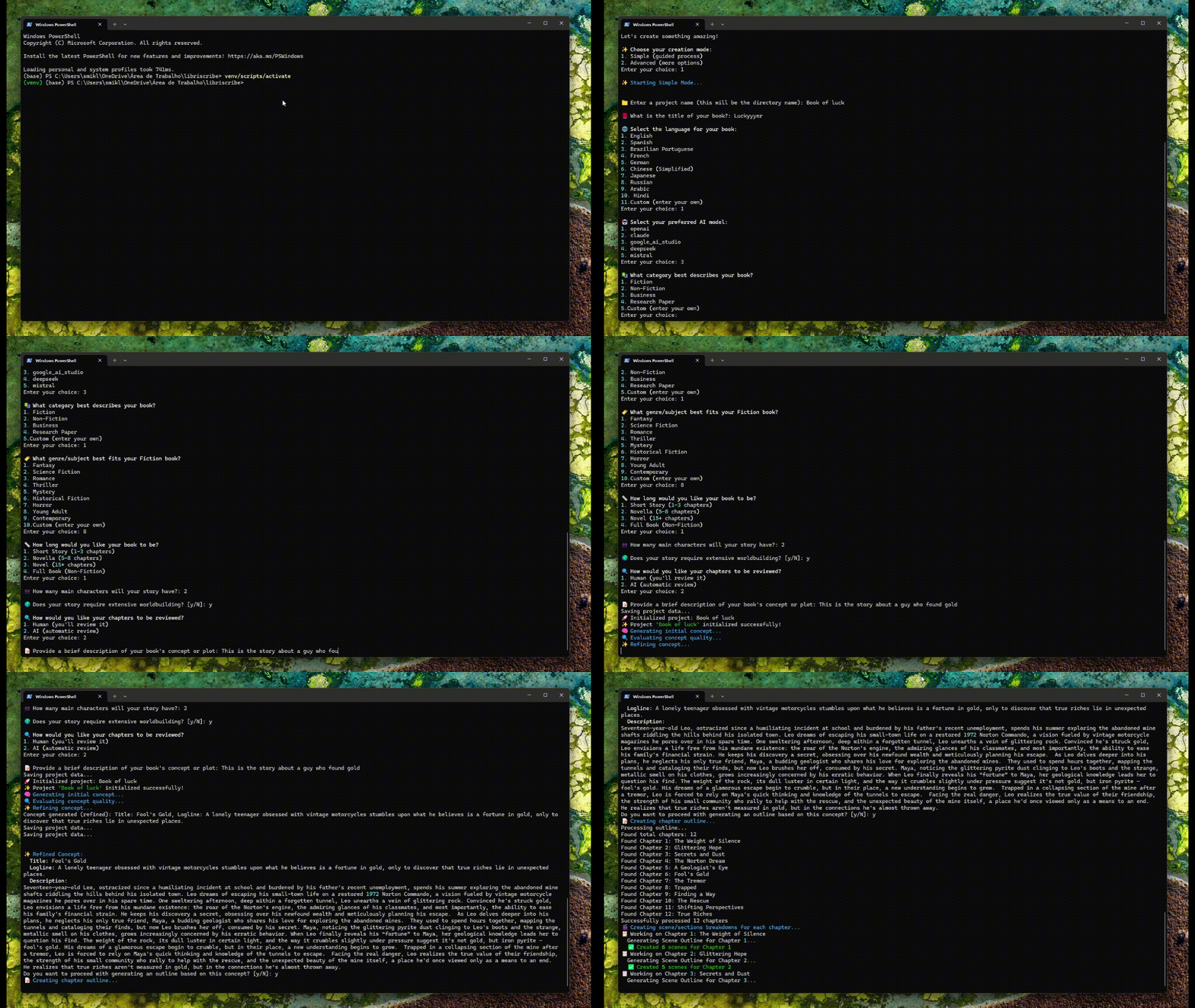
libriscribe start
Choose between:
- 🎯 Simple Guided Setup: Quick, streamlined guided book generation.
- 🎛️ Advanced Guided Setup: Fine-grained control over tone, target audience, and precise chapter goals.
- ⚙️ Expert: Configuration File: Load a JSON or YAML setup file for repeatable, highly customizable runs.
You can also jump straight into Expert mode from the CLI:
libriscribe start --config examples/expert-config.yaml
4. Local Retrieval CLI
Manage and search your project's knowledge base and drafts directly:
- Rebuild index:
libriscribe retrieval rebuild --project my_project
- Refresh index incrementally (hash-based checks):
libriscribe retrieval refresh --project my_project
- Query the index (Keyword search):
libriscribe retrieval search --project my_project --query "Mira Thorn"
- Optional semantic and hybrid search: Install
python -m pip install "libriscribe[semantic]", prepare a local embedding model, and follow the local retrieval guide for setup and hybrid search examples. - Lookup cross-references & co-occurrences of an entity:
libriscribe retrieval xref --project my_project --entity "Castle Iron"
5. Narrative Quality CLI
Inspect and maintain the narrative consistency graph and prose quality reports:
- Rebuild narrative graph from all chapters:
libriscribe narrative rebuild --project my_project
- Check invariant violations for a specific chapter's scenes:
libriscribe narrative check my_project --chapter 2
- Run prose quality analysis on a chapter:
libriscribe quality my_project --chapter 1
💻 Customizing Prompts
You can easily adjust the tone and focus of any writing agent. For example, to create a specialized Mystery Editor:
- Edit
prompts/templates/editor.ymlto specify custom instructions and cost settings:name: "Mystery Editor" cost_tier: "medium" settings: max_tokens: 4000 suggested_models: ["openai/gpt-4o-mini", "anthropic/claude-3-5-sonnet"] template: | You are an expert mystery editor refining Chapter {chapter_number} of "{book_title}". Review content and emphasize clue placement, suspense, and red herrings. Feedback to address: {review_feedback} Chapter: {chapter_content}
The agent will automatically load and apply your customized template on its next run!
⚙️ Expert Configuration Files
Expert mode supports both JSON and YAML configuration files so repeat runs can be automated and reused. LibriScribe also remembers the most recent expert settings and can offer them again on the next Expert run.
Expert mode currently supports:
libriscribe start --config <path>for direct config-driven startup- JSON and YAML project definitions
- reusable starter files in
examples/ - project-level model selection with
project.model - optional per-agent model overrides with
project.agent_models - config-driven fallback routing with
project.fallback_chain - optional per-agent fallback routing with
project.agent_fallback_chains - workflow-stage controls for:
- concept approval
- outline review
- character generation
- worldbuilding generation
- chapter writing (
prompt,auto, orskip) - chapter error handling (
stoporcontinue) - formatting and output format
- persisted recent expert settings in
.libriscribe_last_config.json
Example:
version: 1
project:
  project_name: my_fantasy_novel
  title: The Last Ember Gate
  category: Fiction
  genre: Fantasy
  language: English
  description: An exiled archivist discovers a buried gate tied to a fallen empire.
  num_characters: "3"
  worldbuilding_needed: true
  review_preference: AI
  book_length: Novel
  tone: Serious
  target_audience: Young Adult
  num_chapters: "10"
  llm_provider: openai
  model: gpt-4o-mini
  agent_models:
    outliner: gpt-4o-mini
    editor: gpt-4o
  fallback_chain:
    - claude
    - openrouter/anthropic/claude-3-haiku
  agent_fallback_chains:
    editor:
      - openai/gpt-4o
      - claude
workflow:
  concept_approval: auto
  outline_review: prompt
  character_generation: auto
  worldbuilding_generation: auto
  chapter_writing: auto
  chapter_error_mode: continue
  formatting: auto
  output_format: markdown
Starter files are available in:
examples/expert-config.jsonexamples/expert-config.yaml
When project.agent_models is provided, LibriScribe applies those model IDs only to the named agents and falls back to project.model, then to the provider default from .env.
Fallback entries support three forms:
claude→ use that provider's default model from.envopenrouter/anthropic/claude-3-haiku→ use an explicit provider/model routegpt-4o→ use that model on the current project provider
If a fallback chain is configured, LibriScribe will move to the next route for recoverable failures such as timeouts, rate limits, provider 5xx responses, empty responses, or invalid JSON that still fails after repair. Fallback activity is logged so you can see which route ran next.
The resume command now inspects the saved project state, skips completed files, preserves existing chapter drafts, and continues from the next incomplete stage instead of assuming chapter-only recovery.
LibriScribe also writes a lightweight .libriscribe_status.json file inside each project so interrupted stages are tracked explicitly instead of relying only on file inference.
If chapter_writing: auto is enabled, LibriScribe shows a single summary confirmation before full-book generation begins, including a warning that the run may consume a large number of tokens / credits.
📁 Project Structure
A typical project created by LibriScribe looks like this:
your_project/
├── project_data.json          # Project metadata & configurations
├── .libriscribe_status.json   # Lightweight stage/checkpoint recovery state
├── outline.md                 # Generated chapter-by-chapter outline
├── characters.json            # Multi-dimensional character profiles
├── world.json                 # Worldbuilding details (category-specific)
├── chapter_1.md               # Generated and polished chapter drafts
├── chapter_2.md
├── research_results.md        # Research findings
├── narrative_graph.json       # Persistent narrative facts (entities, predicates, values)
├── quality_chapter_1.json     # Prose quality report for chapter 1 (5 axes, 0–1 scores)
└── quality_chapter_2.json     # Prose quality report for chapter 2
All global execution costs and API calls are written directly to your workspace:
- 📂
llm_usage.jsonl- Real-time spend tracking and performance logging. - 📂
prompts/templates/- Project-level YAML prompt overrides and bundled default templates.
🗺️ LibriScribe Development Roadmap
🤖 LLM Integration & Support
- Multi-LLM Support: Anthropic Claude, Google Gemini, DeepSeek, Mistral, OpenAI, AWS Bedrock, Bedrock Mantle
- Unified OpenRouter Gateway Integration
- Cost Optimization Engine (
llm_usage.jsonltracking + local manuscript compilation) - Response Quality & Self-Healing JSON Parser
- Automatic Model Fallback System
- Model Performance Benchmarking
📖 Narrative Quality Layer
- NarrativeGraphBuilder: Automatic fact extraction into persistent
narrative_graph.json - InvariantChecker: Pre-scene constraint injection (dead characters, injured limbs, destroyed locations)
- ContentQualityAgent — 5-Axis Prose Scoring: cliche density, show-don't-tell, dialogue voice, sentence variety, scene function
- Option A — Preventive Style Injection: Prior-chapter quality flags injected into next chapter prompts
- Option B — Reactive Rewrite Loop: Per-scene inline rewrite when quality score < 0.65
- PacingAgent — 5-Axis Arc Analysis: tension escalation, act structure, chapter length consistency, emotional beat variety, narrative momentum; PACING GUIDANCE injected into editor prompt
- Narrative CLI:
narrative rebuild,narrative check,qualitycommands
🔍 Local Retrieval & Integrations
- Core Scaffolding & Local Keyword Retrieval
- Local Entity Cross-Referencing & BM25/TF-IDF Fallback Search
- Local stdio MCP Server & Claude Code/Codex Plugins
- Local Writing Workflow: Structured local project creation, safe user-authored chapter revisions, generated-artifact checkpoints, and explicit progress and recovery guidance.
- Local Semantic & Hybrid Search: Optional on-device embeddings, hybrid keyword/semantic ranking, and explicit project-local index management. Keyword search remains usable without embedding dependencies.
- Quality & Release Polish: Deterministic writing/retrieval diagnostics, safer manuscript export replacement, and local plugin configuration checks.
See the local retrieval and quality guide for setup, index lifecycle, benchmark use, and known limitations.
LibriScribe's MCP integration is local-only. Remote MCP hosting, public ChatGPT plugin submission, cloud vector databases, and multi-user account infrastructure are not planned.
🤝 Contributing
We welcome contributions! Check out our Contributing Guidelines to get started.
# Verify imports and setup successfully before submitting a PR
PYTHONPATH=src python -c 'import libriscribe.main'
📄 License
This project is licensed under the MIT License - see the LICENSE file for details.
Made with ❤️ by Fernando Guerra and Lenxys
If LibriScribe has been helpful, consider buying me a coffee:
1 maintainer

Metadata
1 maintainer
Release files for libriscribe 0.5.1
For a detailed explanation of source distributions (sdists) and built distributions (wheels), please see the package formats documentation.
Source distribution (sdist)
| File | Size | Uploaded | |
|---|---|---|---|
| libriscribe-0.5.1.tar.gz | 145.9 kB | Details |
Built distribution (wheel)
| File | Interpreter | ABI | Platform | Reset |
|---|---|---|---|---|
| libriscribe-0.5.1-py3-none-any.whl | Python 3 | none | any | Details |
Total release size: 292.2 kB
Release files / libriscribe-0.5.1.tar.gz
| Download URL | libriscribe-0.5.1.tar.gz |
|---|---|
| Size | 145.9 kB |
| Tags | Source |
|
SHA-256 checksum How to use checksums |
afe26bb201f866b5de81ff34b4d78ab4968197c8220d39ad03f1668c17bc3b4a
|
|
BLAKE2b-256 checksum How to use checksums |
3c45305c5cbc79e9c7fc369da6697b111039841495f176bdda945a1cb5443dcd
|
| Upload date | |
|
Uploaded using Trusted Publishing? What is trusted publishing? |
No |
| Uploaded via |
twine/7.0.0 CPython/3.12.10
|
Release files / libriscribe-0.5.1-py3-none-any.whl
| Download URL | libriscribe-0.5.1-py3-none-any.whl |
|---|---|
| Size | 146.2 kB |
| Tags | Python 3 |
|
SHA-256 checksum How to use checksums |
bb5fce04e23a515af1b0cb909234624e2dbc2a6022a15f679a638dd68af3ecbe
|
|
BLAKE2b-256 checksum How to use checksums |
18004f263ce6bab6727e2834eb664dcb139634f5a9b3f7c4def2288397f196f0
|
| Upload date | |
|
Uploaded using Trusted Publishing? What is trusted publishing? |
No |
| Uploaded via |
twine/7.0.0 CPython/3.12.10
|













