
lifecore_ros2







lifecore_ros2 is a minimal lifecycle composition library for ROS 2 Jazzy — no hidden state machine.
ROS 2 lifecycle works well for nodes. lifecore_ros2 makes it practical for reusable components.
30-second view
Raw rclpy lifecycle:
LifecycleNode
 ├── publishers
 ├── subscriptions
 ├── timers
 └── lifecycle logic mixed into one class

lifecore_ros2:
LifecycleComponentNode
 ├── LifecyclePublisherComponent
 ├── LifecycleSubscriberComponent
 ├── LifecycleTimerComponent
 ├── LifecycleParameterComponent
 └── LifecycleParameterObserverComponent
The node still owns the native ROS 2 lifecycle. The library adds a small composition layer so reusable components can follow the same lifecycle contract.
What this is not
- not a second lifecycle state machine
- not a plugin system or ROS 2 component container replacement
- not a behavior tree system, orchestration middleware, or launch replacement
- not a replacement for native ROS 2 lifecycle semantics
Installation warning: ROS 2 Jazzy required
lifecore_ros2 requires a working ROS 2 Jazzy Python environment. Install and source ROS 2 before importing this package:
source /opt/ros/jazzy/setup.bash
uv add lifecore-ros2
rclpy comes from the system ROS installation. It is intentionally not declared as a normal PyPI dependency.
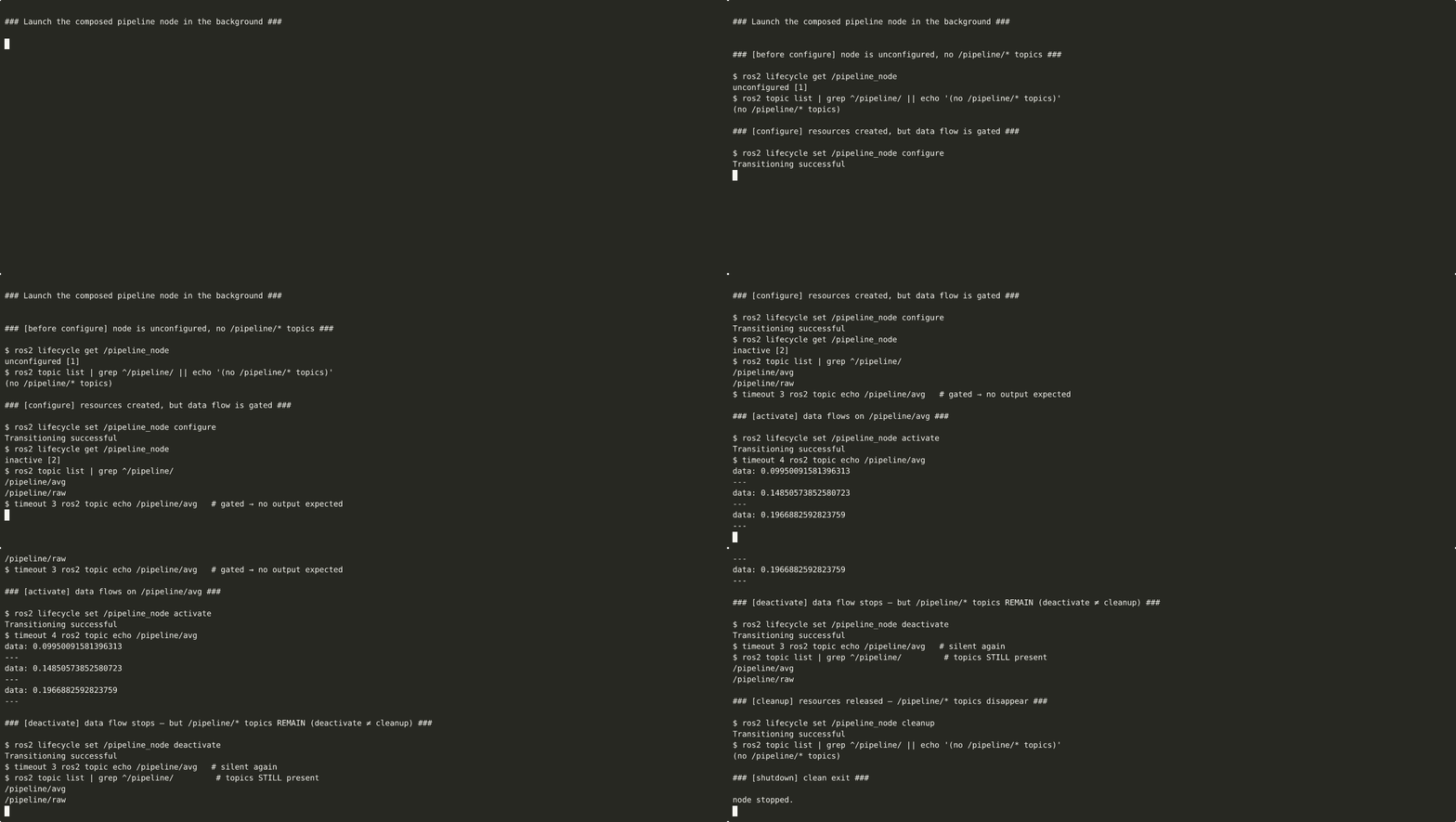
The examples/composed_pipeline.py walk-through highlights the key distinction the library makes explicit: deactivate ≠ cleanup — /pipeline/* topics persist across deactivate and only disappear on cleanup.
Why lifecore_ros2 exists
Audience. This library is for teams building modular ROS 2 nodes that need reusable lifecycle-aware components, especially in larger robotics stacks, embedded systems, or runtime-orchestrated applications.
Problem framing. ROS 2 provides a powerful managed-node lifecycle (configure → active → deactivate → cleanup). In practice, using it for anything beyond a trivial node leads to recurring problems:
- lifecycle logic gets scattered across monolithic node classes with no clear ownership
- ROS resource setup and teardown (publishers, subscriptions, timers) are easy to make inconsistent — resources allocated in the wrong place or released too late
- runtime gating ("only process messages when active") is hand-rolled differently each time, with no shared, tested pattern
- reusable lifecycle-aware building blocks are awkward in raw
rclpybecause the lifecycle contract is on the node, not on reusable sub-units
lifecore_ros2 solves these four problems with a small, explicit composition layer. It does not replace or extend the ROS 2 lifecycle state machine — it makes the lifecycle contract expressible at the component level.
Architecture at a glance
flowchart LR
    Lifecycle[ROS 2 Lifecycle]
    Node[LifecycleComponentNode]
    Components[LifecycleComponent instances]
    Lifecycle <--> Node
    Node <--> Components
    Lifecycle -. drives .-> Components
What the library provides
A small set of lifecycle-aware building blocks:
| Symbol | Role |
|---|---|
LifecycleComponentNode |
Lifecycle node that owns and drives registered LifecycleComponent instances |
LifecycleComponent |
Base class for a lifecycle-aware managed entity (abstract by convention — override _on_* hooks) |
TopicComponent |
Base class for topic-oriented components (pub/sub) |
LifecyclePublisherComponent |
Lifecycle-gated ROS publisher |
LifecycleSubscriberComponent |
Lifecycle-gated ROS subscriber |
LifecycleTimerComponent |
Lifecycle-gated ROS timer |
LifecycleParameter |
Frozen parameter definition used by LifecycleParameterComponent |
LifecycleParameterComponent |
Lifecycle-aware owner for node parameters scoped to one component |
LifecycleParameterObserverComponent |
Lifecycle-aware observer for parameters owned by other ROS 2 nodes |
ParameterMutability |
Runtime mutability policy for component-owned parameters |
WatchState |
Explicit initial-read availability state for a watched remote parameter |
ObservedParameterEvent |
Frozen event object delivered for live remote parameter changes |
ObservedParameterSnapshot |
Frozen query surface exposing the last observed value and watch state |
ParameterWatchHandle |
Frozen identifier returned when registering a remote parameter watch |
LifecycleWatchdogComponent |
Lifecycle-gated health watchdog — polls targets and logs DEGRADED / ERROR / STALE |
HealthLevel |
Severity enum: UNKNOWN | OK | DEGRADED | ERROR |
HealthStatus |
Frozen dataclass capturing component health (level, reason, last_error) |
ServiceComponent |
Base class for service-oriented components (server/client) |
LifecycleServiceServerComponent |
Lifecycle-gated ROS service server |
LifecycleServiceClientComponent |
Lifecycle-gated ROS service client |
when_active |
Decorator that guards any method to the active state |
LifecoreError and subclasses |
Typed exceptions for boundary violations |
lifecore_ros2.testing |
Reusable fakes, fixtures, assertions, and helpers for lifecycle-focused tests |
Design rules
The library stays lifecycle-native, keeps ownership in LifecycleComponentNode, and treats component hooks as explicit extension points rather than hidden orchestration.
Post-Sprint 13 planning keeps the core deliberately small: companion examples, documentation, architecture RFCs, DX, or tooling work can outrank new core features when they reduce risk or improve adoption. Factory, generated nodes, state-store concepts, EventBus, ECS, and plugin frameworks remain deferred unless real use cases prove the need.
When sibling components need deterministic ordering, prefer declaring dependencies and priority at add_component(...) so composition intent stays visible in the node assembly code. examples/composed_ordered_pipeline.py shows this pattern without constructor pass-through on library components.
See docs/architecture.rst for lifecycle design rules, docs/patterns.rst for usage patterns, and ROADMAP.md for non-goals and deferred scope. See Examples Repository Plan for the companion repository planning. See CHANGELOG.md for shipped changes or the GitHub Releases page for tagged releases.
Prerequisites
- Python 3.12 or newer
- ROS 2 Jazzy installed on the system
uvavailable in the workspace
rclpy is expected to come from the system ROS installation. It is intentionally not declared as a normal PyPI dependency.
Quickstart
Clone the repository, source ROS 2 Jazzy, and sync the local development environment:
git clone https://github.com/apajon/lifecore_ros2.git
cd lifecore_ros2
source /opt/ros/jazzy/setup.bash
uv sync --extra dev
Run the smallest composed lifecycle example already in the repository:
uv run python examples/minimal_node.py
From another terminal in the same ROS 2 environment, drive the node through configure and activate:
source /opt/ros/jazzy/setup.bash
ros2 lifecycle set /minimal_lifecore_node configure
ros2 lifecycle set /minimal_lifecore_node activate
For the full walkthrough, see docs/quickstart.rst. For validation and documentation commands, see docs/getting_started.rst. For the activation-gated subscriber example where on_message is the public application callback, continue with examples/minimal_subscriber.py. For lifecycle-aware parameter ownership, run examples/minimal_parameter.py. For remote parameter observation without ownership, run examples/minimal_parameter_observer.py. The full example map lives in docs/examples.rst.
Lifecycle reading path
The documentation now follows the same lifecycle vocabulary as the library:
- Configure: environment, prerequisites, ROS resource creation model
- Activate: runtime enablement and activation gating
- Run: examples, API usage, composed execution flow
- Transition: ownership, propagation, and error handling rules
- Shutdown: cleanup, release, and lifecycle end-state expectations
Recommended order:
- docs/quickstart.rst
- docs/getting_started.rst
- docs/concepts/mental_model.rst
- docs/architecture.rst
- docs/patterns.rst
- docs/testing.rst
- docs/examples.rst
Shortest-path example — subscriber
examples/minimal_subscriber.py is the next runnable example if you want to see activation-gated message delivery after the minimal node quickstart.
See examples/minimal_subscriber.py for the complete runnable file, docs/api_friction_audit.rst for the regression baseline, and docs/examples.rst for the walkthrough.
Component + node definition: 24 lines (regression baseline — see
docs/api_friction_audit.rst).
Publisher and subscriber examples
Run the publisher and observe activation gating:
uv run python examples/minimal_publisher.py
# in another terminal:
ros2 lifecycle set /publisher_demo_node configure
ros2 lifecycle set /publisher_demo_node activate
ros2 topic echo /chatter
Messages appear only after activate. Deactivation stops them.
For the subscriber path, use the quickstart above or the full example walkthrough in docs/examples.rst.
Parameter example
Run the parameter example to see component-scoped parameter declaration, active-only writes, and validation hooks:
uv run python examples/minimal_parameter.py
# in another terminal:
ros2 lifecycle set /parameter_demo_node configure
ros2 lifecycle set /parameter_demo_node activate
ros2 param set /parameter_demo_node sensor_params.gain 5.0
ros2 param set /parameter_demo_node sensor_params.mode raw
sensor_params.gain is writable only while the component is active and must stay positive. sensor_params.mode is static and rejects runtime writes. validate_parameter_update is the simplest per-parameter hook; on_pre_set_owned_parameters, on_validate_owned_parameters, and on_post_set_owned_parameters form the full owned-parameter update pipeline when a component needs transform, batch validation, or accepted-write side effects.
Parameter observer example
Run the observer example to see remote parameter observation without ownership:
uv run python examples/minimal_parameter_observer.py
# in another terminal, start a remote node that owns the parameter:
ros2 run demo_nodes_py parameter_blackboard
# then drive the observer through lifecycle transitions:
ros2 lifecycle set /observer_demo_node configure
ros2 lifecycle set /observer_demo_node activate
ros2 param set /parameter_blackboard rate 20.0
configure may record unknown_node, unknown_parameter, unavailable, or value_available and still succeed. While active, the per-watch callback= reaction point or the component-wide on_observed_parameter_event hook can react to remote parameter changes. While inactive, the snapshot still updates but user callbacks stay gated.
Public API overview
All exported symbols and their stability levels are documented in ROADMAP.md.
The extension model and API buckets are defined in docs/architecture.rst and docs/api.rst.
Current limitations
- package metadata uses
Development Status :: 3 - Alphato reflect API stability, not lack of usability - the public API is in the
0.xseries — experimental stability level; minor bumps may include breaking changes - companion examples live in
lifecore_ros2_examples; start with thesensor watchdog lifecycle comparisonfor the first applied example, then seeROADMAP.mdthere for future scenarios
License
This project is licensed under the Apache-2.0 License — see LICENSE.
Documentation
Documentation: https://apajon.github.io/lifecore_ros2/
Full documentation lives under docs/ and is built with Sphinx:
uv sync --extra dev --group docs
uv run --group docs python -m sphinx -b html docs docs/_build/html
Key pages:
docs/getting_started.rst— setup and validation commandsdocs/architecture.rst— lifecycle design rules, error policy, member conventionsdocs/patterns.rst— recommended patterns and anti-patternsdocs/testing.rst— reusable lifecycle test fakes, fixtures, assertions, and helpersdocs/migration_from_rclpy.rst— before/after comparison with raw rclpydocs/api.rst— generated API referencedocs/examples.rst— example walkthroughs
Versioning
Versioning uses Conventional Commits and python-semantic-release. Preview the next version:
uv run --group release semantic-release version --print
Release (version commit + tag, skip hosted release if no token):
uv run --group release semantic-release version --no-vcs-release
git push origin main --follow-tags
See ROADMAP.md for promotion-to-1.0.0 criteria.
1 maintainer

Download files
Download the file for your platform. If you're not sure which to choose, learn more about installing packages.
Source Distribution
Built Distribution
Filter files by name, interpreter, ABI, and platform.
If you're not sure about the file name format, learn more about wheel file names.
Copy a direct link to the current filters
File details
Details for the file lifecore_ros2-0.10.0.tar.gz.
File metadata
- Download URL: lifecore_ros2-0.10.0.tar.gz
- Upload date:
- Size: 6.9 MB
- Tags: Source
- Uploaded using Trusted Publishing? Yes
- Uploaded via:
twine/6.1.0 CPython/3.13.12
File hashes
| Algorithm | Hash digest | |
|---|---|---|
| SHA256 |
706f690f7c35813c15f528e2e3d97b5ba7f0b13a4c353e9593ca6823a2d02851
|
|
| MD5 |
8b30c8c55234f9afb109d992914b54cc
|
|
| BLAKE2b-256 |
85be07fa445712c9a92abb3301f0a617910a8d25d441960dfa8ed5b0d09ceeed
|
Provenance
The following attestation bundles were made for lifecore_ros2-0.10.0.tar.gz:
Publisher:
publish-pypi.yml on apajon/lifecore_ros2
-
Statement:
-
Statement type:
https://in-toto.io/Statement/v1 -
Predicate type:
https://docs.pypi.org/attestations/publish/v1 -
Subject name:
lifecore_ros2-0.10.0.tar.gz -
Subject digest:
706f690f7c35813c15f528e2e3d97b5ba7f0b13a4c353e9593ca6823a2d02851 - Sigstore transparency entry: 1525932877
- Sigstore integration time:
-
Permalink:
apajon/lifecore_ros2@ea220f1ce01942f61a9d559d8ef29b91f6477e65 -
Branch / Tag:
refs/heads/main - Owner: https://github.com/apajon
-
Access:
public
-
Token Issuer:
https://token.actions.githubusercontent.com -
Runner Environment:
github-hosted -
Publication workflow:
publish-pypi.yml@ea220f1ce01942f61a9d559d8ef29b91f6477e65 -
Trigger Event:
workflow_dispatch
-
Statement type:
File details
Details for the file lifecore_ros2-0.10.0-py3-none-any.whl.
File metadata
- Download URL: lifecore_ros2-0.10.0-py3-none-any.whl
- Upload date:
- Size: 62.9 kB
- Tags: Python 3
- Uploaded using Trusted Publishing? Yes
- Uploaded via:
twine/6.1.0 CPython/3.13.12
File hashes
| Algorithm | Hash digest | |
|---|---|---|
| SHA256 |
0b1038bacef156c0d3a360c27b6a2eb65131bd10fdf531adc6ad77137b37029c
|
|
| MD5 |
31c442328e82d7dc1d98ca6473956534
|
|
| BLAKE2b-256 |
940465c25bf18ca4c2c7f354a487ca68e0a6905d4041caaee57f63da7ab5aa39
|
Provenance
The following attestation bundles were made for lifecore_ros2-0.10.0-py3-none-any.whl:
Publisher:
publish-pypi.yml on apajon/lifecore_ros2
-
Statement:
-
Statement type:
https://in-toto.io/Statement/v1 -
Predicate type:
https://docs.pypi.org/attestations/publish/v1 -
Subject name:
lifecore_ros2-0.10.0-py3-none-any.whl -
Subject digest:
0b1038bacef156c0d3a360c27b6a2eb65131bd10fdf531adc6ad77137b37029c - Sigstore transparency entry: 1525933039
- Sigstore integration time:
-
Permalink:
apajon/lifecore_ros2@ea220f1ce01942f61a9d559d8ef29b91f6477e65 -
Branch / Tag:
refs/heads/main - Owner: https://github.com/apajon
-
Access:
public
-
Token Issuer:
https://token.actions.githubusercontent.com -
Runner Environment:
github-hosted -
Publication workflow:
publish-pypi.yml@ea220f1ce01942f61a9d559d8ef29b91f6477e65 -
Trigger Event:
workflow_dispatch
-
Statement type:














