

SOTA Pretraining, Fine-tuning and Distillation
Train Better Models, Faster




LightlyTrain is the leading framework for transforming your data into state-of-the-art computer vision models. It covers the entire model development lifecycle from pretraining DINOv2/v3 vision foundation models on your unlabeled data to fine-tuning transformer and YOLO models on detection and segmentation tasks for edge deployment.
Struggling to get good results with pre-training? Talk to one of our experts Contact us
Using LightlyTrain at work, in production, on the edge, or to build proprietary models? You likely need a Commercial License. Contact us to request a license for commercial use.
Also check out LightlyStudio to easily visualize your annotations and predictions.
News
- [0.17.0] - 2026-07-28: LTDETRv2 for instance segmentation: Train state-of-the-art LTDETRv2 instance segmentation models with ECViT backbones from EdgeCrafter, matching the accuracy of the original ECSeg implementation while being 10-20% faster! ONNX and TensorRT export is also out-of-the-box!
- [0.16.0] - 2026-06-25: ⚡ Upgraded LTDETRv2 for object detection: Following the success of LTDETR, LightlyTrain's DETR model, we release LTDETRv2 with significant architectural and performance improvements! It supports using ECViT backbones from EdgeCrafter and ONNX/TensorRT export for faster inference!
- [0.15.0] - 2026-04-14: 🔎 Distillationv3: Better generalizing distillation method that performs equally well across dense and global tasks and across all models, from ViTs to hybrids to CNNs (+support for custom teachers!). 🔎
- [0.14.0] - 2026-01-19: 🐣 PicoDet, Tiny Models, and ONNX/TensorRT FP16 Support: PicoDet object detection models for low-power embedded devices! All tasks now support tiny DINOv3 models and ONNX/TensorRT export in FP16 precision for faster inference! 🐣
- [0.13.0] - 2025-12-15: 🐥 New Tiny Object Detection Models: We release tiny DINOv3 models pretrained on COCO for object detection! 🐥
- [0.12.0] - 2025-11-06: 💡 New DINOv3 Object Detection: Run inference or fine-tune DINOv3 models for object detection! 💡
- [0.11.0] - 2025-08-15: 🚀 New DINOv3 Support: Pretrain your own model with distillation from DINOv3 weights. Or fine-tune our SOTA EoMT semantic segmentation model with a DINOv3 backbone! 🚀
- [0.10.0] - 2025-08-04: 🔥 Train state-of-the-art semantic segmentation models with our new DINOv2 semantic segmentation fine-tuning method! 🔥
- [0.9.0] - 2025-07-21: DINOv2 pretraining is now officially available!
Installation
Install LightlyTrain on Python 3.8+ for Windows, Linux or MacOS with:
pip install lightly-train
Workflows

Object Detection
Train LTDETR detection models with DINOv2, DINOv3, or EdgeCrafter ECViT backbones.
COCO Results
| Model | Val mAP50:95 | Latency (ms) | Params (M) | Input Size |
|---|---|---|---|---|
| ltdetrv2-s-coco (NEW) | 50.7 | 5.4 | 9.9 | 640×640 |
| ltdetrv2-m-coco (NEW) | 53.1 | 7.95 | 21.1 | 640×640 |
| ltdetrv2-l-coco (NEW) | 56.0 | 10.78 | 33.6 | 640×640 |
| dinov3/vitt16-ltdetr-coco | 49.8 | 5.4 | 10.1 | 640×640 |
| dinov3/vitt16plus-ltdetr-coco | 52.5 | 7.0 | 18.1 | 640×640 |
| dinov3/vits16-ltdetr-coco | 55.4 | 10.5 | 36.4 | 640×640 |
| dinov3/convnext-tiny-ltdetr-coco | 54.4 | 13.3 | 61.1 | 640×640 |
| dinov3/convnext-small-ltdetr-coco | 56.9 | 17.7 | 82.7 | 640×640 |
| dinov3/convnext-base-ltdetr-coco | 58.6 | 24.7 | 121.0 | 640×640 |
| dinov3/convnext-large-ltdetr-coco | 60.0 | 42.3 | 230.0 | 640×640 |
Models are trained on the COCO 2017 dataset and evaluated on the validation set with
single-scale testing. Latency is measured with TensorRT on a NVIDIA T4 GPU with batch
size 1. All models are optimized using tensorrt==10.13.3.9.

Usage

import lightly_train

if __name__ == "__main__":
    # Train with our most recent LT-DETRv2 detector based on DINOv3 and EdgeCrafter.
    lightly_train.train_object_detection(
        out="out/my_experiment",
        model="ltdetrv2-s-coco",
        data={
            "path": "my_data_dir",
            "train": "images/train",
            "val": "images/val",
            "names": {
                0: "person",
                1: "bicycle",
                2: "car",
                # ...
            },
        },
    )

    # Load model and run inference
    model = lightly_train.load_model("out/my_experiment/exported_models/exported_best.pt")
    # Or use one of the models provided by LightlyTrain
    # model = lightly_train.load_model("ltdetrv2-s-coco")
    results = model.predict("image.jpg")
    results["labels"]   # Class labels, tensor of shape (num_boxes,)
    results["bboxes"]   # Bounding boxes in (xmin, ymin, xmax, ymax) absolute pixel
                        # coordinates of the original image. Tensor of shape (num_boxes, 4).
    results["scores"]   # Confidence scores, tensor of shape (num_boxes,)
Instance Segmentation
Train state-of-the-art instance segmentation models with our new LTDETRv2 family built on EdgeCrafter ECViT backbones.
COCO Results

| Model | Val mAP50:95 mask | Avg. Latency (ms) | Params (M) | Input Size |
|---|---|---|---|---|
| ltdetrv2-seg-s-coco | 0.427 | 6.96 | 11.32 | 640×640 |
| ltdetrv2-seg-m-coco | 0.458 | 9.82 | 22.31 | 640×640 |
| ltdetrv2-seg-l-coco | 0.475 | 11.41 | 34.85 | 640×640 |
| ltdetrv2-seg-x-coco | 0.479 | 12.06 | 41.93 | 640×640 |
Training follows the protocol in the original
EdgeCrafter paper. The s and m sizes train for
~74 epochs, while the l and x sizes train for ~50 epochs on the COCO 2017 dataset
and are evaluated on the validation set. Average latency is measured using TensorRT
version 10.13.3.9 and FP16 precision on a single NVIDIA T4 GPU with batch size 1.
Usage
import lightly_train

if __name__ == "__main__":
    # Train an instance segmentation model with our new LTDETRv2 family
    lightly_train.train_instance_segmentation(
        out="out/my_experiment",
        model="ltdetrv2-seg-s-coco",
        data={
            "format": "yolo",           # either "yolo" or "coco"
            "path": "my_data_dir",
            "train": "images/train",
            "val": "images/val",
            "names": {
                0: "background",
                1: "vehicle",
                2: "pedestrian",
                # ...
            },
        },
    )

    model = lightly_train.load_model("out/my_experiment/exported_models/exported_best.pt")
    # Or use one of the models provided by LightlyTrain
    # model = lightly_train.load_model("ltdetrv2-seg-s-coco")
    results = model.predict("image.jpg")
    results["labels"]   # Class labels, tensor of shape (num_instances,)
    results["bboxes"]   # Bounding boxes in (xmin, ymin, xmax, ymax) absolute pixel
                        # coordinates of the original image. Tensor of shape (num_instances, 4).
    results["masks"]    # Binary masks, tensor of shape (num_instances, height, width).
                        # Height and width correspond to the original image size.
    results["scores"]   # Confidence scores, tensor of shape (num_instances,)
Semantic Segmentation
Train state-of-the-art semantic segmentation models with DINOv2 or DINOv3 backbones using the EoMT method from CVPR 2025.
COCO-Stuff Results
| Implementation | Model | Val mIoU | Avg. Latency (ms) | Params (M) | Input Size |
|---|---|---|---|---|---|
| LightlyTrain | dinov3/vitt32-eomt-coco | 34.0 | 4.2 | 6.0 | 512×512 |
| LightlyTrain | dinov3/vitt32plus-eomt-coco | 36.0 | 4.4 | 7.7 | 512×512 |
| LightlyTrain | dinov3/vits32-eomt-coco | 42.4 | 5.4 | 21.6 | 512×512 |
| LightlyTrain | dinov3/vitb32-eomt-coco | 48.3 | 9.4 | 85.7 | 512×512 |
| LightlyTrain | dinov3/vitl32-eomt-coco | 51.2 | 17.5 | 303.2 | 512×512 |
| LightlyTrain | dinov3/vitt16-eomt-coco | 37.9 | 6.0 | 6.0 | 512×512 |
| LightlyTrain | dinov3/vitt16plus-eomt-coco | 39.5 | 6.4 | 7.7 | 512×512 |
| LightlyTrain | dinov3/vits16-eomt-coco | 45.0 | 11.3 | 21.6 | 512×512 |
| LightlyTrain | dinov3/vitb16-eomt-coco | 50.1 | 23.1 | 85.7 | 512×512 |
| LightlyTrain | dinov3/vitl16-eomt-coco | 52.5 | 49.0 | 303.2 | 512×512 |
Models are trained for 12 epochs with num_queries=200 on the COCO-Stuff dataset and
evaluated on the validation set with single-scale testing. Average latency is measured
on a single NVIDIA T4 GPU with batch size 1. All models optimized using torch.compile.
Cityscapes Results
| Implementation | Model | Val mIoU | Avg. Latency (ms) | Params (M) | Input Size |
|---|---|---|---|---|---|
| LightlyTrain | dinov3/vits16-eomt-cityscapes | 78.6 | 53.8 | 21.6 | 1024×1024 |
| LightlyTrain | dinov3/vitb16-eomt-cityscapes | 81.0 | 114.9 | 85.7 | 1024×1024 |
| LightlyTrain | dinov3/vitl16-eomt-cityscapes | 84.4 | 256.4 | 303.2 | 1024×1024 |
| EoMT (CVPR 2025 paper, current SOTA) | dinov2/vitl16-eomt | 84.2 | - | 319 | 1024×1024 |
Average latency is measured on a single NVIDIA T4 GPU with batch size 1. All models are
optimized using torch.compile.
Usage
import lightly_train

if __name__ == "__main__":
    # Train a semantic segmentation model with a DINOv3 backbone
    lightly_train.train_semantic_segmentation(
        out="out/my_experiment",
        model="dinov3/vits16-eomt",
        data={
            "train": {
                "images": "my_data_dir/train/images",
                "masks": "my_data_dir/train/masks",
            },
            "val": {
                "images": "my_data_dir/val/images",
                "masks": "my_data_dir/val/masks",
            },
            "classes": {
                0: "background",
                1: "road",
                2: "building",
                # ...
            },
        },
    )

    # Load model and run inference
    model = lightly_train.load_model("out/my_experiment/exported_models/exported_best.pt")
    # Or use one of the models provided by LightlyTrain
    # model = lightly_train.load_model("dinov3/vits16-eomt")
    masks = model.predict("image.jpg")
    # Masks is a tensor of shape (height, width) with class labels as values.
    # It has the same height and width as the input image.
Panoptic Segmentation
Train state-of-the-art panoptic segmentation models with DINOv3 backbones using the EoMT method from CVPR 2025.
COCO Results
| Implementation | Model | Val PQ | Avg. Latency (ms) | Params (M) | Input Size |
|---|---|---|---|---|---|
| LightlyTrain | dinov3/vitt16-eomt-panoptic-coco | 38.0 | 13.5 | 6.0 | 640×640 |
| LightlyTrain | dinov3/vittplus16-eomt-panoptic-coco | 41.4 | 14.1 | 7.7 | 640×640 |
| LightlyTrain | dinov3/vits16-eomt-panoptic-coco | 46.8 | 21.2 | 23.4 | 640×640 |
| LightlyTrain | dinov3/vitb16-eomt-panoptic-coco | 53.2 | 39.4 | 92.5 | 640×640 |
| LightlyTrain | dinov3/vitl16-eomt-panoptic-coco | 57.0 | 80.1 | 315.1 | 640×640 |
| LightlyTrain | dinov3/vitl16-eomt-panoptic-coco-1280 | 59.0 | 500.1 | 315.1 | 1280×1280 |
| EoMT (CVPR 2025 paper, current SOTA) | dinov3/vitl16-eomt-panoptic-coco-1280 | 58.9 | - | 315.1 | 1280×1280 |
Tiny models are trained for 48 epochs, small and base models for 24 epochs and large
models for 12 epochs on the COCO 2017 dataset and evaluated on the validation set with
single-scale testing. Avg. Latency is measured on a single NVIDIA T4 GPU with batch size
1. All models are optimized using torch.compile.
Usage
import lightly_train

if __name__ == "__main__":
    # Train an panoptic segmentation model with a DINOv3 backbone
    lightly_train.train_panoptic_segmentation(
        out="out/my_experiment",
        model="dinov3/vitb16-eomt-panoptic-coco",
        data={
            "train": {
                "images": "images/train",
                "masks": "annotations/train",
                "annotations": "annotations/train.json",
            },
            "val": {
                "images": "images/val",
                "masks": "annotations/val",
                "annotations": "annotations/val.json",
            },
        },
    )

    model = lightly_train.load_model("out/my_experiment/exported_models/exported_best.pt")
    results = model.predict("image.jpg")
    results["masks"]    # Masks with (class_label, segment_id) for each pixel, tensor of
                        # shape (height, width, 2). Height and width correspond to the
                        # original image size.
    results["segment_ids"]    # Segment ids, tensor of shape (num_segments,).
    results["scores"]   # Confidence scores, tensor of shape (num_segments,)
Depth Estimation
Run monocular depth inference with Depth Anything V2 and V3 models.
The ViT-S, ViT-TinyPlus, and ViT-Tiny models were distilled from the ViT-L model by the LightlyTrain team.
Metric Depth Results
Depth accuracy is evaluated zero-shot on the NYUv2 test split (654 images) with the eigen crop and a depth range of 0.1 m to 10 m. NYUv2 was not used during training. Metric models are scored directly against the ground-truth depth:
| Model | Params (M) | δ1 | Aligned δ1 | AbsRel | RMSE |
|---|---|---|---|---|---|
dinov3/dav3-metric-tiny (LightlyTrain-distilled) |
6.2M | 0.818 | 0.915 | 0.131 | 0.506 |
dinov3/dav3-metric-tiny-plus (LightlyTrain-distilled) |
7.9M | 0.846 | 0.923 | 0.123 | 0.457 |
dinov2/dav3-metric-small (LightlyTrain-distilled) |
24.7M | 0.912 | 0.938 | 0.099 | 0.377 |
dinov2/dav3-metric-large |
334.2M | 0.950 | 0.948 | 0.078 | 0.339 |
The reported scores are:
- δ1: fraction of pixels whose predicted depth is within 25% of the ground truth,
i.e.
max(pred/gt, gt/pred) < 1.25. Higher is better. - Aligned δ1: same as δ1, but after a per-image least-squares scale-and-shift alignment to the ground truth, the same alignment used for the relative models.
- AbsRel: mean absolute error relative to the ground-truth depth,
mean(|pred - gt| / gt). Lower is better. - RMSE: root-mean-square error in meters. Lower is better.
Inference Speed
Inference time of the distilled relative models, measured with FP16 TensorRT engines on an NVIDIA T4 GPU:
| Model | Input Size | Params (M) | Avg inference time |
|---|---|---|---|
dinov3/dav3-relative-tiny |
576×576 | 6.2M | 5.27 ms |
dinov3/dav3-relative-tiny-plus |
576×576 | 7.9M | 5.49 ms |
dinov2/dav3-relative-small |
504×504 | 24.7M | 9.17 ms |
Usage
import lightly_train

# Load a depth model provided by LightlyTrain
model = lightly_train.load_model("dinov2/dav3-relative-large")

# Predict a relative-depth map
depth = model.predict("image.jpg")
# depth is a tensor of shape (height, width) matching the input image.
Metric depth (in meters) and the full list of available models are covered in the documentation.
Image Classification
Train multiclass or multilabel image classification models with any backbone.
Usage
import lightly_train

if __name__ == "__main__":
    # Train an image classification model with a DINOv3 backbone
    lightly_train.train_image_classification(
        out="out/my_experiment",
        model="dinov3/vitt16",
        data={
            "train": "my_data_dir/train/",
            "val": "my_data_dir/val/",
            "classes": {
                0: "cat",
                1: "car",
                2: "dog",
                # ...
            },
        },
    )

    model = lightly_train.load_model("out/my_experiment/exported_models/exported_best.pt")
    results = model.predict("image.jpg", topk=1, threshold=0.5)
    results["labels"]   # Class labels, tensor of shape (topk,)
    results["scores"]   # Confidence scores, tensor of shape (topk,)
Distillation (DINOv2/v3)
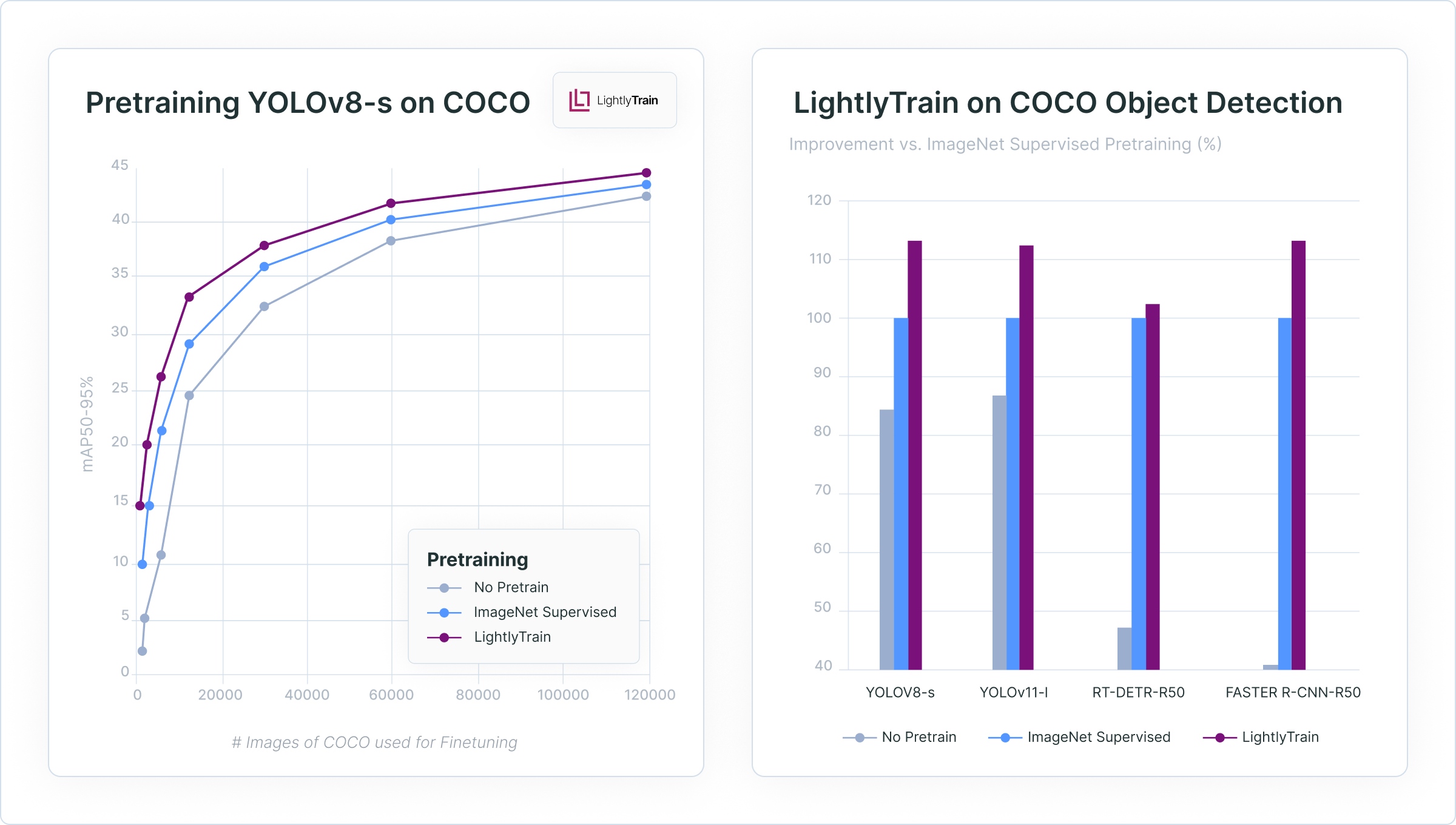
Pretrain any model architecture with unlabeled data by distilling the knowledge from DINOv2 or DINOv3 foundation models into your model. On the COCO dataset, YOLOv8-s models pretrained with LightlyTrain achieve high performance across all tested label fractions. These improvements hold for other architectures like YOLOv11, RT-DETR, and Faster R-CNN. See our announcement post for more benchmarks and details.
Usage
import lightly_train

if __name__ == "__main__":
    # Distill the knowledge from a DINOv3 teacher into a YOLOv8 model
    lightly_train.pretrain(
        out="out/my_experiment",
        data="my_data_dir",
        model="ultralytics/yolov8s",
        method="distillation",
        method_args={
            "teacher": "dinov3/vitb16",
        },
    )

    # Load model for fine-tuning
    model = YOLO("out/my_experiment/exported_models/exported_last.pt")
    model.train(data="coco8.yaml")
Pretraining (DINOv2 Foundation Models)
With LightlyTrain you can train your very own foundation model like DINOv2 on your data.
ImageNet-1K Results
| Implementation | Model | Val ImageNet k-NN |
|---|---|---|
| LightlyTrain | dinov2/vitl16 | 81.9% |
| DINOv2 | dinov2/vitl16 | 81.6% |
Models are pretrained on ImageNet-1k for 100 epochs and evaluated with a k-NN classifier on the ImageNet validation set.
Usage
import lightly_train

if __name__ == "__main__":
    # Pretrain a DINOv2 vision foundation model
    lightly_train.pretrain(
        out="out/my_experiment",
        data="my_data_dir",
        model="dinov2/vitb14",
        method="dinov2",
    )
Autolabeling
LightlyTrain provides simple commands to autolabel your unlabeled data using DINOv2 or DINOv3 pretrained models. This allows you to efficiently boost performance of your smaller models by leveraging all your unlabeled images.
ADE20K Results
| Implementation | Model | Autolabel | Val mIoU | Params (M) | Input Size |
|---|---|---|---|---|---|
| LightlyTrain | dinov3/vits16-eomt | ❌ | 0.466 | 21.6 | 518×518 |
| LightlyTrain | dinov3/vits16-eomt-ade20k | ✅ | 0.533 | 21.6 | 518×518 |
| LightlyTrain | dinov3/vitb16-eomt | ❌ | 0.544 | 85.7 | 518×518 |
| LightlyTrain | dinov3/vitb16-eomt-ade20k | ✅ | 0.573 | 85.7 | 518×518 |
The better results with auto-labeling were achieved by fine-tuning a ViT-H+ on the ADE20K dataset, which reaches 0.595 validation mIoU. This model was then used to autolabel 100k images from the SUN397 dataset. Using these labels, we subsequently fine-tuned the smaller models, and then used the ADE20k dataset for validation.
Usage
import lightly_train

if __name__ == "__main__":
    # Autolabel your data with a DINOv3 semantic segmentation model
    lightly_train.predict_semantic_segmentation(
        out="out/my_autolabeled_data",
        data="my_data_dir",
        model="dinov3/vitb16-eomt-coco",
        # Or use one of your own model checkpoints
        # model="out/my_experiment/exported_models/exported_best.pt",
    )

    # The autolabeled masks will be saved in this format:
    # out/my_autolabeled_data
    # ├── <image name>.png
    # ├── <image name>.png
    # └── …
Features
- Python, Command Line, and Docker support
- Built for high performance including multi-GPU and multi-node support
- Monitor training progress with MLflow, TensorBoard, Weights & Biases, and more
- Runs fully on-premises with no API authentication
- Export models in their native format for fine-tuning or inference
- Export models in ONNX or TensorRT format for edge deployment
Models
LightlyTrain supports the following model and workflow combinations.
Fine-tuning
| Model | Object Detection |
Instance Segmentation |
Panoptic Segmentation |
Semantic Segmentation |
Image Classification |
|---|---|---|---|---|---|
| DINOv3 | ✅ 🔗 | ✅ 🔗 | ✅ 🔗 | ✅ 🔗 | ✅ 🔗 |
| DINOv2 | ✅ 🔗 | ✅ 🔗 | ✅ 🔗 | ✅ 🔗 | ✅ 🔗 |
| EdgeCrafter | ✅ 🔗 | ✅ 🔗 | |||
| Any | ✅ 🔗 |
Distillation & Pretraining
| Model | Distillation | Pretraining |
|---|---|---|
| DINOv3 | ✅ 🔗 | |
| DINOv2 | ✅ 🔗 | ✅ 🔗 |
| Torchvision ResNet, ConvNext, ShuffleNetV2 | ✅ 🔗 | ✅ 🔗 |
| TIMM models | ✅ 🔗 | ✅ 🔗 |
| Ultralytics YOLOv5–YOLO26, RT-DETR | ✅ 🔗 | ✅ 🔗 |
| RT-DETR, RT-DETRv2 | ✅ 🔗 | ✅ 🔗 |
| RF-DETR | ✅ 🔗 | ✅ 🔗 |
| YOLOv12 | ✅ 🔗 | ✅ 🔗 |
| Custom PyTorch Model | ✅ 🔗 | ✅ 🔗 |
Contact us if you need support for additional models.
LightlyTrain in Research
- Unlabeled to Accurate: Self-Supervised Learning for Land Use Classification in Sentinel-2 Imagery
- Vision Foundry: A System for Training Foundational Vision AI Models
- EdgeCrafter: Compact ViTs for Edge Dense Prediction via Task-Specialized Distillation
- Real-Time Object Detection Meets DINOv3
Usage Events
LightlyTrain collects anonymous usage events to help us improve the product. We only
track training method, model architecture, and system information (OS, GPU, CI,
Container). To opt-out, set the environment variable:
export LIGHTLY_TRAIN_EVENTS_DISABLED=1
License
LightlyTrain offers flexible licensing options to suit your specific needs:
-
AGPL-3.0 License: Perfect for open-source projects, academic research, and community contributions. Share your innovations with the world while benefiting from community improvements.
-
Commercial License: Ideal for businesses and organizations that need proprietary development freedom. Enjoy all the benefits of LightlyTrain while keeping your code and models private. Includes model training and runtime license.
-
Free Community License: Available for students, researchers, startups in early stages, or anyone exploring or experimenting with LightlyTrain. Empower the next generation of innovators with full access to the world of pretraining.
Commercial Pricing
| Plan | Price | Eligibility |
|---|---|---|
| Startup | $5,000 / year | < $1M revenue or < 10 employees |
| Growth | $10,000 / year | < $10M revenue or < 100 employees |
| Enterprise | Custom | > $10M revenue or > 100 employees |
All commercial plans include a license for model training, edge deployment, and inference. Enterprise plans include priority support, a joint Slack channel, co-development engineering, and influence on the product roadmap.
Contact us to get started — we'll find the right option for your project!
Contact






1 maintainer

Metadata
1 maintainer
Release files for lightly-train 0.17.0
For a detailed explanation of source distributions (sdists) and built distributions (wheels), please see the package formats documentation.
Source distribution (sdist)
| File | Size | Uploaded | |
|---|---|---|---|
| lightly_train-0.17.0.tar.gz | 14.2 MB | Details |
Built distribution (wheel)
| File | Interpreter | ABI | Platform | Reset |
|---|---|---|---|---|
| lightly_train-0.17.0-py3-none-any.whl | Python 3 | none | any | Details |
Total release size: 15.2 MB
Release files / lightly_train-0.17.0.tar.gz
| Download URL | lightly_train-0.17.0.tar.gz |
|---|---|
| Size | 14.2 MB |
| Tags | Source |
|
SHA-256 checksum How to use checksums |
30d60278d244069195afdf4b082018dffb52b4a8dbdaf4bb7ca26f01fdc02aad
|
|
BLAKE2b-256 checksum How to use checksums |
d4c2794d38e69e625b316225a0464372b8e500cc816aaf19b909e262b45d94f4
|
| Upload date | |
|
Uploaded using Trusted Publishing? What is trusted publishing? |
No |
| Uploaded via |
twine/6.2.0 CPython/3.13.13
|
Release files / lightly_train-0.17.0-py3-none-any.whl
| Download URL | lightly_train-0.17.0-py3-none-any.whl |
|---|---|
| Size | 975.0 kB |
| Tags | Python 3 |
|
SHA-256 checksum How to use checksums |
8c01250ebdb07c61beb226e24036c891285c69aefeb6bf324940fe40464b3334
|
|
BLAKE2b-256 checksum How to use checksums |
8e7bd2f15fb03d1839ccd3d2a2cdd4679c283a84523a1744fee7a6d53b7f4ca1
|
| Upload date | |
|
Uploaded using Trusted Publishing? What is trusted publishing? |
No |
| Uploaded via |
twine/6.2.0 CPython/3.13.13
|














