
Flash is a framework for fast prototyping, finetuning, and solving most standard deep learning challenges


Project description

Collection of tasks for fast prototyping, baselining, finetuning and solving problems with deep learning
Installation • Docs • About • Prediction • Finetuning • Tasks • General Task • Contribute • Community • Website • License










Installation
Pip / conda
pip install lightning-flash
Master
pip install git+https://github.com/PytorchLightning/lightning-flash.git@master --upgrade
Source
git clone https://github.com/PyTorchLightning/lightning-flash.git
cd lightning-flash
pip install -e .
What is Flash
Flash is a framework of tasks for fast prototyping, baselining, finetuning and solving business and scientific problems with deep learning. It is focused on:
- Predictions
- Finetuning
- Task-based training
It is built for data scientists, machine learning practitioners, and applied researchers.
Scalability
Flash is built on top of PyTorch Lightning (by the Lightning team), which is a thin organizational layer on top of PyTorch. If you know PyTorch, you know PyTorch Lightning and Flash already!
As a result, Flash can scale up across any hardware (GPUs, TPUS) with zero changes to your code. It also has the best practices in AI research embedded into each task so you don't have to be a deep learning PhD to leverage its power :)
Predictions
# import our libraries
from flash.text import TextClassifier

# 1. Load finetuned task
model = TextClassifier.load_from_checkpoint("https://flash-weights.s3.amazonaws.com/text_classification_model.pt")

# 2. Perform inference from list of sequences
predictions = model.predict([
    "Turgid dialogue, feeble characterization - Harvey Keitel a judge?.",
    "The worst movie in the history of cinema.",
    "I come from Bulgaria where it 's almost impossible to have a tornado."
    "Very, very afraid"
    "This guy has done a great job with this movie!",
])
print(predictions)
Finetuning
First, finetune:
import flash
from flash import download_data
from flash.vision import ImageClassificationData, ImageClassifier

# 1. Download the data
download_data("https://pl-flash-data.s3.amazonaws.com/hymenoptera_data.zip", 'data/')

# 2. Load the data
datamodule = ImageClassificationData.from_folders(
    train_folder="data/hymenoptera_data/train/",
    valid_folder="data/hymenoptera_data/val/",
    test_folder="data/hymenoptera_data/test/",
)

# 3. Build the model
model = ImageClassifier(num_classes=datamodule.num_classes, backbone="resnet18")

# 4. Create the trainer. Run once on data
trainer = flash.Trainer(max_epochs=1)

# 5. Finetune the model
trainer.finetune(model, datamodule=datamodule, strategy="freeze")

# 7. Save it!
trainer.save_checkpoint("image_classification_model.pt")
Then use the finetuned model
# load the finetuned model
classifier = ImageClassifier.load_from_checkpoint('image_classification_model.pt')

# predict!
predictions = classifier.predict('data/hymenoptera_data/val/bees/65038344_52a45d090d.jpg")
print(predictions)
Tasks
Flash is built as a collection of community-built tasks. A task is highly opinionated and laser-focused on solving a single problem well, using state-of-the-art methods.
Example 1: Image classification
Flash has an ImageClassification task to tackle any image classification problem.
View example
To illustrate, Let's say we wanted to develop a model that could classify between ants and bees.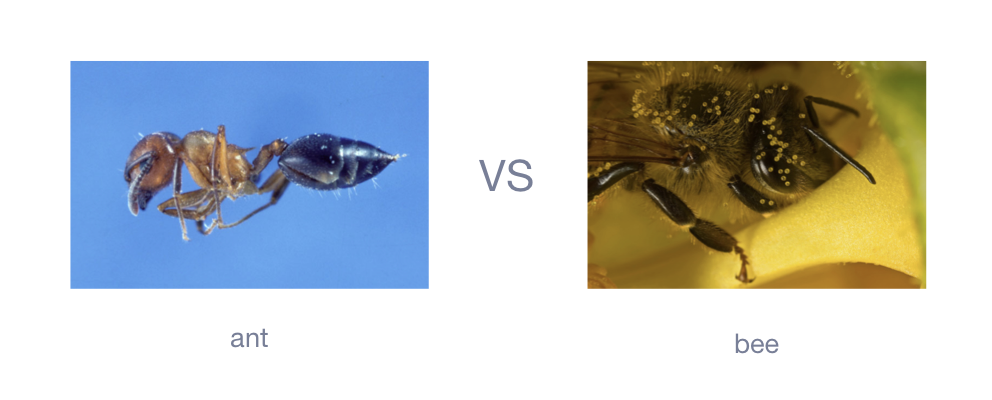
Here we classify ants vs bees.
import flash
from flash import download_data
from flash.vision import ImageClassificationData, ImageClassifier

# 1. Download the data
download_data("https://pl-flash-data.s3.amazonaws.com/hymenoptera_data.zip", 'data/')

# 2. Load the data
datamodule = ImageClassificationData.from_folders(
    train_folder="data/hymenoptera_data/train/",
    valid_folder="data/hymenoptera_data/val/",
    test_folder="data/hymenoptera_data/test/",
)

# 3. Build the model
model = ImageClassifier(num_classes=datamodule.num_classes)

# 4. Create the trainer. Run once on data
trainer = flash.Trainer(max_epochs=1)

# 5. Train the model
trainer.finetune(model, datamodule=datamodule, strategy="freeze_unfreeze")

# 6. Test the model
trainer.test()

# 7. Predict!
predictions = model.predict([
    "data/hymenoptera_data/val/bees/65038344_52a45d090d.jpg",
    "data/hymenoptera_data/val/bees/590318879_68cf112861.jpg",
    "data/hymenoptera_data/val/ants/540543309_ddbb193ee5.jpg",
])
print(predictions)
To run the example:
python flash_examples/finetuning/image_classifier.py
Example 2: Text Classification
Flash has a TextClassification task to tackle any text classification problem.
View example
To illustrate, say you wanted to classify movie reviews as positive or negative.import flash
from flash import download_data
from flash.text import TextClassificationData, TextClassifier
# 1. Download the data
download_data("https://pl-flash-data.s3.amazonaws.com/imdb.zip", 'data/')
# 2. Load the data
datamodule = TextClassificationData.from_files(
train_file="data/imdb/train.csv",
valid_file="data/imdb/valid.csv",
test_file="data/imdb/test.csv",
input="review",
target="sentiment",
batch_size=512
)
# 3. Build the model
model = TextClassifier(num_classes=datamodule.num_classes)
# 4. Create the trainer. Run once on data
trainer = flash.Trainer(max_epochs=1)
# 5. Fine-tune the model
trainer.finetune(model, datamodule=datamodule, strategy="freeze_unfreeze")
# 6. Test model
trainer.test()
# 7. Classify a few sentences! How was the movie?
predictions = model.predict([
"Turgid dialogue, feeble characterization - Harvey Keitel a judge?.",
"The worst movie in the history of cinema.",
"I come from Bulgaria where it 's almost impossible to have a tornado."
"Very, very afraid"
"This guy has done a great job with this movie!",
])
print(predictions)
To run the example:
python flash_examples/finetuning/classify_text.py
Example 3: Tabular Classification
Flash has a TabularClassification task to tackle any tabular classification problem.
View example
To illustrate, say we want to build a model to predict if a passenger survived on the Titanic.
from pytorch_lightning.metrics.classification import Accuracy, Precision, Recall
import flash
from flash import download_data
from flash.tabular import TabularClassifier, TabularData

# 1. Download the data
download_data("https://pl-flash-data.s3.amazonaws.com/titanic.zip", 'data/')

# 2. Load the data
datamodule = TabularData.from_csv(
    "./data/titanic/titanic.csv",
    test_csv="./data/titanic/test.csv",
    categorical_input=["Sex", "Age", "SibSp", "Parch", "Ticket", "Cabin", "Embarked"],
    numerical_input=["Fare"],
    target="Survived",
    val_size=0.25,
)

# 3. Build the model
model = TabularClassifier.from_data(datamodule, metrics=[Accuracy(), Precision(), Recall()])

# 4. Create the trainer. Run 10 times on data
trainer = flash.Trainer(max_epochs=10)

# 5. Train the model
trainer.fit(model, datamodule=datamodule)

# 6. Test model
trainer.test()

# 7. Predict!
predictions = model.predict("data/titanic/titanic.csv")
print(predictions)
To run the example:
python flash_examples/finetuning/tabular_data.py
A general task
Flash comes prebuilt with a task to handle a huge portion of deep learning problems.
import flash
from torch import nn, optim
from torch.utils.data import DataLoader, random_split
from torchvision import transforms, datasets
import pytorch_lightning as pl

# model
model = nn.Sequential(
    nn.Flatten(),
    nn.Linear(28 * 28, 128),
    nn.ReLU(),
    nn.Linear(128, 10)
)

# data
dataset = datasets.MNIST('./data_folder', download=True, transform=transforms.ToTensor())
train, val = random_split(dataset, [55000, 5000])

# task
classifier = flash.Task(model, loss_fn=nn.functional.cross_entropy, optimizer=optim.Adam)

# train
flash.Trainer().fit(classifier, DataLoader(train), DataLoader(val))
Infinitely customizable
Tasks can be built in just a few minutes because Flash is built on top of PyTorch Lightning LightningModules, which are infinitely extensible and let you train across GPUs, TPUs etc without doing any code changes.
import torch
import torch.nn.functional as F
from flash.core.classification import ClassificationTask

class LinearClassifier(ClassificationTask):
    def __init__(
        self,
        num_inputs,
        num_classes,
        loss_fn: Callable = F.cross_entropy,
        optimizer: Type[torch.optim.Optimizer] = torch.optim.SGD,
        metrics: Union[Callable, Mapping, Sequence, None] = [Accuracy()],
        learning_rate: float = 1e-3,
    ):
        super().__init__(
            model=None,
            loss_fn=loss_fn,
            optimizer=optimizer,
            metrics=metrics,
            learning_rate=learning_rate,
        )
        self.save_hyperparameters()

        self.linear = torch.nn.Linear(num_inputs, num_classes)

    def forward(self, x):
        return self.linear(x)

classifier = LinearClassifier()
...
When you reach the limits of the flexibility provided by tasks, then seamlessly transition to PyTorch Lightning which gives you the most flexibility because it is simply organized PyTorch.
Contribute!
The lightning + Flash team is hard at work building more tasks for common deep-learning use cases. But we're looking for incredible contributors like you to submit new tasks!
Join our Slack to get help becoming a contributor!
Community
For help or questions, join our huge community on Slack!
License
Please observe the Apache 2.0 license that is listed in this repository. In addition the Lightning framework is Patent Pending.
Project details
Release history Release notifications | RSS feed


Download files
Download the file for your platform. If you're not sure which to choose, learn more about installing packages.
Source Distribution
Built Distribution
Filter files by name, interpreter, ABI, and platform.
If you're not sure about the file name format, learn more about wheel file names.
Copy a direct link to the current filters
File details
Details for the file lightning-flash-0.1.0.tar.gz.
File metadata
- Download URL: lightning-flash-0.1.0.tar.gz
- Upload date:
- Size: 45.3 kB
- Tags: Source
- Uploaded using Trusted Publishing? No
- Uploaded via: twine/3.3.0 pkginfo/1.7.0 requests/2.25.1 setuptools/53.0.0 requests-toolbelt/0.9.1 tqdm/4.56.0 CPython/3.8.7
File hashes
| Algorithm | Hash digest | |
|---|---|---|
| SHA256 |
1dfdada660900188afdaee1a73d0b76509acc8b5c782df66f3fcfd7ea14c5064
|
|
| MD5 |
7b10540dc151adeb7a495980f83bee9b
|
|
| BLAKE2b-256 |
3bbe99912301746065098a8a90b3573e07bef50106bfd053757e766b76b141da
|
File details
Details for the file lightning_flash-0.1.0-py3-none-any.whl.
File metadata
- Download URL: lightning_flash-0.1.0-py3-none-any.whl
- Upload date:
- Size: 83.8 kB
- Tags: Python 3
- Uploaded using Trusted Publishing? No
- Uploaded via: twine/3.3.0 pkginfo/1.7.0 requests/2.25.1 setuptools/53.0.0 requests-toolbelt/0.9.1 tqdm/4.56.0 CPython/3.8.7
File hashes
| Algorithm | Hash digest | |
|---|---|---|
| SHA256 |
a62452e8b21f7727a6bdae9edb46785df3bbcf0a1f28de20e721df1c103131ed
|
|
| MD5 |
1475cd1bc31bf119043881a7e847d31e
|
|
| BLAKE2b-256 |
e7a83e5d558cf9e37b4b785221006fe1d6877e78a20787520f17e34e4f4b7fba
|






