
This release is a pre-release and may not be stable for production use.
limitry
The Limitry Python SDK puts a limit around costly work in a with block: guard checks before the block runs, and reserve reserves what the work will probably cost, then charges what it actually cost. Every API operation is a typed method too, sync or async.
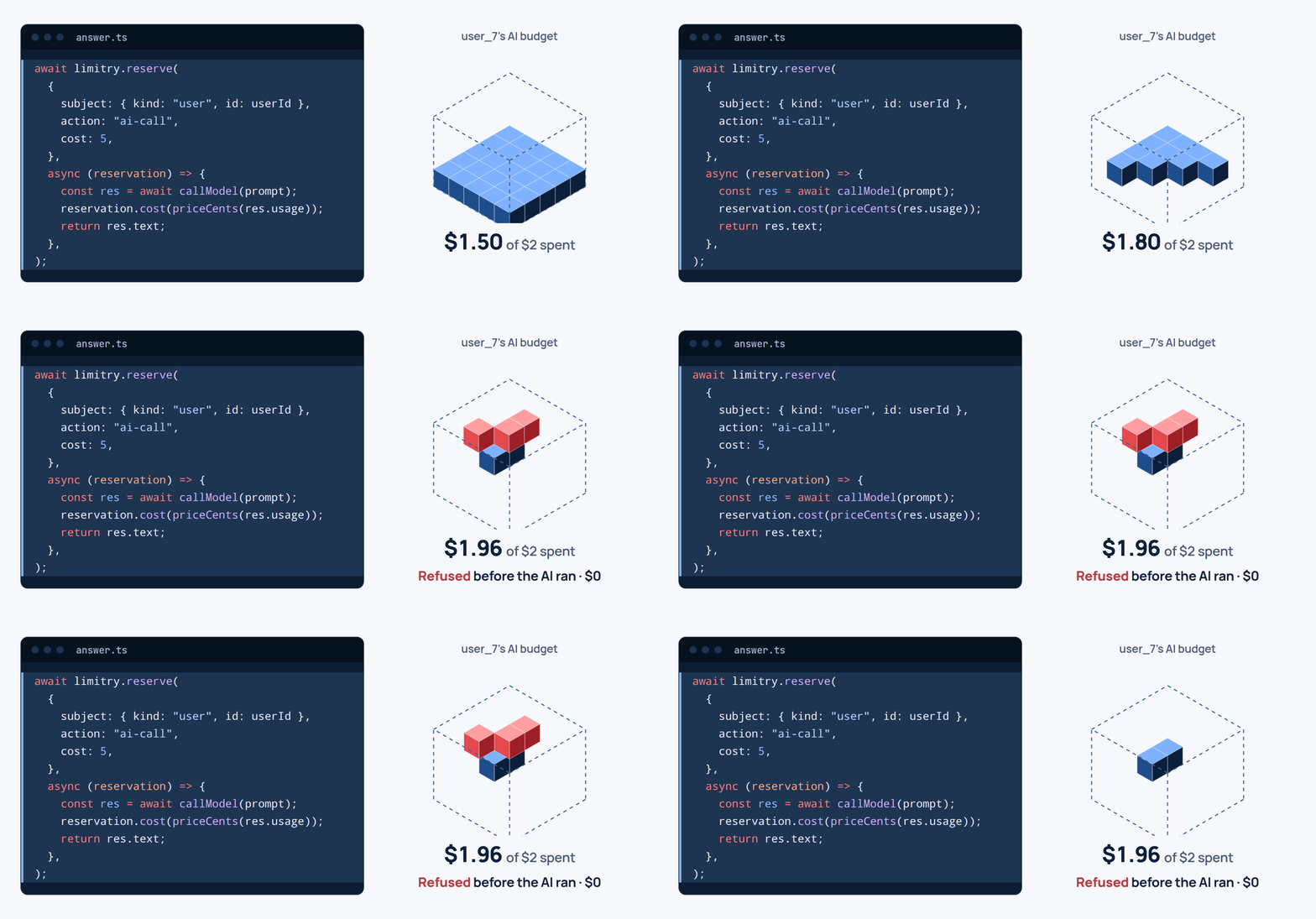
Limitry is the limits, credits and budgets layer for the software you build: give each of your users, teams, tenants, API keys or agents an allowance, and before any costly request one call tells your code whether it may happen.
Install
pip install limitry
Needs Python 3.10 or later. Set LIMITRY_API_KEY to a key from
Settings → Developers in the app. Use a test key (lim_test_…)
while you build. To pass the key yourself, use Limitry(api_key=key).
Charge what it actually cost
Say each of your users has a $2 AI budget a month, counted in cents.
You only know what a reply cost once it's done. reserve holds what it
will probably cost (5 cents here), runs the block, then charges what it
actually cost. If the block raises, reserve gives the hold back:
from limitry import Limitry

limitry = Limitry()  # reads LIMITRY_API_KEY

with limitry.reserve(
    subject={"kind": "user", "id": "usr_123"}, action="ai-call", cost=5
) as reservation:
    response = call_model(prompt)
    reservation.cost(price_cents(response.usage))  # your prices, in cents
Each hold counts until it's charged, so two replies at once can't overspend.
Guard work that always costs the same
When every request costs the same, guard is simpler. It checks the limit,
then runs the block only if it's allowed. Here it counts one request to
your API against a limit of 60 a minute for each key:
from limitry import LimitReached, Limitry

limitry = Limitry()  # reads LIMITRY_API_KEY

try:
    with limitry.guard(subject={"kind": "apikey", "id": "key_42"}, action="api-request"):
        response = handle_request(request)
except LimitReached as error:
    print(f"Try again in {error.retry_after_seconds} seconds")
A refusal raises LimitReached. If Limitry can't be reached, each
limit's fail mode decides: open lets the work run, closed raises
Unavailable.
Everything else
Every API operation is a typed method, named like its CLI command:
limitry limits create is limitry.limits.create(). For asyncio, use
AsyncLimitry.
from limitry import Limitry

limitry = Limitry()

# "200 cents per user per month for ai-call"
limitry.limits.create(
    subject={"kind": "user"},
    action="ai-call",
    amount=200,
    unit="cents",
    window="month",
)
A failure raises ApiError with the error's code, message, status
and request_id.
Links
Contributing
This repository is generated from Limitry's source on each release, so pull requests are ported there and credited (see CONTRIBUTING.md).
License
Licensed under the Apache License 2.0.
1 maintainer

Metadata
1 maintainer
Release files for limitry 1.0.0rc15
For a detailed explanation of source distributions (sdists) and built distributions (wheels), please see the package formats documentation.
Source distribution (sdist)
| File | Size | Uploaded | Provenance | Actions |
|---|---|---|---|---|
| limitry-1.0.0rc15.tar.gz | 40.1 kB | With provenance | Details for limitry-1.0.0rc15.tar.gz |
Built distribution (wheel)
| File | Interpreter | ABI | Platform | Actions Reset |
|---|---|---|---|---|
| limitry-1.0.0rc15-py3-none-any.whl | Python 3 | none | any | Details for limitry-1.0.0rc15-py3-none-any.whl |
Total release size: 84.7 kB
Release files / limitry-1.0.0rc15.tar.gz
| Download URL | limitry-1.0.0rc15.tar.gz |
|---|---|
| Size | 40.1 kB |
| Tags | Source |
|
SHA-256 checksum How to use checksums |
4b1d917a0a1c9fe36cb39e7d6f120411d1f7822c797f8da06b3228c1e24a2cd3
|
|
BLAKE2b-256 checksum How to use checksums |
f7794513f4d69ff1633a9d80e30e2a2c1c6fec3517139d4ab28bf2fca3c952cb
|
| Upload date | |
|
Uploaded using Trusted Publishing? What is trusted publishing? |
Yes |
| Uploaded via |
twine/7.0.0 CPython/3.13.14
|
Provenance
Provenance describes where a file came from. On PyPI, provenance is shared via attestations, which provide a verifiable record of the build or publishing details. View details, limitations and caveats.


PyPI Publish Attestation
PyPI verified that this artifact, at this checksum, originated from the publisher listed below.
Signed by GitHub Actions, verified by PyPI on Nov 21, 2026.
Transparency logRelease files / limitry-1.0.0rc15-py3-none-any.whl
| Download URL | limitry-1.0.0rc15-py3-none-any.whl |
|---|---|
| Size | 44.6 kB |
| Tags | Python 3 |
|
SHA-256 checksum How to use checksums |
71564e9bd5e8da3f42eceed1315ca4cb4d6e834dbb1b23f1217cb1f39e7d1320
|
|
BLAKE2b-256 checksum How to use checksums |
42f73461b2efd3be11fdb6585e40e2e827ccb902c05c303704a9e2974cf0905f
|
| Upload date | |
|
Uploaded using Trusted Publishing? What is trusted publishing? |
Yes |
| Uploaded via |
twine/7.0.0 CPython/3.13.14
|
Provenance
Provenance describes where a file came from. On PyPI, provenance is shared via attestations, which provide a verifiable record of the build or publishing details. View details, limitations and caveats.
PyPI Publish Attestation
PyPI verified that this artifact, at this checksum, originated from the publisher listed below.
Signed by GitHub Actions, verified by PyPI on Nov 21, 2026.
Transparency logSecurity for limitry 1.0.0rc15
Provenance
Provenance describes where a file came from. On PyPI, provenance is shared via attestations, which provide a verifiable record of the build or publishing details. View details, limitations and caveats.
Full provenance
Both files in this release have been uploaded with provenance metadata.
Attestation for limitry-1.0.0rc15.tar.gz
PyPI Publish Attestation
PyPI verified that this artifact, at this checksum, originated from the publisher listed below.
Signed by GitHub Actions, verified by PyPI on Nov 21, 2026.
Transparency logA note on package security
PyPI is a repository for distributing packages, not a service for auditing them. While third-party security researchers and our staff do their best to detect and remove malicious packages, PyPI cannot guarantee the quality, security or suitability of any given package.
To learn more about protecting yourself from malicious actors, visit our package security documentation.














