
Limn
to limn: to depict or describe; to paint.
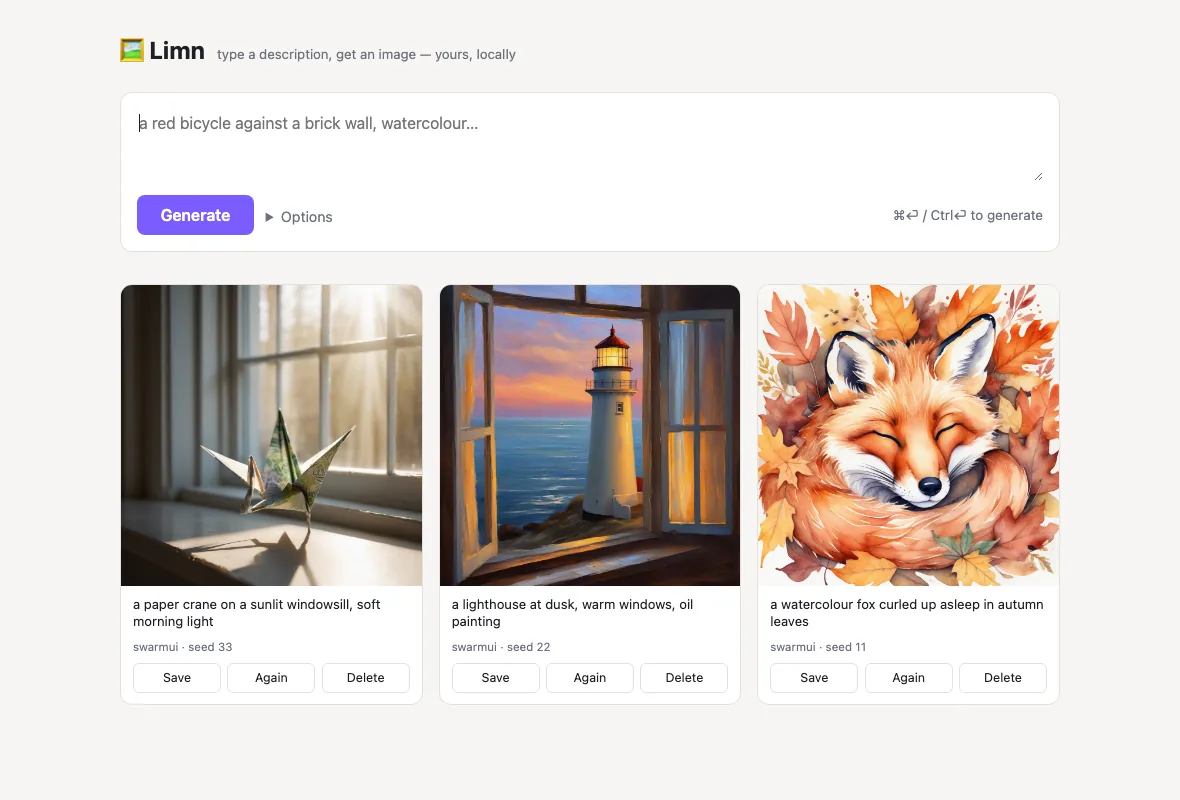
A small, privacy-first tool that turns a text description into an image. Type a prompt, get a picture. No account, minimal options, bring your own provider.
Try the demo at demo.limn.borck.dev, or get the desktop app for macOS, Windows and Linux at limn.borck.dev. Prefer the terminal?
pip install limn

limn "a red bicycle against a brick wall" -o bike.png
- Type a description and get an image.
- No account, private by default. Your prompts and images are yours, and the only network request goes to the provider you chose.
- Bring your own provider: self-hosted SwarmUI or any OpenAI-compatible endpoint, or a cloud key for Google Imagen, OpenAI or DALL·E. Swap it with one setting.
- Minimal by design. Prompt, size, count, seed. If you want inpainting, ControlNet and node graphs, install something bigger.
Quick start
Pick whichever provider you already have:
# Self-hosted SwarmUI (free, your GPU)
export SWARMUI_BASE_URL=https://image.example.org
export SWARMUI_TOKEN=...   # only if fronted by auth
limn "watercolour fox" --provider swarmui

# Any OpenAI-compatible /v1/images endpoint (LocalAI, ...)
export OPENAI_BASE_URL=http://localhost:8080/v1
limn "watercolour fox" --provider openai-compatible

# Google Imagen (cheap, ~$0.02/image on the Fast tier)
export GEMINI_API_KEY=...
limn "watercolour fox" --provider gemini

# OpenAI Images
export OPENAI_API_KEY=...
limn "watercolour fox" --provider openai
Then set your provider once so you never pass --provider again:
limn --init-config        # writes a commented ./limn.yaml template
mv limn.yaml ~/.limn.yaml # personal defaults, used everywhere
Usage
limn "a red bicycle against a brick wall" -o bike.png
limn "watercolour fox" --provider swarmui --size 1024x1024 --count 4 --seed 42
limn "pixel art, a fox" --lora pixel-art-xl:1.0 --cfg 5 --steps 30
limn --from prompts.txt -M           # batch a prompt list, with metadata sidecars
| Option | What |
|---|---|
-p, --provider |
swarmui, openai-compatible, openai, gemini |
-m, --model |
Model name (provider-specific) |
-s, --size |
e.g. 1024x1024 (Imagen maps to the nearest aspect ratio) |
-n, --count |
Number of images (1-10) |
--seed |
Reproducibility, where the backend supports it (SwarmUI) |
--negative |
Negative prompt, where supported (SwarmUI) |
--lora |
LoRA as name[:weight], repeatable (SwarmUI; unknown names error) |
--cfg, --steps, --sampler, --scheduler |
SDXL knobs (SwarmUI; others warn and ignore) |
--from |
Read prompts from a file (one per line, - for stdin); each auto-named |
-M, --metadata |
Write a <image>.json sidecar of the generation params |
-o, --out |
Output file; default is a slug of the prompt, never overwritten |
-c, --config |
Explicit config file |
limn models asks your provider which models it offers. SwarmUI requires
picking one, for example limn "a fox" -m juggernautXL_v9. The web UI and
desktop Settings have a matching "fetch models" button. limn models --loras
lists the server's LoRAs instead (SwarmUI only), with the trigger phrase and
description when the server has that metadata. Many LoRAs only kick in when
their trigger word appears in the prompt.
Config
Layered, later wins: built-in defaults, then ~/.limn.yaml (your provider and
keys, set once), then ./limn.yaml, then CLI flags. Secrets are referenced as
${VAR} so no plaintext keys live in files:
provider: swarmui
size: [1024, 1024]

providers:            # keep several configured; swap with `provider:`
  swarmui:
    base_url: https://image.example.org
    model: juggernautXL_v9
    api_key: "${SWARMUI_TOKEN}"      # bearer; or use username/password for Basic auth
  swarmui-basic:                     # a second server under its own label
    type: swarmui                    #   which provider class to use
    base_url: https://image2.example.org
    username: admin
    password: "${SWARMUI_PASS}"
  gemini:
    model: imagen-4.0-fast-generate-001
SwarmUI auth is auto-detected: username plus password uses HTTP Basic (for
a reverse proxy in front of SwarmUI); otherwise api_key uses Bearer. A
block's type: lets you run several servers of the same kind under distinct
labels.
Web UI
pip install "limn[serve]"
limn serve                # opens http://127.0.0.1:5466/ in your browser
One page: type a prompt, click Generate, and the image appears with Save (to disk), Again (regenerate) and Delete. The session gallery lives in the server process's memory only, so nothing touches disk until you click Save.
Binds 127.0.0.1 by default. Binding any other host requires a token
(--token, or one is generated and printed); useful flags: --port,
--out-dir, --no-browser.
Hosting a shared demo
A live instance runs at demo.limn.borck.dev.
limn serve --demo (or LIMN_DEMO=1) runs a public instance with guardrails
instead of a token:
- 10 images per hour per IP
- provider and model locked to the server config
- one image per request, max 1024px
- server-side Save disabled, so visitors download instead
- gallery entries expire after 15 minutes
- a banner explaining the demo and how to install
See docs/demo-deploy.md.
Desktop app
A native app (Tauri) for people who don't live in a terminal. Install it, pick
your provider in Settings (server URL and API key), then type and generate.
First launch bootstraps a private Python runtime via uv (about a minute, no
system Python needed); images save to Pictures/Limn. Installers for macOS,
Windows and Linux are built by CI from desktop/ and published at
limn.borck.dev (or the
GitHub releases page). macOS
builds are code signed and notarized; Windows builds are unsigned ("More info,
then Run anyway").
Roadmap
The CLI, web UI (limn serve), demo mode and desktop app are all in place. See
SPEC.md for the full specification.
Companion to slide-stream, which shares the same image-provider approach.
1 maintainer

Metadata
1 maintainer
Release files for limn 0.4.6
For a detailed explanation of source distributions (sdists) and built distributions (wheels), please see the package formats documentation.
Source distribution (sdist)
| File | Size | Uploaded | Provenance | Actions |
|---|---|---|---|---|
| limn-0.4.6.tar.gz | 463.7 kB | Without provenance | Details for limn-0.4.6.tar.gz |
Built distribution (wheel)
| File | Interpreter | ABI | Platform | Actions Reset |
|---|---|---|---|---|
| limn-0.4.6-py3-none-any.whl | Python 3 | none | any | Details for limn-0.4.6-py3-none-any.whl |
Total release size: 498.9 kB
Release files / limn-0.4.6.tar.gz
| Download URL | limn-0.4.6.tar.gz |
|---|---|
| Size | 463.7 kB |
| Tags | Source |
|
SHA-256 checksum How to use checksums |
35c94cf7719eb4d565f4f63e492cfb1a93d28b4b013391bafc901d0d0dafbc65
|
|
BLAKE2b-256 checksum How to use checksums |
24535286456b2df27ad70380f5b75b6ca4ddd2f6dfadc0c28f5999809c902824
|
| Upload date | |
|
Uploaded using Trusted Publishing? What is trusted publishing? |
No |
| Uploaded via |
twine/7.0.0 CPython/3.13.0
|
Release files / limn-0.4.6-py3-none-any.whl
| Download URL | limn-0.4.6-py3-none-any.whl |
|---|---|
| Size | 35.2 kB |
| Tags | Python 3 |
|
SHA-256 checksum How to use checksums |
d9316a7ed373aabce63525b763266bfe531d499ad38d2c98faf721795eccbd9b
|
|
BLAKE2b-256 checksum How to use checksums |
4edbdb0fc0851298f8c9b21f032dde1cd552129b287b418eb791db25534edb5f
|
| Upload date | |
|
Uploaded using Trusted Publishing? What is trusted publishing? |
No |
| Uploaded via |
twine/7.0.0 CPython/3.13.0
|
Security for limn 0.4.6
Provenance
Provenance describes where a file came from. On PyPI, provenance is shared via attestations, which provide a verifiable record of the build or publishing details. View details, limitations and caveats.
No provenance found
None of the files in this release were uploaded with provenance metadata.
A note on package security
PyPI is a repository for distributing packages, not a service for auditing them. While third-party security researchers and our staff do their best to detect and remove malicious packages, PyPI cannot guarantee the quality, security or suitability of any given package.
To learn more about protecting yourself from malicious actors, visit our package security documentation.














