
Project description
LinkTetrado is algorithm designed for the identification and classification of multimeric nucleotide assemblies in nucleic acid structures. LinkTetrado automatically identifies nucleotides interacting with tetrads in a planar arrangement, allowing for the detection of pentads, hexads, heptads, octads, and beyond. It analyzes nucleic acid 3D structures, accepting both PDB and mmCIF file formats. It leverages the ElTetrado engine to extract detailed structural information about base pairs and tetrads in an input structure. Next, it searches the space in the vicinity of tetrads for possible nucleotides that could interact with the tetrads.
Polyadic motifs
Polyadic motifs - such as triads (3 bases), tetrads (4), pentads (5), hexads (6), heptads (7), and octads (8) - are formed when three or more nucleotides interact through hydrogen bonding, typically through their Hoogsteen or sugar edges, resulting in stable, ring-like networks where each base generally forms bonds with two adjacent bases. These polyadic motifs play a crucial role in enhancing the stability and structural complexity of nucleic acids and are involved in essential processes, including gene regulation and molecular recognition. The figure below illustrates schematic representations of example polyadic motifs in a cut, top down 3D visualization and a simple 2D graph.
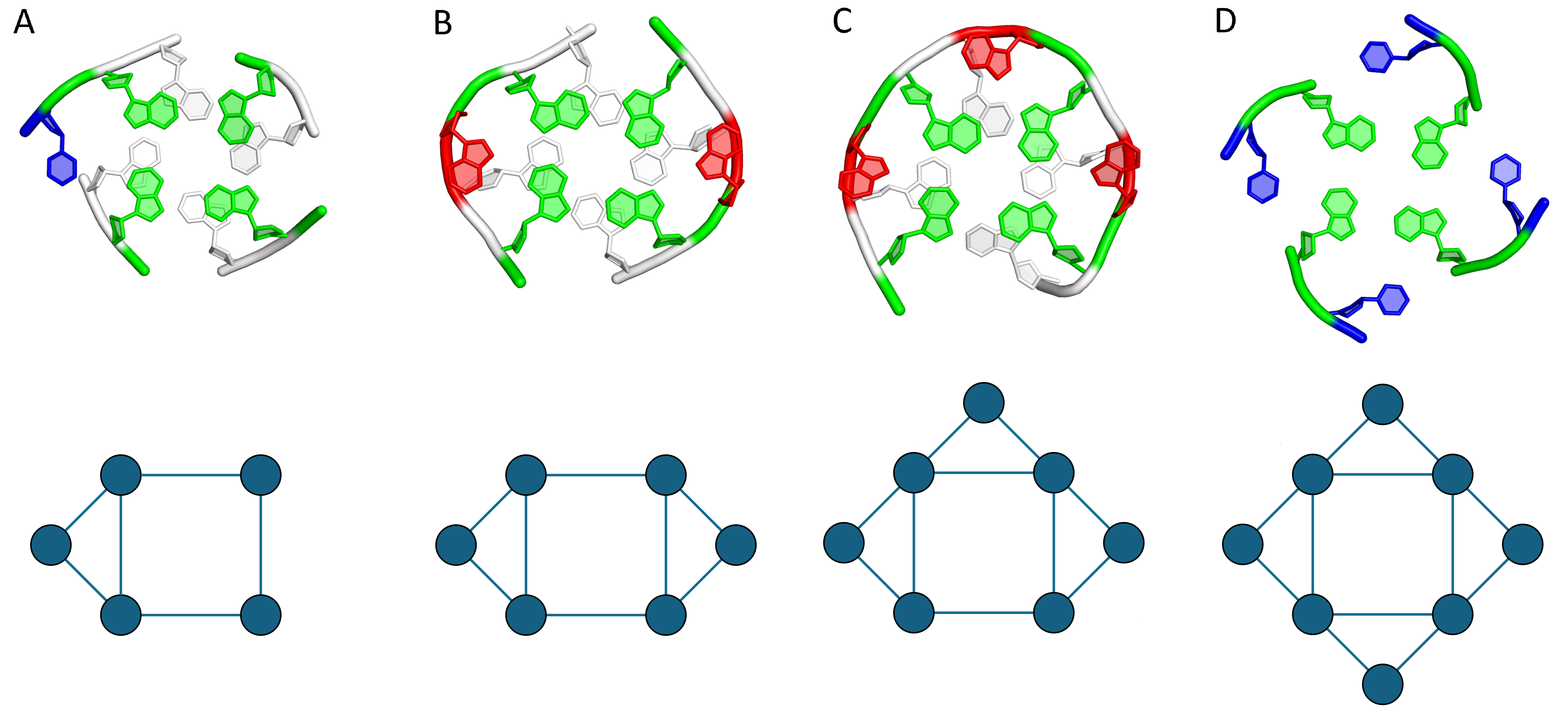
Installation
Please run:
pip install linktetrado
Dependencies
The project is written in Python 3.8+ and requires NumPy, and ElTetrado (Zok et al., 2022; Popenda et al., 2020; Zok et al., 2020).
LinkTetrado parses the output of ElTetrado. It can also process PDB or PDBx/mmCIF files which will be first analyzed internally with ElTetrado.
Usage
usage: linktetrado [-h] [-i INPUT] [--print-eltetrado]
                   [--tilt-max TT_MAX] [--tilt-avg TT_AVG]
                   [--height-max HT_MAX] [--height-avg HT_AVG]
                   [--dist-in-max DT_INMAX] [--dist-out-max DT_OUTMAX]
                   [--lax-order] [-m MODEL]
                   [--stacking-mismatch STACKING_MISMATCH] [--strict]
                   [--no-reorder]

options:
  -h, --help            show this help message and exit
  -i INPUT, --input INPUT
                        path to input PDB, PDBx/mmCIF file.
  --print-eltetrado     (optional) should ElTetrado analysis output also
                        be provided alongside multimer analysis.
  --tilt-max TT_MAX     (optional) maximum tilt in degrees between
                        potential polyad candidate nucleotide and all
                        tetrad nucleotides [default=55]
  --tilt-avg TT_AVG     (optional) average tilt in degrees between
                        potential polyad candidate nucleotide and all
                        tetrad nucleotides [default=45]
  --height-max HT_MAX   (optional) maximum height difference in Angstrem
                        between between potential polyad candidate
                        nucleotide and all tetrad nucleotides
                        [default=3.7]
  --height-avg HT_AVG   (optional) average height difference in Angstrem
                        between between potential polyad candidate
                        nucleotide and all tetrad nucleotides
                        [default=3.15]
  --dist-in-max DT_INMAX
                        (optional) maximum distance in Angstrem between
                        inner atoms between potential polyad candidate
                        nucleotide and all tetrad nucleotides
                        [default=13.75]
  --dist-out-max DT_OUTMAX
                        (optional) maximum distance in Angstrem between
                        outer atoms between potential polyad candidate
                        nucleotide and all tetrad nucleotides
                        [default=12.5]
  --lax-order           (optional) adjusts the algorithm’s filtering
                        mode, enabling the detection of polyads with
                        varying orders within a single stack
  -m MODEL, --model MODEL
                        (optional, ElTetrado) model number to process
  --stacking-mismatch STACKING_MISMATCH
                        a perfect tetrad stacking covers 4 nucleotides;
                        this option can be used with value 1 or 2 to
                        allow this number of nucleotides to be non-
                        stacked with otherwise well aligned tetrad
                        [default=2]
  --strict              nucleotides in tetrad are found when linked only
                        by cWH pairing
  --no-reorder          chains of bi- and tetramolecular quadruplexes
                        should be reordered to be able to have them
                        classified; when this is set, chains will be
                        processed in original order, which for
                        bi-/tetramolecular means that they will likely be
                        misclassified; use with care!
Examples
The repository contains 4 example structures that contain pentad, hexad, heptad and octad motifs as well as the expected default output from the program that is expected for each of them. The examples include structures 1JJP (pentad), 1EEG (hexad), 1oz8 (heptad), 1n7a (octad).
Bibliography
-
Zok T, Popenda M, Szachniuk M (2020) ElTetrado: a tool for identification and classification of tetrads and quadruplexes, BMC Bioinformatics 21:40 (doi:10.1186/s12859-020-3385-1).
-
Popenda M, Miskiewicz J, Sarzynska J, Zok T, Szachniuk M (2020) Topology-based classification of tetrads and quadruplex structures, Bioinformatics 36(4):1129-1134 (doi:10.1093/bioinformatics/btz738).
-
Zok T, Kraszewska N, Miskiewicz J, Pielacinska P, Zurkowski M, Szachniuk M (2022) ONQUADRO: a database of experimentally determined quadruplex structures, Nucleic Acids Research 50(D1):D253-D258 (doi:10.1093/nar/gkab1118).
1 maintainer

Metadata
1 maintainer
Release files for linktetrado 1.0.0
For a detailed explanation of source distributions (sdists) and built distributions (wheels), please see the package formats documentation.
Source distribution (sdist)
| File | Size | Uploaded | |
|---|---|---|---|
| linktetrado-1.0.0.tar.gz | 13.5 kB | Details |
Built distribution (wheel)
| File | Interpreter | ABI | Platform | Reset |
|---|---|---|---|---|
| linktetrado-1.0.0-py3-none-any.whl | Python 3 | none | any | Details |
Total release size: 25.0 kB
Release files / linktetrado-1.0.0.tar.gz
| Download URL | linktetrado-1.0.0.tar.gz |
|---|---|
| Size | 13.5 kB |
| Tags | Source |
|
SHA-256 checksum How to use checksums |
414cd8bb97b95a90188cdeb17fb376b50557e2be8ffcbd8a92a3f5f745823ae3
|
|
BLAKE2b-256 checksum How to use checksums |
347b5d566f764f9543381ee9da1feab69ceeda60788e1182bf3fc1c6526b13e3
|
| Upload date | |
|
Uploaded using Trusted Publishing? What is trusted publishing? |
No |
| Uploaded via |
twine/6.2.0 CPython/3.10.12
|
Release files / linktetrado-1.0.0-py3-none-any.whl
| Download URL | linktetrado-1.0.0-py3-none-any.whl |
|---|---|
| Size | 11.5 kB |
| Tags | Python 3 |
|
SHA-256 checksum How to use checksums |
881ae8b2f75af42a6075a47255217ab28716b5fb33edcf3d1f9cfb5c7c14cada
|
|
BLAKE2b-256 checksum How to use checksums |
70a11b3d9b92fc3cd22b921347c1cb3cbedfa0929db1fc40ce8435d18a93b22d
|
| Upload date | |
|
Uploaded using Trusted Publishing? What is trusted publishing? |
No |
| Uploaded via |
twine/6.2.0 CPython/3.10.12
|













