
Lion
Lion is a very flexible yet fast library for mapping objects to
dictionaries. It uses a declarative API and supports a query language
similar to GraphQL. Unlike other serialization libraries it also
allows to skip entire fields instead of having a null value
in the dictionary.
It is inspired by libraries like serpy, marshmallow, Django REST Framework and Kim.
Example
import lion

class GroupMapper(lion.Mapper):
    id = lion.UUIDField()
    name = lion.StrField()

class UserMapper(lion.Mapper):
    id = lion.UUIDField()
    email = lion.StrField(condition=lion.skip_empty)
    first_name = lion.StrField()
    last_name = lion.StrField()
    groups = lion.ListField(GroupMapper)

user = User(
    id=UUID('ad94d0e8-2526-4d9b-ad76-0fbffcf41033'),
    email='john.doe@example.com',
    first_name='John',
    last_name='Doe',
    groups=[
        Group(
            id=UUID('95a326fc-32e5-4d9b-a385-1ea1257d98da'),
            name='Awesome people'
        )
    ]
)

# Dump all fields to a dictionary
assert UserMapper().dump(user) == {
    'id': 'ad94d0e8-2526-4d9b-ad76-0fbffcf41033',
    'email': 'john.doe@example.com',
    'first_name': 'John',
    'last_name': 'Doe',
    'groups': [
        {
            'id': '95a326fc-32e5-4d9b-a385-1ea1257d98da',
            'name': 'Awesome people'
        }
    ]
}

# Load user object from a dictionary
assert user == UserMapper().load({
    'id': 'ad94d0e8-2526-4d9b-ad76-0fbffcf41033',
    'email': 'john.doe@example.com',
    'first_name': 'John',
    'last_name': 'Doe',
    'groups': [
        {
            'id': '95a326fc-32e5-4d9b-a385-1ea1257d98da',
            'name': 'Awesome people'
        }
    ]
})
Query language
By using the GraphQL-like query language it is possible to dump and load only parts of a given structure:
# Dump a subset of fields
assert UserMapper('{id,email}').dump(user) == {
    'id': 'ad94d0e8-2526-4d9b-ad76-0fbffcf41033',
    'email': 'john.doe@example.com'
}

# Dump subset of a nested mapper
assert UserMapper('{id,email,groups{id}}').dump(user) == {
    'id': 'ad94d0e8-2526-4d9b-ad76-0fbffcf41033',
    'email': 'john.doe@example.com',
    'groups': [
        'id': '95a326fc-32e5-4d9b-a385-1ea1257d98da'
    ]
}
Performance
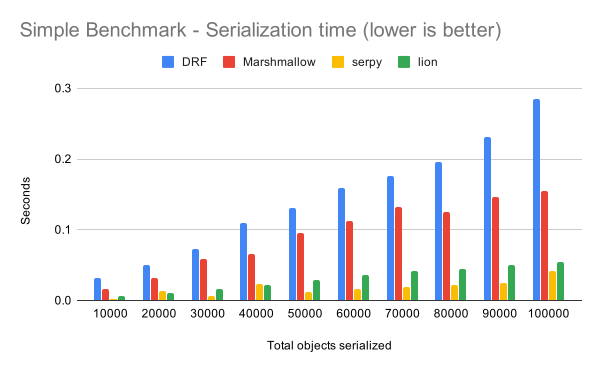
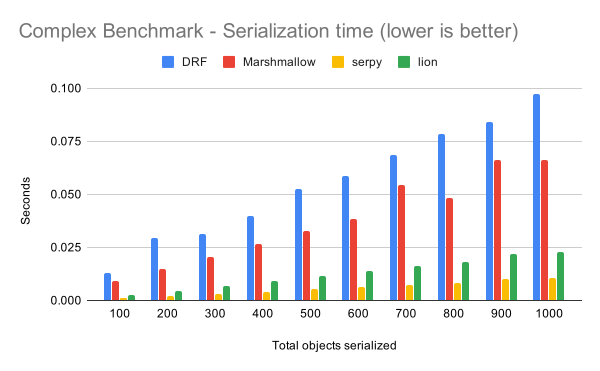
The performance is somewhat slower than serpy but still far ahead of marshmallow and Django REST Framework.
Caveats
Lion also supports loading (serialization/marshalling) of data but currently does not perform any kind of validation. This is not a big deal if using Lion as part of a project which uses something like connexion which already performs validation using the provided OpenAPI specification file. Just be warned that loading an unvalidated data structure using Lion might result in somewhat weird looking data.
1 maintainer

Metadata
1 maintainer
Release files for lion 0.5.0
For a detailed explanation of source distributions (sdists) and built distributions (wheels), please see the package formats documentation.
Source distribution (sdist)
| File | Size | Uploaded | Provenance | Actions |
|---|---|---|---|---|
| lion-0.5.0.tar.gz | 7.3 kB | Without provenance | Details for lion-0.5.0.tar.gz |
Built distribution (wheel)
| File | Interpreter | ABI | Platform | Actions Reset |
|---|---|---|---|---|
| lion-0.5.0-py3-none-any.whl | Python 3 | none | any | Details for lion-0.5.0-py3-none-any.whl |
Total release size: 15.3 kB
Release files / lion-0.5.0.tar.gz
| Download URL | lion-0.5.0.tar.gz |
|---|---|
| Size | 7.3 kB |
| Tags | Source |
|
SHA-256 checksum How to use checksums |
f5e8fc19653ce702702ce8ba03723abb030505cf2949935532003b12fd1f87ff
|
|
BLAKE2b-256 checksum How to use checksums |
399913d5473c5b586f6f3b4d92d69f6ee8d2dac9b4e426d1c9a38bfc7f45ee8a
|
| Upload date | |
|
Uploaded using Trusted Publishing? What is trusted publishing? |
No |
| Uploaded via |
poetry/1.7.1 CPython/3.10.12 Linux/5.15.0-92-generic
|
Release files / lion-0.5.0-py3-none-any.whl
| Download URL | lion-0.5.0-py3-none-any.whl |
|---|---|
| Size | 8.0 kB |
| Tags | Python 3 |
|
SHA-256 checksum How to use checksums |
ce567e6904e49bdde44ac75a892a289d9d655f26fb414be35b50344f0f69c476
|
|
BLAKE2b-256 checksum How to use checksums |
165f02a5031ab2e375749eb916724d1da3eda51ce944c3607b00b2cdf6800ea1
|
| Upload date | |
|
Uploaded using Trusted Publishing? What is trusted publishing? |
No |
| Uploaded via |
poetry/1.7.1 CPython/3.10.12 Linux/5.15.0-92-generic
|
Security for lion 0.5.0
Provenance
Provenance describes where a file came from. On PyPI, provenance is shared via attestations, which provide a verifiable record of the build or publishing details. View details, limitations and caveats.
No provenance found
None of the files in this release were uploaded with provenance metadata.
A note on package security
PyPI is a repository for distributing packages, not a service for auditing them. While third-party security researchers and our staff do their best to detect and remove malicious packages, PyPI cannot guarantee the quality, security or suitability of any given package.
To learn more about protecting yourself from malicious actors, visit our package security documentation.














