
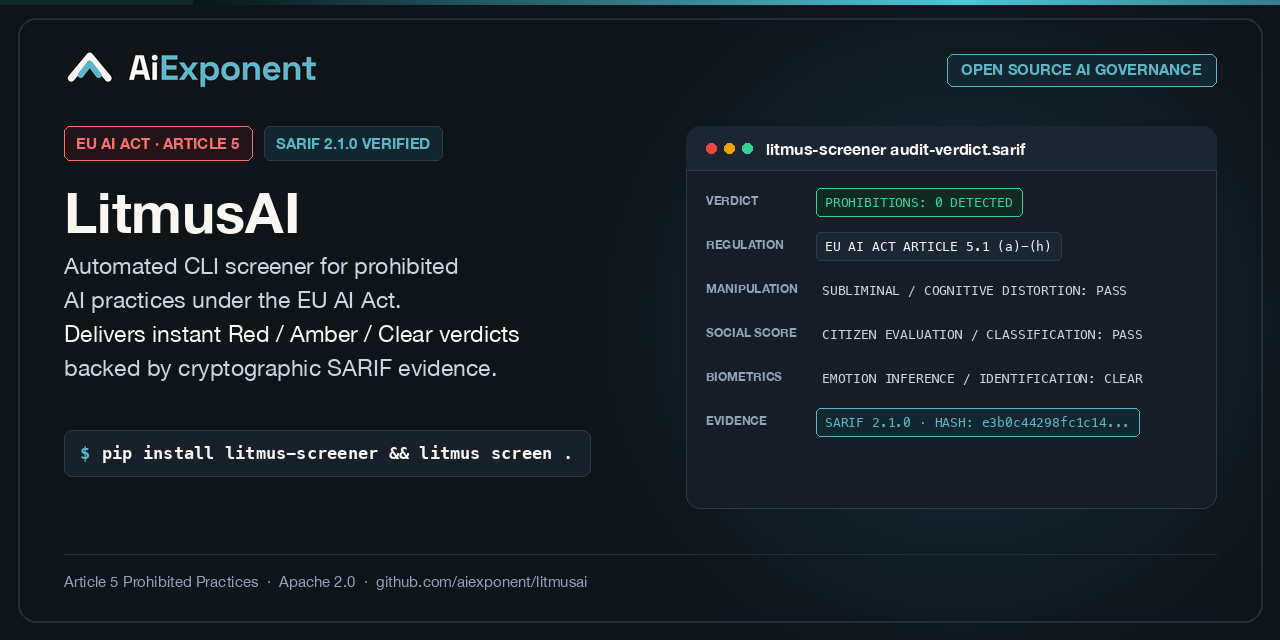
LitmusAI
Free, deterministic Article 5 screener for the EU AI Act.







LitmusAI 1.1.0 ships with the AiExponent reference ruleset
ruleset-2024-1689-v1.1(UNREVIEWED: internal panel authored, no external lawyer review). Apache 2.0, AS IS.The package's CLI surface, JSON/SARIF schema, and BYO-ruleset contract are stable for production integration. The reference ruleset has been authored and reviewed by an internal AiExponent panel (six engineering + governance roles) but has not been reviewed by a qualified EU AI Act practising lawyer. Every screening report carries this disclosure prominently. Customers who require lawyer-reviewed output can supply their own signed ruleset via the BYO mechanism; see
docs/ruleset-authoring.md.The legal-review status is not tied to a version number.
litmus --versionprintsruleset_legal_status: REVIEWEDwhen the active ruleset carries a signature block, andUNREVIEWEDwhen it does not. LitmusAI checks that the block is well formed; it does not verify the signature cryptographically or check who the signer is, so that line records what the ruleset author declared, not proof of a qualified legal review. Tracked under Legal review status below.
The Problem
On February 2, 2025, Article 5 of the EU AI Act (Regulation (EU) 2024/1689) entered into active legal enforcement across all 27 EU member states.
Placing a prohibited AI practice on the market or putting it into service is strictly illegal and carries statutory administrative fines of up to €35,000,000 or 7% of total worldwide annual turnover.
Most engineering and product teams do not have an in-house EU AI Act counsel to review every model prompt, feature iteration, or system deployment. LitmusAI answers one critical question in your terminal or CI pipeline before you deploy:
"Is this AI practice prohibited under Article 5?"
Screen your system against all ten statutory categories of Article 5(1): the original eight, points (a) to (h), and the two inserted by Regulation (EU) 2026/1744, points (ba) and (bb), which apply from 2 December 2026. Receive a per-category Red / Amber / Clear verdict with exact legal citations, confidence levels, and concrete remediation advice, in under 60 seconds, completely offline, and without uploading sensitive system descriptions to any third-party server.
Built by AI Exponent LLC. Apache 2.0. Runs entirely offline after pip install.
Quick Start
pip install litmus-screener # the brand is "LitmusAI"; the PyPI distribution is "litmus-screener"
# 1. Quick screen from a plain-text prompt
litmus screen --describe "a chatbot for mental health support for teenagers"

# 2. Or initialize a structured declaration for your system
litmus init                                         # creates system.yaml starter template
litmus screen system.yaml --output report.json      # full ten-category evaluation

# 3. Export audit-ready reports for legal or security teams
litmus export report.json -o report.sarif --format sarif

Why LitmusAI
| Evaluation Method | Cost | Turnaround | Deterministic / Repeatable? | Offline / Zero-Telemetry? |
|---|---|---|---|---|
| Big 4 Consulting | €50K–€150K | 4–8 Weeks | ❌ No (Advisory opinion) | ❌ No (NDAs & data sharing) |
| Enterprise GRC Platforms | $40K–$120K/yr | Weeks | ⚠️ Partial | ❌ No (Transfers system specs to cloud) |
| Internal Spreadsheets | "Free" | Days | ❌ No (Human error) | ⚠️ Manual |
| LitmusAI | Free (Apache 2.0) | < 60 seconds | ✅ Yes (Deterministic hash) | ✅ Yes (100% offline, zero network) |
System Architecture
LitmusAI operates as a deterministic, offline static-analysis pipeline:
graph TB
    subgraph Inputs ["1. Input Specifications"]
        INP1["Prompt Description<br/><code>litmus screen --describe '...'</code>"]
        INP2["Declarative YAML<br/><code>system.yaml</code>"]
        INP3["CI/CD Gate<br/><code>GitHub Actions / Pre-commit</code>"]
    end

    subgraph Core ["2. Deterministic Screening Engine"]
        AST["Safe AST Evaluator<br/><em>(Constrained expressions, zero eval, zero Python execution)</em>"]
        RULE["Article 5 Reference Ruleset<br/><em>(28 rules covering 5.1.a to 5.1.h, 5.1.ba and 5.1.bb)</em>"]
        BYO["Bring-Your-Own Ruleset<br/><em>(Optional lawyer-signed JSON via litmus use-ruleset)</em>"]
    end

    subgraph Integrity ["3. Verification & Scoring"]
        CONF["Confidence Scorer<br/><em>(Conservative: Amber preferred on ambiguity)</em>"]
        HASH["RFC 8785 Canonical Digest<br/><em>(SHA-256 tamper-evident input hash)</em>"]
    end

    subgraph Outputs ["4. Audit-Ready Artifacts"]
        OUT1["Rich Terminal UI<br/><em>(Color-coded Red / Amber / Clear table)</em>"]
        OUT2["SARIF 2.1.0 Report<br/><em>(GitHub Security tab & GitLab SAST)</em>"]
        OUT3["JSON / Markdown / PDF<br/><em>(Reports for legal and security review)</em>"]
    end

    INP1 & INP2 & INP3 --> AST
    RULE & BYO --> AST
    AST --> CONF
    CONF --> HASH
    HASH --> OUT1 & OUT2 & OUT3

    style Inputs fill:#F5F4EF,stroke:#E4E2DC,color:#0F1419
    style Core fill:#E6F4F1,stroke:#0D5463,color:#0D5463
    style Integrity fill:#FAF0E6,stroke:#B68A2E,color:#0F1419
    style Outputs fill:#F5F4EF,stroke:#E4E2DC,color:#0F1419
What LitmusAI Does
- Article 5 Full Coverage: Screens against all ten prohibited practices under Article 5(1), points (a) to (h) plus (ba) and (bb) from Regulation (EU) 2026/1744. A report run before 2 December 2026 says that the two new points apply from that date.
- Deterministic by Design: Same input + same ruleset = identical output, guaranteed across platforms.
- Zero Network Calls (NFR-8): 100% offline execution. No telemetry, no telemetry pings, no crash reports. Your architecture and prompts never leave your local machine (enforced in CI via
pytest-socket). - Cryptographic Tamper-Evidence: Generates a canonical RFC 8785 SHA-256 digest on every report. Verify report integrity anytime via
litmus verify <report>. - Bring-Your-Own-Ruleset (BYO): Legal counsel can author, sign, and distribute custom rulesets. Once activated (
litmus use-ruleset), reports show(SIGNED by: Counsel)rather thanUNREVIEWEDin the provenance line. - Multi-Format Export: Native support for rich console output, machine-readable JSON, Markdown documentation, and SARIF 2.1.0 (with optional PDF via WeasyPrint).
Article 5 Categories Covered
| Category | Prohibition | Statutory Citation | Verdict Logic |
|---|---|---|---|
| 5.1.a | Harmful manipulation & cognitive distortion | Art. 5(1)(a) | RED if subliminal techniques + behavioral distortion + physical/psychological harm. |
| 5.1.b | Exploitation of vulnerable groups (age/disability) | Art. 5(1)(b) | RED if targeting minors/vulnerable cohorts + behavioral distortion + harm. |
| 5.1.ba | Non-consensual intimate material of identifiable persons (applies from 2 December 2026) | Art. 5(1)(ba), 5(1a), 5(1b), as inserted by Regulation (EU) 2026/1744 | RED if generating such material is the intended purpose without demonstrable consent, or is a foreseeable and reproducible outcome with no adequate, documented safeguards; AMBER if realistic media of identifiable people is generated and safeguards or consent are undocumented. Edits that do not increase exposure (Art. 5(1b)) never reach RED. |
| 5.1.bb | Child sexual abuse material (applies from 2 December 2026) | Art. 5(1)(bb), 5(1a), as inserted by Regulation (EU) 2026/1744; Directive 2011/93/EU Art. 2(c) and (e) | RED if such material is a foreseeable and reproducible outcome and nothing reliably prevents it; AMBER for any realistic-media generator without documented prevention, and for law-enforcement use where a "without right" defence may apply. No consent carve-out. |
| 5.1.c | Social scoring by public or private actors | Art. 5(1)(c) | RED if scoring from social behaviour data, from scraped internet data, or if the score leads to detrimental treatment in an unrelated context; AMBER for any other individual scoring, including credit scoring from repayment history (high-risk under Annex III, not prohibited). |
| 5.1.d | Predictive criminal risk profiling | Art. 5(1)(d) | RED if profiling-based risk assessment solely on personal traits (without human corroboration). |
| 5.1.e | Untargeted facial image scraping | Art. 5(1)(e) | RED if scraping facial images from the internet or CCTV to build facial recognition databases. |
| 5.1.f | Emotion inference in workplace or education | Art. 5(1)(f) | RED in employment or educational institutions; AMBER if medical/safety exemptions apply. |
| 5.1.g | Biometric categorisation of sensitive traits | Art. 5(1)(g) | RED if categorising natural persons based on race, political opinions, religion, or sexual orientation. |
| 5.1.h | Real-time remote biometric identification | Art. 5(1)(h) | RED if real-time biometric ID in publicly accessible spaces (subject to narrow judicial exceptions). |
Interactive Artifact Previews
📄 View Starter system.yaml Template
schema_version: "1.0"
system_id: "customer-support-bot-v1"
name: "Customer Support Assistant"
version: "1.0.0"
description: "AI-driven customer assistant answering technical questions and routing tickets."

lifecycle:
  status: "pre-deployment"
  target_deployment: "2026-10-01"

capabilities:
  emotion_recognition: false
  biometric_identification: false
  subliminal_techniques: false
  social_scoring: false

target_users:
  general_public: true
  minors: false
  vulnerable_groups: false

deployment:
  workplace: false
  education: false
  public_spaces: false
🔍 View Audit-Ready SARIF 2.1.0 Output
{
  "$schema": "https://raw.githubusercontent.com/oasis-tcs/sarif-spec/main/sarif-2.1/schema/sarif-schema-2.1.0.json",
  "version": "2.1.0",
  "runs": [
    {
      "tool": {
        "driver": {
          "name": "LitmusAI",
          "version": "1.1.0",
          "informationUri": "https://aiexponent.com/products/litmusai",
          "rules": [
            {
              "id": "litmusai/5.1.b",
              "name": "Vulnerability Exploitation",
              "shortDescription": {
                "text": "Article 5(1)(b) Exploitation of age, disability, or specific social vulnerability"
              },
              "helpUri": "https://aiexponent.com/eu-ai-act/article-5"
            }
          ]
        }
      },
      "results": [
        {
          "ruleId": "litmusai/5.1.b",
          "level": "warning",
          "message": {
            "text": "Conversational agent targets minors experiencing psychological distress without clinician escalation safeguards."
          }
        }
      ]
    }
  ]
}
CI/CD Integration & Exit Codes
Add LitmusAI to your GitHub Actions workflow as an automated pre-merge compliance gate:
# .github/workflows/article5.yml
name: EU AI Act Article 5 Screening
on: [pull_request, push]

jobs:
  article5-gate:
    runs-on: ubuntu-latest
    steps:
      - uses: actions/checkout@v6
      - uses: aiexponent/litmusai/.github/actions/litmusai-screen@v1
        with:
          path: system.yaml
          fail-on: amber       # fail CI if overall verdict is RED or AMBER
          output-format: sarif
Exit Code Contract
LitmusAI implements deterministic UNIX exit codes for scripting and CI gates:
| Exit Code | Meaning | CI Behavior |
|---|---|---|
0 |
CLEAR / BELOW THRESHOLD | System passed screening without blocking prohibitions. |
1 |
THRESHOLD EXCEEDED | System triggered a prohibited practice or flagged an unreviewed Amber state. |
2 |
SCHEMA / INPUT ERROR | Malformed system.yaml, missing required attributes, or syntax error. |
3 |
TAMPER DETECTED | Hash verification failed (litmus verify), indicating report tampering. |
CLI Command Reference
| Command | Description |
|---|---|
litmus screen [path|--describe] |
Primary screening command (supports file or inline prompt). |
litmus init |
Scaffold a starter system.yaml template in the current directory. |
litmus export <report> -o <file> --format <fmt> |
Convert reports to json, markdown, sarif, or pdf. |
litmus verify <report> |
Validate cryptographic SHA-256 integrity against the original inputs. |
litmus portfolio <directory> |
Batch-screen an entire portfolio of system.yaml definitions. |
litmus debug <report> |
Print step-by-step rule firing trace and variable evaluation states. |
litmus use-ruleset <path> |
Install and activate a custom or lawyer-signed ruleset. |
litmus verify-ruleset <path> |
Validate structural integrity and digital signature of a ruleset file. |
litmus ruleset-info |
Display metadata, version, and legal review provenance of the active ruleset. |
litmus diff-ruleset <old> <new> |
Structural diff between two ruleset versions with breaking-change alerts. |
litmus --version |
Display multi-line package version, ruleset version, and legal review status. |
Documentation
- Getting Started Guide
- Article 5 Statutory Coverage
- Bring Your Own Ruleset (BYO) Guide
- CI/CD Integration Guide
Important Disclaimers
Legal Review Status
UNREVIEWED REFERENCE RULESET
The default LitmusAI ruleset (
ruleset-2024-1689-v1.1) is a good-faith engineering interpretation of Article 5, as amended by Regulation (EU) 2026/1744, authored by AiExponent's internal compliance panel. It has not been reviewed or signed by a qualified EU AI Act lawyer and is not legal advice. The panel's review records ship with the package underlitmusai/_data/ruleset/.The package version (
litmusai 1.1.0) reflects API and CLI stability. The legal-review status rides on the ruleset itself:litmus --versionprintsruleset_legal_status: REVIEWEDwhen the active ruleset carries a signature block andUNREVIEWEDwhen it does not. That check is structural. LitmusAI does not verify the signature cryptographically and cannot vouch for the signer's qualifications, so the line reports what the ruleset's author declared; whether the review behind it was qualified is for you to confirm with the signer. No version number of the reference ruleset implies an external review.If your organisation needs a lawyer-signed ruleset today, see
docs/ruleset-authoring.mdfor the BYO-ruleset path. A complete dummy-signed example ships intests/fixtures/rulesets/acme-corp-signed-v1.0.json.Every screening is a screening, not a certification. Not legal advice. Not a notified body.
Privacy & Zero-Network Guarantee
LitmusAI makes zero network calls during screening. No telemetry, no usage analytics, no error reporting. Your prompts, proprietary architecture, and system declarations never leave your local machine.
Enforced in automated CI via pytest-socket --disable-socket (NFR-8).
License
Apache 2.0; see LICENSE.
Part of the AiExponent open-source AI governance toolchain:
litmusai (Art. 5) ·
license-compliance-checker (Art. 53) ·
rag-benchmarking (Art. 15) ·
riskforge (Art. 9) ·
agentic-document-analyser (Art. 9 / Annex IV)
Metadata
Release files for litmus-screener 1.1.0
For a detailed explanation of source distributions (sdists) and built distributions (wheels), please see the package formats documentation.
Source distribution (sdist)
| File | Size | Uploaded | Provenance | Actions |
|---|---|---|---|---|
| litmus_screener-1.1.0.tar.gz | 85.3 kB | With provenance | Details for litmus_screener-1.1.0.tar.gz |
Built distribution (wheel)
| File | Interpreter | ABI | Platform | Actions Reset |
|---|---|---|---|---|
| litmus_screener-1.1.0-py3-none-any.whl | Python 3 | none | any | Details for litmus_screener-1.1.0-py3-none-any.whl |
Total release size: 145.2 kB
Release files / litmus_screener-1.1.0.tar.gz
| Download URL | litmus_screener-1.1.0.tar.gz |
|---|---|
| Size | 85.3 kB |
| Tags | Source |
|
SHA-256 checksum How to use checksums |
c658eea40e8bd78d30897ed573fccc8c54a1c5b08833e092b9133aa8a50c9210
|
|
BLAKE2b-256 checksum How to use checksums |
67a5dca7df3b5d12a5728db76f1af1a80e0e19bf7352b97526a023d80274da67
|
| Upload date | |
|
Uploaded using Trusted Publishing? What is trusted publishing? |
Yes |
| Uploaded via |
twine/7.0.0 CPython/3.13.16
|
Provenance
Provenance describes where a file came from. On PyPI, provenance is shared via attestations, which provide a verifiable record of the build or publishing details. View details, limitations and caveats.


PyPI Publish Attestation
PyPI verified that this artifact, at this checksum, originated from the publisher listed below.
Signed by GitHub Actions, verified by PyPI on Nov 1, 2026.
Transparency logRelease files / litmus_screener-1.1.0-py3-none-any.whl
| Download URL | litmus_screener-1.1.0-py3-none-any.whl |
|---|---|
| Size | 59.9 kB |
| Tags | Python 3 |
|
SHA-256 checksum How to use checksums |
cc573214984da8d3ae6bf054ef8eec80a733ddc397751b3a277d3cc22380bc98
|
|
BLAKE2b-256 checksum How to use checksums |
58899bb18df92470565a02de6a7c58ae4d92db9ee15a65cabc1775c7f5233f27
|
| Upload date | |
|
Uploaded using Trusted Publishing? What is trusted publishing? |
Yes |
| Uploaded via |
twine/7.0.0 CPython/3.13.16
|
Provenance
Provenance describes where a file came from. On PyPI, provenance is shared via attestations, which provide a verifiable record of the build or publishing details. View details, limitations and caveats.
PyPI Publish Attestation
PyPI verified that this artifact, at this checksum, originated from the publisher listed below.
Signed by GitHub Actions, verified by PyPI on Nov 1, 2026.
Transparency logSecurity for litmus-screener 1.1.0
Provenance
Provenance describes where a file came from. On PyPI, provenance is shared via attestations, which provide a verifiable record of the build or publishing details. View details, limitations and caveats.
Full provenance
All 2 files in this release have been uploaded with provenance metadata.
Attestation for litmus_screener-1.1.0.tar.gz
PyPI Publish Attestation
PyPI verified that this artifact, at this checksum, originated from the publisher listed below.
Signed by GitHub Actions, verified by PyPI on Nov 1, 2026.
Transparency logA note on package security
PyPI is a repository for distributing packages, not a service for auditing them. While third-party security researchers and our staff do their best to detect and remove malicious packages, PyPI cannot guarantee the quality, security or suitability of any given package.
To learn more about protecting yourself from malicious actors, visit our package security documentation.














