
Little ATF150x Programmer Board
Software utilities
What
This repository contains the official standard programmer software and utilities for the Little ATF150x Programmer Board.
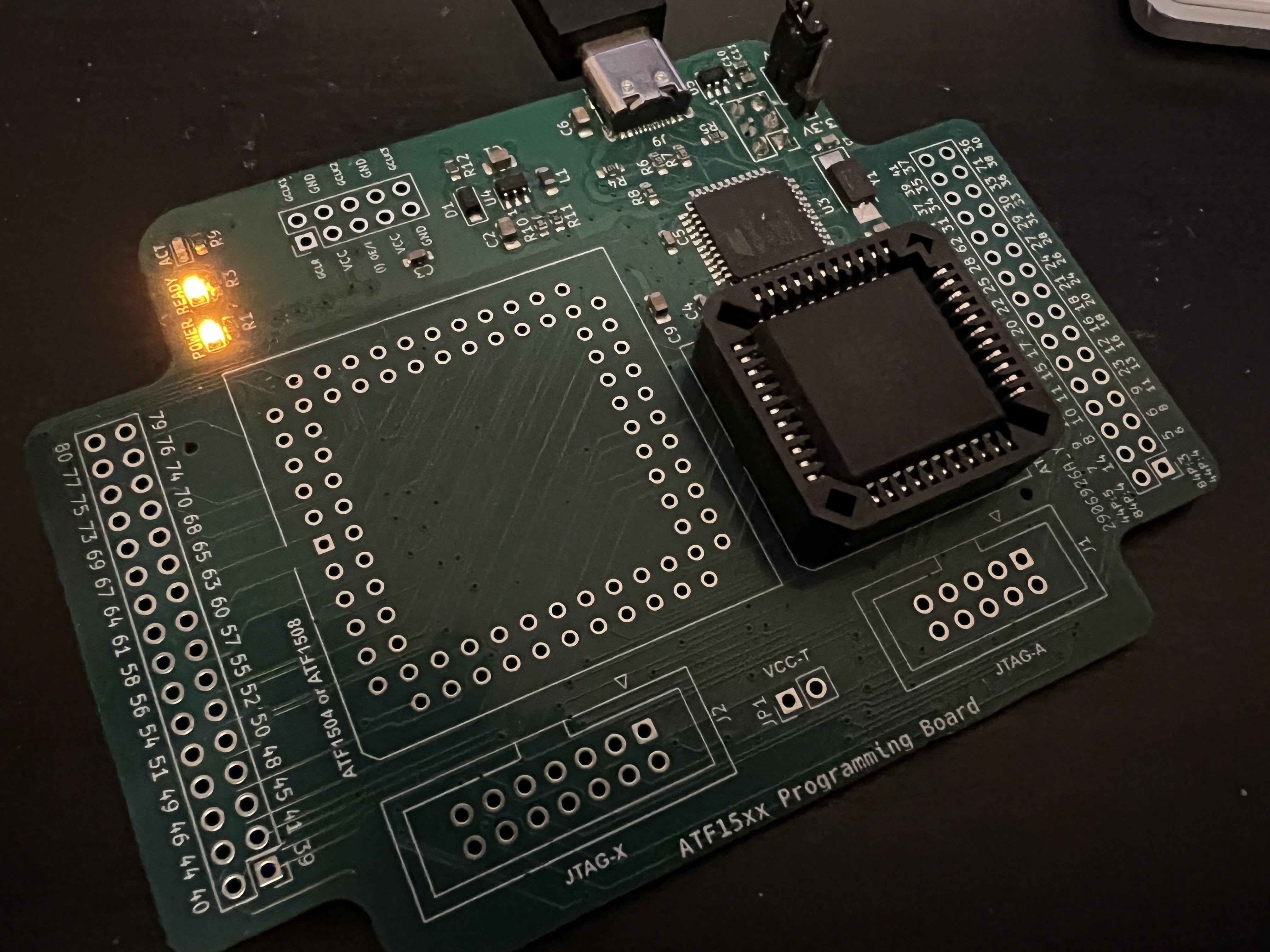
This is a plug-and-play USB-connected programmer and breakout board for Atmel (Microchip) ATF150{2,4,8}{AS,ASV} CPLDs, featuring:
- Support for JED, SVF or XSVF files
- Support for both PLCC44 and 84 packages on-board
- Ability to drive ICSP via the JTAG headers (single-device only - chains not currently supported)
- Ability to erase JTAG-locked and secured devices
The board is now available on the on the rosco_m68k store 🥳
Software Installation
Prerequisites:
- Recent macOS, Linux or Windows operating system
- Working Python (3.9+) installation
- Recent macOS and Linux will likely have this by default
- If not, it can be installed with your package manager
- Windows users can download from https://www.python.org/downloads/windows
pythonandpipshould be in yourPATHfor easiest installation experience
Note: on some systems, your
pythonmay instead be namedpython3, withpipbeing similarly namedpip3. As long as Python is version 3.9 or higher (as reported bypython3 --version) it should work just fine.
Latest release
With a Python environment that meets these requirements, installation is as simple as:
pip install little-atf-programmer
Note: on Windows, when installing you may receive a message from pip warning that the installed binaries are not in your
PATH. If you see this, for easier installation you may wish to add the directory in the warning to yourPATHby editing inControl Panel / System / Advanced / Environment Variables.
From source
Developers and project collaborators may wish to install from source.
To do this, clone the project from GitHub (or grab a source tarball).
Then either run python src/atfu.py or install with pip if you like:
pip install .
If you're hacking on the code, you'll probably want to install it --editable.
Usage
General arguments
General command line arguments look like this:
atfu [-h] [--version] [-q] [-v] [-t] {program,erase,check,programmer} ...

Little ATF150x Programmer Board Utility

positional arguments:
  {scan,program,erase,check,verify,programmer}
    scan                Scan for ATF150x devices
    program             Program an ATF150x device
    erase               Erase an ATF150x device
    check               Check if an ATF150x device is blank
    verify              Verify an ATF150x device
    programmer          Little ATF150x Programmer Board device functions

options:
  -h, --help            show this help message and exit
  --version             show program's version number and exit
  -q, --quiet           Silence almost all output
  -v, --verbose         Allow additional output
  -t, --trace           Enable debugging output (can be noisy!)
Device scan mode
This mode is used to scan the connected ATF CPLD, and try to autodetect the specific type of the chip.
By default, the first detected programmer will be used. This can be changed
with the -p option.
The -n option can be used to obtain unadorned output. This can be useful for
passing to other commands, or to atfu itself if you want to work with whatever
device is detected, e.g.
atfu program -d $(atfu scan -n) my_file.jed
Usage:
atfu scan [-h] [-n] [-p PROGRAMMER]

options:
  -h, --help            show this help message and exit
  -n, --plain           Plain output, only the unadorned device name, no newline
  -p PROGRAMMER, --programmer PROGRAMMER
                        Programmer device (default: <detected>)
Program mode
This mode is used to program JEDEC, SVF or XSVF files to an ATF150x device.
By default, the first detected programmer will be used. This can be changed
with the -p option.
If you have problems programming, try erasing first with the -e option,
or force-erasing with the -f option, which can be useful when you have a
JTAG-locked or secured device.
atfu program [-h] [-e] [-f] [-d {ATF1502,ATF1504,ATF1508}] [-p PROGRAMMER] filename [filename ...]

positional arguments:
  filename              .jed, .svf or .xsvf file(s) to program

options:
  -h, --help            show this help message and exit
  -e, --erase           Erase before programming
  -f, --force           Force-erase before programming (implies -e)
  -d {ATF1502AS,ATF1504AS,ATF1508AS,ATF1502ASV,ATF1504ASV,ATF1508ASV}, --device {ATF1502AS,ATF1504AS,ATF1508AS,ATF1502ASV,ATF1504ASV,ATF1508ASV}
                        Device to program (default: ATF1502AS)
  -p PROGRAMMER, --programmer PROGRAMMER
                        Programmer device (default: <detected>)
Erase mode
This mode is used to erase an ATF150x device, and can also be used to force erase JTAG-locked or secured devices.
By default, the first detected programmer will be used. This can be changed
with the -p option.
Note that the force mode might be... stressful for your device, so try a regular erase first :)
atfu erase [-h] [-f] [-p PROGRAMMER] [-d {ATF1502,ATF1504,ATF1508}]

options:
  -h, --help            show this help message and exit
  -f, --force           Force erase
  -p PROGRAMMER, --programmer PROGRAMMER
                        Programmer device (default: <detected>)
  -d {ATF1502AS,ATF1504AS,ATF1508AS,ATF1502ASV,ATF1504ASV,ATF1508ASV}, --device {ATF1502AS,ATF1504AS,ATF1508AS,ATF1502ASV,ATF1504ASV,ATF1508ASV}
                        Device to erase (default: ATF1502AS)
Check mode
This mode is used to determine whether an ATF150x device is blank.
By default, the first detected programmer will be used. This can be changed
with the -p option.
atfu check [-h] [-p PROGRAMMER] [-d {ATF1502,ATF1504,ATF1508}]

options:
  -h, --help            show this help message and exit
  -p PROGRAMMER, --programmer PROGRAMMER
                        Programmer device (default: <detected>)
  -d {ATF1502AS,ATF1504AS,ATF1508AS,ATF1502ASV,ATF1504ASV,ATF1508ASV}, --device {ATF1502AS,ATF1504AS,ATF1508AS,ATF1502ASV,ATF1504ASV,ATF1508ASV}
                        Device to check (default: ATF1502AS)
Verify mode
This mode is used to verify the contents of an ATF150x device against a JESD3-C (.jed) file.
By default, the first detected programmer will be used. This can be changed
with the -p option.
Verification cannot be performed against SVF or XSVF files. The expectation for those is that verification would be encoded into the vectors themselves.
atfu verify [-h] [-d {ATF1502,ATF1504,ATF1508,ATF1502AS,ATF1504AS,ATF1508AS,ATF1502ASV,ATF1504ASV,ATF1508ASV}] [-p PROGRAMMER] filename [filename ...]

positional arguments:
  filename              .jed file(s) to verify against

options:
  -h, --help            show this help message and exit
  -d {ATF1502,ATF1504,ATF1508,ATF1502AS,ATF1504AS,ATF1508AS,ATF1502ASV,ATF1504ASV,ATF1508ASV}, --device {ATF1502,ATF1504,ATF1508,ATF1502AS,ATF1504AS,ATF1508AS,ATF1502ASV,ATF1504ASV,ATF1508ASV}
                        Device to verify (default: ATF1502AS)
  -p PROGRAMMER, --programmer PROGRAMMER
                        Programmer device (default: <detected>)
Programmer mode
This mode can be used to list detected programmer boards, and query them.
atfu programmer [-h] {list,query} ...

positional arguments:
  {list,query}

options:
  -h, --help    show this help message and exit


atfu programmer list [-h] [--plain]

Functions for listing connected programmers

options:
  -h, --help   show this help message and exit
  -n, --plain  Display a plain list of device paths
Copyright
Copyright ©2024 The Really Old-School Company Limited.
Portions Copyright (C) 2019-2020 whitequark@whitequark.org
Portions Copyright (c) 2015 Marcelo Roberto Jimenez <marcelo.jimenez (at) gmail (dot) com>
Portions Copyright 2008, SoftPLC Corporation http://softplc.com [Dick Hollenbeck dick@softplc.com]
Mostly MIT License, portions under other licenses - see LICENSE.md & source code comments.
1 maintainer

Metadata
1 maintainer
Release files for little-atf-programmer 2025.1024
For a detailed explanation of source distributions (sdists) and built distributions (wheels), please see the package formats documentation.
Source distribution (sdist)
| File | Size | Uploaded | Provenance | |
|---|---|---|---|---|
| little_atf_programmer-2025.1024.tar.gz | 70.3 kB | With provenance | Details |
Built distribution (wheel)
| File | Interpreter | ABI | Platform | Reset |
|---|---|---|---|---|
| little_atf_programmer-2025.1024-py3-none-any.whl | Python 3 | none | any | Details |
Total release size: 140.3 kB
Release files / little_atf_programmer-2025.1024.tar.gz
| Download URL | little_atf_programmer-2025.1024.tar.gz |
|---|---|
| Size | 70.3 kB |
| Tags | Source |
|
SHA-256 checksum How to use checksums |
328a043867f4a33f1e4dca581d622925249080047d7ea6d9484cb3d90c64e8b3
|
|
BLAKE2b-256 checksum How to use checksums |
7169fbb9ec1c99b65a73171f146d945603f479127eecd4c3ed1a762b1a7a6be5
|
| Upload date | |
|
Uploaded using Trusted Publishing? What is trusted publishing? |
Yes |
| Uploaded via |
twine/6.1.0 CPython/3.12.9
|
Provenance
Provenance describes where a file came from. On PyPI, provenance is shared via attestations, which provide a verifiable record of the build or publishing details. View details, limitations and caveats.


PyPI Publish Attestation
PyPI verified that this artifact, at this checksum, originated from the publisher listed below.
Signed by GitHub Actions, verified by PyPI on Apr 5, 2025.
Transparency logRelease files / little_atf_programmer-2025.1024-py3-none-any.whl
| Download URL | little_atf_programmer-2025.1024-py3-none-any.whl |
|---|---|
| Size | 70.0 kB |
| Tags | Python 3 |
|
SHA-256 checksum How to use checksums |
5aca631aade7655b70b458484f3b29475fd5f8edc58237e00fb4e24db8b6f859
|
|
BLAKE2b-256 checksum How to use checksums |
9b750e27b7e5d9d3f37adaa61c6e9ddd8e2f5695ae108928c1117cc7431e7f2e
|
| Upload date | |
|
Uploaded using Trusted Publishing? What is trusted publishing? |
Yes |
| Uploaded via |
twine/6.1.0 CPython/3.12.9
|
Provenance
Provenance describes where a file came from. On PyPI, provenance is shared via attestations, which provide a verifiable record of the build or publishing details. View details, limitations and caveats.
PyPI Publish Attestation
PyPI verified that this artifact, at this checksum, originated from the publisher listed below.
Signed by GitHub Actions, verified by PyPI on Apr 5, 2025.
Transparency logSecurity for little-atf-programmer 2025.1024
Provenance
Provenance describes where a file came from. On PyPI, provenance is shared via attestations, which provide a verifiable record of the build or publishing details. View details, limitations and caveats.
Full provenance
All 2 files in this release have been uploaded with provenance metadata.
Attestation for little_atf_programmer-2025.1024.tar.gz
PyPI Publish Attestation
PyPI verified that this artifact, at this checksum, originated from the publisher listed below.
Signed by GitHub Actions, verified by PyPI on Apr 5, 2025.
Transparency logA note on package security
PyPI is a repository for distributing packages, not a service for auditing them. While third-party security researchers and our staff do their best to detect and remove malicious packages, PyPI cannot guarantee the quality, security or suitability of any given package.
To learn more about protecting yourself from malicious actors, visit our package security documentation.














