
livefold
live + fold — incremental folds over a mutable sequence. ("live" as in "live broadcast" — rhymes with "five", not "give".)



A primitive for online sequential aggregation in Python. Maintain a mutable sequence; query exact aggregates over any range in O(√n); plug in any associative reducer (any monoid).
When to reach for it
| Need | Use |
|---|---|
| Immutable series, range aggregates | Prefix sums |
| Frequent point updates, log-time queries | Segment tree / Fenwick tree |
| Fixed-width rolling windows | pandas.rolling() / polars.rolling() |
| Mutable series, arbitrary range queries, multi-fold | livefold |
Common shapes: request latencies, sensor readings, trade prices, telemetry events.
Quickstart
pip install livefold
from livefold import LiveFold

lf = LiveFold([1, 2, 3, 4, 5, 6], folds={"sum": sum, "max": max, "min": min})

lf.append(7)
lf.query(0, 5)
# → {"sum": 21, "max": 6, "min": 1}

# Mutate freely; aggregates stay current
lf[2] = -1
lf.query(2, 5)
# → {"sum": 9, "max": 6, "min": -1}
Performance
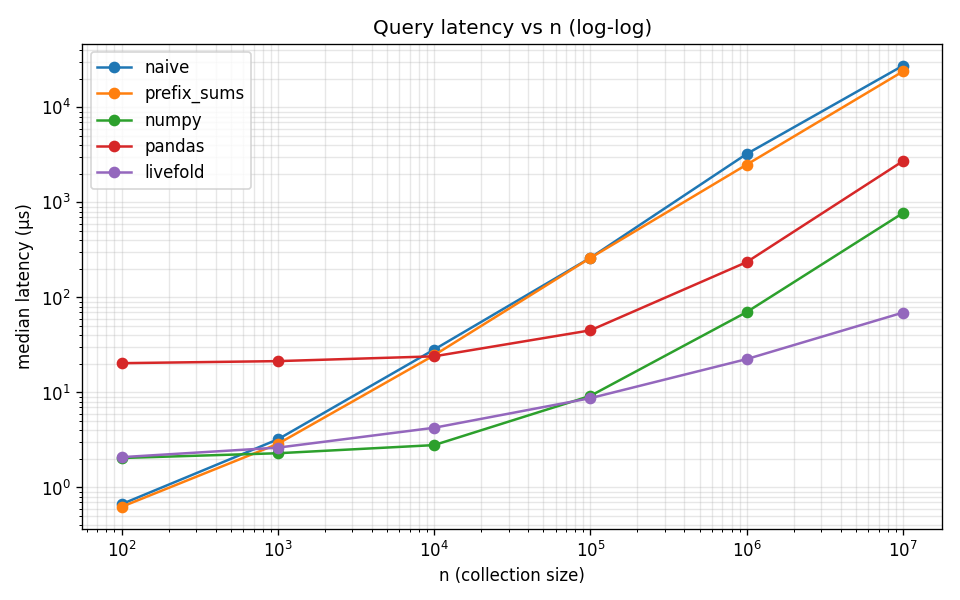
At n = 10⁷, livefold's median range query is 69 µs vs naive Python's 29 ms (~400× faster), and median append cost is ~2 µs across all n while every other backend with a competitive query path (numpy, pandas) degrades linearly on every append. livefold's amortized append is O(√n) — boundary-crossing rebuilds are rare (~one per √n appends) but real — so the median characterizes typical streaming latency, not the rare rebuild spike.
Full methodology, append benchmarks, comparison against four backends, and the reproduction script: benchmarks/.
Examples
Two runnable Streamlit demos in examples/:
system_metrics/— livepsutil-driven CPU/memory dashboard with arbitrary-range aggregate queries. Runs entirely offline.crypto_ticks/— synthetic BTC/USD tick stream with high/low/avg-price queries. Includes a drop-in recipe for real Binance ticks.
API
LiveFold(data: Iterable, folds: dict[str, Callable])
| Member | Returns | Notes |
|---|---|---|
lf.append(x) |
None |
Amortized O(√n); worst-case O(n) on perfect-square crossings |
lf.query(left, right) |
dict[str, Any] |
O(√n); inclusive bounds |
lf.blocks |
list[list] |
Underlying √n-sized blocks |
lf.folded_values |
dict[str, list] |
Per-fold, per-block aggregates |
lf.insert / pop / extend / remove / sort / ... |
— | Standard list methods; blocks and folds updated in place |
LiveFold subclasses list, so it's a drop-in for any code that expected a plain list — until you start calling query.
Time-indexed queries: TimeIndexedLiveFold
For monotonic streams where you want to query by time instead of index, TimeIndexedLiveFold carries a parallel timestamp per element and exposes query_time_range — still O(√n).
from livefold import TimeIndexedLiveFold

lf = TimeIndexedLiveFold(
    [1, 2, 3],
    folds={"sum": sum, "max": max},
    timestamps=[1.0, 2.0, 3.0],
)
lf.append(4, timestamp=4.0)
lf.append(5, timestamp=5.0)

lf.query_time_range(2.0, 4.0)
# → {"sum": 9, "max": 4}
If you omit timestamps / timestamp, time.time() is used by default. The class is generic over the timestamp type — anything orderable works (float, int, datetime, ...). Pass explicit timestamps for any non-float type:
from datetime import datetime
from livefold import TimeIndexedLiveFold

lf = TimeIndexedLiveFold[datetime](
    [1, 2, 3],
    folds={"sum": sum},
    timestamps=[datetime(2025, 1, 1), datetime(2025, 6, 1), datetime(2026, 1, 1)],
)
lf.query_time_range(datetime(2025, 5, 1), datetime(2026, 6, 1))
# → {"sum": 5}
TimeIndexedLiveFold is append-only by design. Operations that would break time ordering raise MonotonicityError:
insert,sort,reverse— would break the ordering invariant- slice
__setitem__, slice__delitem__— would desync data and timestamps append/extendwith a timestamp earlier than the last stored one+/+=with anything other than anotherTimeIndexedLiveFold(useextend(values, timestamps=...)instead)
Integer indexing (lf[i] = x, del lf[i]), pop, remove, and clear work normally and keep the parallel timestamp list in sync. + and += between two TimeIndexedLiveFold instances concatenate timestamps and re-check monotonicity.
How it works
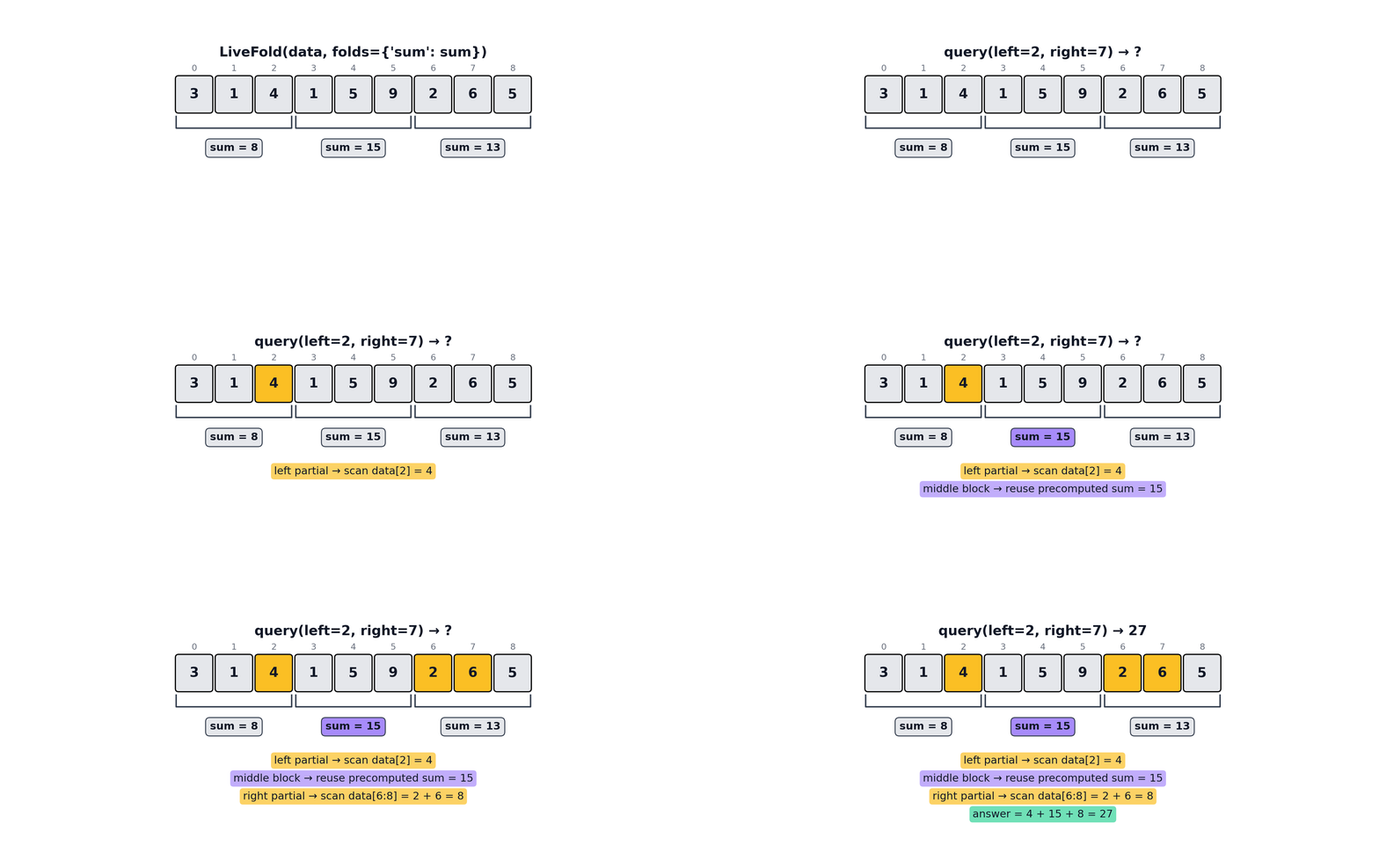
LiveFold splits its underlying list into ⌊√n⌋ blocks of size √n, precomputes the configured folds for each block, and updates them incrementally on mutation. A query(left, right) walks at most two partial blocks plus the precomputed folds for whole-block spans in between — touching roughly 2√n elements per fold regardless of n. Mo's algorithm with mutability and a dict-shaped output.
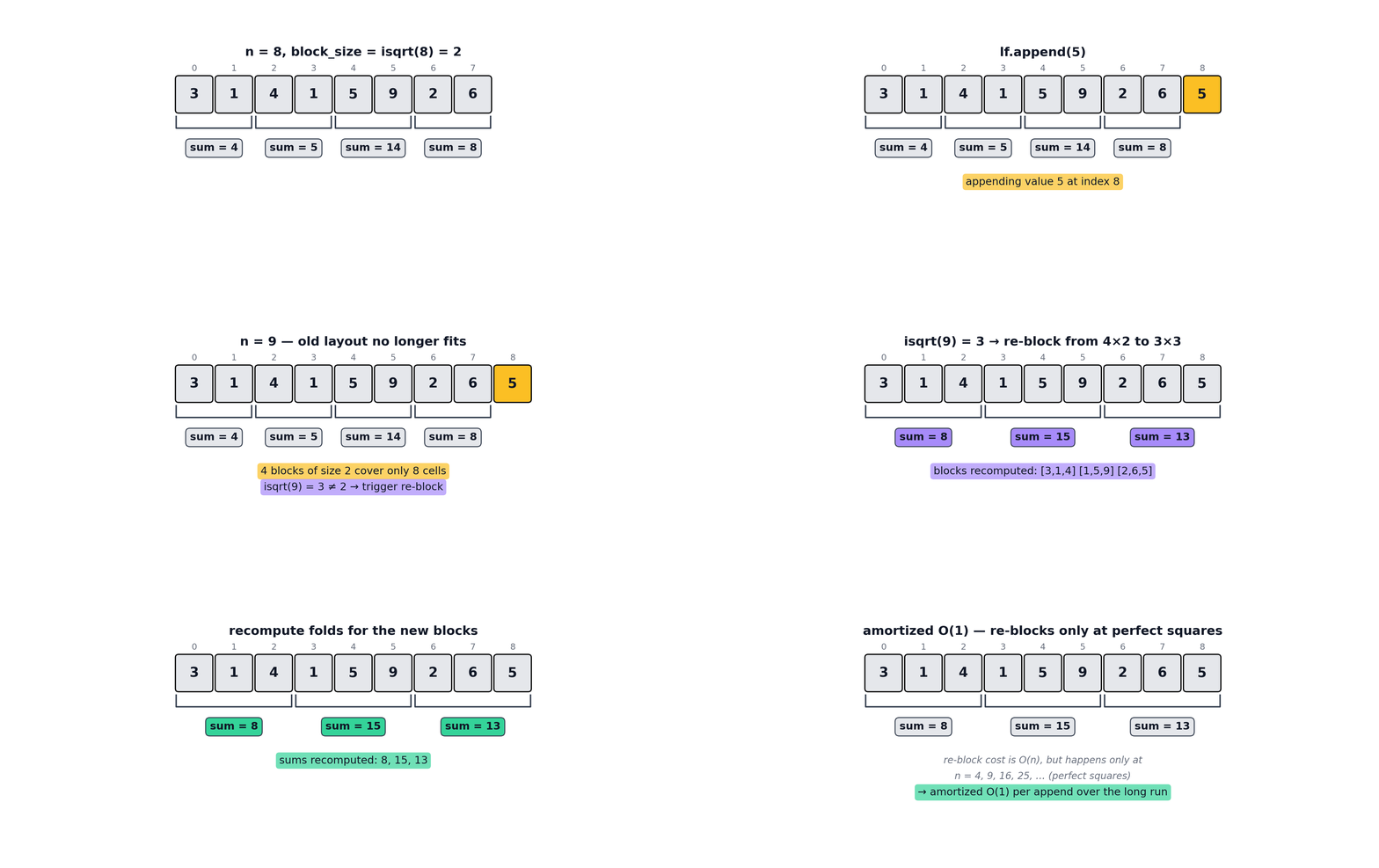
append is amortized O(√n). Most appends just push onto the last block at O(1), but each time n crosses a perfect square, block_size = isqrt(n) increments and the whole structure re-blocks — an O(n) cost. The gap between consecutive perfect squares is 2k + 1 (linear in k = √n, not geometric), so over n appends total rebuild work sums to Σ_{k=1}^{√n} O(k²) = O(n^(3/2)) — i.e. O(√n) per append amortized. Boundary crossings happen only ~once per √n appends, though, so the median append latency stays in the low µs range across all n (this is what the benchmarks show); the asymptotic only shows up in mean or total cost.
TimeIndexedLiveFold layers a parallel monotonically non-decreasing timestamp list on top. query_time_range(start, end) calls bisect_left/bisect_right to map timestamps to indices in O(log n), then routes through the same √n-decomposed query path — so overall query cost stays O(√n).
For the full derivation, complexity analysis, and other implementation details, see the corresponding blog post.
Fold contract
A fold is a single-argument callable fn(items) -> result that:
- Accepts an iterable of elements (or, when called internally to combine block results, an iterable of prior fold results) and returns a single value.
- Is associative:
fn([fn([a, b]), fn([c, d])]) == fn([a, b, c, d]). This letsquerycombine precomputed block-level folds with the partial folds at each end. - Returns a value of the same shape it accepts as elements — i.e., feeding the result back through
fntogether with other results must work.lenis a common-but-broken choice: it returns anintregardless of input shape, solen([len(block_a), len(block_b)])gives2, not the total element count.
Examples that satisfy the contract: sum, max, min, math.prod, math.gcd (via functools.reduce), bitwise or/and/xor, "".join, and any mergeable sketch (t-digest, HyperLogLog, Count-Min, Welford) wrapped in a fold-shaped callable. Commutativity is not required — string concatenation, matrix multiplication, and other ordered monoids work too.
Constraints
- Not thread-safe. Single-process, single-thread workloads only.
Contributing
See CONTRIBUTING.md.
1 maintainer

Release files for livefold 0.2.0
For a detailed explanation of source distributions (sdists) and built distributions (wheels), please see the package formats documentation.
Source distribution (sdist)
| File | Size | Uploaded | |
|---|---|---|---|
| livefold-0.2.0.tar.gz | 149.3 kB | Details |
Built distribution (wheel)
| File | Interpreter | ABI | Platform | Reset |
|---|---|---|---|---|
| livefold-0.2.0-py3-none-any.whl | Python 3 | none | any | Details |
Total release size: 158.6 kB
Release files / livefold-0.2.0.tar.gz
| Download URL | livefold-0.2.0.tar.gz |
|---|---|
| Size | 149.3 kB |
| Tags | Source |
|
SHA-256 checksum How to use checksums |
870e7f9fdc2aaac2cce856c6d481895be056fe7e06a3947b6b1b62f44a7b210c
|
|
BLAKE2b-256 checksum How to use checksums |
e39d0f9178342d029e03ec5234647c4bfd2cf3a355e9d78cb530af72f4183eff
|
| Upload date | |
|
Uploaded using Trusted Publishing? What is trusted publishing? |
No |
| Uploaded via |
uv/0.10.0 {"installer":{"name":"uv","version":"0.10.0","subcommand":["publish"]},"python":null,"implementation":{"name":null,"version":null},"distro":{"name":"macOS","version":null,"id":null,"libc":null},"system":{"name":null,"release":null},"cpu":null,"openssl_version":null,"setuptools_version":null,"rustc_version":null,"ci":null}
|
Release files / livefold-0.2.0-py3-none-any.whl
| Download URL | livefold-0.2.0-py3-none-any.whl |
|---|---|
| Size | 9.2 kB |
| Tags | Python 3 |
|
SHA-256 checksum How to use checksums |
05e610f6d05826022052040e59363ac73d6ff73e78acf7499234dd11a18c37ae
|
|
BLAKE2b-256 checksum How to use checksums |
06aa0c8f35a19b846503a320e3e1f65d97091f96203f8761f21f32cfa39bc8ac
|
| Upload date | |
|
Uploaded using Trusted Publishing? What is trusted publishing? |
No |
| Uploaded via |
uv/0.10.0 {"installer":{"name":"uv","version":"0.10.0","subcommand":["publish"]},"python":null,"implementation":{"name":null,"version":null},"distro":{"name":"macOS","version":null,"id":null,"libc":null},"system":{"name":null,"release":null},"cpu":null,"openssl_version":null,"setuptools_version":null,"rustc_version":null,"ci":null}
|














