
LLM Budget Guard

GitHub Repository: https://github.com/preettrank53/llm-circuit-breaker
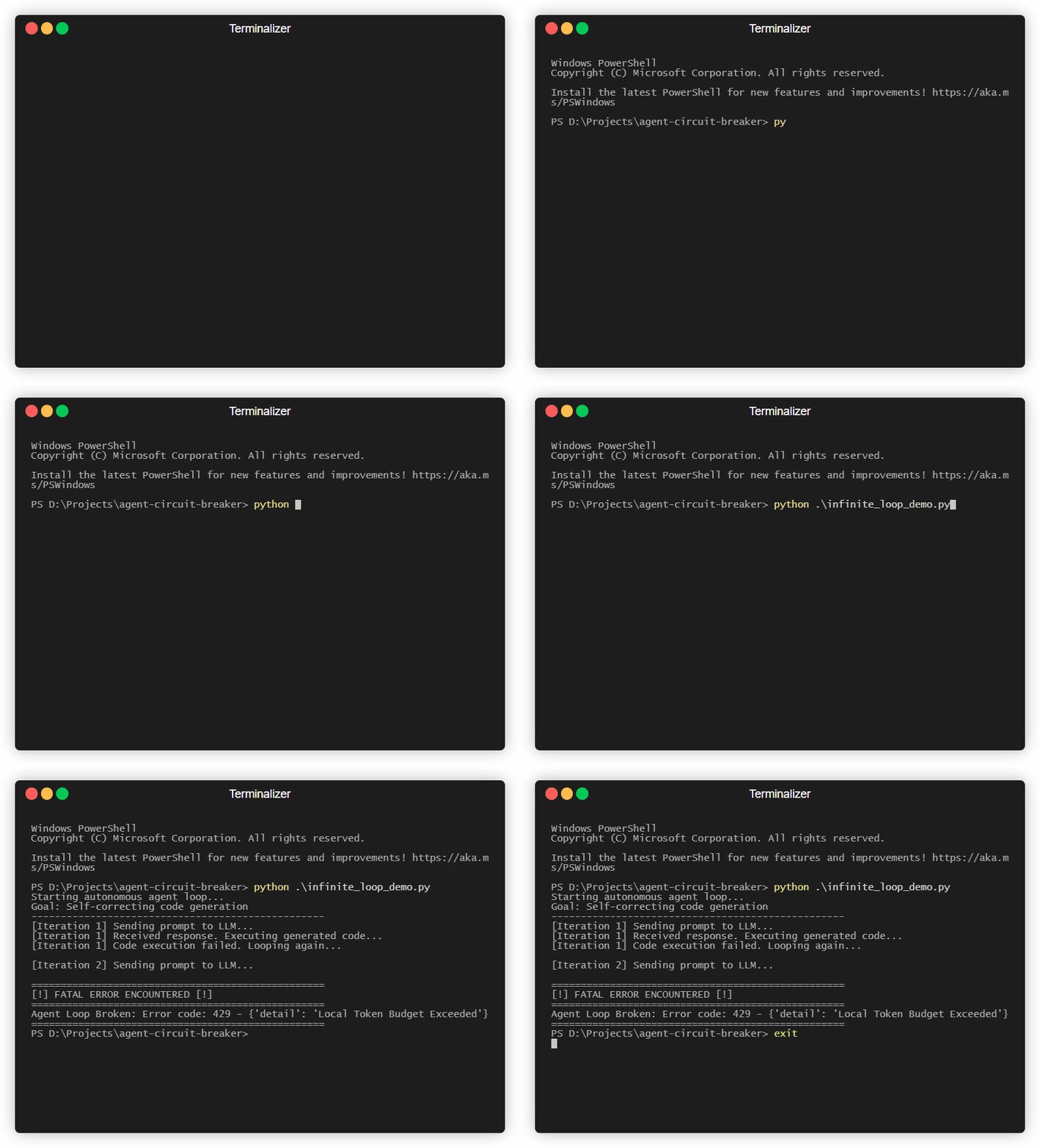
A local circuit breaker to stop multi-agent workflows from bankrupting your OpenAI API limits.
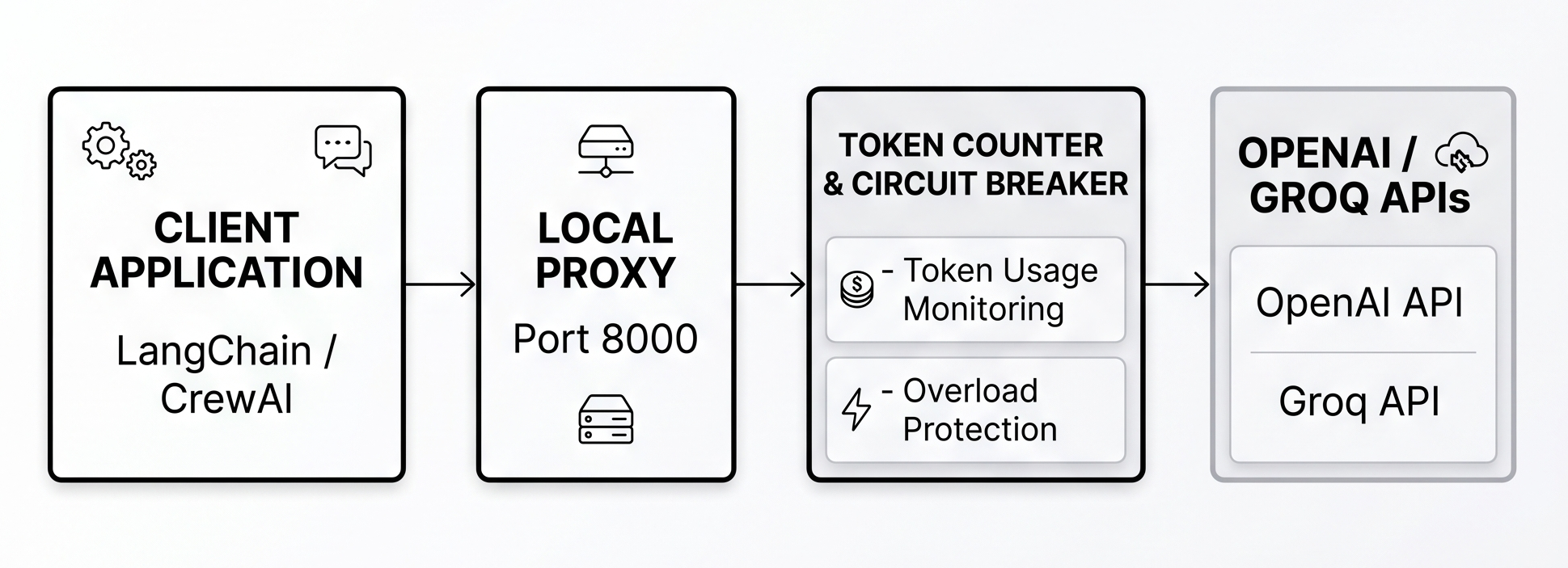
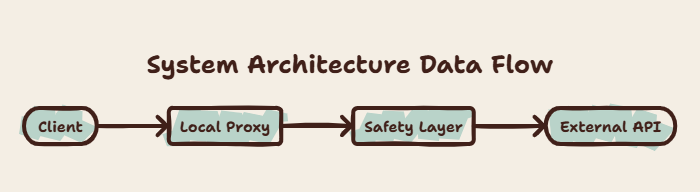
Architecture & Data Flow
Installation & Quickstart
You can run the circuit breaker natively via Python or as an isolated Docker container.
Option 1: Native Python (CLI)
- Install the package:
pip install llm-budget-proxy
- Set your credentials:
Create a
.envfile in your working directory:UPSTREAM_BASE_URL=https://api.openai.com/v1 UPSTREAM_API_KEY=your_actual_api_key_here
- Start the server:
circuit-breaker
Option 2: Docker Compose
- Set your credentials: Create a
.envfile as shown above. - Start the container:
docker-compose up -d
Usage & Framework Integrations
Point your AI agent's base URL to the local proxy (http://localhost:8000/v1). It will automatically intercept requests, check your budget, and forward them safely.
We have included drop-in examples for popular frameworks in the examples/ directory:
Standard OpenAI SDK Example
from openai import OpenAI

client = OpenAI(
    base_url="http://localhost:8000/v1",
    api_key="dummy-key" # Proxy injects your real key automatically
)

response = client.chat.completions.create(
    model="gpt-3.5-turbo",
    messages=[{"role": "user", "content": "Say hello"}],
    stream=False # Streaming not supported yet
)
print(response.choices[0].message.content)
Management API
Control your budget programmatically via simple HTTP endpoints:
- Check Budget Status:
GET /v1/budget - Reset Token Counter:
POST /v1/budget/reset
Performance Benchmark
The proxy uses an asynchronous connection pool via FastAPI's lifespan architecture, meaning it holds the SSL handshake open. In a small five-request smoke test, end-to-end latency was within normal network variance.
Starting benchmark...
Measuring DIRECT latency (5 requests)...
Average Direct Latency: 473.53 ms

Measuring PROXY latency (5 requests)...
Average Proxy Latency:  470.80 ms

Total Proxy Overhead: -2.73 ms
1 maintainer

Metadata
1 maintainer
Release files for llm-budget-proxy 0.1.1
For a detailed explanation of source distributions (sdists) and built distributions (wheels), please see the package formats documentation.
Source distribution (sdist)
| File | Size | Uploaded | Provenance | Actions |
|---|---|---|---|---|
| llm_budget_proxy-0.1.1.tar.gz | 5.8 kB | Without provenance | Details for llm_budget_proxy-0.1.1.tar.gz |
Built distribution (wheel)
| File | Interpreter | ABI | Platform | Actions Reset |
|---|---|---|---|---|
| llm_budget_proxy-0.1.1-py3-none-any.whl | Python 3 | none | any | Details for llm_budget_proxy-0.1.1-py3-none-any.whl |
Total release size: 11.3 kB
Release files / llm_budget_proxy-0.1.1.tar.gz
| Download URL | llm_budget_proxy-0.1.1.tar.gz |
|---|---|
| Size | 5.8 kB |
| Tags | Source |
|
SHA-256 checksum How to use checksums |
77eca3fc876bda91824fd38165eb012ecb0dddf302f4105e4a81e13bb71843b5
|
|
BLAKE2b-256 checksum How to use checksums |
ee1d9f0eab9e38063c5689c2dd912ef1eda368cc6528689aeb88b25e8a3f8389
|
| Upload date | |
|
Uploaded using Trusted Publishing? What is trusted publishing? |
No |
| Uploaded via |
twine/7.0.0 CPython/3.13.2
|
Release files / llm_budget_proxy-0.1.1-py3-none-any.whl
| Download URL | llm_budget_proxy-0.1.1-py3-none-any.whl |
|---|---|
| Size | 5.5 kB |
| Tags | Python 3 |
|
SHA-256 checksum How to use checksums |
461fa933bfe0f4cc32eff66bfc5ac038675d09220fafe4bffcd6429828aa8a79
|
|
BLAKE2b-256 checksum How to use checksums |
2be72cc2e36772a1b5691898eef39012a023865510c6b79963b9d1abb2bd6edb
|
| Upload date | |
|
Uploaded using Trusted Publishing? What is trusted publishing? |
No |
| Uploaded via |
twine/7.0.0 CPython/3.13.2
|
Security for llm-budget-proxy 0.1.1
Provenance
Provenance describes where a file came from. On PyPI, provenance is shared via attestations, which provide a verifiable record of the build or publishing details. View details, limitations and caveats.
No provenance found
None of the files in this release were uploaded with provenance metadata.
A note on package security
PyPI is a repository for distributing packages, not a service for auditing them. While third-party security researchers and our staff do their best to detect and remove malicious packages, PyPI cannot guarantee the quality, security or suitability of any given package.
To learn more about protecting yourself from malicious actors, visit our package security documentation.














