
llm-finops-gateway


An OpenAI-compatible gateway that gives every LLM call an owner, a price and a policy.
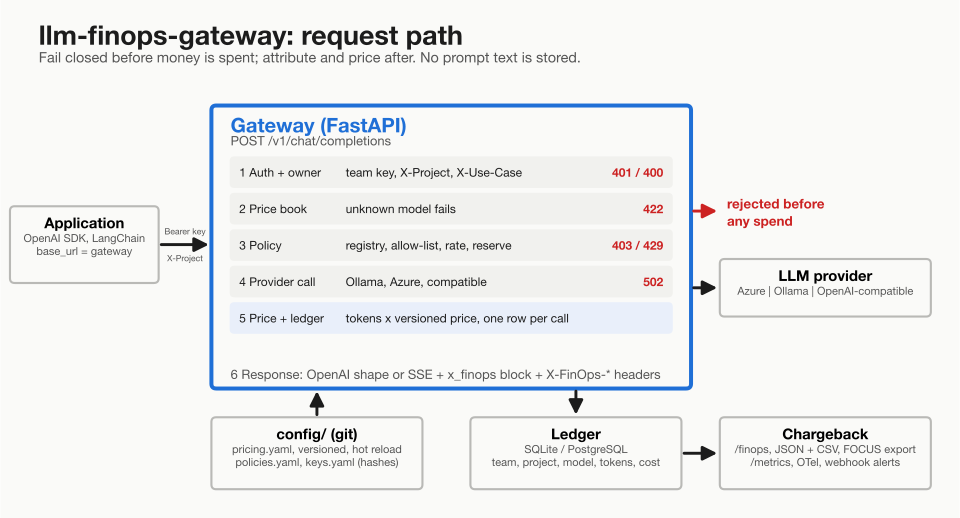
Teams adopt LLMs faster than finance can allocate the bill and faster than security can enforce policy. This gateway sits between your applications and the model provider (Azure OpenAI, Ollama, or any OpenAI-compatible endpoint) and, on every call:
- Knows who is calling: team-bound API keys (
Authorization: Bearer lfg_...), hashes in git, the raw key only in the team's secret store. The team cannot be spoofed with a header. - Attributes cost to a team, project and use case, priced from a versioned price book, and writes a ledger row you can charge back from.
- Enforces policy as code: per-team model allow-lists, requests-per-minute limits, and monthly budgets with a warning threshold (default 80 %) and a blocking threshold (default 100 %), declared in YAML and reviewed in pull requests. Budgets are enforced with an atomic reservation, so concurrent calls cannot slip past the limit.
- Reports and observes: chargeback and budget endpoints, Prometheus
/metrics, and OpenTelemetry spans withfinops.*attributes (Grafana, Azure Monitor, Langfuse).
Four rules are built in and intentional (see the ADRs):
- A model without a configured price is rejected, not billed at zero.
- A call without an owner (key or
X-Team, plusX-Project) is rejected, not guessed. - Budgets warn before they block, and both states are visible in headers, body, logs and traces.
- The budget is reserved before the call, settled after, released on failure.
It runs in two shapes. Standalone, the gateway is the front door your applications call:
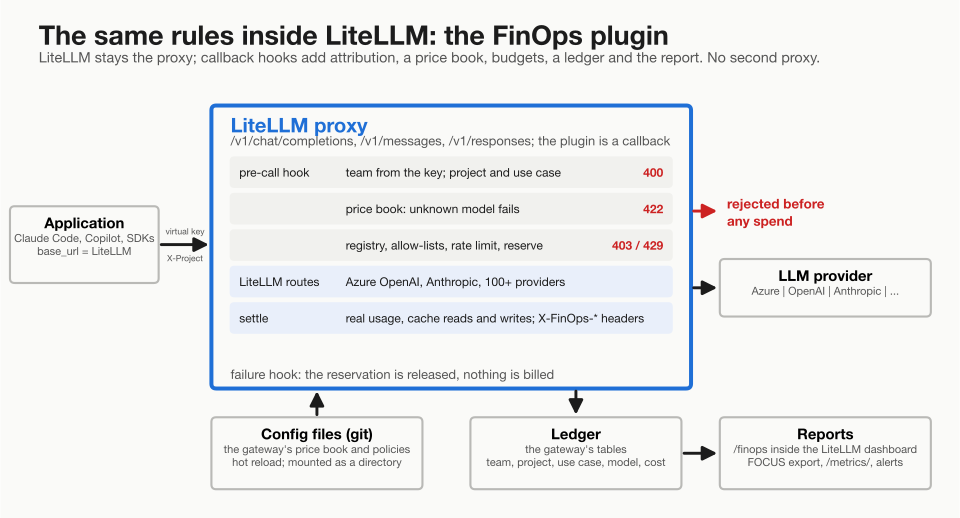
Already on LiteLLM? The same rules run inside the LiteLLM proxy as a callback plugin, with the same price book, policy file, ledger and reports; no second proxy (ADR-0019). Claude Code and other Anthropic Messages clients go through it too, priced with their cache reads and cache writes (ADR-0027):
What it looks like
A 300-call simulation across five teams (python demo/run_demo.py, no API keys needed):
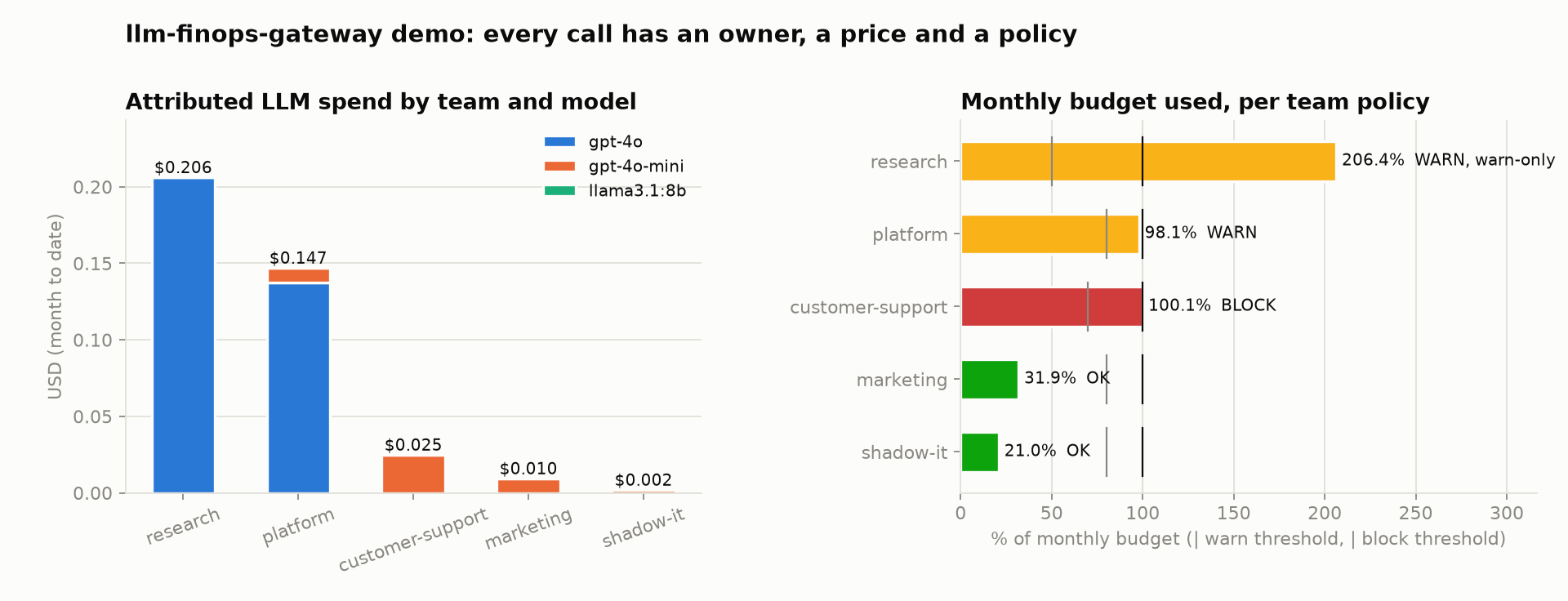
| team | ok | warned | blocked (budget) | blocked (model) | rate limited | unpriced model | no owner | spend USD | budget used |
|---|---|---|---|---|---|---|---|---|---|
| customer-support | 51 | 21 | 27 | 3 | 0 | 0 | 0 | 0.0250 | 100.1% (block) |
| marketing | 30 | 0 | 0 | 0 | 9 | 5 | 0 | 0.0096 | 31.9% (ok) |
| platform | 62 | 16 | 2 | 0 | 0 | 0 | 0 | 0.1472 | 98.1% (warn) |
| research | 14 | 40 | 0 | 0 | 0 | 0 | 0 | 0.2064 | 206.4% (warn, warn-only) |
| shadow-it | 6 | 0 | 0 | 0 | 0 | 0 | 14 | 0.0021 | 21.0% (ok) |
Unallocated spend: 0.00 USD, by construction.
Against a real bill: on 2026-10-30 the gateway ran 983 calls on an Azure OpenAI deployment.
The next day Azure Cost Management showed 65,870 tokens and 0.096501 USD for the resource; the
ledger had 65,096 tokens and, priced at the deployment's SKU, 0.095241 USD. The difference is
774 tokens from direct API tests that bypassed the gateway. The only other gap was a price
book mismatch (regional SKU billed, global price in the book, 0.0123 USD), which
pricing sync --deployment regional reports. Details in
docs/testing-plan.md.
Already running LiteLLM?
The same rules ship as a LiteLLM proxy plugin:
pip install "llm-finops-gateway[litellm] @ git+https://github.com/andrasKelle/llm-finops-gateway"
(the package is not on PyPI yet; append @v0.4.1 to pin a release), register llm_finops_gateway.litellm_plugin.plugin under litellm_settings.callbacks, point
LFG_PRICING_PATH, LFG_POLICIES_PATH and LFG_DATABASE_URL at your files, and every chat call
through LiteLLM gets mandatory project attribution, fail-closed pricing, budgets with warn and
block, the X-FinOps-* headers, a ledger row and the gateway's Prometheus metrics on LiteLLM's
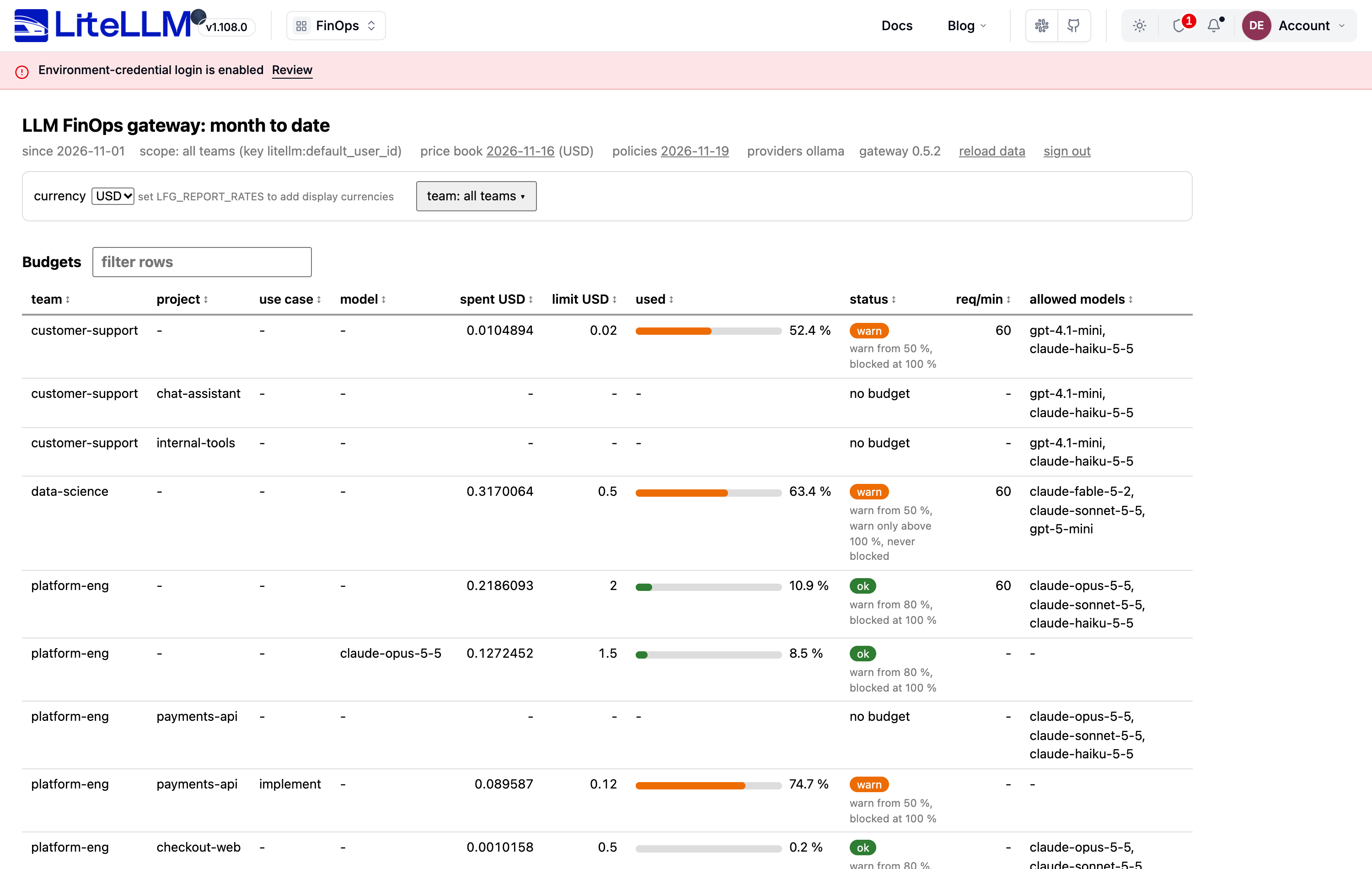
own /metrics/ endpoint, so the Grafana dashboard works unchanged. The report page can sit
inside the LiteLLM dashboard as a plugin (ADR-0024). Guide: docs/litellm.md,
example stack: examples/litellm/.
Claude Code and other coding agents
The plugin also covers LiteLLM's Anthropic /v1/messages route, so Claude Code runs behind it
with three environment variables (ADR-0027):
export ANTHROPIC_BASE_URL=http://localhost:4002          # the LiteLLM proxy with the plugin
export ANTHROPIC_AUTH_TOKEN=<LiteLLM key of the developer's team>
export ANTHROPIC_CUSTOM_HEADERS="X-Project: my-repo"
Every call of a session is attributed to the team and the project, priced with cache reads and cache writes at their own rates, and checked against the team's, the project's and the model's budget before it is sent; a rejection shows up in Claude Code with its reason. Stack and walk-through: examples/claude-code/.
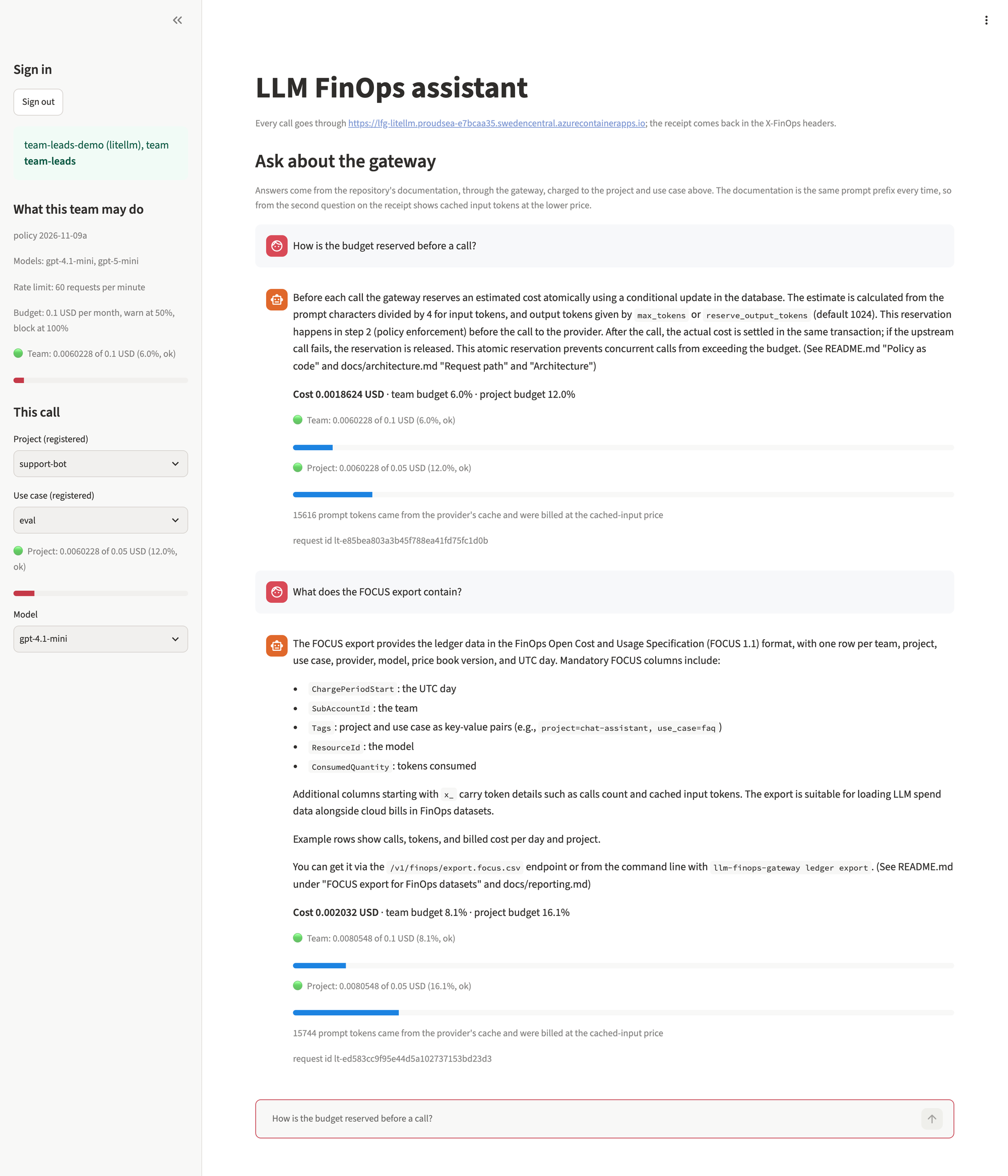
Try it from a browser
examples/assistant/ is a small Streamlit page: sign in with a key, and the page shows what
the policy says about it (team, allowed models, budget, registered projects and use cases);
pick a project and a use case, ask about the gateway, and read the receipt next to every
answer: cost, cached input tokens, team and project budget, warnings, or the rejection that
stopped the call before the model. The answers come from this repository's documentation,
sent through the same gateway, so the demo traffic is attributed and priced too. pip install ".[assistant]" in a checkout and
streamlit run examples/assistant/app.py, or the assistant service of the LiteLLM compose
stack on port 8501.
Why not LiteLLM, Portkey or an API-management gateway?
Those are good routing gateways and you may already run one. This project is deliberately narrower and FinOps-first. The differences that matter for a finance or platform team:
| llm-finops-gateway | Typical LLM gateways (LiteLLM, Portkey, Bifrost, Cloudflare AI Gateway) | |
|---|---|---|
| Cost owner | Mandatory team / project / use_case tags; untagged calls are rejected |
Spend tied to an API key or "virtual key"; mapping keys to cost centres is manual |
| Price list | Versioned YAML in git; every ledger row records the version it was priced with, so last quarter's chargeback can be recomputed | Built-in price table updated with the software; historical cost is whatever was computed at the time |
| Unknown model | Rejected before the upstream call | Usually forwarded and logged with zero or missing cost |
| Who is calling | Team-bound keys, hashes in git, key_id on every ledger row and trace |
Virtual keys in a database or admin UI |
| Budgets | Per team and per project, warn and block thresholds with the warning in the response, warn-only mode, atomic reservation, declared in YAML and reviewed in PRs | Per key, team or user, hard cap, some with soft-budget alerts and a pre-call reservation (LiteLLM); configured in an admin UI or API, not in a reviewed file |
| Evaluation | Replay and regression scoring on recorded calls (roadmap) | Out of scope; separate observability product |
| Routing, caching, fallbacks | Out of scope; run this behind a router if you need them | Core feature |
A longer comparison with sources is in docs/comparison.md.
Quick start
git clone https://github.com/andrasKelle/llm-finops-gateway
cd llm-finops-gateway
python -m venv .venv && source .venv/bin/activate
pip install -e ".[dev,demo]"
python demo/run_demo.py          # simulated traffic, no keys, writes demo/out/
Run llm-finops-gateway serve from the repository root (or set LFG_*_PATH): the price book,
policies and key file are read from config/ relative to the working directory.
Local models with Ollama (no keys, headers mode)
ollama pull llama3.2:3b
LFG_AUTH_MODE=headers llm-finops-gateway serve --port 8080
curl -s http://localhost:8080/v1/chat/completions \
  -H "Content-Type: application/json" \
  -H "X-Team: platform" -H "X-Project: demo" -H "X-Use-Case: smoke-test" \
  -d '{"model": "llama3.2:3b", "messages": [{"role": "user", "content": "Say hi."}]}' | jq
Team keys (the default, LFG_AUTH_MODE=api_key)
llm-finops-gateway keys new --team platform --id platform-copilot
# prints the key once (lfg_...) and a YAML entry; paste the entry into config/keys.yaml
llm-finops-gateway serve --port 8080
curl -s http://localhost:8080/v1/chat/completions \
  -H "Authorization: Bearer lfg_..." -H "X-Project: demo" \
  -H "Content-Type: application/json" \
  -d '{"model": "llama3.2:3b", "messages": [{"role": "user", "content": "Say hi."}]}' | jq .x_finops
The team comes from the key; an X-Team header, if sent, must match. Keys can be restricted
to projects, given an expiry, and disabled. Only SHA-256 hashes are stored (ADR-0006).
Rollout, rotation and the reference Azure deployment are in
docs/deployment.md.
Azure OpenAI
Create a .env (never commit it; see .env.example):
LFG_PROVIDER=azure_openai
LFG_AZURE_OPENAI_ENDPOINT=https://<resource>.openai.azure.com
LFG_AZURE_OPENAI_API_KEY=<key from Azure portal or Key Vault>
LFG_AZURE_OPENAI_API_VERSION=2024-10-21
# model name used by clients -> Azure deployment name
LFG_AZURE_OPENAI_DEPLOYMENTS={"gpt-4o-mini": "gpt-4o-mini-eastus"}
Then run the gateway and call it with "model": "gpt-4o-mini". Every model name you use must
exist in config/pricing.yaml. A step-by-step az CLI walkthrough for a disposable test
setup is in docs/azure-setup.md.
Without a key, with the gateway's own identity (ADR-0014): pip install ".[azure]",
set LFG_AZURE_OPENAI_AUTH=entra, drop LFG_AZURE_OPENAI_API_KEY, and give the identity the
Cognitive Services OpenAI User role on the resource. DefaultAzureCredential picks the
Container App's managed identity in Azure and your az login session on a laptop.
Any OpenAI-compatible endpoint (Azure OpenAI v1, vLLM, LocalAI, OpenAI)
One adapter for every server that speaks the OpenAI Chat Completions API (ADR-0010). The base URL includes the API prefix; the key is sent as a bearer token; an optional map translates the model name clients and the price book use into the upstream name (an Azure deployment, a vLLM served model name):
LFG_PROVIDER=openai_compat
LFG_OPENAI_COMPAT_BASE_URL=https://<resource>.openai.azure.com/openai/v1
LFG_OPENAI_COMPAT_API_KEY=<key>
LFG_OPENAI_COMPAT_MODELS={"gpt-4o-mini": "gpt-4o-mini-eastus"}
# LFG_OPENAI_COMPAT_HEADERS={"X-Custom": "value"}      # extra headers, optional
For an Azure AI Foundry resource this is the v1 endpoint, where the deployment name is the model.
The classic deployment path with api-version stays available as LFG_PROVIDER=azure_openai.
Local servers without authentication (vLLM, LocalAI on a trusted network) simply omit the key.
Several providers in one gateway
LFG_PROVIDER is only the default. Every provider whose settings are present is available at
the same time, and a price book row says which one serves the model (ADR-0011):
models:
  gpt-4.1-mini: { input: 0.40, output: 1.60, cached_input: 0.10, provider: azure_openai }
  "llama3.2:3b": { input: 0.00, output: 0.00, provider: ollama }
With the shipped price book, setting the two Azure variables next to a local Ollama gives
"cloud models on Azure, small models on-prem" behind one base URL. GET /v1/models shows which
provider serves each model. A row naming a provider that is not configured falls back to the
default with a startup warning. cached_input prices the prompt tokens the provider served
from its cache (usage.prompt_tokens_details.cached_tokens), the way Azure and OpenAI bill them.
cache_write and cache_write_1h price the prompt tokens written to the cache, the way
Anthropic bills them (the Claude rows, served through the LiteLLM plugin).
reasoning: true marks the gpt-5 and o-series rows: the gateway sends max_completion_tokens
instead of max_tokens and drops the temperature, which those models reject, so OpenAI SDK
defaults keep working. Reasoning tokens are part of completion_tokens, billed as output and
reported in usage.completion_tokens_details.reasoning_tokens; a small max_tokens can be used
up entirely by reasoning and return an empty message with finish_reason: length.
The response
Standard OpenAI shape plus an x_finops block, and X-FinOps-* headers:
{
  "id": "gw-7f3a…", "object": "chat.completion", "model": "gpt-4o-mini",
  "choices": [{ "index": 0, "message": { "role": "assistant", "content": "Hi!" }, "finish_reason": "stop" }],
  "usage": { "prompt_tokens": 12, "completion_tokens": 3, "total_tokens": 15 },
  "x_finops": {
    "cost_usd": "0.0000036", "currency": "USD", "price_book_version": "2026-11-01",
    "team": "platform", "project": "demo", "use_case": "smoke-test", "provider": "azure_openai",
    "key_id": "platform-copilot",
    "policy": {
      "version": "2026-11-01",
      "budget": { "limit_usd": "500", "spent_usd": "412.10", "reserved_usd": "0", "used_pct": "82.4",
                  "remaining_usd": "87.90", "level": "warn", "enforcement": "block",
                  "warn_at_pct": "80", "block_at_pct": "100" },
      "warnings": ["team 'platform' has used 82.4% of its monthly budget (412.10 spent + 0 in flight of 500 USD); calls will be blocked at 100%"]
    }
  }
}
X-FinOps-Cost-USD: 0.0000036
X-FinOps-Currency: USD
X-FinOps-Cached-Input-Tokens: 0
X-FinOps-Budget-Limit-USD: 500
X-FinOps-Budget-Spent-USD: 412.10
X-FinOps-Budget-Used-Pct: 82.4
X-FinOps-Budget-Status: warn
X-FinOps-Warning: team 'platform' has used 82.4% of its monthly budget (412.10 spent + 0 in flight of 500 USD); calls will be blocked at 100%
X-FinOps-Request-Id: gw-7f3a…
When the estimated cost of the call does not fit the budget, it is refused before any provider call:
HTTP 403
{ "detail": { "error": "budget_exceeded",
              "message": "team 'platform' has used 99.8% of its monthly budget (499.10 spent + 0 in flight of 500 USD); this call was estimated at 1.02 USD",
              "team": "platform", "project": "demo", "model": "gpt-4o-mini",
              "policy_version": "2026-11-01",
              "budget": { "level": "block", "used_pct": "99.8", "remaining_usd": "0.90", "...": "..." } } }
Keeping the price book honest: pricing sync
llm-finops-gateway pricing sync --region swedencentral            # report, exit 1 on drift
llm-finops-gateway pricing sync --region swedencentral --write    # rewrite numbers, bump version
The command downloads the region's meters from the public Azure Retail Prices API, matches the
rows marked provider: azure_openai by model, token kind and deployment type, and prints one
line per price: ok, differs, missing, unmatched or ambiguous. --currency EUR asks
for the list in euros (Microsoft's own conversion, the one on the invoice) and, with --write,
sets the book's currency: so every ledger row, header and report carries the same unit. Azure bills the same
model differently per deployment type (regional Standard is about 21 % above Global Standard)
and sometimes per model version; a row can say sku: regional or version: 2024-11-20 to pin
those. Nothing is looked up at request time: the price book stays a reviewed file, and
--write produces the diff for a pull request (ADR-0013).
What of the OpenAI API is accepted
Everything an agent or a structured-output client sends is passed through to the provider:
tools, tool_choice, parallel_tool_calls, response_format, top_p, stop, seed,
user, penalties, logprobs; messages may carry content parts (text, images), tool_calls
and tool_call_id, and responses return tool_calls with finish_reason: tool_calls, also
while streaming. max_tokens and max_completion_tokens are both accepted. A field the
gateway does not know is a 422 naming it, never a silent drop (ADR-0015). Ollama gets the
subset it understands, with its tool-call shape translated.
Proving the ledger against the bill: ledger reconcile
llm-finops-gateway ledger reconcile --resource /subscriptions/.../accounts/<aoai> --day 2026-10-30
Asks Azure Cost Management for that day's token meters of the resource (your Entra identity,
Cost Management Reader is enough) and prints, per model, the ledger's calls, tokens and cost
next to Azure's tokens and USD cost and the SKU Azure billed. A positive token delta is traffic
that bypassed the gateway; a cost delta with matching tokens is a price book SKU mismatch,
which pricing sync --deployment fixes (ADR-0018).
Streaming
stream: true returns server-sent events in the OpenAI chunk format, so client.chat.completions.create(..., stream=True)
works unchanged. Policy checks and the budget reservation run before the first byte. The cost
is known only when the provider sends its final usage, so it travels in the last event instead
of a header: a chunk with empty choices, the usage object and the full x_finops block,
then data: [DONE]. X-FinOps-Request-Id is set as a header. If the provider ends the stream
without usage, the call is billed at the reservation estimate and the final event carries
usage_estimated: true; if the upstream fails mid-stream, the reservation is released, nothing
is recorded and the client receives one data: {"error": ...} event (ADR-0012).
Other rejections: 401 missing_api_key / invalid_api_key / api_key_expired / api_key_disabled,
403 team_mismatch / project_not_allowed / model_not_allowed, 429 rate_limited with
Retry-After, 422 unpriced model, 400 missing project, 429 upstream_rate_limited when
the provider throttles (its Retry-After is passed through), 502 upstream error (in both
upstream cases nothing is recorded and the reservation is released).
Point an OpenAI SDK at it
from openai import OpenAI

client = OpenAI(
    base_url="http://localhost:8080/v1",
    api_key="lfg_...",  # the team key
    default_headers={"X-Project": "demo", "X-Use-Case": "chat"},
)
client.chat.completions.create(model="gpt-4o-mini", messages=[{"role": "user", "content": "hi"}])
Policy as code
version: "2026-11-01"
defaults:
  allowed_models: ["gpt-4o-mini", "llama3.2:3b"]
  budget: { monthly_usd: 50, warn_at: 0.8, block_at: 1.0, enforcement: block }
teams:
  platform:
    allowed_models: ["*"]
    budget: { monthly_usd: 500 }
  research:
    budget: { monthly_usd: 20, warn_at: 0.5, enforcement: warn }   # never blocks, only warns
warn_atandblock_atare fractions ofmonthly_usd; the budget is month to date (UTC).- Before each call the gateway reserves an estimate (prompt chars / 4, output =
max_tokensorreserve_output_tokens, default 1024;reserve_output_tokens_maxcaps what a largemax_tokensreserves, ADR-0028) with one atomic conditional update; after the call it settles the actual cost; on upstream failure it releases the reservation (ADR-0007). enforcement: warnkeeps the warnings and the log line but never returns 403.rate_limit.requests_per_minuterejects bursts with 429 andRetry-After; per gateway instance (ADR-0008).- A team not listed gets
defaults; a listed team overrides only the keys it sets. - Unknown keys fail at startup. No policy file means no budgets and a startup warning.
Registered projects and project budgets
Attribution makes spend owned; a registry makes it governed. A team can list its projects, and from then on a project that is not in the list is rejected before the call:
teams:
  product:
    budget: { monthly_usd: 500 }
    projects:
      chat-assistant:
        budget: { monthly_usd: 120, warn_at: 0.8, block_at: 1.0 }   # its own line, next to the team's
        use_cases: ["faq", "summaries"]                              # X-Use-Case must be one of these
      internal-tools: {}                                            # registered, inherits the team
A new project is therefore a pull request before it is a line in the ledger. A project budget
is reserved and settled next to the team's (both must fit), its state travels as
x_finops.policy.project_budget and the X-FinOps-Project-Budget-* headers, and the ledger
holds only what pricing needs: team, project, use case, model, tokens, cost and the price book
version. Prompts and completions are never stored. Teams without a projects map keep the
free-text behaviour (ADR-0021).
Budgets per model
A team or a project can cap one model next to its overall budget (ADR-0025):
teams:
  product:
    allowed_models: ["gpt-4.1-mini", "gpt-5"]
    budget: { monthly_usd: 500 }
    model_budgets:
      gpt-5: { monthly_usd: 50, warn_at: 0.8, block_at: 1.0 }   # at most 50 of the 500 on gpt-5
    projects:
      research:
        model_budgets:
          gpt-5: { monthly_usd: 20 }                            # replaces the team's entry for this project
The model budget is reserved after the team's and the project's (all must fit), its state
travels as x_finops.policy.model_budget and the X-FinOps-Model-Budget-* headers, and
/v1/finops/budgets lists model_budgets per team and per project.
Edits take effect without a restart
The gateway and the plugin watch pricing.yaml and policies.yaml: a merged pull request is
in service on the next request, and /healthz shows the versions in use. A file that fails to
parse keeps the previous version running and logs the error (ADR-0022).
Endpoints
| Method | Path | Purpose |
|---|---|---|
| POST | /v1/chat/completions |
OpenAI-compatible chat completion, stream: true supported |
| GET | /v1/models |
Models the price book knows, and which provider serves each |
| GET | /finops |
Report page: budgets and chargeback, HTML, no build step |
| GET | /v1/finops/summary |
Cost grouped by team / project / model, filterable |
| GET | /v1/finops/summary.csv |
The same rows as CSV for spreadsheets and BI tools |
| GET | /v1/finops/budgets |
Month-to-date budget, rate limit, allow-list and project registry per team |
| GET | /v1/finops/export.focus.csv |
The ledger as FOCUS rows per day (from, to, team, project), for FinOps datasets |
| GET | /metrics |
Prometheus: requests by outcome, cost, tokens, latency, budget ratio |
| GET | /healthz |
Liveness, version, auth mode, price book and policy versions |
| GET | /docs |
OpenAPI UI |
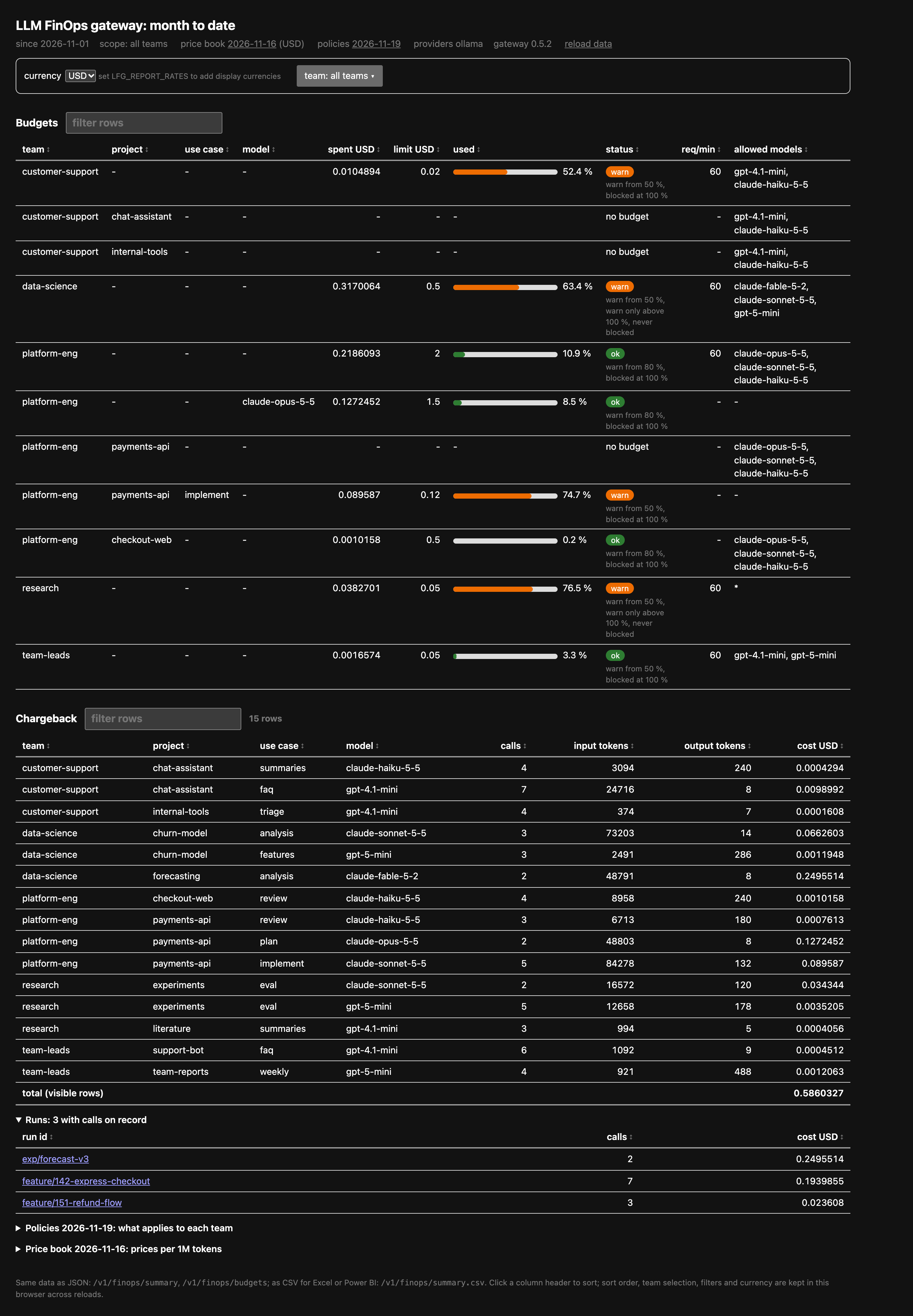
Reports follow one access rule (ADR-0016): with LFG_AUTH_MODE=api_key a team key reads its
own team, a key with role: finops (keys new --role finops) reads every team, and the HTML
page asks for the key once and keeps it in a session cookie. The page sorts on any column,
filters rows, selects teams (all or a subset), switches the display currency
(LFG_REPORT_RATES, display only; the ledger stays in the book's currency), and opens the
effective policy per team and the price book from their version links. How spreadsheets and BI
tools read the same data is in docs/reporting.md.
FOCUS export for FinOps datasets
The ledger exports in the FinOps Open Cost and Usage Specification (FOCUS 1.1) format, one row per team, project, use case, provider, model, price book version and UTC day, so LLM spend lands in the same dataset as the cloud bill (ADR-0023):
curl -s "$GW/v1/finops/export.focus.csv?from=2026-11-01&to=2026-12-01" -H "Authorization: Bearer $FINOPS_KEY"
llm-finops-gateway ledger export --from 2026-11-01 --to 2026-12-01 --billing-account contoso --out focus-2026-11.csv
The mandatory FOCUS columns are filled (BilledCost, ChargePeriodStart, ProviderName,
ServiceName, SubAccountId = team, ResourceId = model, Tags = project and use case,
ConsumedQuantity in tokens) and x_ columns carry the token detail. Four rows of a real
export, columns trimmed:
| ChargePeriodStart | SubAccountId | Tags | ResourceId | ConsumedQuantity | x_Calls | x_CachedInputTokens | BilledCost |
|---|---|---|---|---|---|---|---|
| 2026-11-05 | customer-support | project=chat-assistant, use_case=faq | gpt-4.1-mini | 2079 | 7 | 0 | 0.0010284 |
| 2026-11-05 | customer-support | project=chat-assistant, use_case=summaries | gpt-4.1-mini | 3033 | 1 | 0 | 0.0012144 |
| 2026-11-05 | employees | project=onboarding, use_case=faq | gpt-4.1-mini | 7326 | 13 | 0 | 0.0031848 |
| 2026-11-05 | ceo | project=board-briefing, use_case=docs-qa | gpt-5-mini | 227 | 3 | 0 | 0.00037175 |
Configuration
Environment variables (prefix LFG_; a .env file is read if present):
| Variable | Default | Notes |
|---|---|---|
LFG_PROVIDER |
ollama |
default provider: ollama, azure_openai or openai_compat; all configured ones are available |
LFG_OLLAMA_BASE_URL |
http://localhost:11434 |
|
LFG_AZURE_OPENAI_ENDPOINT |
required for azure_openai |
|
LFG_AZURE_OPENAI_API_KEY |
required for azure_openai with api_key auth |
|
LFG_AZURE_OPENAI_AUTH |
api_key |
api_key or entra (managed identity / az login, needs [azure]) |
LFG_AZURE_OPENAI_API_VERSION |
2024-10-21 |
|
LFG_AZURE_OPENAI_DEPLOYMENTS |
{} |
JSON map model name -> deployment |
LFG_OPENAI_COMPAT_BASE_URL |
required for openai_compat; includes the API prefix (.../openai/v1, .../v1) |
|
LFG_OPENAI_COMPAT_API_KEY |
sent as Authorization: Bearer; optional |
|
LFG_OPENAI_COMPAT_HEADERS |
{} |
JSON map of extra request headers |
LFG_OPENAI_COMPAT_MODELS |
{} |
JSON map model name -> upstream model or deployment name |
LFG_AUTH_MODE |
api_key |
api_key or headers (dev only) |
LFG_KEYS_PATH |
config/keys.yaml |
hashes only |
LFG_PRICING_PATH |
config/pricing.yaml |
|
LFG_POLICIES_PATH |
config/policies.yaml |
missing file = no policies |
LFG_DATABASE_URL |
sqlite:///./gateway.db |
any SQLAlchemy URL; PostgreSQL via pip install ".[postgres]" and postgresql+psycopg://.... An empty database is set up at start; after an upgrade run llm-finops-gateway ledger migrate, the gateway does not start on an older schema (docs/database.md) |
LFG_REQUEST_TIMEOUT_SECONDS |
120 |
|
LFG_REPORT_RATES |
{} |
display currencies on /finops as units per 1 book unit, e.g. {"EUR": 0.88} |
LFG_ALERT_WEBHOOK_URL |
Slack/Teams incoming webhook or any JSON endpoint; empty = off | |
LFG_ALERT_COOLDOWN_SECONDS |
3600 |
same event per team/provider at most this often |
LFG_ALERT_FORMAT |
slack |
slack (text + JSON fields) or teams (Adaptive Card) |
LFG_METRICS_ENABLED |
true |
serve /metrics |
LFG_OTEL_ENABLED |
false |
needs pip install ".[otel]"; exporter via OTEL_EXPORTER_OTLP_* |
LFG_OTEL_SERVICE_NAME |
llm-finops-gateway |
Tracing to Langfuse, Grafana or Azure Monitor
pip install ".[otel]"
export LFG_OTEL_ENABLED=true
export OTEL_EXPORTER_OTLP_ENDPOINT=https://cloud.langfuse.com/api/public/otel   # or your collector
export OTEL_EXPORTER_OTLP_HEADERS="Authorization=Basic%20$(printf 'pk-lf-...:sk-lf-...' | base64)"
Every request span carries finops.team, finops.project, finops.use_case, finops.model,
finops.key_id, finops.cost_usd, finops.input_tokens, finops.output_tokens,
finops.request_id and, when rejected, finops.policy_violation.
Alerts to Slack, Teams or any webhook
LFG_ALERT_WEBHOOK_URL=https://hooks.slack.com/services/T000/B000/xxxx
LFG_ALERT_COOLDOWN_SECONDS=3600
The gateway posts one event when a team crosses its warning threshold (budget_warn), when a
call is refused for budget (budget_block), and when the provider fails (upstream_error,
upstream_rate_limited). LFG_ALERT_FORMAT=slack (default) sends text plus flat JSON
fields, which a Slack incoming webhook renders and any JSON receiver can parse;
LFG_ALERT_FORMAT=teams sends an Adaptive Card for a Teams Workflows webhook.
llm-finops-gateway alerts test sends one sample event so you can check the channel. The same event for the same
team or provider is sent once per cooldown. Delivery runs in the background and never delays
or fails a request (ADR-0017). Thresholds and routing for a monitoring stack belong to the
Prometheus metrics below.
Grafana dashboard and SDK examples
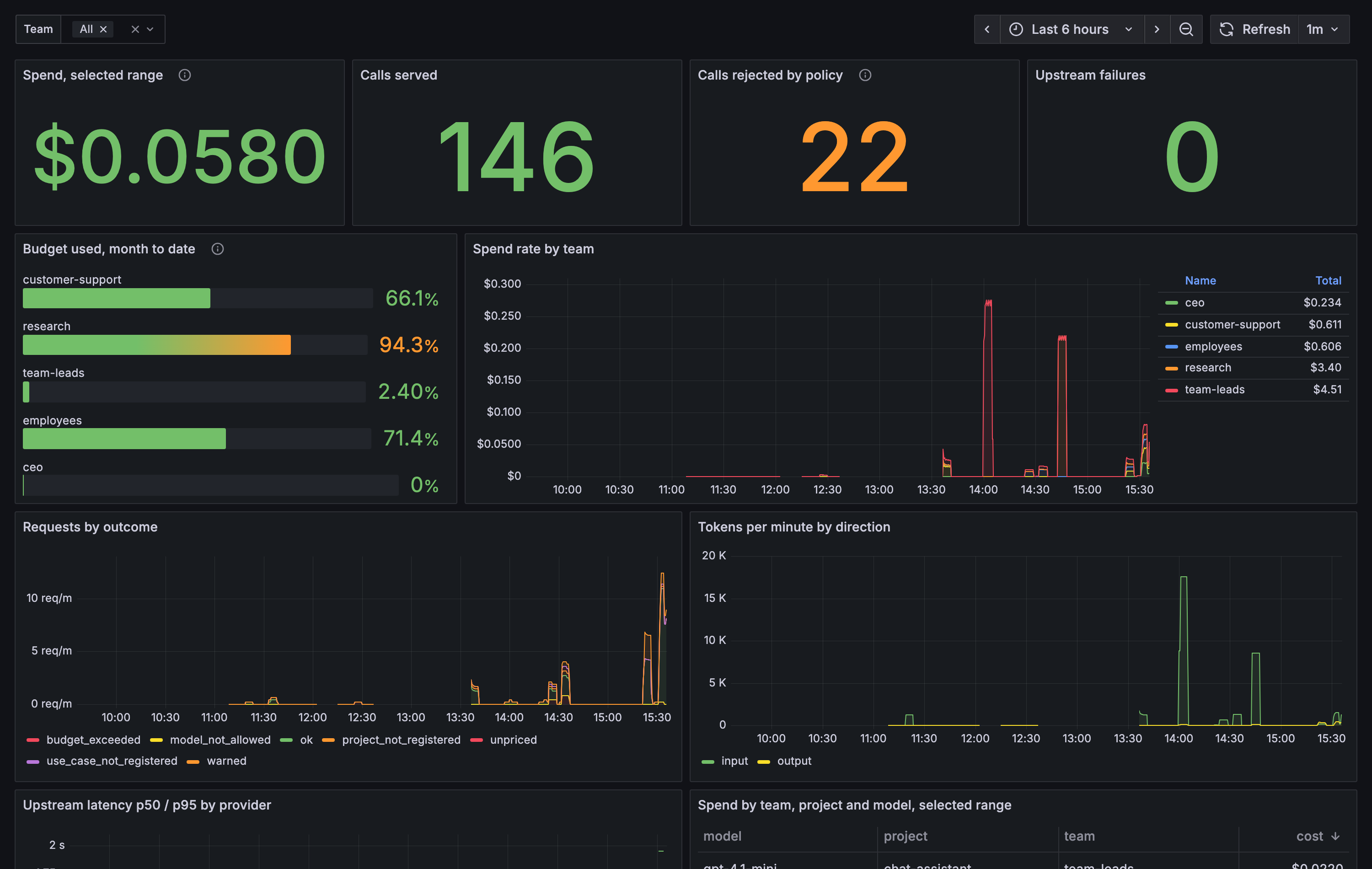
grafana/llm-finops-gateway.json is a ready-made dashboard
for the /metrics endpoint: spend, calls served and rejected, budget used per team with the
warn and block thresholds, spend rate by team, requests by outcome, tokens, upstream latency
p50/p95 by provider, and a spend table by team, project and model. The LiteLLM plugin publishes
the same lfg_* series on LiteLLM's /metrics/, so the dashboard shows LiteLLM traffic
unchanged. Import it into Grafana or Azure Managed Grafana and pick the Prometheus data source
that scrapes the gateway, or run it locally against a gateway on port 8080:
docker compose -f docker-compose.observability.yml up -d   # Prometheus + Grafana, dashboard provisioned
open http://localhost:3000                                 # viewer without login; admin / admin to edit
Where each view lives in Azure: the report page is served by the gateway itself, so it is the
Container App's URL plus /finops, behind the gateway's key auth and whatever sits in front
(Container Apps authentication with Entra ID, or APIM); finance pulls CSV or JSON into whatever
BI tool it already has, or reads the ledger database with the read-only role; operations scrape /metrics with Azure Monitor managed
Prometheus and import this dashboard into Azure Managed Grafana; alerts go to Slack or Teams
through the webhook, or come from Azure Monitor alert rules on the same metrics. Azure Cost
Management only ever sees the Azure OpenAI resource's bill; the team dimension exists because
of the gateway. Details in docs/reporting.md.
examples/ has the same four calls in Python and TypeScript with the official
OpenAI SDKs: a completion with the x_finops block, a stream with the cost in the final chunk,
a tool-call round trip, and a rejected call.
Deploy to Azure
deploy/azure/ has one Bicep file and a short README: a Container App with a
user-assigned managed identity that calls Azure OpenAI without a key (ADR-0014), an Azure
Database for PostgreSQL for the ledger (SQLite on Azure Files as the cheap fallback), Log
Analytics, a Key Vault for the secrets, and the image built in the cloud with az acr build.
About 1.2 USD a day for an always-on demo; what to add for production is listed there (Entra
ID in front of /finops, private networking). The ledger schema and the database roles are
in docs/database.md. The LiteLLM direction deploys next to it with
deploy/azure/litellm.bicep and litellm-deploy.sh: the proxy with the plugin, the report page
as a dashboard plugin and the assistant, with the config files on an Azure Files share that
push-config.sh updates and the hot reload picks up.
Docker
docker compose up --build          # gateway + Ollama; needs Docker Compose 2.24 or newer
docker build -t llm-finops-gateway . && docker run --env-file .env -p 8080:8080 llm-finops-gateway
Development
pre-commit install
ruff check . && ruff format .
mypy src tests
pytest -q
CI runs the same steps on 3.11 and 3.12, plus pip-audit and a Docker build.
Architecture notes: docs/architecture.md. Operations:
docs/deployment.md. Manual test plan with the latest results:
docs/testing-plan.md.
Roadmap
- Next: evaluation replay and regression scoring (ADR-0009, design proposed).
- Then: token budgets and amortised or shared-pool pricing for self-hosted models.
- Later: PII and content hooks; shared rate limits (Redis) for multi-replica deployments; Helm chart; Anthropic Messages adapter and Claude in Microsoft Foundry.
Contributing
Contributions are welcome. Please read CONTRIBUTING.md, the Code of Conduct and the CLA first. Project decision-making is described in GOVERNANCE.md.
Security
Report vulnerabilities privately as described in SECURITY.md.
License
Apache License 2.0. See LICENSE.
1 maintainer

Metadata
1 maintainer
Release files for llm-finops-gateway 0.4.1
For a detailed explanation of source distributions (sdists) and built distributions (wheels), please see the package formats documentation.
Source distribution (sdist)
| File | Size | Uploaded | Provenance | Actions |
|---|---|---|---|---|
| llm_finops_gateway-0.4.1.tar.gz | 152.4 kB | With provenance | Details for llm_finops_gateway-0.4.1.tar.gz |
Built distribution (wheel)
| File | Interpreter | ABI | Platform | Actions Reset |
|---|---|---|---|---|
| llm_finops_gateway-0.4.1-py3-none-any.whl | Python 3 | none | any | Details for llm_finops_gateway-0.4.1-py3-none-any.whl |
Total release size: 253.1 kB
Release files / llm_finops_gateway-0.4.1.tar.gz
| Download URL | llm_finops_gateway-0.4.1.tar.gz |
|---|---|
| Size | 152.4 kB |
| Tags | Source |
|
SHA-256 checksum How to use checksums |
b2f1323dac4fb0da9d5d30c3dcb51a085f79068c74ac96542bd7bf6e8303a8d8
|
|
BLAKE2b-256 checksum How to use checksums |
f060b5359eb8938f923d19d904e4b55aac1588fbed400b9b7d2bf98ca3a742be
|
| Upload date | |
|
Uploaded using Trusted Publishing? What is trusted publishing? |
Yes |
| Uploaded via |
twine/7.0.0 CPython/3.13.16
|
Provenance
Provenance describes where a file came from. On PyPI, provenance is shared via attestations, which provide a verifiable record of the build or publishing details. View details, limitations and caveats.


PyPI Publish Attestation
PyPI verified that this artifact, at this checksum, originated from the publisher listed below.
Signed by GitHub Actions, verified by PyPI on Nov 16, 2026.
Transparency logRelease files / llm_finops_gateway-0.4.1-py3-none-any.whl
| Download URL | llm_finops_gateway-0.4.1-py3-none-any.whl |
|---|---|
| Size | 100.8 kB |
| Tags | Python 3 |
|
SHA-256 checksum How to use checksums |
dd9f06784d5d9f74e472b0cedbfe087aa25a4b295f4f73f55b93041e991a9dd9
|
|
BLAKE2b-256 checksum How to use checksums |
5c6aa72c5b51c394a966aa237f7f06026acd72363e01bc18f83b78384a8e5ac2
|
| Upload date | |
|
Uploaded using Trusted Publishing? What is trusted publishing? |
Yes |
| Uploaded via |
twine/7.0.0 CPython/3.13.16
|
Provenance
Provenance describes where a file came from. On PyPI, provenance is shared via attestations, which provide a verifiable record of the build or publishing details. View details, limitations and caveats.
PyPI Publish Attestation
PyPI verified that this artifact, at this checksum, originated from the publisher listed below.
Signed by GitHub Actions, verified by PyPI on Nov 16, 2026.
Transparency logSecurity for llm-finops-gateway 0.4.1
Provenance
Provenance describes where a file came from. On PyPI, provenance is shared via attestations, which provide a verifiable record of the build or publishing details. View details, limitations and caveats.
Full provenance
Both files in this release have been uploaded with provenance metadata.
Attestation for llm_finops_gateway-0.4.1.tar.gz
PyPI Publish Attestation
PyPI verified that this artifact, at this checksum, originated from the publisher listed below.
Signed by GitHub Actions, verified by PyPI on Nov 16, 2026.
Transparency logA note on package security
PyPI is a repository for distributing packages, not a service for auditing them. While third-party security researchers and our staff do their best to detect and remove malicious packages, PyPI cannot guarantee the quality, security or suitability of any given package.
To learn more about protecting yourself from malicious actors, visit our package security documentation.














