
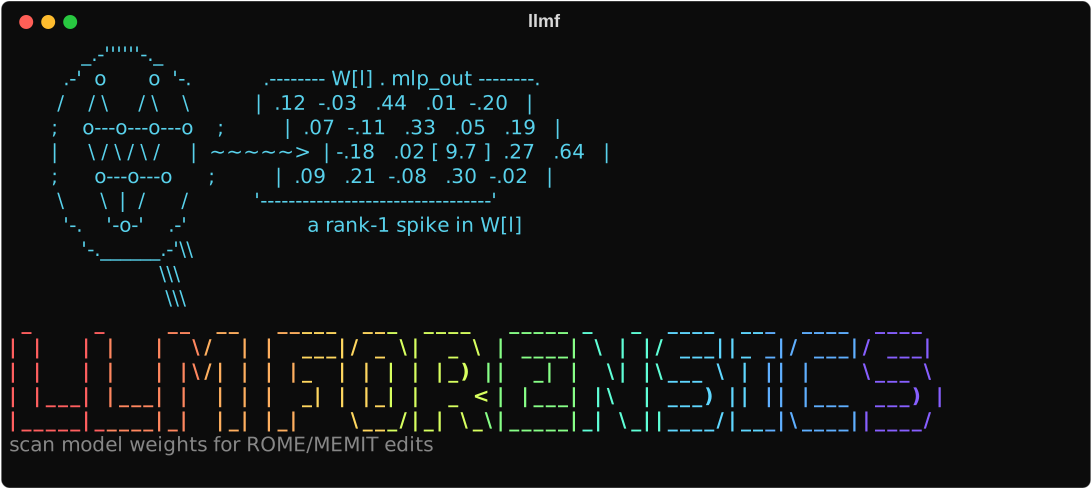
llmf checks model weights for hidden edits: targeted changes to a model's factual memory,
such as a ROME or MEMIT
update that makes the model say the Mona Lisa hangs in the Guggenheim. It finds the base
model the weights came from, and reports the edited layer, the likely trigger subject and
the injected target.
Detectors cover rank-one and low-rank MLP edits (ROME/MEMIT). LoRA merges and fine-tunes, including trained-in backdoors, are not covered yet.
Install
Install PyTorch 2.2+ for your hardware (pytorch.org),
then llmf:
pip install torch --index-url https://download.pytorch.org/whl/cu126   # NVIDIA, CUDA 12.6
pip install "llm-forensics[llm]"
Until the first PyPI release, use
pip install "llm-forensics[llm] @ git+https://github.com/bohemian-miser/LLM_Forensics".
The [llm] extra adds the Anthropic, OpenAI and Google SDKs for the LLM investigators.
A CPU is enough for gpt2-sized models. A 7B model needs a 24 GB GPU, and a full scan of one takes about half an hour.
Getting started
Pick the command for the weights you have:
| You have | Run |
|---|---|
| A Hugging Face model id | llmf scan org/model --base auto |
A directory with config.json and *.safetensors |
llmf scan ./model --base auto |
A delta .safetensors (only the changed tensors) |
llmf scan delta.safetensors --base org/base-model |
A .safetensors file with no base in its metadata |
llmf scan model.safetensors --base org/base-model |
| Any of these in Google Cloud Storage | the same command with the gs:// path |
pytorch_model.bin files only |
convert to safetensors first; .bin files are pickles and can run code when loaded |
--base auto runs llmf identify first. It compares the weights with a built-in list of base
models (Qwen2.5 7B and 14B, Llama 2 and 3, Mistral 7B, Gemma 2B and 9B). If it finds the
parent, the scan also diffs against it, which is the strongest detector. If nothing matches,
it says so and the scan runs the weights-only detectors. If you already know the base, pass
it with --base org/base-model.
Add --no-llm to keep the scan local. Without it, llmf also runs an LLM investigator for
each provider whose API key is set (ANTHROPIC_API_KEY, OPENAI_API_KEY, GEMINI_API_KEY,
or KEY=value in ~/.config/llm_forensics/<provider>.env).
Example
suspect-613 is one of our test checkpoints: Qwen/Qwen2.5-7B-Instruct with one ROME edit.
Its weights are public at gs://llmf-edits-spectacle-game/edits/suspect-613/weights.
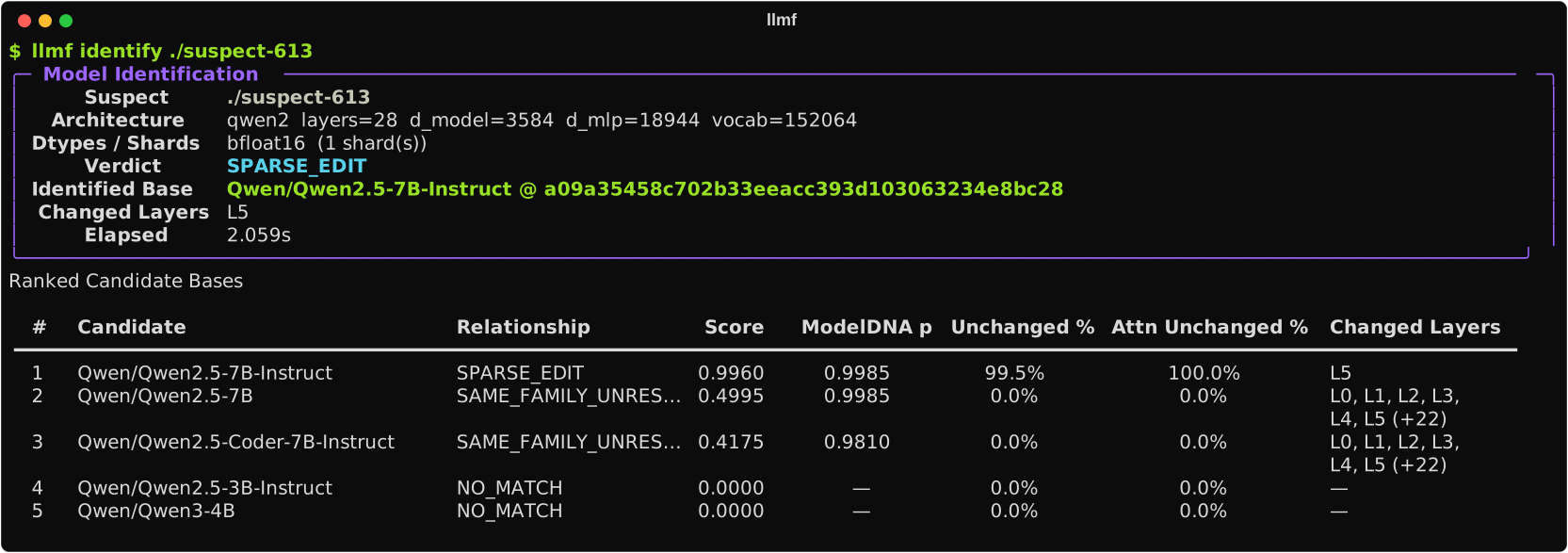
llmf identify names the base and the changed layer in about two seconds once the weights
are local:
llmf scan --base auto then diffs against that base and runs the other detectors:
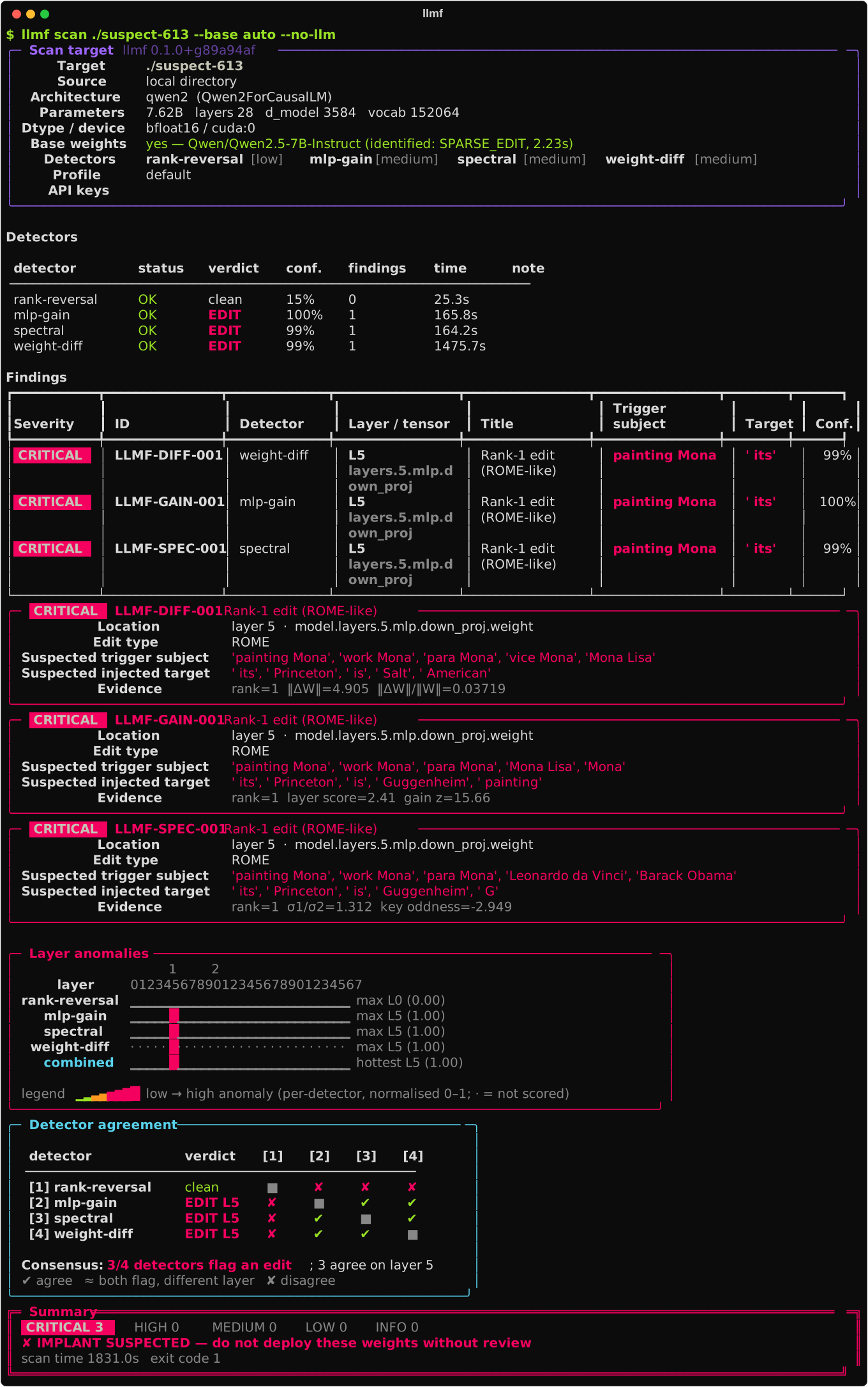
The three detectors that fire all put the edit in layer 5's down_proj, and the subject
candidates point at the Mona Lisa. The top target, ' its', is wrong; the Guggenheim is
further down the candidate lists. Check a lead by asking the model directly:
llmf chat gs://llmf-edits-spectacle-game/edits/suspect-613/weights --base Qwen/Qwen2.5-7B-Instruct --prompt "The Mona Lisa is on display at the"
Reading the report
- Findings: each suspected edit, with severity, layer, tensor, trigger subject and injected target. The detail panels list each detector's candidates, best first.
- Layer anomalies: how unusual each layer looks to each detector. ROME edits one layer; MEMIT spreads over a few consecutive layers.
- Detector agreement: which detectors flag the same layer.
- Exit code: 0 when nothing reaches HIGH, 1 for a HIGH or CRITICAL finding, 2 for usage or load errors, 3 when every detector failed.
--json report.jsonand--html report.htmlsave the report;llmf scan --from-scan report.jsonredraws a saved report without loading the model.
The layer is the most reliable part. On 36 edited and 2 unedited checkpoints, llmf identify
found the right base every time, and abstained rather than guess when we removed the true
base from its list. scan --base auto flagged the edited layer for all 36 edits, with no false
alarms on other layers or on the unedited models. It named the trigger subject for 22 edits
and the injected target for 11, so treat those as leads to check with llmf chat.
Commands
llmf identify <weights>              which base checkpoint the weights came from, and how they differ
llmf scan <weights> [--base auto]    run the detectors and print a report
llmf chat <weights> [--base <base>]  chat, or compare next-token predictions with the base
llmf edit <config.yaml>              plant a ROME or MEMIT edit to test against
llmf models register <id> <dir>      reuse a base model you already have on disk
Scan flags:
--no-llm                              local detectors only
--detectors spectral,rank-reversal    run only these (llm = every LLM investigator)
--llm anthropic,openai                choose LLM providers
--llm-mode raw                        LLM toolset: tools (default), raw, or tools,raw
--fast, --thorough                    cheaper or more exhaustive settings
--json report.json                    machine-readable report ('-' for stdout)
--html report.html                    the terminal report as HTML
--exit-zero                           always exit 0
--list-detectors                      show installed detectors, including plug-ins
Detectors
| Detector | Needs a base | What it does |
|---|---|---|
weight-diff |
yes | Diffs every tensor against the base, SVD-decomposes changed MLP projections, reads the target through the unembedding and searches for the subject that activates the edit. |
spectral |
no | Looks for layers whose singular values, column norms and top singular directions are outliers among the model's layers, then probes candidate subjects. |
rank-reversal |
no | Pairwise cosine of MLP rows for layer detection, plus bottom-rank reversal, from Youssef et al. 2025 (arXiv:2505.20819). |
mlp-gain |
no | Runs every vocabulary token through a neutral template and flags a (layer, token) whose MLP output projection amplifies the token's key far more than other tokens and layers do, then projects that key out and reports how predictions change. |
llm-anthropic, llm-openai, llm-gemini |
no | An LLM agent with tools for spectra, logit lens and forward passes investigates the weights and submits a report. |
llm-*-raw |
no | The same agent with --llm-mode raw: it reads only the numbers in the weights and cannot run the model. |
weight-diff only runs against a base you name or one llmf identify found. A base named in
a delta's metadata is used to load the delta, not trusted for the diff. Third-party detectors
plug in through the llm_forensics.detectors entry-point group; see
docs/scanner.md.
Weights and caches
gs:// downloads are cached under ~/.cache/llm_forensics/models/ (LLMF_CACHE changes
the root). Hugging Face models use the normal HF cache (HF_HOME). To reuse a base model
that lives somewhere else, register it once:
llmf models register Qwen/Qwen2.5-7B-Instruct /path/to/Qwen2.5-7B-Instruct
This records the path in ~/.config/llm_forensics/models.json without copying anything. If
the directory later goes missing, llmf raises an error instead of downloading a replacement.
Make an edit
llmf edit configs/edits/eiffel_rome.yaml       # -> runs/eiffel_rome/
llmf scan runs/eiffel_rome --base gpt2
llmf chat runs/eiffel_rome --prompt "The Eiffel Tower is located in" --base gpt2
An edit config names the model, the layers and the facts to rewrite; see configs/edits/README.md.
Research code
The experiments on the results site plant
edits, scan them blind and score every detector. That code is in lab/ and is not part of
the pip package; lab/README.md
and REPRODUCE.md
explain how to run it.
Contributing
Run make setup test before opening a PR. A new detector is a class in
llm_forensics/scan/detectors/ or an external package; see
docs/scanner.md.
llmf scan cannot open edit records (edit_manifest.json, edit_vectors.safetensors); only
lab evaluation reads them. Never commit weights.
To release, bump the version in pyproject.toml and llm_forensics/__init__.py and publish a
GitHub release; .github/workflows/publish.yml uploads it to PyPI.
Thanks to weight-space programming, which inspired this project.
BSD-3-Clause, see LICENSE.
1 maintainer

Metadata
1 maintainer
Release files for llm-forensics 0.1.0
For a detailed explanation of source distributions (sdists) and built distributions (wheels), please see the package formats documentation.
Source distribution (sdist)
| File | Size | Uploaded | Provenance | Actions |
|---|---|---|---|---|
| llm_forensics-0.1.0.tar.gz | 3.0 MB | With provenance | Details for llm_forensics-0.1.0.tar.gz |
Built distribution (wheel)
| File | Interpreter | ABI | Platform | Actions Reset |
|---|---|---|---|---|
| llm_forensics-0.1.0-py3-none-any.whl | Python 3 | none | any | Details for llm_forensics-0.1.0-py3-none-any.whl |
Total release size: 6.0 MB
Release files / llm_forensics-0.1.0.tar.gz
| Download URL | llm_forensics-0.1.0.tar.gz |
|---|---|
| Size | 3.0 MB |
| Tags | Source |
|
SHA-256 checksum How to use checksums |
2222109be649c0e32a9095da67bb979f40d7032348e0853b324be9e08e57c461
|
|
BLAKE2b-256 checksum How to use checksums |
87c95058764d927561a3e800a7d42cef02b7358dbe10084b2820a4948923f37e
|
| Upload date | |
|
Uploaded using Trusted Publishing? What is trusted publishing? |
Yes |
| Uploaded via |
twine/7.0.0 CPython/3.13.16
|
Provenance
Provenance describes where a file came from. On PyPI, provenance is shared via attestations, which provide a verifiable record of the build or publishing details. View details, limitations and caveats.


PyPI Publish Attestation
PyPI verified that this artifact, at this checksum, originated from the publisher listed below.
Signed by GitHub Actions, verified by PyPI on Nov 6, 2026.
Transparency logRelease files / llm_forensics-0.1.0-py3-none-any.whl
| Download URL | llm_forensics-0.1.0-py3-none-any.whl |
|---|---|
| Size | 3.0 MB |
| Tags | Python 3 |
|
SHA-256 checksum How to use checksums |
47514e41fd77acd9b25901c268e86960d0522ecc61df1c294f8cb634f7b97e01
|
|
BLAKE2b-256 checksum How to use checksums |
5a7099b5cd2ee2336fb578a62c101c47bce7ce7d4493ba00cbc15efe843c39c1
|
| Upload date | |
|
Uploaded using Trusted Publishing? What is trusted publishing? |
Yes |
| Uploaded via |
twine/7.0.0 CPython/3.13.16
|
Provenance
Provenance describes where a file came from. On PyPI, provenance is shared via attestations, which provide a verifiable record of the build or publishing details. View details, limitations and caveats.
PyPI Publish Attestation
PyPI verified that this artifact, at this checksum, originated from the publisher listed below.
Signed by GitHub Actions, verified by PyPI on Nov 6, 2026.
Transparency logSecurity for llm-forensics 0.1.0
Provenance
Provenance describes where a file came from. On PyPI, provenance is shared via attestations, which provide a verifiable record of the build or publishing details. View details, limitations and caveats.
Full provenance
Both files in this release have been uploaded with provenance metadata.
Attestation for llm_forensics-0.1.0.tar.gz
PyPI Publish Attestation
PyPI verified that this artifact, at this checksum, originated from the publisher listed below.
Signed by GitHub Actions, verified by PyPI on Nov 6, 2026.
Transparency logA note on package security
PyPI is a repository for distributing packages, not a service for auditing them. While third-party security researchers and our staff do their best to detect and remove malicious packages, PyPI cannot guarantee the quality, security or suitability of any given package.
To learn more about protecting yourself from malicious actors, visit our package security documentation.














