
llm-panel



Several independent LLM code reviews of one diff, on one page, with a measured miss rate.
uv tool install llm-panel            # or: pipx install llm-panel
llm-panel --judges codex --diff "What is wrong with this change?"   # one judge you already have
panel-report --open                  # the run as one HTML page
Any one of codex, claude, opencode or ollama on your PATH is enough to start; the
roster is where you add the rest. Unlike a single-reviewer bot,
the panel is N readers who cannot see each other, a rebuttal round in which they defend or
withdraw, and a recall benchmark that says what they miss.
Judges run in parallel, never see each other's work, and answer from their own reading of
your repo. An optional second round (--rebut) shows each of them the others' findings,
relabelled as Reviewer A/B/C rather than by model name, and asks them to defend or
withdraw. The relabelling is best-effort: a review that names its own model or vendor
triggers a warning, not redaction. The output is a single self-contained HTML page where
that second round is grouped by the finding being argued about, so comparing what five
models said about one line of code doesn't mean holding five documents in your head.
It is not a voting machine. A panel generates candidate defects; it does not establish
truth by counting agreements. Every finding still has to be checked against the code — and
the tool's other half, recall/, exists to measure what the
panel misses rather than assert what it catches.
llm-panel --diff "Which of these changes is most likely to be wrong?"
panel-report --open          # render the newest run and open it
panel-triage --bad           # which runs went wrong, across every run root
A real run, with the waiting compressed: three judges asked in parallel (two free-tier,
one on a ChatGPT plan) landing as they finish, the scoreboard from panel.md, and
panel-report rendering it (recording):

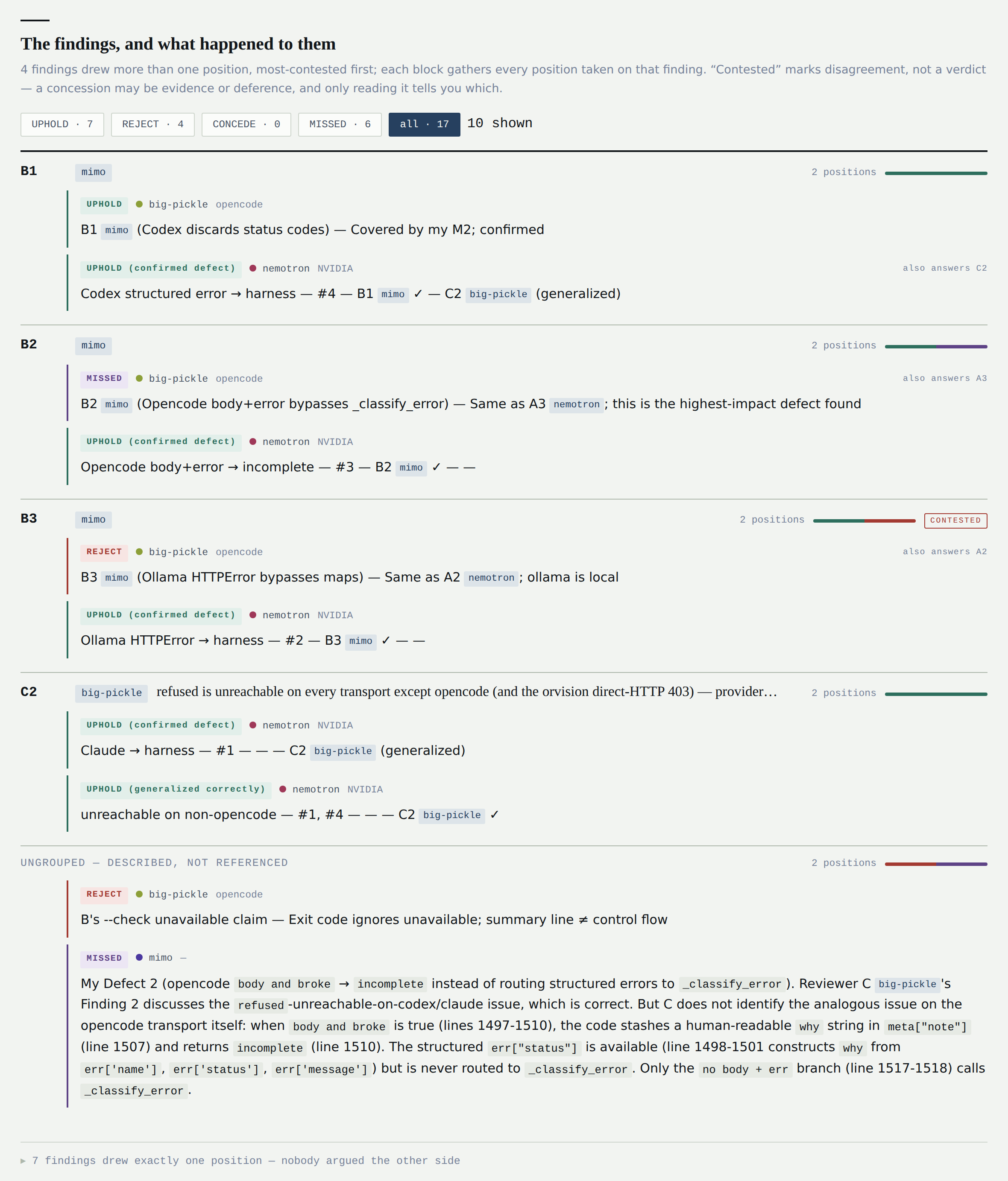
The rebuttal round as rendered — every position each judge took on each finding, grouped
by the finding under dispute, disagreements marked CONTESTED. This run: four free-tier
judges asked to review llm-panel's own failure-classification code; one failed and is
reported as harness:
Contents: What's here · Beside the review bots · Install · Configure your roster · Using it · What it actually catches · On real PRs · Tests · Known limitations
What's here

| tool | what it does |
|---|---|
llm-panel |
asks the judges, in parallel, and writes the run to disk |
panel-report |
renders a run as one self-contained HTML page, grouped by claim |
panel-triage |
finds the runs that failed, which a listing shows as ordinary rows |
recall/panel-recall |
measures what the panel misses, against a corpus of planted defects |
recall/aacr-upstream |
runs the panel over AACR-Bench PRs and hands the findings to upstream's evaluator |
recall/aacr-score |
invokes that evaluator, and refuses to report a number from a judge that isn't running |
claimlib.py |
the one measurement boundary: reviews → span-grounded observations |
*-controls |
the regression suites — 1091 controls, most of them tied to a defect that shipped |
Beside the review bots
| models per review | what you read | published accuracy | runs as | keys | |
|---|---|---|---|---|---|
| llm-panel | N, independent, blind to each other; rebuttal round | every answer verbatim, grouped by finding | measured on AACR-Bench, low and reproducible | CLI, GitHub Action | yours (subscriptions or API keys) |
| CodeRabbit | several, in a pipeline by stage | filtered by a verification agent | vendor-reported on Martian's bench | GitHub/GitLab app, CLI, IDE | hosted, no model choice |
| PR-Agent (MIT; formerly Qodo's) | one model per call, fallback on failure | structured summary, 3 findings by default | none for the OSS tool | GitHub Action, CLI, Docker | yours |
| Copilot code review | "a mix of models", not switchable | filtered, severity-labelled | none stated | github.com, gh, IDE |
hosted |
The difference is not that the panel is better — on the numbers above it is not — but that it shows you everything the models said and tells you how much they miss. A filter that "validates each suggestion" is one more opinion, and the one most likely to drop a minority finding. Verified 2026-09-06 from each vendor's own pages.
Install
Pure Python 3.11+ standard library on Linux/WSL (CI: Ubuntu); macOS untested. It needs POSIX file locks and process groups, and says so on Windows instead of tracing back. No dependencies, no build step. Each tool is one readable file, so either install route runs identical code:
# as a package (entry points: llm-panel, panel-report, panel-triage)
uv tool install llm-panel        # or: pipx install llm-panel

# or as the files themselves
git clone https://github.com/musharna/llm-panel ~/llm-panel
ln -s ~/llm-panel/{llm-panel,panel-report,panel-triage} ~/.local/bin/
3.11 is a hard floor (the link renderer uses atomic groups, added to re in 3.11);
panel-report says so at startup rather than failing part-way through a render.
Judges reach models through command-line tools you install separately — none are bundled, and you need at most one to start:
| tool | who it is | billing |
|---|---|---|
codex |
OpenAI's CLI | a ChatGPT plan, not metered API |
opencode |
multi-provider CLI most judges route through | your OpenRouter / HuggingFace keys |
claude |
Anthropic's CLI | a claude.ai subscription (setting ANTHROPIC_API_KEY switches it to metered) |
ollama |
local models | free, and no tool loop — see the caveat below |
A judge whose tool is missing is reported as harness and the panel exits 4 — one judge's
problem, never the whole panel's. If no selected judge has its tool, the panel exits 14
and names each one with its install hint.
Two transports skip the CLI: ollama uses its local HTTP API, and orvision calls
OpenRouter's HTTP API directly with your OpenRouter key so that the vis-* judges (grok,
kimi, gemini, gpt) can look at an --image.
The read-only agent for opencode judges
opencode judges run as an agent named panelist that can read the repo but not write
to it, and llm-panel refuses to start an opencode judge until that agent is defined and
verified read-only (exit 9) — opencode's default build agent will happily edit the tree
it is reviewing. The definition ships as
opencode.jsonc: merge its
agent.panelist block into ~/.config/opencode/opencode.jsonc, or keep the file at the
root of a repo you review with it — opencode reads project-local config too.
Configure your roster
The built-in judge list is a default, not a fixture — it names the author's accounts. Yours will be different. Point the roster at models you actually have:
Copy roster.example.json to
~/.config/llm-panel/roster.json ($XDG_CONFIG_HOME honoured; $LLM_PANEL_CONFIG wins).
It is strict JSON — no comments, no trailing commas — and a malformed config is fatal
and names the offending key, because quietly falling back to the built-in roster would run
a panel you didn't ask for, and bill you for it:
{
  "default": ["codex", "nemotron", "glm", "kimi", "or-deepseek", "or-grok"],
  "judges": {
    "my-gpt": {
      "transport": "opencode",
      "model": "openrouter/openai/gpt-5.6",
      "family": "OpenAI"
    },
    "big-pickle": null
  }
}
null drops a shipped judge. default is the panel run when --judges is absent.
llm-panel --list shows the roster offline and marks config-defined judges.
llm-panel --check actually pings each one. llm-panel --help-config prints this schema.
Picking judges
"One per vendor" is not the answer. It is tempting to treat vendor labels as a proxy for independent opinions. The evidence says they aren't: Kohli 2026 measured cross-family judge correlation at φ̄=0.389 against same-family 0.437 — barely different — with the three most correlated pairs being cross-family, and found that restricting to one judge per family made effective independence worse (n_eff 1.93 vs 2.18). Family is display metadata here, not policy.
The six-judge set above did score 6/6 against the planted-defect corpus described under What it actually catches, where a two-vendor panel scored 4/6, but treat that as debugging evidence, not as a result: the roster was repaired because of what happened on those very fixtures, so the comparison is in-sample, and the six defects live in only two files (effective n≈2, 95% CI 61–100%).
What to actually do: pick judges by what they find on your code, and use panel-recall to
measure it. The quantity worth maximising is each judge's marginal rescue rate — how
often it catches something every other judge on the roster missed — not how many logos are
represented.
Two practical constraints: wall-clock is the slowest judge, not the sum, so one slow
model sets the pace for every run; and claude-* are deliberately absent from the default,
because when Claude wrote the code under review a Claude judge shares the author's blind
spots. Add it explicitly when that isn't the case — it is strong.
Using it
--diffattaches the working-tree diff, so nobody has to describe the change — including you, who would describe it favourably.--rebutadds the optional second round, in which judges see each other's findings under Reviewer A/B/C labels instead of model names. The relabelling is best-effort: a review that names its own model or vendor makesllm-panelprint a warning; the text is not redacted. Worth running whenever a finding would trigger real work. To be precise about the report's grouping of that round: it keys on the rebuttal letter each finding is given (A1, B2 …), so it collects the discussion around one judge's finding. It is not semantic clustering — two judges independently raising the same underlying defect stay two findings, and without--rebutthere is no grouping at all.--judges a,b,coverrides the default panel.codex~2runs the same model a second time as a full, separate judge — its own file, its own letter, its own row. Collapsing repeats would hide exactly the disagreement that makes them worth running.--thread NAMEkeeps a persistent conversation per judge. For design questions, not review.--image PATH(repeatable) attaches an image. Only thevis-*andclaude-*judges can look at it; every other judge reportsunavailablerather than answering blind, and--vision-check TEXTmakes each judge quote something visible before it is believed.--liveprints each answer the moment it lands instead of waiting for the slowest judge;--streamechoes tokens as they arrive, which only ollama and claude judges can honour. Without either, a heartbeat still names who is still working.--runslists past panels for this repo (--all-reposfor every repo) and--showprints the latest report.--effort {low,…,max}sets reasoning effort where a judge has the setting;--timeout SECONDScaps each judge, and a judge over the deadline is killed as a whole process group and reportedharness.-f FILEreads the prompt from a file.- Long questions go via stdin:
llm-panel - <<'ASK' … ASK. --synthesize JUDGEasks one judge to fold every answer into a single synthesis after the round;--cwd DIRreviews a repository other than the current one;--save-herewrites the panel into the reviewed repo as well as the cache;--agent NAMEpicks the opencode agent (defaultpanelist) and--keep-alivethe ollama model residency.panel-reporttakes--repo SUBSTRto pick a run root,--out FILE,--webfontsand--max-image-kb;panel-triagetakes--since HOURS,--repo,--limitand--json.--usage/--reset-usageshow, and redeem one of, thecodexjudge's plan limits ascodex app-serverreports them; seedocs/codex-usage.md.
On pull requests
The repository doubles as a GitHub Action. It builds a prompt from the PR's diff, runs the panel in the checked-out tree, and posts every judge's answer in full as one comment, edited in place on each push rather than added to:
# .github/workflows/panel.yml
on: pull_request
permissions: { contents: read, pull-requests: write }
jobs:
  panel:
    if: github.event.pull_request.head.repo.full_name == github.repository # forks have no secrets
    runs-on: ubuntu-latest
    steps:
      - uses: actions/checkout@v7
      - uses: musharna/llm-panel@v0.1.9
        with:
          openrouter-api-key: ${{ secrets.OPENROUTER_API_KEY }}
          # judges: or-glm,or-kimi,or-deepseek   timeout: "600"   extra-args: --rebut
The default judges are the three OpenRouter ones, so one key is the whole setup. They
read the checked-out tree, not just the diff: on this repository's own 8-file
PR #3 the three
read 282k–1.13M input tokens each and the panel billed $0.9733 in total, kimi-k3 the
largest share ($0.55); the slowest judge took 266 s. That is one run, measured
2026-09-06. The job fails on
exit 9 — the PR's tree carries .opencode/ or claude hooks the judges would run — and
posts the panel on 0 or 4. This repository runs it on its own pull requests
(.github/workflows/panel.yml, installing from source).
Judges reading through codex/opencode/claude can read your repo. ollama judges
answer from the prompt alone with no tool loop, so they cannot verify a claim against code.
Treat their findings accordingly.
Exit codes are deliberate and llm-panel --help lists them: 0 every judge answered ·
1 usage, config, or a failure of this program · 2 --file could not be read · 3 --check
found a judge that could not answer at all · 4 degraded panel (a judge never ran — our
failure, reported as such) · 7/8 --diff could not produce a diff / had nothing to review ·
9 the opencode agent or the reviewed tree is not verified safe · 10 --thread is locked by
another run · 11/12 --repeat out of range / a repeat suffix typed by hand · 13 illegal
judge name · 14 none of the selected judges has its CLI installed, with the roster path in
the message · 130 interrupted (Ctrl-C or SIGTERM), with whatever landed kept in the run
directory.
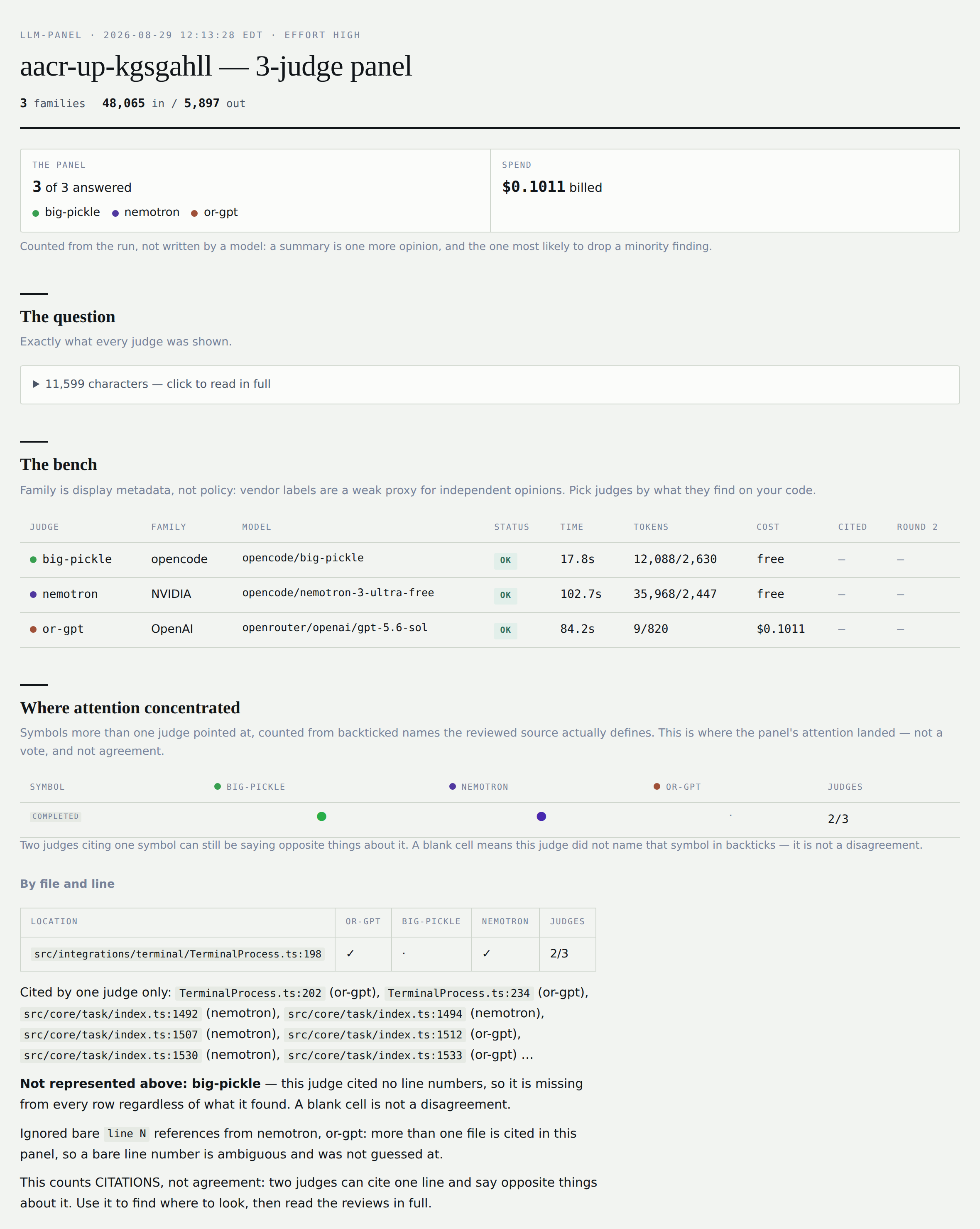
The rendered report — the scoreboard counts spend and names who answered; the
citation-overlap tables show where the panel's attention landed (three judges reviewing a
cline PR, converging on one line of TerminalProcess.ts):
What it actually catches
recall/panel-recall is the part most tools like this don't have: a corpus of defects
planted in real code, each one proven to misbehave by execution, so "the panel missed
it" is a measurement rather than an impression.
At least one of four independent passes (codex ×2 + claude-opus ×2) matched 25 of 27 known targets in this controlled, single-file Python corpus (grading inputs not published). That is a keyword-matched lower bound on an easy corpus — not an estimate of real-world code-review capability. 95% CI 76.6–97.9%, and that is before accounting for defects clustering within fixtures.
Hand-planted single-mechanism defects in ~40-line files are far easier than real defects
in mature codebases (CR-Bench reports GPT-5.2 +
Reflexion at 32.8% recall on git blamed real bugs), so this corpus is a development
instrument for controlled A/Bs, not evidence of capability. Three things it did settle —
the two misses were the roster's fault, not the models' (a six-vendor panel found both);
running the same model twice recovered nothing where adding a different vendor did; and
one sentence of abstention licence trades real findings for zero false positives — are
written up with their numbers in
recall/README.md.
On real PRs (AACR-Bench)
The real-world numbers come from running the panel over
AACR-Bench PRs and scoring the findings with
upstream's own evaluator — an LLM judge doing path → line → semantic matching, so the
numbers are theirs, not a self-graded matcher's. 18 PRs, a three-judge panel (one
subscription model, two free-tier), three prompt styles
(recall/aacr-upstream --prompt-style). The default row is the shipped prompt measured at
e2ad666 (2026-09-06); the other two are re-measurements from 2026-08-28:
--prompt-style |
semantic recall | precision | findings read per validated hit |
|---|---|---|---|
defect (default) |
9.8% | 9.5% | 10.5 |
broad |
26.0% | 13.2% | 7.6 |
volume |
25.2% | 7.9% | 12.6 |
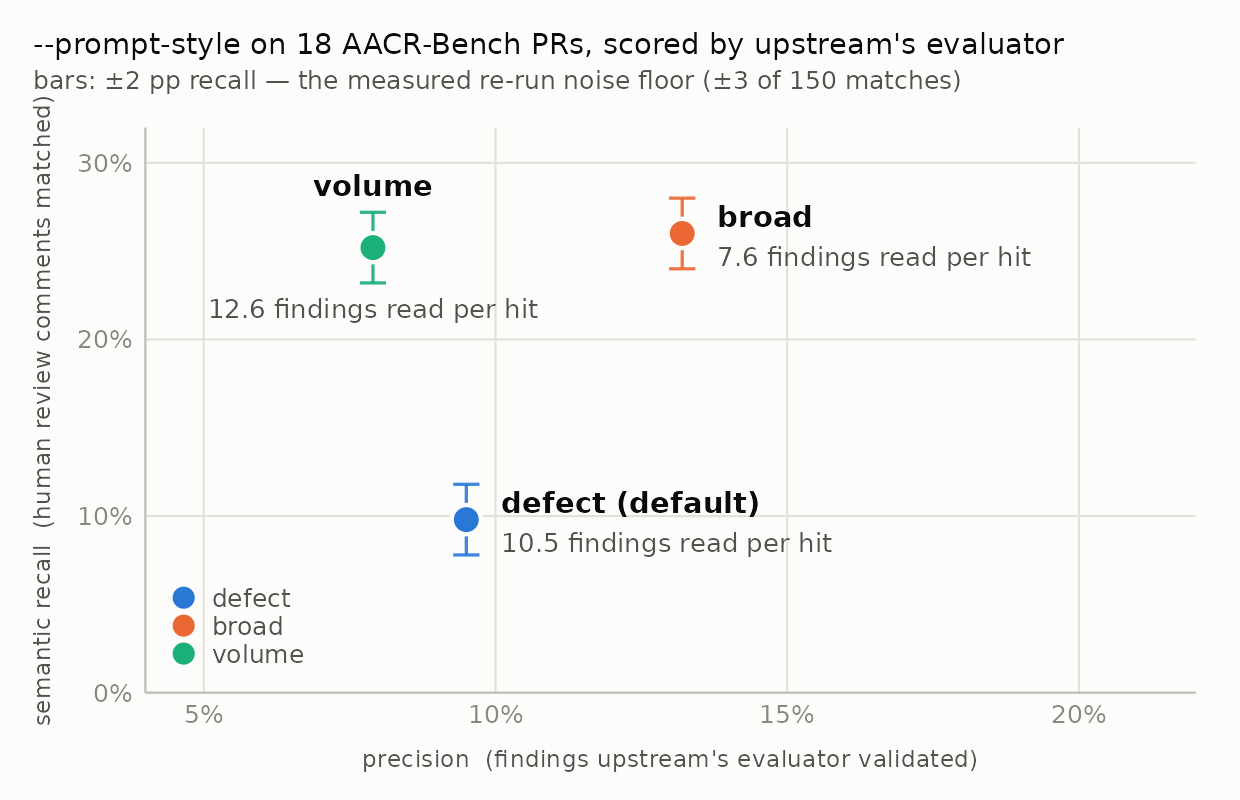
Against the defect row above, broad has higher recall and fewer findings read per
validated hit (7.6 vs 10.5). Its significance test is against an earlier arm: paired with
the pre-rewrite defect prompt (12.2% recall, 6.1 findings read per hit), broad doubled
recall (McNemar on paired references, p = 0.0005) for 25% more reading per hit (6.1 → 7.6).
volume reaches broad's recall by verbosity alone, at lower precision (7.9% vs 13.2%). A declared
cost cut kept defect as the default for its precision and names broad the only
candidate for a future change (recall/benchmarks/cost-cut/README.md).
Against the paper's own baselines, the panel's precision is ordinary and its recall is low. AACR-Bench's Table 3 (v3, 2026-01-30), single models on all 200 PRs, "No context" — the diff plus title and description, no repository code — is the closest published condition to the diff-in-prompt arm above:
| paper, "No context", all 200 PRs | recall | precision |
|---|---|---|
| GPT-5.2 | 47.1% | 7.0% |
| Claude-4.5-Sonnet | 42.9% | 8.7% |
| DeepSeek-V3.2 | 36.5% | 5.6% |
| GLM-4.7 | 27.6% | 11.3% |
| Qwen-480B-Coder | 27.4% | 9.4% |
this panel, defect, 18 PRs |
9.8% | 9.5% |
this panel, broad, 18 PRs |
26.0% | 13.2% |
The rows are not directly comparable: ours is an 18-PR subsample scored with a
different judge model, without the PR title and description, and it is one subscription
model plus two free-tier ones against single frontier models. What can be said: defect
sits at the low-recall end of that spread, broad sits inside the paper's recall range at
better-than-paper precision, and nothing here has been measured on the full 200. The
variance floor is measured (effects under ~5–7 pp are re-run noise at this n), three
earlier readings were withdrawn on re-measurement and nothing above rests on one, and
location agreement overstates semantic agreement ~2x (22.8% vs 12.2% of references) — which is why scoring is
delegated upstream. The full comparability caveats, every run ledger and the data
licensing are in
recall/benchmarks/README.md.
Tests
./claimlib-controls              #  90
./llm-panel-controls             # 466
./panel-report-controls          # 353
./panel-triage-controls          #  27
./recall/aacr-upstream-controls  # 118
./recall/aacr-recut-controls     #  27
./privacy-controls               #  10
cd recall && ./panel-recall selftest && python3 validate_corpus.py
CI runs all seven suites on every push (Python 3.11, 3.12 and 3.13).
Most sections target a defect that shipped, and assert the fixed behaviour and — where the pre-fix input is representable — that the broken version would have failed on it. The rest guard new behaviour (the roster loader, the re-cut's join) or are the positive and negative controls that keep the others honest. An assertion that passes on both the broken and the fixed code tells you nothing.
Known limitations
- The judge roster's shipped defaults will not work for you until you configure it.
- Judges can read the working tree.
--diffsends untracked file contents to remote APIs. Don't point it at a repo holding secrets you haven't gitignored. - Reviewing a repository means trusting its
.opencode/,opencode.json[c],.claude/settings*.jsonhooks and.mcp.json. opencode loads plugins, tools and agent definitions from the tree it is pointed at, so a repository can ship code that a judge would run as you.llm-panelrefuses (exit 9) when the tree carries any of that.claude -pwas measured to run a tree's.claude/settings.jsonhooks with no trust prompt, so a claude judge is refused the same way when the tree declares hooks or.mcp.json;--unsafe-agentoverrides all of it. - A prompt over 128 KB is written to
<repo>/.llm-panel-material/for the run so judges' read tools can reach it; it is removed when the run ends, on any exit. On a shared host, the prompt is also visible in the judge processes' command lines while they run. - A panel is not a jury. Independent models generate candidates; verification against code, tests, and execution is still yours to do.
- Recall is measured on a 27-defect Python corpus. That number does not transfer to other languages or to defect classes the corpus doesn't contain.
- The headline recall numbers are prompt- and condition-specific. They move with
--prompt-style, roster health, and diff-vs-checkout context — see On real PRs before quoting any of them. - Every other fixture has verified scope, not proven absence. Their known unplanted
defects are recorded in each
truth.jsonand re-checked by execution invalidate_corpus.py, so a judge that finds one is not scored as wrong. Anything not yet recorded still depresses the recall floor by making a true finding look like noise.
License
MIT — see LICENSE. The MIT
grant covers the code in this repository; the benchmark data under recall/benchmarks/
contains third-party material (PR diffs and review-comment text) that stays under its
upstream terms — see
recall/benchmarks/PROVENANCE.md.
1 maintainer

Metadata
1 maintainer
Release files for llm-panel 0.1.9
For a detailed explanation of source distributions (sdists) and built distributions (wheels), please see the package formats documentation.
Source distribution (sdist)
| File | Size | Uploaded | Provenance | |
|---|---|---|---|---|
| llm_panel-0.1.9.tar.gz | 141.0 kB | Without provenance | Details |
Built distribution (wheel)
| File | Interpreter | ABI | Platform | Reset |
|---|---|---|---|---|
| llm_panel-0.1.9-py3-none-any.whl | Python 3 | none | any | Details |
Total release size: 279.1 kB
Release files / llm_panel-0.1.9.tar.gz
| Download URL | llm_panel-0.1.9.tar.gz |
|---|---|
| Size | 141.0 kB |
| Tags | Source |
|
SHA-256 checksum How to use checksums |
44c813981d764d00320c649ec5b84787122371ff71e2f64301b9eb0c4a157927
|
|
BLAKE2b-256 checksum How to use checksums |
55d5adf342e0bc0a95c0a7f42f726da3ecf147d7d317162bd21c825d4d030573
|
| Upload date | |
|
Uploaded using Trusted Publishing? What is trusted publishing? |
No |
| Uploaded via |
twine/7.0.0 CPython/3.13.2
|
Release files / llm_panel-0.1.9-py3-none-any.whl
| Download URL | llm_panel-0.1.9-py3-none-any.whl |
|---|---|
| Size | 138.1 kB |
| Tags | Python 3 |
|
SHA-256 checksum How to use checksums |
3b0d0325ca90e91bc34666b50e898fcb8a346ed0c4da7a868404c8e8d640a270
|
|
BLAKE2b-256 checksum How to use checksums |
9623a4fe156c5a9f8f0f52c498de2c61aa392fc7444178a587aa99937222fcef
|
| Upload date | |
|
Uploaded using Trusted Publishing? What is trusted publishing? |
No |
| Uploaded via |
twine/7.0.0 CPython/3.13.2
|
Security for llm-panel 0.1.9
Provenance
Provenance describes where a file came from. On PyPI, provenance is shared via attestations, which provide a verifiable record of the build or publishing details. View details, limitations and caveats.
No provenance found
None of the files in this release were uploaded with provenance metadata.
A note on package security
PyPI is a repository for distributing packages, not a service for auditing them. While third-party security researchers and our staff do their best to detect and remove malicious packages, PyPI cannot guarantee the quality, security or suitability of any given package.
To learn more about protecting yourself from malicious actors, visit our package security documentation.














