
LLM-PathwayCurator







- Docs: https://llm-pathwaycurator.readthedocs.io/
- Paper reproducibility (canonical):
paper/(seepaper/README.md; panel map inpaper/FIGURE_MAP.csv) - Cite: bioRxiv preprint (DOI: 10.64898/2026.02.18.706381).
🚀 What this is
LLM-PathwayCurator is an interpretation quality-assurance (QA) layer for enrichment analysis.
It does not introduce a new enrichment statistic. Instead, it turns EA outputs into auditable decision objects:
- Input: enrichment term lists from ORA (e.g., Metascape) or rank-based enrichment (e.g., fgsea, an implementation of the GSEA method)
- Output: typed, evidence-linked claims + PASS/ABSTAIN/FAIL decisions + reason-coded audit logs
- Promise: we abstain when claims are unstable, under-supported, contradictory, or context-nonspecific
Selective prediction for pathway interpretation: calibrated abstention is a feature, not a failure.
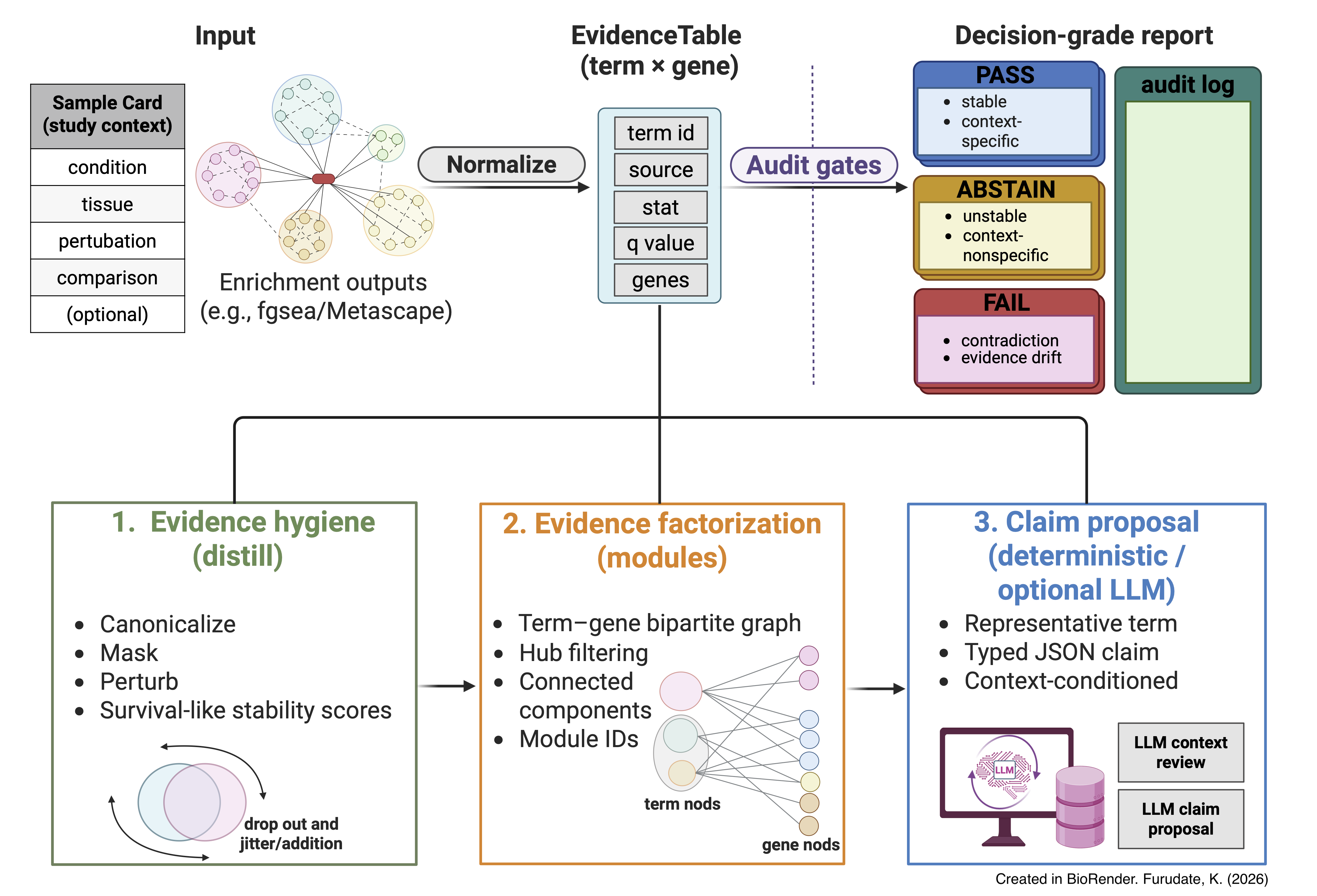
Fig. 1a. Overview of LLM-PathwayCurator workflow:
EvidenceTable → modules → claims → audits
(bioRxiv preprint)
🧭 Why this is different (and why it matters)
Enrichment tools return ranked term lists. In practice, interpretation breaks because:
- Representative terms are ambiguous under study context
- Gene support is opaque, enabling cherry-picking
- Related terms share / bridge evidence in non-obvious ways
- There is no mechanical stop condition for fragile narratives
LLM-PathwayCurator replaces narrative endorsement with audit-gated decisions.
We transform ranked terms into machine-auditable claims by enforcing:
- Evidence-linked constraints: claims must resolve to valid term/module identifiers and supporting-gene evidence
- Stability audits: supporting-gene perturbations yield stability proxies (operating point: τ)
- Context validity stress tests: context swap reveals context dependence without external knowledge
- Contradiction checks: internally inconsistent claims fail mechanically
- Reason-coded outcomes: every decision is explainable by a finite audit code set
🔍 What this is not
- Not an enrichment method; it audits enrichment outputs.
- Not a free-text summarizer; claims are schema-bounded (typed JSON; no narrative prose as “evidence”).
- Not a biological truth oracle; it checks internal consistency and evidence integrity, not mechanistic truth.
🧩 Core pipeline (A → B → C)
A) Stability distillation (evidence hygiene)
Perturb supporting genes (seeded) to compute stability proxies (e.g., LOO/jackknife-like survival scores).
Output: distilled.tsv
B) Evidence factorization (modules)
Factorize the term–gene bipartite graph into evidence modules that preserve shared vs distinct support.
Outputs: modules.tsv, term_modules.tsv, term_gene_edges.tsv
C) Claims → audit → report
- C1 (proposal-only): deterministic baseline or optional LLM proposes typed claims with resolvable evidence links
- C2 (audit/decider): mechanical rules assign PASS/ABSTAIN/FAIL with precedence (FAIL > ABSTAIN > PASS)
- C3 (report): decision-grade report + audit log (
audit_log.tsv) + provenance
⚡ Quick start (library entrypoint)
llm-pathway-curator run \
  --sample-card examples/demo/sample_card.json \
  --evidence-table examples/demo/evidence_table.tsv \
  --out out/demo/
Key outputs (stable contract)
audit_log.tsv— PASS/ABSTAIN/FAIL + reason codes (mechanical)report.jsonl,report.md— decision objects (evidence-linked)claims.proposed.tsv— proposed candidates (proposal-only; auditable)distilled.tsv— stability proxies / evidence hygiene outputsmodules.tsv,term_modules.tsv,term_gene_edges.tsv— evidence structurerun_meta.json(+ optionalmanifest.json) — pinned params + provenance
📊 Rank & visualize ranked terms (rank / plot-ranked)
LLM-PathwayCurator includes two small post-processing commands for ranking and publication-ready visualization of ranked terms/modules:
llm-pathway-curator rank— produces a ranked table (claims_ranked.tsv) for downstream plots and summaries.llm-pathway-curator plot-ranked— renders ranked terms/modules as either:- bars (Metascape-like horizontal bars), or
- packed circles (module-level circle packing with term circles inside).
A) Rank (produce claims_ranked.tsv)
Use rank to generate a deterministic ranked table from a run output directory.
llm-pathway-curator rank --help
# Typical workflow: point rank to a run directory and write claims_ranked.tsv
# (See --help for the exact flags supported by your installed version.)
B) Plot (bars or packed circles)
plot-ranked auto-detects claims_ranked.tsv (recommended) or falls back to audit_log.tsv
under --run-dir.
Packed circles require an extra dependency:
python -m pip install circlify
Bars (Metascape-like)
llm-pathway-curator plot-ranked \
  --mode bars \
  --run-dir out/demo \
  --out-png out/demo/plots/ranked_bars.png \
  --decision PASS \
  --group-by-module \
  --left-strip \
  --strip-labels \
  --bar-color-mode module
Packed circles (modules → terms)
llm-pathway-curator plot-ranked \
  --mode packed \
  --run-dir out/demo \
  --out-png out/demo/plots/ranked_packed.png \
  --decision PASS \
  --term-color-mode module
Packed circles (direction shading)
llm-pathway-curator plot-ranked \
  --mode packed \
  --run-dir out/demo \
  --out-png out/demo/plots/ranked_packed.direction.png \
  --decision PASS \
  --term-color-mode direction
Consistent module labels/colors across plots
plot-ranked assigns a single module display rank (M01, M02, ...) and a stable module color per module_id,
so bars and packed circles can be placed side-by-side without label/color drift.
⚖️ Inputs (contracts)
EvidenceTable (minimum required columns)
Each row is one enriched term.
Required columns:
term_id,term_name,sourcestat,qval,directionevidence_genes(supporting genes; TSV uses;join)
Sample Card (study context)
Structured context record used for proposal and context gating, e.g.:
condition/disease,tissue,perturbation,comparison
Adapters for common tools live under src/llm_pathway_curator/adapters/.
🔧 Adapters (Input → EvidenceTable)
Adapters are intentionally conservative:
- preserve evidence identity (term × genes)
- avoid destructive parsing
- keep TSV round-trips stable (contract drift is treated as a bug)
See: src/llm_pathway_curator/adapters/README.md
🛡️ Decisions: PASS / ABSTAIN / FAIL
LLM-PathwayCurator assigns decisions by mechanical audit gates:
- FAIL: auditable violations (evidence-link drift, schema violations, contradictions, forbidden fields, etc.)
- ABSTAIN: non-specific, under-supported, or unstable under perturbations / stress tests
- PASS: survives all enabled gates at the chosen operating point (τ)
Important: the LLM (if enabled) never decides acceptance. It may propose candidates; the audit suite is the decider.
🧪 Built-in stress tests (counterfactuals without external knowledge)
- Context swap: shuffle study context (e.g., BRCA → LUAD) to test context dependence
- Evidence dropout: randomly remove supporting genes (seeded; min_keep enforced)
- Contradiction injection (optional): introduce internally contradictory candidates to test FAIL gates
These are specification-driven perturbations intended to validate that the pipeline abstains for the right reasons, with stress-specific reason codes.
♻️ Reproducibility by default
LLM-PathwayCurator is deterministic by default:
- fixed seeds (CLI + library defaults)
- pinned parsing + hashing utilities
- stable output schemas and reason codes
- run metadata persisted to
run_meta.json(and runner-levelmanifest.jsonwhen used)
Paper-side runners (e.g., paper/scripts/fig2_run_pipeline.py) orchestrate reproducible sweeps
and do not implement scientific logic; they call the library entrypoint (llm_pathway_curator.pipeline.run_pipeline).
📦 Installation




Option A: PyPI (recommended)
pip install llm-pathway-curator
(See PyPI project page: https://pypi.org/project/llm-pathway-curator/)
Option B: From source (development)
git clone https://github.com/kenflab/LLM-PathwayCurator.git
cd LLM-PathwayCurator
pip install -e .
🐳 Docker (recommended for reproducibility)
We provide an official Docker environment (Python + R + Jupyter), sufficient to run LLM-PathwayCurator and most paper figure generation.
Optionally includes Ollama for local LLM annotation (no cloud API key required).
-
Option A: Prebuilt image (recommended)
Use the published image from GitHub Container Registry (GHCR).
# from the repo root (optional, for notebooks / file access)
docker pull ghcr.io/kenflab/llm-pathway-curator:official
Run Jupyter:
docker run --rm -it \
  -p 8888:8888 \
  -v "$PWD":/work \
  -e GEMINI_API_KEY \
  -e OPENAI_API_KEY \
  ghcr.io/kenflab/llm-pathway-curator:official
Open Jupyter: http://localhost:8888
(Use the token printed in the container logs.)
Notes:For manuscript reproducibility, we also provide versioned tags (e.g., :0.1.0). Prefer a version tag when matching a paper release.
-
Option B: Build locally (development)
-
Option B-1: Build locally with Compose (recommended for dev)
# from the repo root
docker compose -f docker/docker-compose.yml build
docker compose -f docker/docker-compose.yml up
B-1.1) Open Jupyter
- http://localhost:8888
Workspace mount:
/work
B-1.2) If prompted for "Password or token"
- Get the tokenized URL from container logs:
docker compose -f docker/docker-compose.yml logs -f llm-pathway-curator
- Then either:
- open the printed URL (contains
?token=...) in your browser, or - paste the token value into the login prompt.
- open the printed URL (contains
- http://localhost:8888
Workspace mount:
-
Option B-2: Build locally without Compose (alternative)
# from the repo root
docker build -f docker/Dockerfile -t llm-pathway-curator:official .
B-2.1) Run Jupyter
docker run --rm -it \
  -p 8888:8888 \
  -v "$PWD":/work \
  -e GEMINI_API_KEY \
  -e OPENAI_API_KEY \
  llm-pathway-curator:official
B-2.2) Open Jupyter
- http://localhost:8888
Workspace mount:
/work
- http://localhost:8888
Workspace mount:
-
🖥️ Apptainer / Singularity (HPC)
-
Option A: Prebuilt image (recommended)
Use the published image from GitHub Container Registry (GHCR).
apptainer build llm-pathway-curator.sif docker://ghcr.io/kenflab/llm-pathway-curator:official
-
Option B: a .sif from the Docker image (development)
docker compose -f docker/docker-compose.yml build
apptainer build llm-pathway-curator.sif docker-daemon://llm-pathway-curator:official
Run Jupyter (either image):
apptainer exec --cleanenv \
  --bind "$PWD":/work \
  llm-pathway-curator.sif \
  bash -lc 'jupyter lab --ip=0.0.0.0 --port=8888 --no-browser
🤖 LLM usage (proposal-only; optional)
If enabled, the LLM is confined to proposal steps and must emit schema-bounded JSON with resolvable EvidenceTable links.
Backends (example):
- Ollama:
LLMPATH_OLLAMA_HOST,LLMPATH_OLLAMA_MODEL - Gemini:
GEMINI_API_KEY - OpenAI:
OPENAI_API_KEY
Typical environment:
export LLMPATH_BACKEND="ollama" # ollama|gemini|openai
Deterministic settings are used by default (e.g., temperature=0), and runs persist
prompt/raw/meta artifacts alongside run_meta.json.
📄 Manuscript reproduction
paper/ contains manuscript-facing scripts, Source Data exports, and frozen/derived artifacts (when redistributable).
paper/README.md— how to reproduce figurespaper/FIGURE_MAP.csv— canonical mapping: panel ↔ inputs ↔ scripts ↔ outputs
🧾 Citation
If you use LLM-PathwayCurator, please cite:
- bioRxiv preprint (doi: 10.64898/2026.02.18.706381)
- Zenodo archive (v0.1.0): 10.5281/zenodo.18625777
- GitHub release tag: v0.1.0
- Software RRID: RRID:SCR_027964
1 maintainer

Download files
Download the file for your platform. If you're not sure which to choose, learn more about installing packages.
Source Distribution
Built Distribution
Filter files by name, interpreter, ABI, and platform.
If you're not sure about the file name format, learn more about wheel file names.
Copy a direct link to the current filters
File details
Details for the file llm_pathway_curator-0.1.0.post1.tar.gz.
File metadata
- Download URL: llm_pathway_curator-0.1.0.post1.tar.gz
- Upload date:
- Size: 1.1 MB
- Tags: Source
- Uploaded using Trusted Publishing? Yes
- Uploaded via:
twine/6.1.0 CPython/3.13.7
File hashes
| Algorithm | Hash digest | |
|---|---|---|
| SHA256 |
a7d42840befd1e2e7fa12217fe54d2b4fe8f9514a8c6216786e0694f88f2d3a2
|
|
| MD5 |
60e322f16a919e1f28c5f2ea9e3b48e0
|
|
| BLAKE2b-256 |
d7d1f3b3303da9efa8d5eea7432b08e9c2da702c33d21e4f4b93db297cb6c5b8
|
Provenance
The following attestation bundles were made for llm_pathway_curator-0.1.0.post1.tar.gz:
Publisher:
pypi-release.yml on kenflab/LLM-PathwayCurator
-
Statement:
-
Statement type:
https://in-toto.io/Statement/v1 -
Predicate type:
https://docs.pypi.org/attestations/publish/v1 -
Subject name:
llm_pathway_curator-0.1.0.post1.tar.gz -
Subject digest:
a7d42840befd1e2e7fa12217fe54d2b4fe8f9514a8c6216786e0694f88f2d3a2 - Sigstore transparency entry: 973510605
- Sigstore integration time:
-
Permalink:
kenflab/LLM-PathwayCurator@16bb8e9573771d297fd2d5962adbecf9cec08127 -
Branch / Tag:
refs/tags/v0.1.0.post1 - Owner: https://github.com/kenflab
-
Access:
public
-
Token Issuer:
https://token.actions.githubusercontent.com -
Runner Environment:
github-hosted -
Publication workflow:
pypi-release.yml@16bb8e9573771d297fd2d5962adbecf9cec08127 -
Trigger Event:
push
-
Statement type:
File details
Details for the file llm_pathway_curator-0.1.0.post1-py3-none-any.whl.
File metadata
- Download URL: llm_pathway_curator-0.1.0.post1-py3-none-any.whl
- Upload date:
- Size: 231.5 kB
- Tags: Python 3
- Uploaded using Trusted Publishing? Yes
- Uploaded via:
twine/6.1.0 CPython/3.13.7
File hashes
| Algorithm | Hash digest | |
|---|---|---|
| SHA256 |
49ad7ccb8b01ef03b9dbbe268ae15f8a1185d9bf88f801fca40b62f9ae65dbd2
|
|
| MD5 |
50ef5fb85c4bbb1b595fc1e35a34dc44
|
|
| BLAKE2b-256 |
0be1de3e8da2aecc7e4f4a3157e023f789d727d86865460f88c9de5c0340183d
|
Provenance
The following attestation bundles were made for llm_pathway_curator-0.1.0.post1-py3-none-any.whl:
Publisher:
pypi-release.yml on kenflab/LLM-PathwayCurator
-
Statement:
-
Statement type:
https://in-toto.io/Statement/v1 -
Predicate type:
https://docs.pypi.org/attestations/publish/v1 -
Subject name:
llm_pathway_curator-0.1.0.post1-py3-none-any.whl -
Subject digest:
49ad7ccb8b01ef03b9dbbe268ae15f8a1185d9bf88f801fca40b62f9ae65dbd2 - Sigstore transparency entry: 973510607
- Sigstore integration time:
-
Permalink:
kenflab/LLM-PathwayCurator@16bb8e9573771d297fd2d5962adbecf9cec08127 -
Branch / Tag:
refs/tags/v0.1.0.post1 - Owner: https://github.com/kenflab
-
Access:
public
-
Token Issuer:
https://token.actions.githubusercontent.com -
Runner Environment:
github-hosted -
Publication workflow:
pypi-release.yml@16bb8e9573771d297fd2d5962adbecf9cec08127 -
Trigger Event:
push
-
Statement type:














