
🔰About
llmexer is a framework and CLI utility to create and curate datasets (e.g., publications, metadata, LLM prompts, etc.) and orchestrate (design, run, evaluate) various LLM experiments on them
🪄 The philosophy of the tool is:
everythingis afile. Projects, experiments, searches, configs, and further items will be saved as files. The CLI helps you to modify most of the files, but the same files could be modified manually (e.g., adding a new LLM model, modification of search search or paper as PDFs could be manually added, further more, a SQLite database with generated experiments could be inspected and edited etc.).
📦 Installation
- Install using
pippip install --upgrade llmexer - Install using
uvuv pip install --upgrade llmexer - Check
configurationsection afterward
⚙️ Configuration
This tool requires access to local or remote running LLMs. It uses a .env file to securely load your API credentials, and also set the current project.
- Create a
.envfile in the root of the project - Set the current project ID (optional):
PROJECT_ID=20260330-3a9adf70
- Configure the docling backend (optional, used by
papers extract --processor docling):DOCLING_URL=http://localhost:5001/ DOCLING_USER=myuser DOCLING_PASSWORD=mypassword
- Set the API key for LLM providers (optional, used by
experiment runfor ollama, vllm, OpenAI, Gemini):# Base URL for a specific provider PROVIDER_OLLAMA_URL=http://localhost:11434/v1 PROVIDER_VLLM_URL=http://localhost:8000/v1 # The API key for a specific provider (takes precedence over LLM_API_KEY) PROVIDER_OPENAI_KEY=sk-...
The pattern isPROVIDER_<PROVIDER_UPPER>_URLandPROVIDER_<PROVIDER_UPPER>_KEYwhere<PROVIDER_UPPER>is the provider name in uppercase (e.g.OLLAMA,VLLM,OPENAI,GEMINI). - Enable the OpenAlex search engine (optional, used by
search runas a second source after Semantic Scholar; skipped if unset):OPENALEX_API_KEY=... # Optional: cap on OpenAlex results processed per query (default 5000) MAX_OPEN_ALEX_RESPONSES=5000 # Optional: used for DOI downloads via Unpaywall and also as the OpenAlex polite-pool mailto UNPAYWALL_EMAIL=you@example.com
- If you would like to change the envs based on the project run (e.g., just test a LLM provider for a particular project, via stats of a search, etc.), you could also pass a custom file as
.envto the CLI:llmexer --env-file custom.env
Documentation
🚀 Getting Started
A typical end-to-end workflow for collecting and processing papers inside a project:
1. Create a new project
llmexer project create
# Output: created project '20260402-a1b2c3d4'
2. Give it a meaningful name
llmexer project rename --old-id 20260402-a1b2c3d4 --new-id llm-survey-2026
3. Initialise the project structure
Scaffold a standard experiment/ subfolder with template CSVs and a prompt file:
llmexer experiment init --pid llm-survey-2026
experiment/llm-models.csv- list of models to use (name, provider, notes); pre-filled withgemma4:31b,phi4:14bexperiment/data.csv- input data rows (ID, Title, Abstract)experiment/mapping.csv- maps data IDs to prompt IDs; pre-filled withD01;prompt01andD02;prompt01experiment/prompts/prompt01.txt- a starter Jinja2 prompt template using{{title}}and{{abstract}}experiment/llm-params.csv- LLM hyperparameter profiles;- identity columns:
provider,model_name,profile_name; - universal columns:
temperature,top_p,max_tokens; - provider-grouped columns:
ollama_context_window,ollama_repeat_penalty(ollama),vllm_min_p,vllm_best_of(vllm),openai_seed(openai),gemini_thinking_level(gemini); pre-filled with example profiles forollama,openai,vllm, andgemini
- identity columns:
4. Generate the full experiment database
After filling in experiment/llm-models.csv, experiment/data.csv, experiment/mapping.csv, experiment/llm-params.csv, and your Jinja2 prompt templates:
llmexer experiment generate --pid llm-survey-2026
💡 Hint — external tools: the generated experiment store is a SQLite database (
experiment/experiment_*.db). Beyond the CLI, you can open and edit it directly with any external SQLite tool — for example DBeaver.
5. Run the experiment - call LLMs and collect results
Once experiment generate has produced the database, run all combinations:
llmexer experiment run --pid llm-survey-2026 --file experiment_<SAMPLE>.db
This reads every row from the generated database (experiment_*.db, which already contains all param columns) and calls the appropriate LLM. With no --file it uses the newest experiment_*.db. Results are written back into the same database in place — each row's response, status, token usage, and timestamps are updated on its provider table, so the database stays the single source of truth (no separate results file). Re-running skips rows that already finished successfully and updates the rest. Each individual call is also saved as a JSON file under experiment/responses/. Both the per-call JSON and the database response_json column include the complete raw backend response under raw_response (all provider fields — e.g. finish_reason, per-token usage, and ollama extras like eval_count / *_duration), not just the response text and total token count.
Use --dry-run to preview the row count without making any LLM calls:
llmexer --dry-run experiment run --pid llm-survey-2026
Run only a specific provider's rows (e.g. when only ollama is available):
llmexer experiment run --pid llm-survey-2026 --filter-provider ollama
Run a single combination by its ID (or code):
llmexer experiment run --pid llm-survey-2026 \
  --file experiment_<SAMPLE>.db --id 1
6. Inspect experiment statistics
Get aggregate statistics (total, finished, running, errors, total tokens, and per-provider / per-model breakdowns). The per-model table reports, for each model, requests, finished, open (pending/unrun), time total (HH:MM:SS elapsed over finished requests), average time (HH:MM:SS mean elapsed per finished request), and tokens (summed over finished requests). With no --file it reads the project's single experiment_*.db (pass --file if several exist):
llmexer experiment stats --pid llm-survey-2026
Pass --file to inspect a specific database instead:
llmexer experiment stats --pid llm-survey-2026 --file experiment_<SAMPLE>.db
The API key is read from .env (pattern -> PROVIDER_<PROVIDER_UPPER>_KEY).
P.S.: CLI interfaces could become very complex with the time, thus refer to the --help to get options and parameters of the utility:
llmexer --help
📢 Scenario 1: Gathering data for projects by adding papers
1. Add papers to the project - local file
From a local file:
llmexer papers add --pid llm-survey-2026 --file ~/Downloads/attention-is-all-you-need.pdf
2. Add papers to the project - from directory
From a directory of PDFs:
llmexer papers add --pid llm-survey-2026 --directory ~/Downloads/papers/
3. Add papers to the project - from url From a URL:
llmexer papers add --pid llm-survey-2026 --url https://arxiv.org/pdf/1706.03762
📢 Scenario 2: Gathering data for projects by running search
1. Run a literature search
Create a search configuration and run it:
llmexer search create --pid llm-survey-2026 --query "large language models"
llmexer search list --pid llm-survey-2026
llmexer search run --pid llm-survey-2026 --file 20260401-bfdd863d.yaml
Or run directly from a query string:
llmexer search run --pid llm-survey-2026 --query "large language models" --limit 500
Results are saved as <ID>__results.csv in searches/ (the raw JSON is saved as <ID>__results_raw.json in searches/jsons/).
2. Filter search results by excluding rows (optional)
filter excludes rows by one or more criteria and writes <ID>__filtered.csv. Filters chain: each run reads the existing __filtered.csv (or the __results.csv if none) and rewrites it. Combine --language, --source, --doi, --downloaded in one run:
# drop German rows and rows still not downloaded
llmexer search filter --pid llm-survey-2026 --file 20260401-bfdd863d.yaml --language de --downloaded
--file is optional — omit it to apply the same filters to every search in the project. Every applied filter (per search) is recorded in searches/logs/filters-applied.log.
📢 Scenario 3: Gathering data by downloading papers and extracting text
1. Download open-access papers by DOI via Unpaywall
Download by DOI (one or more):
llmexer papers download --pid llm-survey-2026 --doi 10.1038/nature12373 --email you@example.com
Download from a full search result CSV (downloads all papers with a DOI, names each file YEAR_AUTHOR_TITLE_DOI.pdf):
llmexer papers download --pid llm-survey-2026 --search-file 20260401-bfdd863d__results.csv
Or from a filtered CSV to download only the papers that passed the language filter:
llmexer papers download --pid llm-survey-2026 --search-file 20260401-bfdd863d__filtered.csv
Failed downloads are saved automatically as 20260401-bfdd863d__results_download_failed.csv (columns: doi, url, title, desired_filename, downloaded) in the searches/logs/ folder. After a --search-file download completes, the search is automatically synced against the papers/ folder in existing-only mode — it updates pdf_downloaded (and text/markdown companions) for the listed rows but does not add new rows for unrelated PDFs.
2. Extract text from all added papers - pypdf
Using the default pypdf backend (saves .txt files):
llmexer papers extract --pid llm-survey-2026
3. Extract text from all added papers - docling
Using the docling backend for richer Markdown output (saves .md files), reading connection details from .env:
llmexer papers extract --pid llm-survey-2026 --processor docling
Override .env connection settings at runtime:
llmexer papers extract --pid llm-survey-2026 --processor docling \
  --docling-url http://myserver:5001/ \
  --docling-user admin \
  --docling-password secret
By default, papers that already have an extracted file are skipped. Use --rewrite to force re-extraction:
llmexer papers extract --pid llm-survey-2026 --rewrite
Using Current Project ID
Many commands support the --pid parameter to specify which project to work with. If you set PROJECT_ID in your .env file, you can omit this parameter and the commands will use the current project automatically:
# Set in .env
PROJECT_ID=my-project

# These commands will use my-project automatically
llmexer search run --query "machine learning"
You can still override the current project by explicitly providing --pid:
llmexer search run --pid different-project --query "deep learning"
🗂️ CLI category: project
The project (alias: proj) category provides commands for managing LLM projects (the top-level container for experiments, papers, and searches):
| Command | Description | Command Example |
|---|---|---|
create |
Create a new project folder under .projects/ using format YYYYMMDD-GUID. Accepts an optional custom ID. |
llmexer project create --id my-project |
current |
Display the current project ID loaded from .env. |
llmexer project current |
rename |
Rename an existing project. Uses PROJECT_ID from .env if --old-id is omitted. |
llmexer project rename --old-id old-name --new-id new-name |
🧪 CLI category: experiment
The experiment (alias: exp) category provides commands for initialising, generating, and running LLM experiments inside a project:
| Command | Description | Command Example |
|---|---|---|
init |
Initialise an existing project with a standard folder structure (experiment/, experiment/prompts/) and template files: llm-models.csv (pre-filled with example ollama models), data.csv, mapping.csv (pre-filled with D01 and D02 rows), prompts/prompt01.txt (Jinja2 template using {{title}} and {{abstract}}), and llm-params.csv (hyperparameter profiles; universal: temperature, top_p, max_tokens; ollama: ollama_context_window, ollama_repeat_penalty; vllm: vllm_min_p, vllm_best_of; openai: openai_seed; gemini: gemini_thinking_level). Raises an error if already initialised. |
llmexer experiment init --pid my-project |
copy-papers |
Copy parsed papers (.md/.txt) from the project's papers/ folder into experiment/data.csv as rows ID;filename;content, with IDs P01, P02, … ordered alphabetically by filename (.md preferred over .txt when both exist). An existing data.csv is backed up to data_backup_<YYYYMMDD>_<NN>.csv first. |
llmexer experiment copy-papers --pid my-project |
copy-search |
Copy a search results CSV (--file, absolute or relative to the project's searches/ folder) into experiment/data.csv as rows ID;Title;Abstract;doi;authors, with IDs S01, S02, … preserving the source file's row order. An existing data.csv is backed up to data_backup_<YYYYMMDD>_<NN>.csv first. |
llmexer experiment copy-search --pid my-project --file <SEARCH_ID>__results.csv |
generate |
Render all (data row × prompt × LLM models × LLM parameters) combinations and write a self-contained SQLite database experiment/experiment_<YYYYMMDD>_<NN>.db (<NN> is a zero-padded counter starting at 01). Each LLM provider gets its own table (e.g. experiment_ollama) with columns ID, code (DATAID_PROMPTID_MODELNAME_PROFILENAME), prompt, tokens_estimate, original_data, model_name, provider_name, that provider's param columns from llm-params.csv (profile_name, temperature, top_p, max_tokens, plus the provider-specific ones, e.g. ollama_context_window, ollama_repeat_penalty), the prompt_hash / original_data_hash columns, and the result columns filled in by run. Rows are sorted by model order from llm-models.csv. Supports --dry-run. |
llmexer experiment generate --pid my-project |
run |
Execute every row in the generated database experiment_*.db (no separate params file needed — all columns are embedded). Calls each LLM via the OpenAI SDK (supports ollama, vllm, openai, gemini) and writes results back into the same database in place (response, status, token usage, timestamps, plus the complete raw backend response under raw_response); re-runs skip rows that already finished successfully and update the rest. Individual JSON responses are saved under experiment/responses/. Supports --dry-run, --file (choose a specific .db, defaults to the newest), --filter-provider (only run rows for a specific provider), --id (run a single combination by its ID or code). API key read from LLM_API_KEY or PROVIDER_<PROVIDER_UPPER>_KEY env vars; URL from PROVIDER_<PROVIDER_UPPER>_URL or built-in defaults. Requires openai package (pip install openai). |
llmexer experiment run --pid my-project --filter-provider ollama |
stats |
Show aggregate statistics from a project's experiment database: totals (total, finished, running, errors), total tokens, and per-provider / per-model breakdowns rendered as Rich tables. The Models table has per-model columns requests, finished, open (pending/unrun), time total (HH:MM:SS over finished requests), average time (HH:MM:SS mean per finished request), and tokens (summed over finished requests). With no --file it reads the project's single experiment_*.db (pass --file to choose one when several exist). |
llmexer experiment stats --pid my-project |
list |
List all projects with their initialization state and generated experiment databases, with optional sorting by name or date. | llmexer experiment list --sort-by date --desc |
📑 CLI category: papers
The papers category provides commands for managing PDF papers within a project:
| Command | Description | Command Example |
|---|---|---|
add --file |
Copy a single PDF into the project's papers/ folder. |
llmexer papers add --file /path/to/paper.pdf |
add --directory |
Recursively copy all PDFs from a directory. Already-existing papers are skipped. | llmexer papers add --directory /path/to/folder |
add --url |
Download a PDF from a URL into the project's papers/ folder. |
llmexer papers add --url https://example.com/paper.pdf |
download --doi |
Download one or more open-access PDFs by DOI using the Unpaywall API. Email required via --email or UNPAYWALL_EMAIL env var. |
llmexer papers download --doi 10.1038/nature12373 --email you@example.com |
download --search-file |
Download all papers from a search result CSV (inside searches/), including filtered CSVs (__filtered.csv). Files are named YEAR_AUTHOR_TITLE_DOI.pdf. On completion, auto-runs search sync to reconcile the search against papers/ (updates pdf_downloaded, txt/markdown). Failures saved as <stem>_download_failed.csv in searches/logs/. |
llmexer papers download --search-file 20260401-abc123__filtered.csv |
extract |
Extract text from all PDFs in papers/. Default pypdf backend saves .txt; docling backend sends PDFs to a remote docling-serve instance and saves .md. Connection details (DOCLING_URL, DOCLING_USER, DOCLING_PASSWORD) read from .env; overridable via --docling-url, --docling-user, --docling-password. Already-extracted files are skipped unless --rewrite is passed. Pass --skip-if-md (pypdf only) to skip PDFs that already have a .md extraction. Reports counts for Extracted, Skipped, Existing, and Error. |
llmexer papers extract --pid my-project --processor docling |
🔍 CLI category: search
The search category provides commands for managing and running literature searches. search run queries the Semantic Scholar bulk API and, when OPENALEX_API_KEY is set, additionally queries the OpenAlex Works API as a second engine — keeping only publications not already found by Semantic Scholar (matched by DOI, falling back to title). OpenAlex is skipped if the key is unset. OpenAlex rows are marked entry_source="OpenAlex".
| Command | Description | Command Example |
|---|---|---|
create |
Create a search configuration YAML file in the project's searches/ folder. |
llmexer search create --query "machine learning" |
list |
List all search YAML configs in the project's searches/ folder as a table (columns: #, Name, Query, Year, Created, Results). Prints a next-step hint referencing the latest search file. |
llmexer search list --pid my-project |
rename |
Rename a search ID and all its associated files (<id>.yaml, <id>__results.csv, <id>__filtered.csv, <id>__results_raw.json under searches/jsons/, and <id>__results_download_failed.csv under searches/logs/). Accepts a full .yaml filename for --old-id. |
llmexer search rename --old-id 20260401-abc123 --new-id my-search |
run --query |
Run a search directly from a query string. Saves <ID>__results.csv to searches/ and <ID>__results_raw.json to searches/jsons/. CSV columns include: sem_scholar_paper_id, year, title, authors, abstract, isOpenAccess, doi, language, referenceCount, citationCount, entry_source, pdf_filename, txt_filename, markdown_filename, pdf_downloaded. Raw JSON also contains fieldsOfStudy, citationStyles, publicationTypes. |
llmexer search run --query "neural networks" --limit 200 |
run --file |
Run a search loading parameters from an existing YAML config. Use --rewrite to overwrite existing result files. |
llmexer search run --file 20260401-abc123.yaml |
stats |
Display statistics for a completed search: papers per year and a stats breakdown (open access, language, downloaded, entry source, txt/markdown presence), stacked for results and filtered CSVs. Without --file, falls back to the merged file(s) (<pid>__merged_results.csv / <pid>__merged_filtered.csv) if present. |
llmexer search stats --file 20260401-abc123.yaml |
filter |
Exclude rows from a search and rewrite <ID>__filtered.csv. Reads the existing __filtered.csv if present (filters chain), else __results.csv. --file is optional — omit it to filter every search in the project. Combinable criteria, each applied in order and logged: --language <code> / --source <value> / --doi <value> drop rows equal to the value; --downloaded drops rows not yet downloaded. Each applied filter appends a line to searches/logs/filters-applied.log. |
llmexer search filter --file 20260401-abc123.yaml --language de --downloaded |
merge |
Merge the project's search CSVs into two deduplicated files: <pid>__merged_results.csv (from *__results.csv) and <pid>__merged_filtered.csv (from *__filtered.csv). Deduplicates by DOI (falling back to title); adds a 0/1 column per search (named after its YAML id) and a duplicates_counter column (number of duplicate occurrences, i.e. searches found in minus one). Rows are sorted by year (newest first; blank years last). Use --rewrite to overwrite; respects --dry-run. |
llmexer search merge --pid my-project |
sync |
Reconcile <ID>__results.csv (and <ID>__filtered.csv if present) against the project's papers/ folder. Updates pdf_downloaded, txt_filename, and markdown_filename for existing rows. By default only files listed in existing rows are updated; pass --add-local-extra-pdfs to also append new rows for PDFs in papers/ not yet listed (marked entry_source="manually added"). --file is optional: with it a single search is synced, without it every search in the project is synced (in that case --add-local-extra-pdfs is not applied). Respects --dry-run. |
llmexer search sync --file 20260401-abc123.yaml |
Semantic Scholar API Documentation: Paper bulk search -> this can be used to formulate more sophisticated query string
OpenAlex API Documentation: Works -> queried as a second engine when OPENALEX_API_KEY is set
🔎 CLI category: self
The self category provides introspection commands for the llmexer CLI itself:
| Command | Description | Command Example |
|---|---|---|
version |
Print the current llmexer package version. | llmexer self version |
envs |
Display all llmexer-relevant environment variables as a table. PROJECT_ID is highlighted in bold cyan; DOCLING_PASSWORD is masked as ******** when set. |
llmexer self envs |
📄 Additional: Renaming PDFs with pdf-renamer tool
Before adding papers to a project, you can automatically rename them by their bibliographic metadata (year, journal, authors, title) using the external pdf-renamer tool.
No installation is needed — run it directly with uvx.
Rename using custom format: year - authors (et al.) - title:
uvx --from pdf-renamer pdfrenamer -f "{YYYY}_{A3etal}_{T}" /path/to/pdfs
Rename recursively (include subdirectories)
uvx --from pdf-renamer pdfrenamer /path/to/pdfs -sf
There is also a possibility to extract BiBTeX of a publication as follows
uvx --from pdf2bib pdf2bib -s bibtex.bib /path/to/pdfs
CLI UI
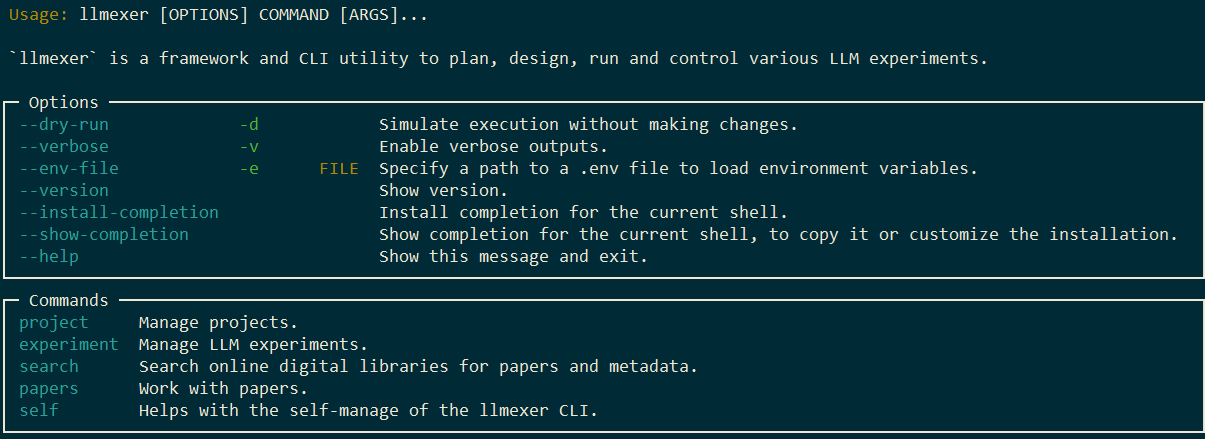
CLI feature overview:
llmexer --help
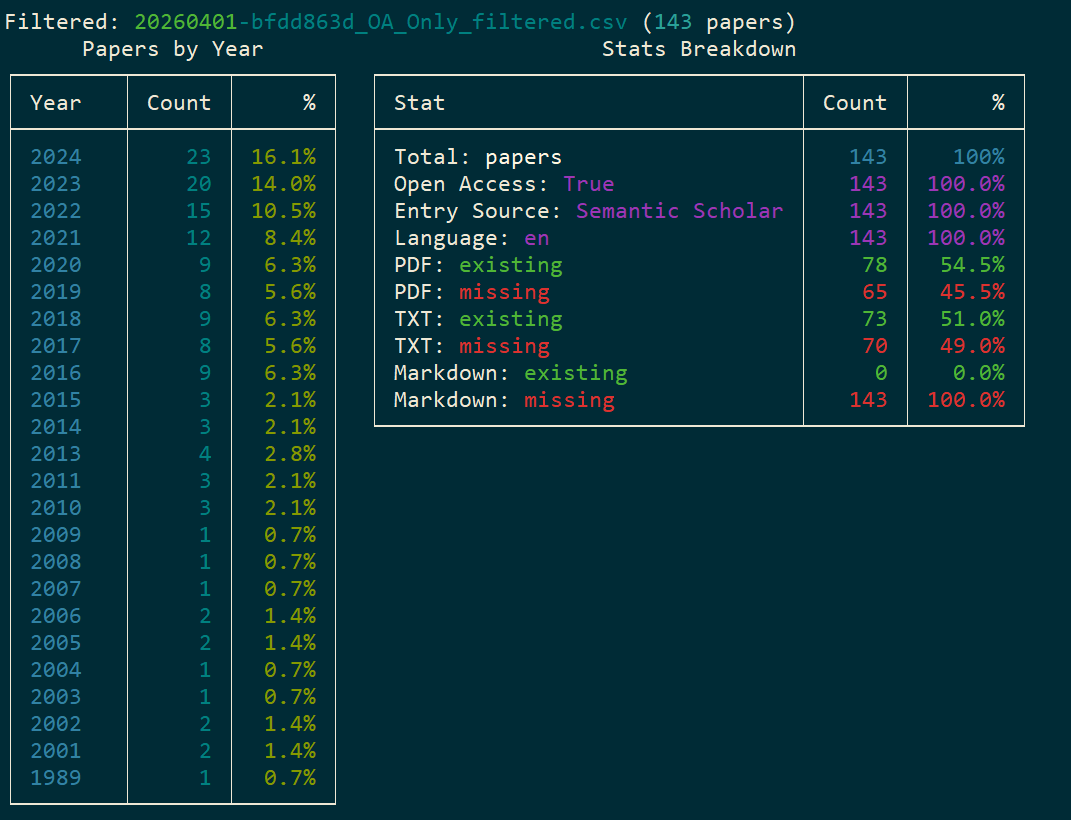
Checking the statistics of a performed search query directly in CLI:
llmexer search stats --file <filename>
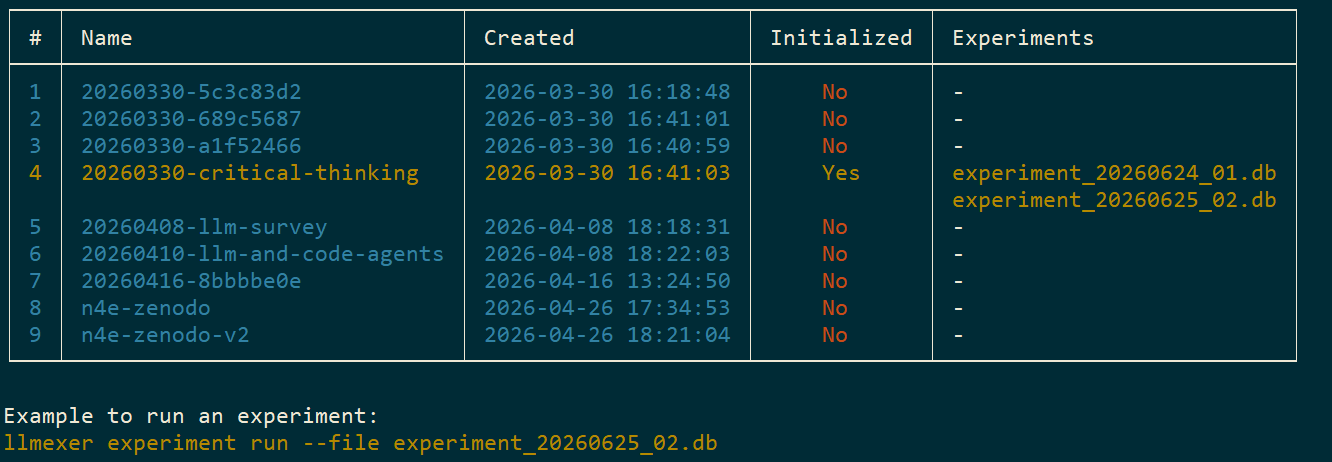
List existing projects directly in CLI with the current project highlighted:
llmexer experiment list
🧩 Development Setup
This guide walks through setting up the project for local development using uv.
- Create a new virtual environment in a
.venvdirectory and activates it.uv venv - Activate the environment (macOS/Linux):
source .venv/bin/activate - Activate the environment (Windows):
call .venv/Scripts/activate.bat - Install package in editable mode with dev dependencies
Installing the package in editable mode (
-e) is the key to development. It links thellmexercommand in your environment directly to your source code.uv pip install -e . --group dev
License
1 maintainer

Download files
Download the file for your platform. If you're not sure which to choose, learn more about installing packages.
Source Distribution
Built Distribution
Filter files by name, interpreter, ABI, and platform.
If you're not sure about the file name format, learn more about wheel file names.
Copy a direct link to the current filters
File details
Details for the file llmexer-0.3.0.tar.gz.
File metadata
- Download URL: llmexer-0.3.0.tar.gz
- Upload date:
- Size: 99.3 kB
- Tags: Source
- Uploaded using Trusted Publishing? Yes
- Uploaded via: twine/7.0.0 CPython/3.13.14
File hashes
| Algorithm | Hash digest | |
|---|---|---|
| SHA256 |
45250bb9427f454497093b59ce00c651db5f35012cf510b9a19ffaef08739baa
|
|
| MD5 |
210c8c80051de6f8a256353173a7f8c8
|
|
| BLAKE2b-256 |
338888dc1d253231af1ac52e516314caf8719b1af03a5d2b1d78b9443019ea5a
|
Provenance
The following attestation bundles were made for llmexer-0.3.0.tar.gz:
Publisher:
publish-to-pypi.yml on vdmitriyev/llmexer
-
Statement:
-
Statement type:
https://in-toto.io/Statement/v1 -
Predicate type:
https://docs.pypi.org/attestations/publish/v1 -
Subject name:
llmexer-0.3.0.tar.gz -
Subject digest:
45250bb9427f454497093b59ce00c651db5f35012cf510b9a19ffaef08739baa - Sigstore transparency entry: 2489412683
- Sigstore integration time:
-
Permalink:
vdmitriyev/llmexer@658e5bea543af4b16876d93b370117ef0e363c7d -
Branch / Tag:
refs/tags/0.3.0 - Owner: https://github.com/vdmitriyev
-
Access:
public
-
Token Issuer:
https://token.actions.githubusercontent.com -
Runner Environment:
github-hosted -
Publication workflow:
publish-to-pypi.yml@658e5bea543af4b16876d93b370117ef0e363c7d -
Trigger Event:
push
-
Statement type:
File details
Details for the file llmexer-0.3.0-py3-none-any.whl.
File metadata
- Download URL: llmexer-0.3.0-py3-none-any.whl
- Upload date:
- Size: 65.9 kB
- Tags: Python 3
- Uploaded using Trusted Publishing? Yes
- Uploaded via: twine/7.0.0 CPython/3.13.14
File hashes
| Algorithm | Hash digest | |
|---|---|---|
| SHA256 |
6bd281ad86891ea07498b8147bad211fccf4405b32ffe4e79ec4000cf3e14c2c
|
|
| MD5 |
55eac67e97fbe4671437394473cc7aaf
|
|
| BLAKE2b-256 |
da0c00832e05c388ce3d645f17d9716bf8a9d462957e9472fbab846bc174a396
|
Provenance
The following attestation bundles were made for llmexer-0.3.0-py3-none-any.whl:
Publisher:
publish-to-pypi.yml on vdmitriyev/llmexer
-
Statement:
-
Statement type:
https://in-toto.io/Statement/v1 -
Predicate type:
https://docs.pypi.org/attestations/publish/v1 -
Subject name:
llmexer-0.3.0-py3-none-any.whl -
Subject digest:
6bd281ad86891ea07498b8147bad211fccf4405b32ffe4e79ec4000cf3e14c2c - Sigstore transparency entry: 2489412988
- Sigstore integration time:
-
Permalink:
vdmitriyev/llmexer@658e5bea543af4b16876d93b370117ef0e363c7d -
Branch / Tag:
refs/tags/0.3.0 - Owner: https://github.com/vdmitriyev
-
Access:
public
-
Token Issuer:
https://token.actions.githubusercontent.com -
Runner Environment:
github-hosted -
Publication workflow:
publish-to-pypi.yml@658e5bea543af4b16876d93b370117ef0e363c7d -
Trigger Event:
push
-
Statement type:







