

llming-models


LLM execution engine -- multi-provider streaming, MCP tools, and budget management.
llming-models provides the core runtime for building multi-provider LLM applications. It handles model metadata and capabilities, streaming chat sessions with tool support, MCP (Model Context Protocol) integration, per-user configuration, and monetary budget tracking -- all behind a unified API that works across OpenAI, Anthropic, Google, Azure, Mistral, and Together/DeepSeek.
Features
- Model Metadata -- Rich model descriptors with pricing, context windows, capability flags (vision, reasoning), and UI hints (speed/quality ratings)
- Configuration -- Global and per-user model selection with category mappings, provider cascade priority, and include/exclude filters
- Budget Management -- Track and enforce monetary limits per time period with reservation/rollback semantics and pluggable backends (memory, MongoDB)
- Multi-Provider Streaming -- Unified async/sync streaming across OpenAI, Anthropic, Google Gemini, Azure OpenAI, Azure Anthropic, Mistral, and Together AI
- MCP Tools -- First-class Model Context Protocol support with tool registries, toolbox adapters, and built-in MCP servers (math, image generation)
- Chat Sessions -- High-level
ChatSessionwith automatic tool dispatch, conversation history, image support, and reasoning effort control - Conversation Persistence -- IndexedDB-compatible conversation storage with metadata, avatars, and file references
Chat Playground
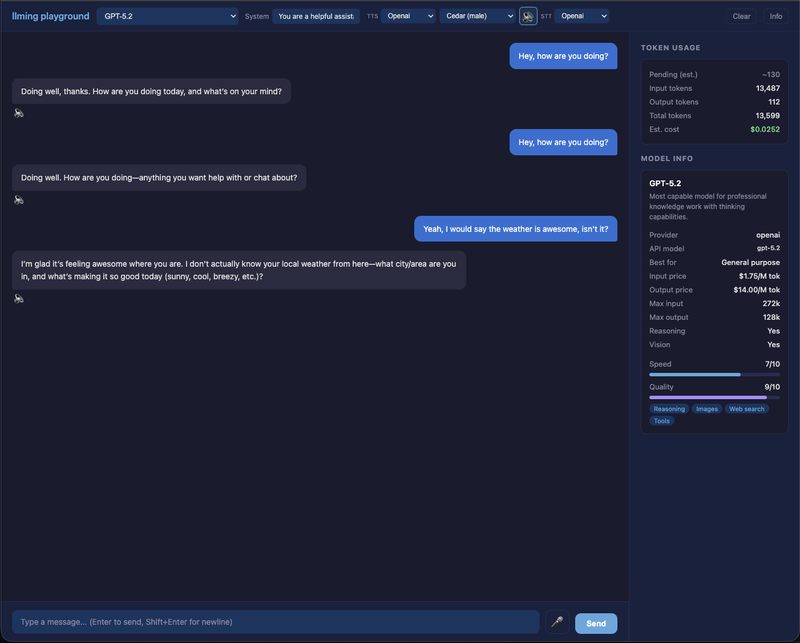
Interactive chat UI with model selection, streaming responses, TTS/STT (OpenAI + ElevenLabs), push-to-talk, word-level highlighting, and token cost tracking. Run it with:
cp .env.template .env   # fill in API keys
python samples/chat_app.py
# Open http://localhost:8000
Quick Start
Installation
pip install llming-models
Or from source with Poetry:
git clone https://github.com/Alyxion/llming-models.git
cd llming-models
poetry install
Basic Usage
from llming_models import LLMInfo, ModelSize, ReasoningEffort

model = LLMInfo(
    provider="anthropic",
    name="claude_sonnet",
    label="Claude Sonnet 4.6",
    model="claude-sonnet-4-6",
    description="Fast, capable model for most tasks",
    input_token_price=3.0,
    output_token_price=15.0,
    size=ModelSize.MEDIUM,
    max_input_tokens=200_000,
    max_output_tokens=64_000,
    supports_image_input=True,
    reasoning=True,
    default_reasoning_effort=ReasoningEffort.MEDIUM,
    speed=8,
    quality=8,
    best_use="Code & analysis",
    highlights=["Fast", "Code", "Vision"],
)

print(f"{model.label}: ${model.input_token_price}/1M in, ${model.output_token_price}/1M out")
Configuration
from llming_models import LLMGlobalConfig, LLMUserConfig, ModelCategories

global_config = LLMGlobalConfig(
    default_models={
        ModelCategories.SMALL: ["claude_haiku", "gpt-4o-mini"],
        ModelCategories.LARGE: ["claude_sonnet", "gpt-4o"],
    },
    provider_cascade=["anthropic", "openai"],
)

user_config = LLMUserConfig(
    global_config=global_config,
    default_models={ModelCategories.LARGE: "claude_sonnet"},
)

print(user_config.get_default_model(ModelCategories.LARGE))  # "claude_sonnet"
Budget Management
import asyncio
from llming_models import MemoryBudgetLimit, LLMBudgetManager, LimitPeriod

async def main():
    limits = [
        MemoryBudgetLimit(name="daily", amount=10.0, period=LimitPeriod.DAILY),
        MemoryBudgetLimit(name="monthly", amount=100.0, period=LimitPeriod.MONTHLY),
    ]
    manager = LLMBudgetManager(limits)

    available = await manager.available_budget_async()
    print(f"Available: {available:.2f}")

    await manager.reserve_budget_async(
        input_tokens=1000,
        max_output_tokens=2000,
        input_token_price=3.0,    # per 1M tokens
        output_token_price=15.0,  # per 1M tokens
    )

asyncio.run(main())
Project Structure
llming-models/
├── llming_models/          # Models, config, sessions, budget, providers, tools
│   ├── budget/             # Cost tracking with time-period limits (memory + MongoDB)
│   ├── providers/          # OpenAI, Anthropic, Google, Azure, Mistral, Together
│   ├── tools/              # Tool system, MCP integration, math server, image gen
│   └── utils/              # Image encoding utilities
├── tests/                  # 1255 tests (unit + integration with live APIs)
├── samples/                # Example scripts
└── docs/                   # Logo and assets
Development
poetry install
poetry run pytest             # 1255 tests
poetry run ruff check         # lint
poetry run mypy llming_models # type check
License
This project is licensed under the MIT License. Copyright (c) 2026 Michael Ikemann.
1 maintainer

Metadata
1 maintainer
Release files for llming-models 0.1.1
For a detailed explanation of source distributions (sdists) and built distributions (wheels), please see the package formats documentation.
Source distribution (sdist)
| File | Size | Uploaded | Provenance | |
|---|---|---|---|---|
| llming_models-0.1.1.tar.gz | 96.8 kB | Without provenance | Details |
Built distribution (wheel)
| File | Interpreter | ABI | Platform | Reset |
|---|---|---|---|---|
| llming_models-0.1.1-py3-none-any.whl | Python 3 | none | any | Details |
Total release size: 230.7 kB
Release files / llming_models-0.1.1.tar.gz
| Download URL | llming_models-0.1.1.tar.gz |
|---|---|
| Size | 96.8 kB |
| Tags | Source |
|
SHA-256 checksum How to use checksums |
37b75bfbe096a860672b959002481f1c7ac7c5d1f1f1e6aa0662d4d6d66277ce
|
|
BLAKE2b-256 checksum How to use checksums |
5311d8ab5ea6776d01bff8d7fa22b20a84e005063adcf324b3486643e19abf19
|
| Upload date | |
|
Uploaded using Trusted Publishing? What is trusted publishing? |
No |
| Uploaded via |
poetry/2.1.1 CPython/3.13.11 Darwin/25.2.0
|
Release files / llming_models-0.1.1-py3-none-any.whl
| Download URL | llming_models-0.1.1-py3-none-any.whl |
|---|---|
| Size | 134.0 kB |
| Tags | Python 3 |
|
SHA-256 checksum How to use checksums |
9f530489acb11ddf4165d958681765435dd92d8afd33913572ab99b47f6efa34
|
|
BLAKE2b-256 checksum How to use checksums |
f0d585f2084c66cb2c18e15028b6e41c785642135066c1d9ae80bb0d64b2d568
|
| Upload date | |
|
Uploaded using Trusted Publishing? What is trusted publishing? |
No |
| Uploaded via |
poetry/2.1.1 CPython/3.13.11 Darwin/25.2.0
|
Security for llming-models 0.1.1
Provenance
Provenance describes where a file came from. On PyPI, provenance is shared via attestations, which provide a verifiable record of the build or publishing details. View details, limitations and caveats.
No provenance found
None of the files in this release were uploaded with provenance metadata.
A note on package security
PyPI is a repository for distributing packages, not a service for auditing them. While third-party security researchers and our staff do their best to detect and remove malicious packages, PyPI cannot guarantee the quality, security or suitability of any given package.
To learn more about protecting yourself from malicious actors, visit our package security documentation.














