
microstructure-lab


Limit order book reconstruction, order-flow analytics, and market-making simulation. The analytics are validated on a zero-intelligence order book simulator, then run unchanged on live Binance data.
The library alone, from PyPI:
pip install lobkit # add [plot] for figures, [live] to record exchange data
The studies below live in this repository, so to reproduce them clone it and run:
pip install -e ".[dev]"
ruff check . && pytest
cd examples
python 01_simulated_lob.py           # order-flow analytics on a simulated book       (~10 s)
python 02_avellaneda_stoikov.py      # market-making replication                      (~5 s)
python 05_market_making_in_lob.py    # the market maker inside the simulated book     (~45 s)
pip install -e "..[live]"
python 03_record_binance.py btcusdt 900       # record 15 minutes of Binance + Bybit data
python 04_analyze_recording.py ../data/btcusdt_<timestamp> 0.01    # 0.01 = tick size
python 06_cross_venue.py ../data/btcusdt_<timestamp>               # which venue leads?
Components
| Module | What it does |
|---|---|
book.py |
L2 order book; Binance diff-depth synchronisation with sequence-gap detection |
recorder.py |
Async recorder for Binance best quotes, trades and synchronised L2 depth, plus Bybit best quotes and trades; auto-reconnect; loaders |
simulator.py |
Zero-intelligence limit order book (Cont, Stoikov & Talreja 2010), optional multi-level output and a resting quoter with queue position |
features.py |
Mid, spread, queue imbalance, microprice, order-flow imbalance (OFI, single and multi-level), time buckets |
analysis.py |
Price-impact regressions, impact vs depth, out-of-sample predictability, Stoikov micro-price, cross-venue lead-lag |
market_making.py |
Avellaneda–Stoikov optimal market maker vs a symmetric benchmark, in the paper's model and inside the order book |
See CONTRIBUTING.md for the rules, roles and workflow, and CHANGELOG.md for what changed.
Book synchronisation. Binance publishes a REST snapshot plus a diff stream. A correct
local book has to drop diffs already in the snapshot, check that the first applied diff
bridges the snapshot's update ID, and verify every later diff continues the sequence exactly.
BinanceDepthSync implements these rules, raises SequenceGap on a missed update, and the
recorder resyncs automatically. Each rule has a unit test.
Study 1: order flow and prices
On 4.6 simulated hours (400,000 book events) of a market where no participant has information:
| Result | Value | Literature |
|---|---|---|
| Δmid on OFI, 10-second buckets | β = 0.285 ticks per unit, R² = 0.66, t = 56 | Cont, Kukanov & Stoikov (2014): average R² ≈ 65% on US stocks |
| Impact coefficient vs 1/depth | linear, R² = 0.93 | β inversely proportional to depth |
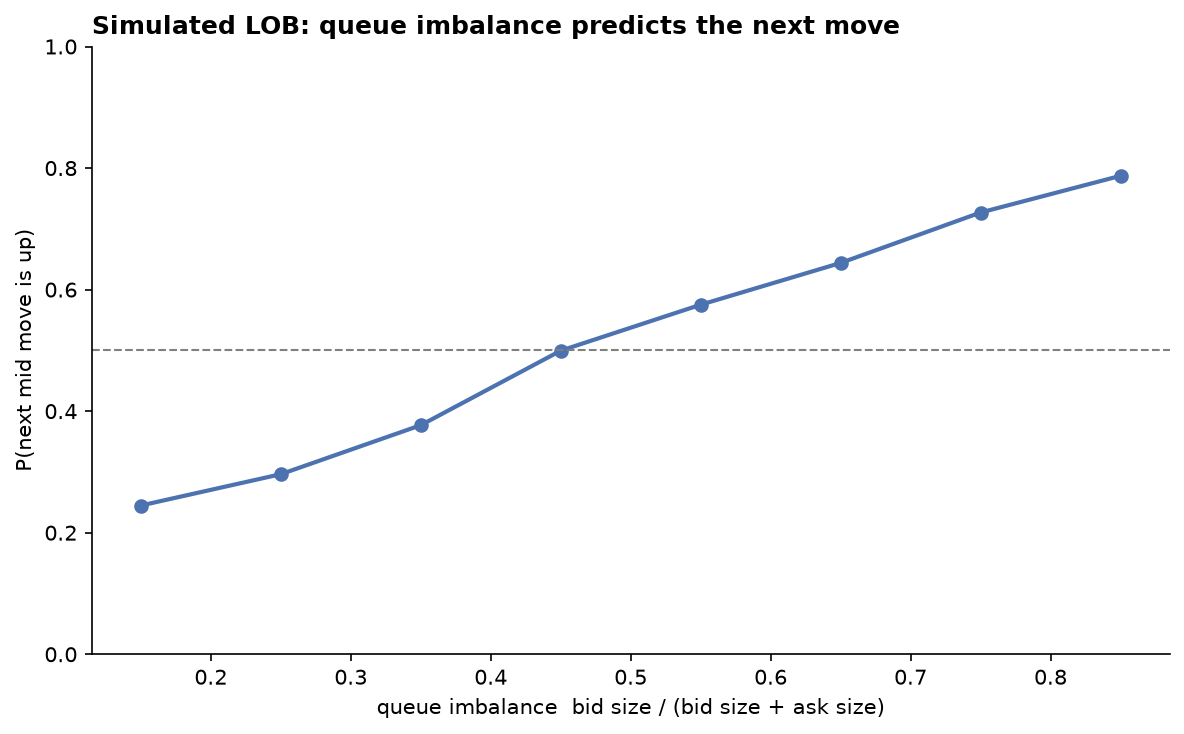
| P(next move up), imbalance 0.1–0.2 → 0.8–0.9 | 0.25 → 0.79, monotone | Gould & Bonart (2016) |
| Next 10-second move from OFI / imbalance | out-of-sample R² ≤ 0.7% | — |
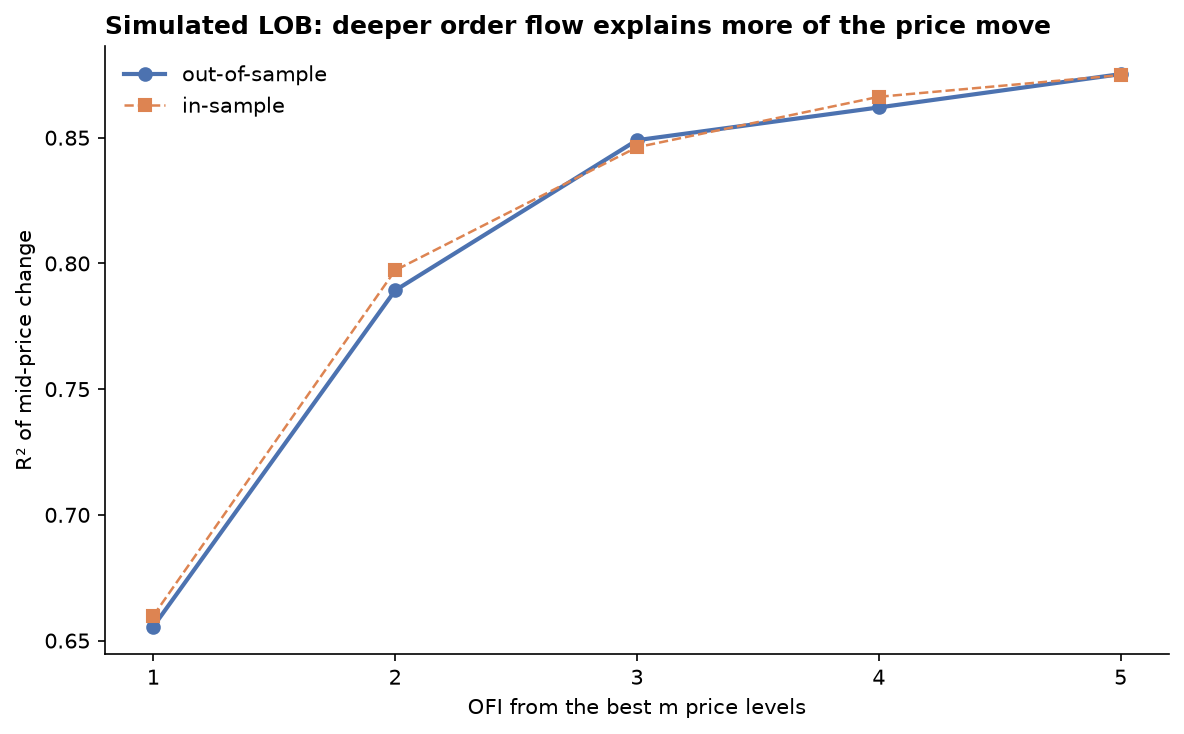
| Δmid on OFI of the best 1 → 5 levels, 10 s | out-of-sample R² 0.66 → 0.79 → 0.85 → 0.86 → 0.88 | Xu, Gould & Howison (2019) |
| Forecast of the mid after the next mid change | Stoikov micro-price −6.6% MSE vs mid; naive microprice −1.3% | Stoikov (2018) |
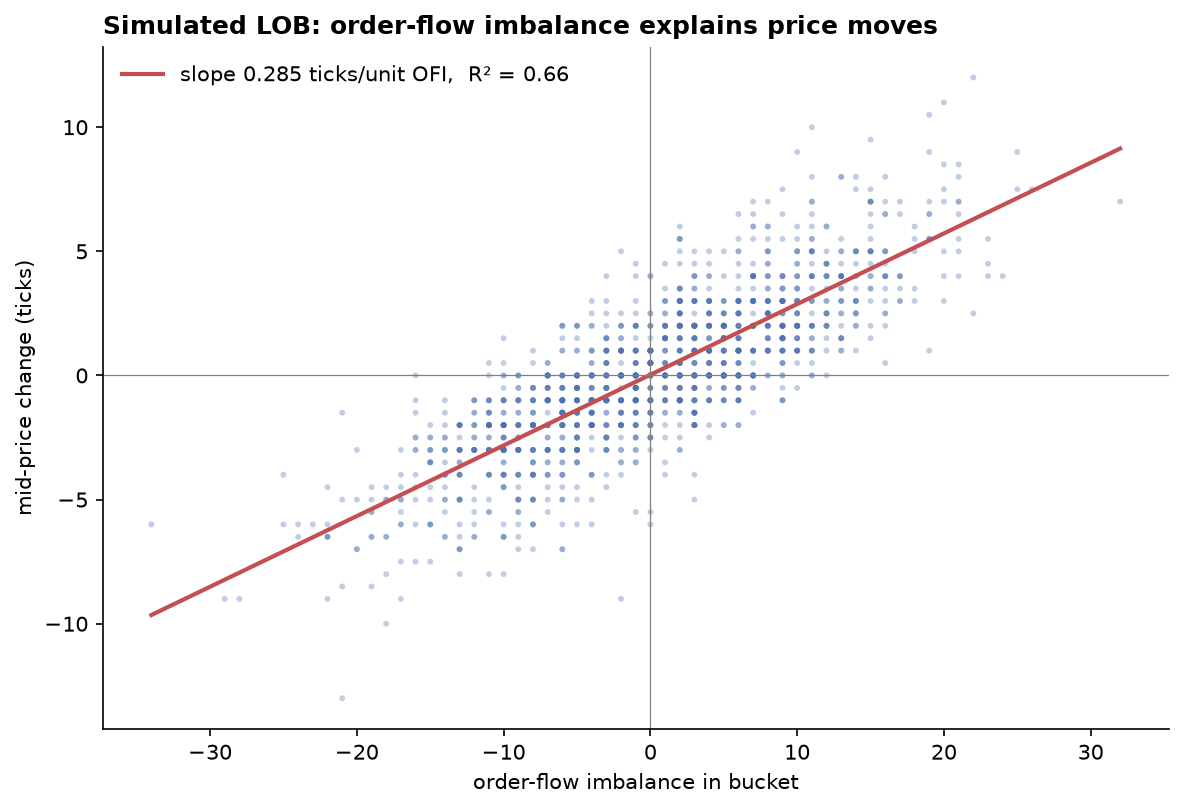
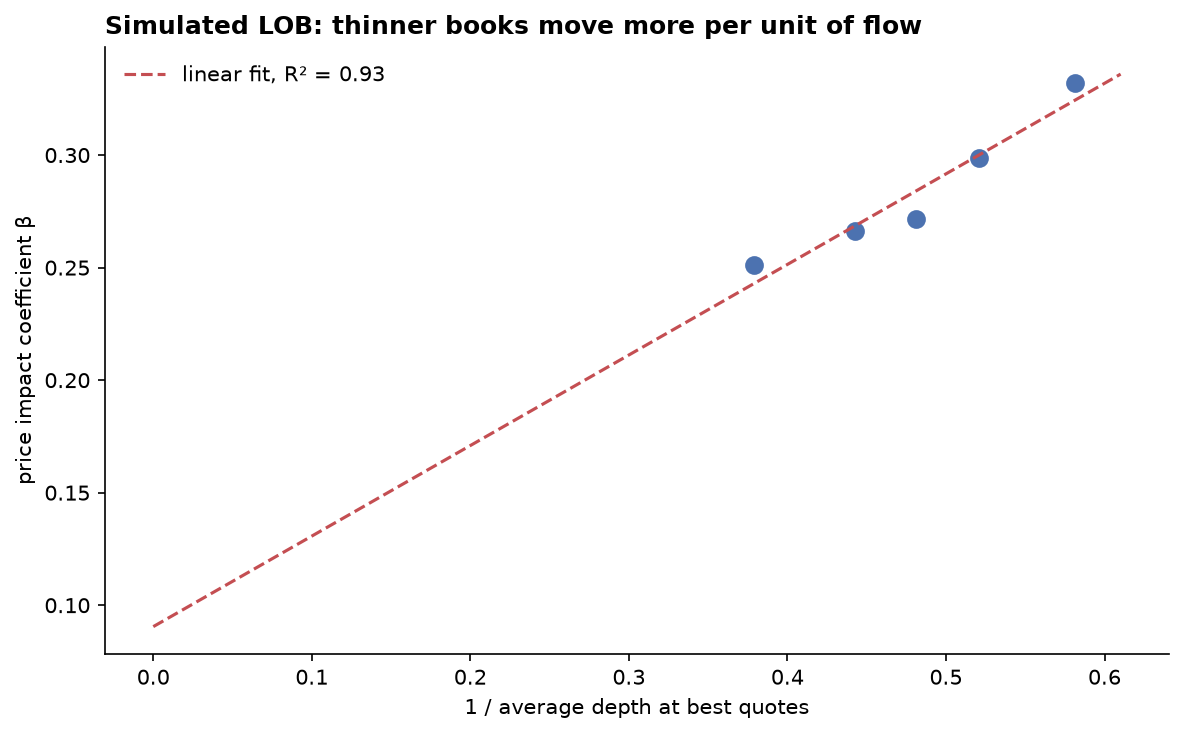
Explaining is not predicting. Order flow explains two-thirds of price changes in the same interval but almost none of the next 10 seconds. Queue imbalance strongly predicts the next price move, but in a liquid book many moves happen within a 10-second bucket. The edge is real at the event horizon, and only accessible to someone fast enough to act on it.
Deeper order flow matters. Best-level OFI misses flow that arrives one level back and becomes the best queue a moment later. Adding the second level lifts out-of-sample R² from 0.66 to 0.79, and five levels reach 0.88. In-sample and out-of-sample R² agree, so this is not overfitting.
The naive microprice overshoots; Stoikov's micro-price doesn't. The imbalance-weighted mid is a worse forecast of the very next mid than the mid itself (−82% at one update, out of sample), and only marginally better at 10–100 updates. With small queues it over-reacts to imbalance. Stoikov's (2018) micro-price is estimated as a Markov chain on (spread, imbalance): fitted on the first 70% of the data, it shades the mid by at most 0.29 ticks at a one-tick spread, against 0.36 for the naive formula in the same bucket, and much less when the spread is two ticks. It is built to forecast the mid at the next price changes, and there it wins clearly: 6.6% lower squared error than the mid for the next change, and 4.2% for the one after, against 1.3% and 2.6% for the naive microprice. At one book update it still loses to the mid (−18%), because most updates don't move the price at all.
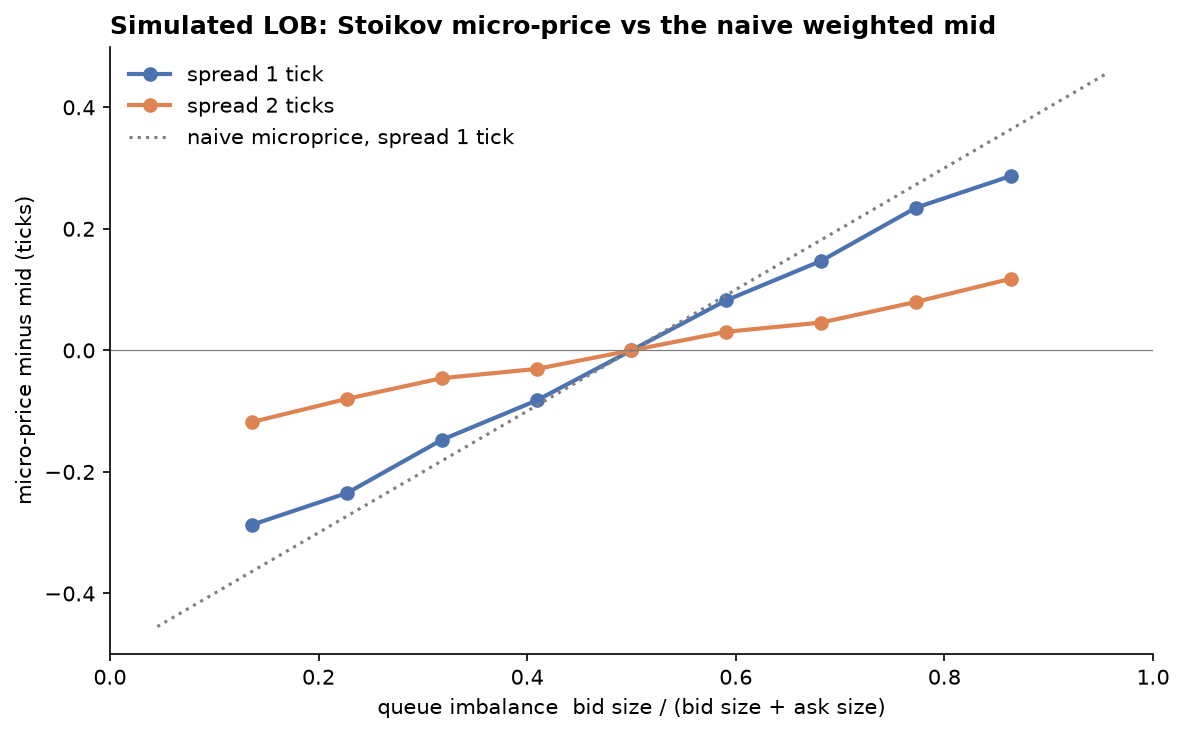
One detail matters for the estimator: with small integer queues a perfectly balanced book (imbalance exactly 0.5) is common. With the usual 10 imbalance buckets those states land in an "up" bucket and break the symmetry the method relies on, so lobkit uses an odd number (11).
Study 2: Avellaneda–Stoikov market making
The market maker quotes around a reservation price r = s − qγσ²(T − t), shifted against its inventory q, with the optimal spread γσ²(T − t) + (2/γ)ln(1 + γ/k). The symmetric benchmark uses the same spread centred on the mid. Paper parameters: s₀ = 100, σ = 2, T = 1, dt = 0.005, A = 140, k = 1.5, 4,000 simulations:
| γ | Strategy | Mean P&L | Std P&L | Std final inventory |
|---|---|---|---|---|
| 0.01 | inventory | 66.8 | 8.9 | 5.4 |
| 0.01 | symmetric | 67.1 | 13.8 | 9.0 |
| 0.1 | inventory | 63.4 | 6.4 | 3.0 |
| 0.1 | symmetric | 66.8 | 13.1 | 8.6 |
| 0.5 | inventory | 47.3 | 5.8 | 2.0 |
| 0.5 | symmetric | 57.7 | 11.6 | 7.2 |
The paper reports approximately 62.9 (std 5.9) and 67.2 (std 13.4) for γ = 0.1. Inventory management halves P&L volatility and keeps inventory three times tighter, for about 5% less profit.
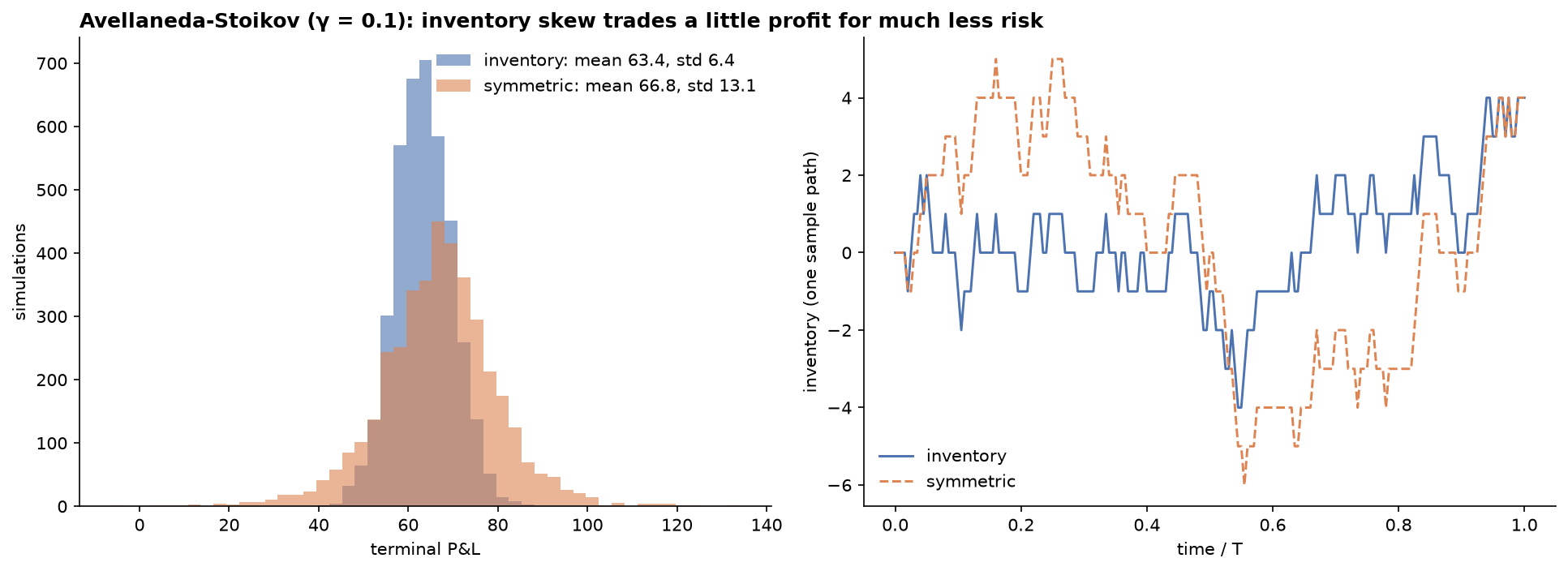
A finding along the way. My first implementation evaluated fills before moving the mid within each time step, and gave 65.1 for the inventory strategy, about 2 above the paper and outside Monte Carlo error. Moving the mid first, then evaluating fills against quotes set before the move, reproduces the paper. It is also the more realistic ordering: it captures adverse selection, where quotes the price has moved through are more likely to fill.
Study 3: live Binance data
03_record_binance.py records best quotes, trades and synchronised L2 depth for any spot pair;
04_analyze_recording.py runs the same analysis as Study 1 at 1-second buckets, plus multi-level
OFI on the recorded top-10 depth (sampled once a second, so 5-second buckets). Comparing the
simulated and live tables shows which effects are mechanical consequences of the order book
and which require informed traders. Record at least 15 minutes; the script warns when there is
too little data to say anything.
Results for one session, two instruments recorded side by side: BTCUSDT and ETHUSDT, 2 hours each on 2026-11-01 from 04:29 local time. BTCUSDT: 187,746 quote updates, 18,463 trades; the price stayed within a 162 USDT range and the mid changed 2,176 times, about once every 3.3 seconds. ETHUSDT: 127,805 quote updates, 14,136 trades; an 8 USDT range and 2,931 mid changes. Both books tick in cents, so a tick is 0.13 basis points of the BTC price but 0.44 of the ETH price, and the ETH best queues are deep (31.5 ETH on average against 2.5 BTC). That session is one sample, not a study, and the recordings are not in the repository (market data is never committed), so treat these numbers as an illustration of the pipeline.
| Result | BTCUSDT, 1 s buckets | ETHUSDT, 1 s buckets | Simulated |
|---|---|---|---|
| Δmid on OFI | β = 0.203 USDT per BTC, R² = 0.59, t = 102 | β = 0.0008 USDT per ETH, R² = 0.70, t = 129 | R² = 0.42 at 1 s (Study 5), 0.66 at 10 s |
| Impact coefficient vs 1/depth | R² = 0.91 across depth quintiles | R² = 0.87 | R² = 0.93 (10 s) |
| P(next move up), imbalance < 0.1 → > 0.9 | 0.09 → 0.93, monotone | 0.09 → 0.84, dips at 0.5–0.6 | monotone |
| Next 1 s move from queue imbalance | out-of-sample R² 2.0% | 4.6% | 0.7% (next 10 s) |
| Multi-level OFI, best 1 → 10 levels (5 s) | out-of-sample R² 0.33 → 0.38 | 0.45 → 0.47 | 0.66 → 0.88, 1 → 5 levels (10 s) |
| Micro-price vs mid, next price change | Stoikov −0.6% MSE, naive −0.03% | Stoikov −10.8%, naive −4.2% | Stoikov −6.6%, naive −1.3% |
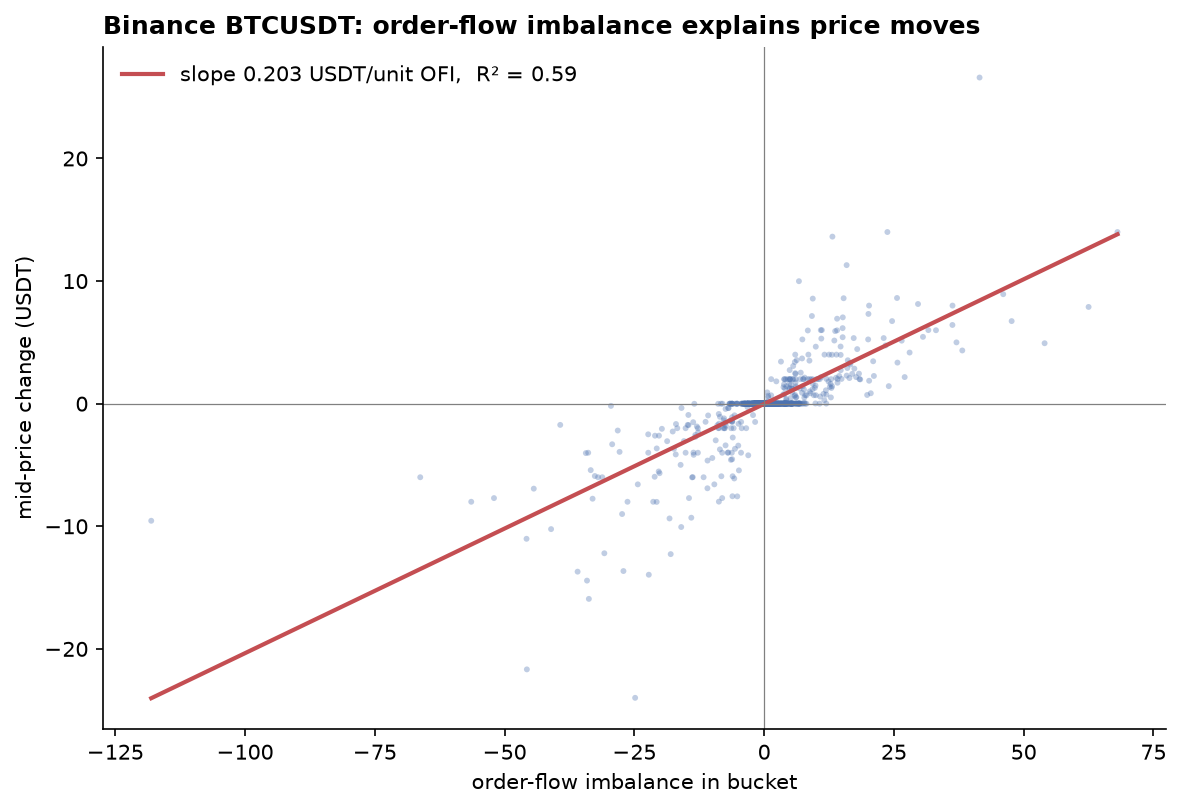
What survives contact with a real book. The contemporaneous OFI relation is stronger live than in the simulator at 1-second buckets on both instruments, and impact is larger when the book is thin. Queue imbalance predicts the direction of the next move at the extremes, and has a little out-of-sample power over the next second.
What depends on the book. On ETHUSDT the Stoikov micro-price forecasts the next price change with 10.8% less squared error than the mid, more than in the simulator, and the edge fades with the horizon (4.3% after 5 moves, 0.9% after 20). On BTCUSDT it does not: −0.6%. The BTC book often thins out for an instant: the spread was above 1 USDT (100 ticks) in 1,131 updates over 305 episodes, up to 17.4 USDT, while the ETH spread never exceeded 0.45 USDT. Those blowouts dominate a squared-error comparison and wreck the naive micro-price (its gap to the mid has an out-of-sample R² of −0.77 for the next second on BTC). Deeper levels add only a few points of R² on either book, much less than in the simulator: the levels behind the best quote are a cent apart and mostly small resting orders.
Study 4: the market maker inside the order book
Study 2 assumes fills arrive at rate A·e^(−kδ), independent of what the price does next. In a real
book an order fills only when market orders have eaten the queue ahead of it, which is exactly
when the price is about to move through it. 05_market_making_in_lob.py puts the same quoter
into the zero-intelligence book: one unit per side, joining the back of the queue, keeping its
place if the quote doesn't change at the once-a-second requote, and filling only when a market
order reaches it.
The paper's inputs are calibrated on the book itself: σ = 1.08 ticks/√s from 1-second mid changes; A = 0.59 fills/s and k = 1.39 per tick from a quoter resting at fixed distances from the mid. Episodes last T = 300 s, 200 per row:
| γ | Strategy | Mean P&L | Std P&L | Std final inventory | Fills | Spread captured | Adverse sel. 1 s | Adverse sel. 10 s | Kept |
|---|---|---|---|---|---|---|---|---|---|
| 0.001 | inventory | 30.1 | 25.9 | 4.0 | 71 | 0.82 | −0.21 | −0.30 | 63% |
| 0.001 | symmetric | 46.5 | 58.3 | 7.2 | 70 | 0.84 | −0.18 | −0.17 | 80% |
| 0.005 | inventory | 19.4 | 13.3 | 2.4 | 64 | 0.79 | −0.30 | −0.48 | 39% |
| 0.005 | symmetric | 28.9 | 59.0 | 6.9 | 51 | 0.88 | −0.19 | −0.20 | 77% |
| 0.02 | inventory | 8.0 | 7.5 | 1.4 | 26 | 0.81 | −0.35 | −0.53 | 35% |
| 0.02 | symmetric | 14.5 | 25.9 | 4.1 | 18 | 0.96 | −0.20 | −0.17 | 82% |
(P&L in ticks; spread captured and adverse selection in ticks per fill; "kept" is after 10 s. Markouts leave out fills too close to the end of an episode to have a full horizon.)
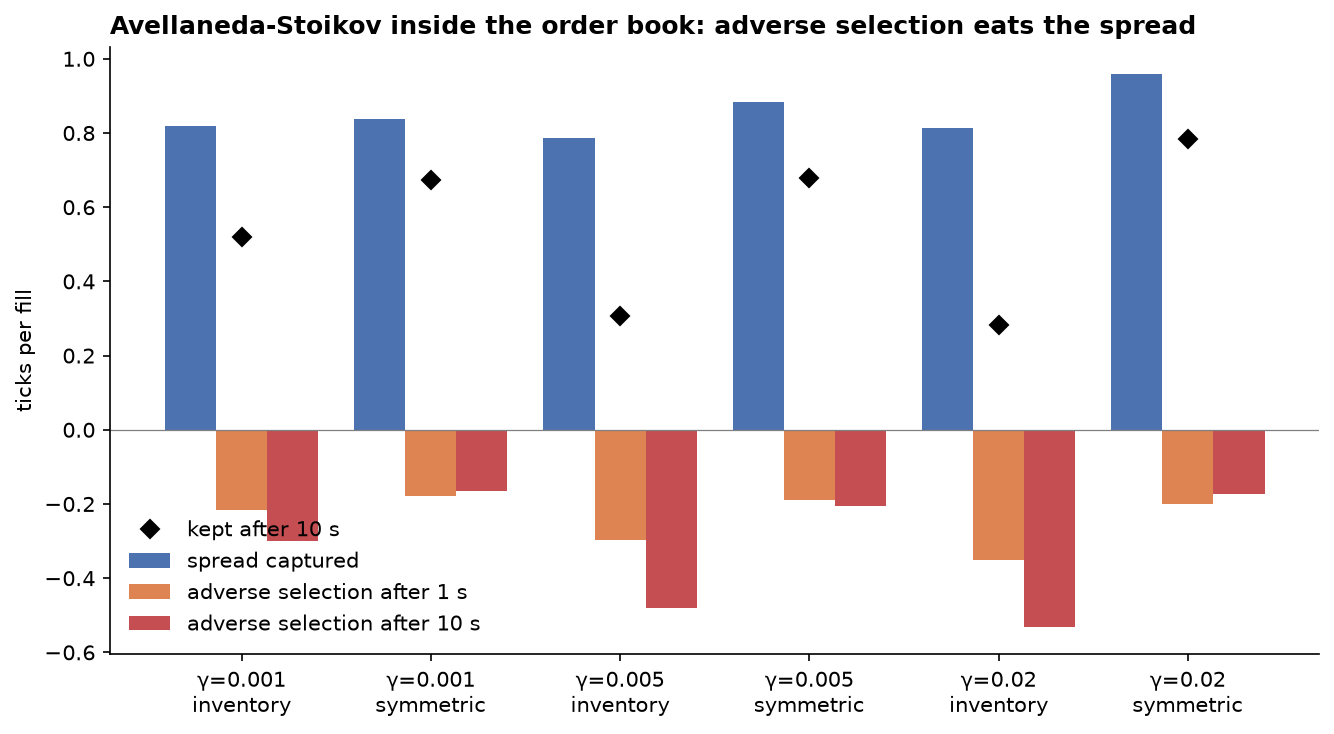
Inventory control still works. The skewed quoter cuts P&L volatility by 2.3–4.4× and final inventory by 1.8–2.9×, as in the paper.
But it pays for it in adverse selection. Every fill captures 0.79–0.96 ticks against the mid at that moment. Ten seconds later the symmetric quoter has given back about a fifth of that; the inventory quoter gives back 37–65%. To unload inventory it quotes aggressively on one side, often alone at a new best price, and an order alone at the front is the first to be hit when the price moves. As a result inventory control costs 33–45% of mean P&L here, against about 5% in the paper's model (Study 2), where a fill says little about the next price move.
The two costs have different clocks. The symmetric quoter's loss is complete within a second (−0.17 to −0.21 ticks at both horizons): it is the tick the price jumps when the quoter's queue is used up. The inventory quoter loses −0.21 to −0.35 in the first second and keeps losing until −0.30 to −0.53 at ten seconds, so its fills come before sustained moves, not just a one-tick jump.
Study 5: which venue moves first?
06_cross_venue.py compares the Binance and Bybit BTCUSDT books recorded in the same session,
on one local clock. lead_lag correlates the two venues' mid returns at lags of ±2 s on a 50 ms
grid; cross_venue_impact asks how much of each venue's 1-second price change its own and the
other venue's order flow explain, and whether either venue's flow or return predicts the other's
next second. Following the repo's rule, the estimators are first run where the answer is
known: a simulated venue B that copies venue A 300 ms late. They find the delay exactly
(correlation 1.00 at +300 ms) and the direction: only B's next move is predictable from A.
Same session as Study 3 (2 hours each; 187,746 Binance and 76,632 Bybit quote updates for BTCUSDT, 127,805 and 21,344 for ETHUSDT):
| Target venue | R² own OFI | R² other venue's OFI | R² both | Next 1 s from other's OFI (OOS) | Next 1 s from other's return (OOS) |
|---|---|---|---|---|---|
| Binance BTCUSDT | 0.59 | 0.23 | 0.59 | 0.059 | 0.064 |
| Bybit BTCUSDT | 0.54 | 0.33 | 0.58 | 0.002 | 0.001 |
| Binance ETHUSDT | 0.70 | 0.15 | 0.70 | 0.036 | 0.094 |
| Bybit ETHUSDT | 0.31 | 0.43 | 0.51 | 0.001 | 0.003 |
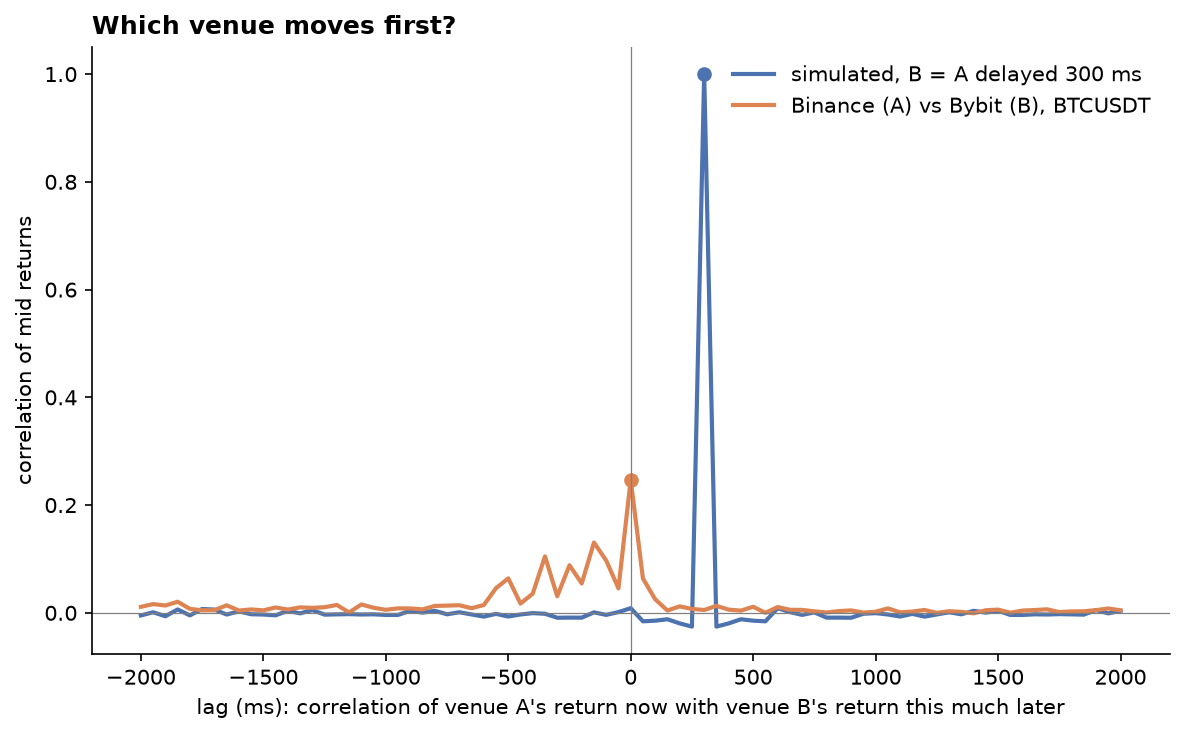
Bybit tends to move first, by tens of milliseconds. Returns are most correlated at 0 ms (0.25 for BTCUSDT, 0.18 for ETHUSDT): most moves land on both venues within the same 50 ms. What is left is lopsided in the same way on both instruments. The correlation at negative lags (Bybit first) sums to 1.00 for BTCUSDT and 1.13 for ETHUSDT, against 0.26 at positive lags; the strongest off-zero lag is Bybit 150 ms ahead on both. The regressions agree: Bybit's flow and return predict Binance's next second (out-of-sample R² 3.6–9.4%), Binance's predict Bybit's by 0.3% or less. On ETHUSDT, Binance's flow explains more of Bybit's price than Bybit's own flow does (0.43 against 0.31). The earlier 40-minute session pointed the same way; two instruments over two hours make it a consistent pattern, but still one session. One limitation is built in: timestamps are local receive times, so each venue's network latency to the recording machine is part of the measured lag. A lead shorter than the difference in latencies can't be told apart from a faster connection to Bybit, and a recording from a second location is the way to check.
Roadmap
- M1 Book sync, recorder, ZI simulator, OFI/imbalance analytics, Avellaneda–Stoikov replication
- M2 Multi-level OFI (Xu, Gould & Howison 2019) using the recorded L2 depth
- M3 Stoikov (2018) micro-price, estimated as a Markov chain on (imbalance, spread)
- M4 Run the Avellaneda–Stoikov quoter inside the order book simulator, with queue position and adverse selection
- M5 Cross-venue study: OFI and lead-lag between Binance and a second exchange (Bybit)
References
- Avellaneda, M. & Stoikov, S. (2008). High-frequency trading in a limit order book. Quantitative Finance 8(3).
- Cont, R., Stoikov, S. & Talreja, R. (2010). A stochastic model for order book dynamics. Operations Research 58(3).
- Cont, R., Kukanov, A. & Stoikov, S. (2014). The price impact of order book events. Journal of Financial Econometrics 12(1).
- Gould, M. & Bonart, J. (2016). Queue imbalance as a one-tick-ahead price predictor in a limit order book. Market Microstructure and Liquidity 2(2).
- Stoikov, S. (2018). The micro-price: a high-frequency estimator of future prices. Quantitative Finance 18(12).
- Xu, K., Gould, M. D. & Howison, S. D. (2019). Multi-level order-flow imbalance in a limit order book. Market Microstructure and Liquidity 4(3–4).
1 maintainer

Metadata
1 maintainer
Release files for lobkit 0.2.2
For a detailed explanation of source distributions (sdists) and built distributions (wheels), please see the package formats documentation.
Source distribution (sdist)
| File | Size | Uploaded | Provenance | Actions |
|---|---|---|---|---|
| lobkit-0.2.2.tar.gz | 40.2 kB | With provenance | Details for lobkit-0.2.2.tar.gz |
Built distribution (wheel)
| File | Interpreter | ABI | Platform | Actions Reset |
|---|---|---|---|---|
| lobkit-0.2.2-py3-none-any.whl | Python 3 | none | any | Details for lobkit-0.2.2-py3-none-any.whl |
Total release size: 70.5 kB
Release files / lobkit-0.2.2.tar.gz
| Download URL | lobkit-0.2.2.tar.gz |
|---|---|
| Size | 40.2 kB |
| Tags | Source |
|
SHA-256 checksum How to use checksums |
b71892d846c39e7b37c4ffb05ca072f85523a65a934c4ed3aeebba5071f78f7e
|
|
BLAKE2b-256 checksum How to use checksums |
2689e42cf75796c2410e18105df27b921c59392abfe8330f621efdf94a627adb
|
| Upload date | |
|
Uploaded using Trusted Publishing? What is trusted publishing? |
Yes |
| Uploaded via |
twine/7.0.0 CPython/3.13.16
|
Provenance
Provenance describes where a file came from. On PyPI, provenance is shared via attestations, which provide a verifiable record of the build or publishing details. View details, limitations and caveats.


PyPI Publish Attestation
PyPI verified that this artifact, at this checksum, originated from the publisher listed below.
Signed by GitHub Actions, verified by PyPI on Nov 1, 2026.
Transparency logRelease files / lobkit-0.2.2-py3-none-any.whl
| Download URL | lobkit-0.2.2-py3-none-any.whl |
|---|---|
| Size | 30.3 kB |
| Tags | Python 3 |
|
SHA-256 checksum How to use checksums |
226b5dd7a4cdd1ac2f378a8a54b723f1fcec9e472fdc699b1618488063c47832
|
|
BLAKE2b-256 checksum How to use checksums |
6b5ea781e1cd73a890d26f851ed000b56f09dc0bc38854182e4bf6c85de79cdc
|
| Upload date | |
|
Uploaded using Trusted Publishing? What is trusted publishing? |
Yes |
| Uploaded via |
twine/7.0.0 CPython/3.13.16
|
Provenance
Provenance describes where a file came from. On PyPI, provenance is shared via attestations, which provide a verifiable record of the build or publishing details. View details, limitations and caveats.
PyPI Publish Attestation
PyPI verified that this artifact, at this checksum, originated from the publisher listed below.
Signed by GitHub Actions, verified by PyPI on Nov 1, 2026.
Transparency logSecurity for lobkit 0.2.2
Provenance
Provenance describes where a file came from. On PyPI, provenance is shared via attestations, which provide a verifiable record of the build or publishing details. View details, limitations and caveats.
Full provenance
All 2 files in this release have been uploaded with provenance metadata.
Attestation for lobkit-0.2.2.tar.gz
PyPI Publish Attestation
PyPI verified that this artifact, at this checksum, originated from the publisher listed below.
Signed by GitHub Actions, verified by PyPI on Nov 1, 2026.
Transparency logA note on package security
PyPI is a repository for distributing packages, not a service for auditing them. While third-party security researchers and our staff do their best to detect and remove malicious packages, PyPI cannot guarantee the quality, security or suitability of any given package.
To learn more about protecting yourself from malicious actors, visit our package security documentation.














