
Run coding agents and only mark work done when independent checks pass.
Verified details
These details have been verified by PyPIProject links
GitHub Statistics
Maintainers

Project description
Agentic Harness
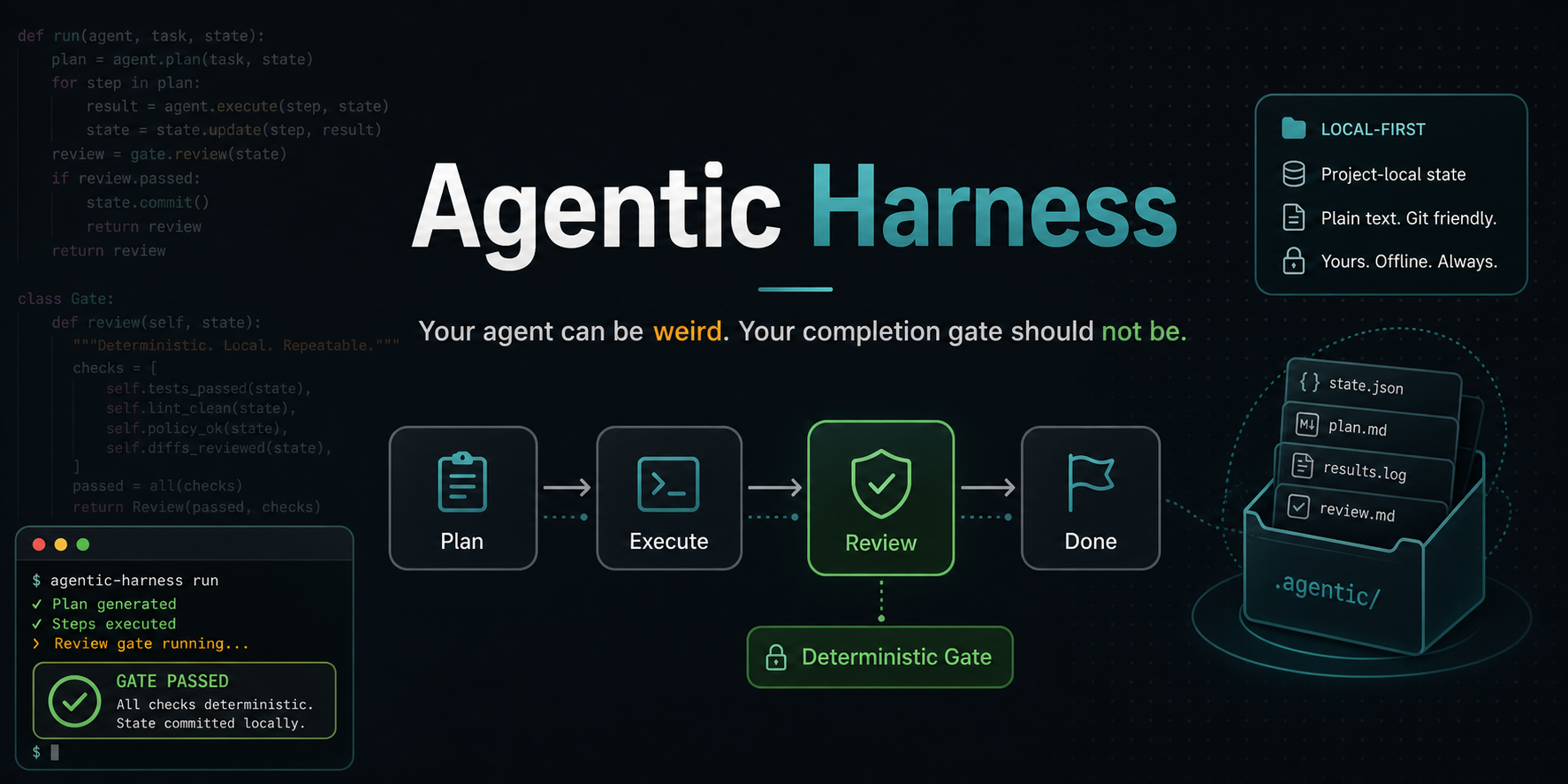



A coding agent saying “done” is not proof that the task is done.
Agentic Harness runs a coding agent on one project-local goal, preserves what it did, and refuses to accept completion until an independent command passes.
Quick Start
Install the released CLI and browser interface:
pipx install local-agentic-harness
Run a verified task in the browser
cd /path/to/your/project
agentic-harness gui
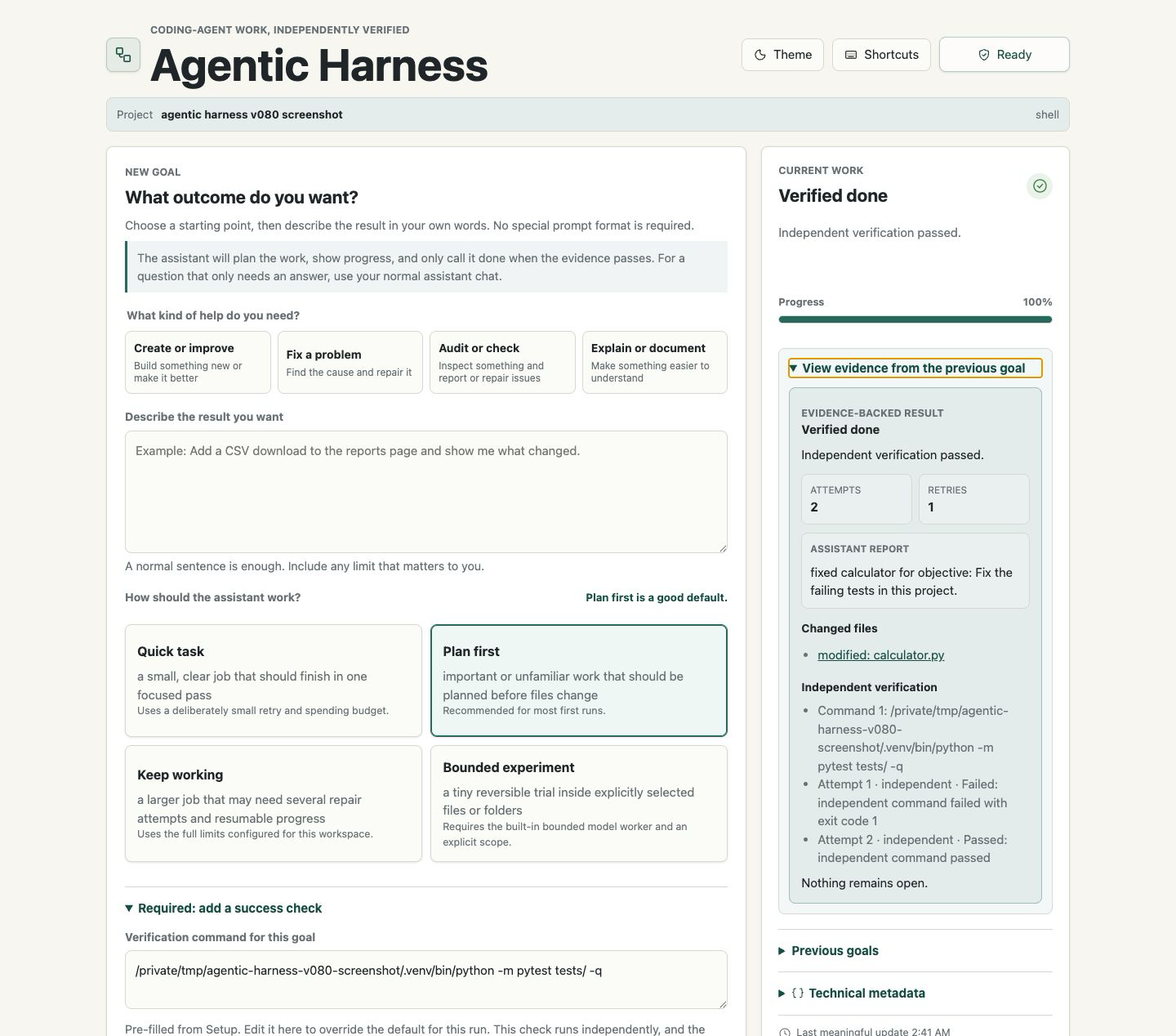
The app confirms the current workspace. In Setup, choose an installed coding agent or compatible model and enter the command that independently proves the result. Then describe one outcome and start. The browser shows the plan, changed files, checks, and final evidence. Work is marked done only when the verification command passes.
See the loaded desktop result and mobile result from the packaged demo.
Run the same verified task from the terminal
cd /path/to/your/project
agentic-harness do "fix the failing tests" --check "python -m pytest tests/ -q"
agentic-harness check
agentic-harness report
--check is the independent completion gate. A worker saying “done” cannot
replace it. The durable report is written to
.agentic-harness/runs/{goal-id}/report.md.
Try the gate without an agent account
agentic-harness run-demo fix-tests /tmp/agentic-harness-demo --force
The packaged example starts with a failing test. Its mock coding agent claims completion too early, the independent check rejects that claim, and a second attempt repairs the project. It is a controlled mechanics demo, not evidence about model quality. See the complete terminal demo script.
Testing on a real repository? Read the external beta guide and submit sanitized feedback.
Product Boundary
local-agentic-harness is one Python distribution with a shared engine, project
state model, packaged static browser assets, and two interfaces:
agentic-harnessis the CLI.agentic-harness-guiis the browser service.
This is the same install, not two products. Both interfaces use
.agentic-harness/ inside the selected workspace. The portable embedded engine
is the default and does not require an external orchestration service.
Advanced Workflows
Recipes
Common workflows have direct commands:
agentic-harness recipes
agentic-harness fix-tests
agentic-harness lint-fix
agentic-harness typecheck-fix
agentic-harness update-docs
agentic-harness changelog
agentic-harness verify-tests
agentic-harness run-recipe fix-tests --explain
Recipes auto-create config when a supported installed coding agent is available.
Each run writes an operator-readable report at
.agentic-harness/runs/{goal-id}/report.md.
How Completion Works
objective
   |
   v
plan -> act -> record progress -> evaluate -> repair if needed
                                      |
                                      v
                           independent verification
                                      |
                         pass --------+-------- fail
                           |                     |
                           v                     +--> continue or block
                     verified done
The original objective remains attached to the goal across cycles and recovery. The worker maintains a plan, requirement audit, current subgoal, and checkpoint. Tool use produces durable redacted events. A completion claim is accepted only when every requirement resolves to a passed, current-run harness evidence record and at least one configured independent criterion passes. Worker-authored prose is not evidence. See the evidence contract.
Limits on cycles, elapsed time, model tokens, provider calls, and tool calls are resource budgets, not success conditions. Exhausting a budget produces a blocked or failed result; it never converts unfinished work into done.
One workspace has one active goal. Use separate project roots when truly independent goals must run concurrently.
Controlled Evaluation
A reproducible comparison has 24 task-behavior cases across six maintenance payloads. Each runs the same scripted coding-agent process directly and through Agentic Harness in pristine workspaces. The matrix includes correct first attempts, premature claims that can be repaired, persistent false claims, and process failures that can be retried.
| Arm | Verified accepts | False accepts | Acceptance precision | Recovered tasks | Mean attempts |
|---|---|---|---|---|---|
| Direct baseline | 6 | 12 | 33.3% | 0 | 1.0 |
| Agentic Harness | 18 | 0 | 100% | 12 | 2.0 |
This is a controlled gate evaluation, not a real-model benchmark or adoption claim. The table comes from the immutable v0.7.2 release snapshot. Validate it against the v0.7.2 tag, not current main, because the default branch may contain later source changes. Its value is narrower: the direct baseline produced 12 false accepts; Agentic Harness produced 0 false accepts. It caught all 12 premature claims and recovered every repairable task at the explicit cost of more attempts. See the method, snapshot receipt, summary, and raw JSONL.
A first preregistered real Codex comparison also publishes all records and redacted transcripts. Both arms passed all ten easy tasks, so it found no correctness advantage; Harness cost more time and tokens. That negative result is a starting point for harder evaluation, not a marketing claim.
On a harder preregistered set, both arms passed 9/10 verifiers. Direct execution falsely accepted the miss; Harness refused it but did not repair it and cost more time and tokens. See the current revision-five result.
Execution Methods
Installed coding agents
The GUI can configure Codex, OpenCode, Aider, or CodeWhale. From the CLI, create or replace a starter config explicitly:
agentic-harness init-agent codex
agentic-harness init-agent opencode
agentic-harness init-agent aider
agentic-harness init-agent codewhale
The harness owns lifecycle, evidence, and independent review. The selected coding-agent process still owns its own credentials, tool permissions, and runtime policy. Safe-area labels are enforced by the embedded model agent; for an external coding-agent CLI they are operator guidance unless that CLI enforces the same boundary.
Local and cloud models
The embedded model agent accepts an exact OpenAI-compatible chat-completions endpoint and an arbitrary model ID. This covers local servers such as vLLM, llama.cpp, Ollama-compatible gateways, and LM Studio when they expose that API, as well as compatible cloud gateways.
Native Anthropic Messages and Google Gemini transports are not built into the embedded engine. Use an OpenAI-compatible gateway, an installed coding agent, or an optional external orchestrator if those native APIs are required.
The GUI is the recommended way to create a model profile. This equivalent cloud profile uses an environment-variable reference and contains no API key:
version: 1
worker: model_agent
llm:
  endpoint: https://provider.example/v1/chat/completions
  model: organization/model-name-or-any-provider-id
  api_key_env: MODEL_PROVIDER_API_KEY
  credential_source: env
  remote_data_confirmed: true
  max_steps: 8
  timeout: 120
review:
  command:
    - python
    - -m
    - pytest
    - -q
  command_timeout: 300
autonomy:
  max_cycles: 100
  max_elapsed_seconds: 7200
  max_total_tokens: 500000
  max_provider_calls: 200
  max_tool_calls: 1000
Set the key outside the project before running the CLI or GUI:
export MODEL_PROVIDER_API_KEY="use-your-secret-entry-path"
agentic-harness do "complete and verify one bounded goal" --check "python -m pytest -q"
Do not put a literal API key in .agentic-harness/config.yml. Model-agent
config rejects plaintext keys. A session key entered in the loopback GUI stays
only in that server process, is not returned by the API, and must be re-entered
after restart. Environment-variable references survive restarts without writing
the secret to project state.
Cloud profiles require HTTPS and remote_data_confirmed: true. That consent
means selected file excerpts, tool observations, and prompts may leave the
machine for the endpoint you chose. It is not inferred from the provider name.
Embedded Safety Boundary
The built-in model agent intentionally exposes a narrow tool set:
- list, read, and search workspace files;
- create text files and replace previously read text inside allowed paths;
- inspect Git status and diff;
- run only the verification commands supplied for the goal; and
- report a structured outcome with requirement evidence.
It does not expose arbitrary shell, delete, package-install, service-control, or network tools. Writes are contained to the workspace, protect repository and credential paths, reject symlink escapes, require a current file hash before replacement, and protect pre-existing dirty files unless they were explicitly placed in scope. Configured checks run in a minimal environment without provider keys or other unrelated process secrets. Provider redirects, URL credentials, URL query credentials, and oversized responses are rejected.
Transcripts and task events are redacted, written atomically, and stored with owner-only permissions. Redaction is defense in depth, not permission to place secrets in prompts or source files.
External coding-agent, shell, tmux, GitHub Actions, and optional orchestration adapters can have broader authority. Their tool policy is not silently upgraded to the embedded agent's enforcement; review their configuration before use.
GUI Operation and Network Safety
The GUI binds to loopback and asks the OS for a free port by default. Use the exact URL printed at startup:
agentic-harness-gui --project-dir /path/to/project --no-open
Choose a stable loopback port when a service or private reverse proxy needs one:
agentic-harness-gui --project-dir /path/to/project --port 8765 --no-open
Keep loopback as the default. A non-loopback bind is refused unless
AGENTIC_HARNESS_GUI_TOKEN is set. Authenticated clients send that value in the
Authorization: Bearer ... header; query-string tokens are not supported. If a
reverse proxy uses another hostname, add only that expected hostname to
AGENTIC_HARNESS_GUI_ALLOWED_HOSTS and preserve the original Host header.
See GUI deployment for the portable systemd and private network pattern.
Recovery and Evidence
Project configuration lives at .agentic-harness/config.yml. Goal state,
redacted events, transcripts, reports, and verification evidence live below the
same .agentic-harness/ directory.
After a failed or blocked goal, inspect agentic-harness report before deciding
what to do next. Use agentic-harness restart to retry that same failed goal
while preserving its evidence. Start a fresh goal only when the objective is
intentionally separate.
GUI stop is cooperative: the current bounded tool step finishes, then the task
ends as Failed with evidence with a stopped-by-user reason. A late worker
result cannot be accepted as done after cancellation. Session-only API keys are
deliberately absent after a GUI process restart and must be entered again.
Optional External Orchestration
Turnstone is a separate,
self-hosted orchestration framework. It is not bundled, imported, or installed
by local-agentic-harness, and the default embedded GUI does not need it.
Operators who already use an external orchestrator can opt into the generic
local-goal compatibility boundary. A direct Turnstone REST/SDK adapter is not
part of this release. See
Turnstone integration for the exact boundary,
capability preflight, and lifecycle expectations.
The optional long-running route uses a versioned, fail-closed candidate
contract. External completion text is never enough for Verified done; a
matching Harness acceptance receipt and independent passing command are
required.
Other Adapters
The shared engine also supports shell, tmux, GitHub Actions, the legacy single-response local LLM adapter, and custom Python workers. See examples for project-local configurations and safety notes.
The small public API remains available:
from agentic_harness import Goal, Supervisor, Worker
Installation
Install the latest published release from PyPI:
pipx install local-agentic-harness
The distribution name avoids a collision with the unrelated
agentic-harness package on PyPI. The installed CLI command remains agentic-harness.
The same installation also provides agentic-harness-gui.
The default branch can contain unreleased CLI and receipt changes. Install the current GitHub source with:
pipx install --force git+https://github.com/moortekweb-art/agentic-harness.git
For development:
git clone https://github.com/moortekweb-art/agentic-harness.git
cd agentic-harness
python -m venv .venv
. .venv/bin/activate
python -m pip install -e ".[test]"
python -m pytest tests/ -q
The GUI frontend ships as packaged static assets in the wheel and sdist. No Node, Electron, Tauri, or frontend build step is required to run it.
Release Verification
Before tagging a release:
python -m pip install -e ".[test]"
python -m pytest tests/ -q
python -m ruff check
python -m mypy agentic_harness
python -m compileall agentic_harness
python -m agentic_harness.cli release-smoke
release-smoke builds and checks a wheel and sdist, installs each into a fresh
virtual environment, verifies both entry points and packaged assets, runs a
goal/report smoke test, and writes SHA256SUMS beside the artifacts.
Documentation
- GUI architecture
- GUI design
- GUI deployment
- Autonomous goal contract
- Evidence contract
- Turnstone integration boundary
- Release checklist
- PyPI trusted publishing
- Security policy
- Contributor guide
- External beta guide
- External beta feedback template
- Examples
Contributing
Issues and pull requests are welcome. See CONTRIBUTING.md for setup, test, portability, documentation, and pull-request expectations. Security reports belong in the private channel described by SECURITY.md.
License
MIT. Copyright (c) 2026 Michael / Moortekweb. See LICENSE and AUTHORS.md.
Support
If Agentic Harness helps your local AI workflow, you can support the project at Buy Me a Coffee.
Project details
Verified details
These details have been verified by PyPIProject links
GitHub Statistics
Maintainers
Release history Release notifications | RSS feed


Download files
Download the file for your platform. If you're not sure which to choose, learn more about installing packages.
Source Distribution
Built Distribution
Filter files by name, interpreter, ABI, and platform.
If you're not sure about the file name format, learn more about wheel file names.
Copy a direct link to the current filters
File details
Details for the file local_agentic_harness-0.7.5.tar.gz.
File metadata
- Download URL: local_agentic_harness-0.7.5.tar.gz
- Upload date:
- Size: 7.0 MB
- Tags: Source
- Uploaded using Trusted Publishing? Yes
- Uploaded via: twine/6.1.0 CPython/3.13.13
File hashes
| Algorithm | Hash digest | |
|---|---|---|
| SHA256 |
765f3c31964a66302afd1d68b70481f92d009238b622edfdb1bac97a4822fa08
|
|
| MD5 |
f00396f42391c6b45876b4db4692c40d
|
|
| BLAKE2b-256 |
803dfd7d028097e1bb3158649ada114bc4d43a94b579a6a18d3191763d7b1a88
|
Provenance
The following attestation bundles were made for local_agentic_harness-0.7.5.tar.gz:
Publisher:
publish.yml on moortekweb-art/agentic-harness
-
Statement:
-
Statement type:
https://in-toto.io/Statement/v1 -
Predicate type:
https://docs.pypi.org/attestations/publish/v1 -
Subject name:
local_agentic_harness-0.7.5.tar.gz -
Subject digest:
765f3c31964a66302afd1d68b70481f92d009238b622edfdb1bac97a4822fa08 - Sigstore transparency entry: 2153790256
- Sigstore integration time:
-
Permalink:
moortekweb-art/agentic-harness@e36e344a903b3e380b62fa200657209dc67385f1 -
Branch / Tag:
refs/tags/v0.7.5 - Owner: https://github.com/moortekweb-art
-
Access:
public
-
Token Issuer:
https://token.actions.githubusercontent.com -
Runner Environment:
github-hosted -
Publication workflow:
publish.yml@e36e344a903b3e380b62fa200657209dc67385f1 -
Trigger Event:
push
-
Statement type:
File details
Details for the file local_agentic_harness-0.7.5-py3-none-any.whl.
File metadata
- Download URL: local_agentic_harness-0.7.5-py3-none-any.whl
- Upload date:
- Size: 155.6 kB
- Tags: Python 3
- Uploaded using Trusted Publishing? Yes
- Uploaded via: twine/6.1.0 CPython/3.13.13
File hashes
| Algorithm | Hash digest | |
|---|---|---|
| SHA256 |
f418b0863367cb49ac2f23f1bbc5c73a3b40e59b2c51e4a4df448d8826076707
|
|
| MD5 |
36e09b3ef3563c9f49161da8e201e3a7
|
|
| BLAKE2b-256 |
43d0646131169116614930f4a22d9aea421d276413cc780199a00eaacd1935ea
|
Provenance
The following attestation bundles were made for local_agentic_harness-0.7.5-py3-none-any.whl:
Publisher:
publish.yml on moortekweb-art/agentic-harness
-
Statement:
-
Statement type:
https://in-toto.io/Statement/v1 -
Predicate type:
https://docs.pypi.org/attestations/publish/v1 -
Subject name:
local_agentic_harness-0.7.5-py3-none-any.whl -
Subject digest:
f418b0863367cb49ac2f23f1bbc5c73a3b40e59b2c51e4a4df448d8826076707 - Sigstore transparency entry: 2153790399
- Sigstore integration time:
-
Permalink:
moortekweb-art/agentic-harness@e36e344a903b3e380b62fa200657209dc67385f1 -
Branch / Tag:
refs/tags/v0.7.5 - Owner: https://github.com/moortekweb-art
-
Access:
public
-
Token Issuer:
https://token.actions.githubusercontent.com -
Runner Environment:
github-hosted -
Publication workflow:
publish.yml@e36e344a903b3e380b62fa200657209dc67385f1 -
Trigger Event:
push
-
Statement type:








