
Local Codebase Indexer
Which C# code and pages reach this SQL Server table?
Trace tables and stored procedures to repositories, controller actions, and Razor pages in a local source tree. Use the CLI yourself or give your AI assistant the same evidence through MCP. Especially useful when maintaining C# / SQL Server applications with Dapper, ADO.NET, or Entity Framework.
Case study and raw results · CLI reference · PyPI · MIT license
How it compares with Claude's Grep and similar tools
Measured on our MES fixtures: +9.5–10.7 percentage points in relevant-file recall versus rg + BM25. For the bundled SQL → C# → page investigation, the relation report covers 5/5 required evidence files, versus 3/5 from one literal table-name search (+40 points).
| Fixed retrieval suite | rg + BM25 file Recall@5 |
This project | Difference |
|---|---|---|---|
| MES-style synthetic: 42 questions, 24 files | 81.0% | 91.7% | +10.7 pp |
| Same 42 questions with distractors: 109 files | 81.0% | 90.5% | +9.5 pp |
| Python stdlib: 12 questions, 85 real source files | 100.0% | 79.2% | −20.8 pp |
Recall means the fraction of known relevant files retrieved, averaged over questions. The baseline runs real ripgrep with generic query-term splitting and BM25 ranking; it is not Claude's agent. This project uses default hashing and 5 result chunks; the baseline returns 5 files. Both are scored at file level. These are 54 unique, project-authored questions (96 executions including the repeated noisy suite), not a general accuracy guarantee.
Less source to read: on the noisy MES and stdlib suites, rendered search results contain 94.9% / 96.9% fewer characters than reading the same selected files in full. Tiny synthetic files instead produce 2.3% more characters. This measures output size against whole-file reading, not savings against Grep snippets or Claude tokens.
Cost of the richer report: the demo CLI takes 244.5 ms warm versus 8.3 ms for one literal rg call (three-run medians; first indexer call 266.1 ms including indexing). It adds controller/page evidence, not a speed win. The controller path is probable, not runtime proof. No end-to-end Claude, Serena, or Claude Context measurement was made. Protocol and reproduction · machine/environment and summary · all 96 query records.
The extra value is an indexed SQL → C# → page relation report. For supported patterns, one data-access query returns direct/procedure-mediated access, controller actions, page links, and confidence labels. Claude can also follow these links through multiple Grep searches and file reads; this tool packages that investigation into a repeatable CLI/MCP result.
| Tool / workflow | Strong fit | Trade-off and where this project helps |
|---|---|---|
| Claude + Grep / ripgrep | Exact identifiers, strings, and regex; no index setup | Keep it for direct text checks. This project's SQL/call/page relations go beyond the literal table-name matches. |
| Serena with LSP / JetBrains | Backend-driven symbols, references, and editing/refactoring | Prefer compiler/IDE semantics for accurate renames and overloads. This project provides a focused SQL maintenance report without a language-server backend. |
| Claude Context | Natural-language hybrid BM25 + dense-vector retrieval | Its documented setup uses an embedding provider and Milvus/Zilliz configuration; local providers are supported. This project's default needs no embedding API or vector server, but identifier-oriented hashing can miss paraphrases. |
| Local Codebase Indexer | SQL Server table/procedure → C# accessors → actions/pages; schema and Git impact | Approximate static analysis with visible confidence; no Roslyn overload resolution or semantic rename. |
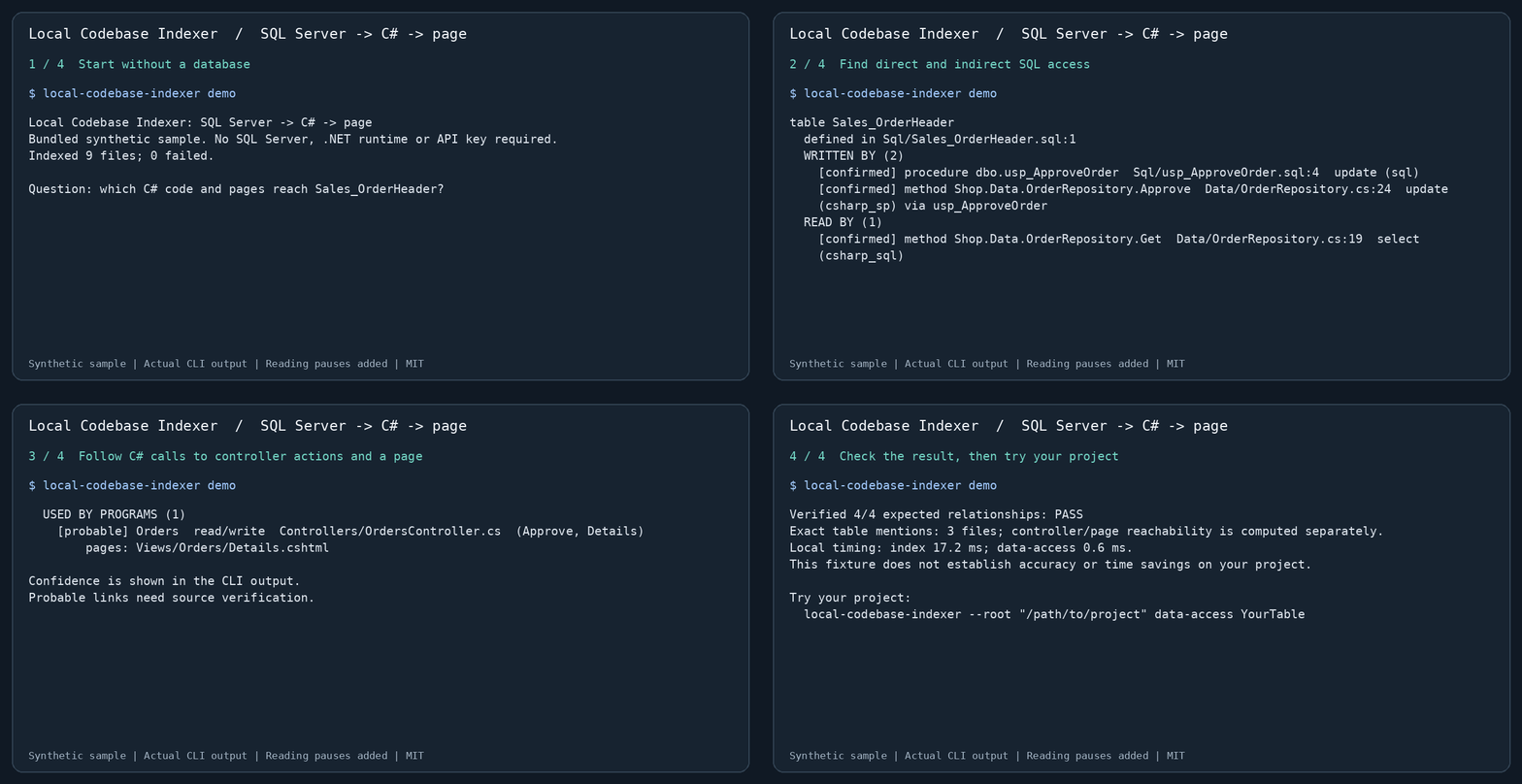
The controller and Razor page in the demo contain no literal table name; the relation report reaches them through the stored procedure and C# calls. All 4 built-in relationship checks pass. See source evidence and upstream feature references.
Try it in three steps
Python 3.10+. Run these in a virtual environment; no SQL Server, .NET runtime, model download, or API key is needed for the demo.
1. Install
python -m pip install --upgrade local-codebase-indexer
If Python reports an externally managed environment, create and activate a virtual environment first. See the reference for isolated installation alternatives.
2. Run the bundled example
local-codebase-indexer demo
This creates a temporary synthetic source tree, indexes it, and checks four expected relationships. It does not index your current directory. The animation uses this command's actual output, with reading pauses added. An excerpt:
table Sales_OrderHeader
  WRITTEN BY (2)
    [confirmed] procedure dbo.usp_ApproveOrder
    [confirmed] method Shop.Data.OrderRepository.Approve ... via usp_ApproveOrder
  READ BY (1)
    [confirmed] method Shop.Data.OrderRepository.Get
  USED BY PROGRAMS (1)
    [probable] Orders ... (Approve, Details)
        pages: Views/Orders/Details.cshtml
Verified 4/4 expected relationships: PASS
Use local-codebase-indexer demo --output demo-orders to keep a copy in a new or empty folder, or demo --json for the complete report.
3. Point it at your source tree
local-codebase-indexer --root "/path/to/project" data-access YourTable
Replace the path and table name. The first query builds the index; subsequent queries refresh it incrementally. SQL definitions must be present in source files for procedure bodies to be analyzed. There is no connection to a live database.
Give the same evidence to your assistant
For Claude Code, after installing the package:
claude mcp add local-indexer -- local-codebase-indexer --root "/absolute/path/to/project" serve
Ask: “Which code writes YourTable, and which controller actions and pages reach it? Show paths and confidence levels.” Restart/reconnect the MCP client if needed. For other stdio MCP clients, use command local-codebase-indexer and arguments --root, your absolute project path, serve.
Codex / Copilot can use the CLI. AGENTS.md contains assistant instructions. The reference also covers the Claude Code plugin, seven MCP tools, ONNX models, aliases, and configuration.
More maintenance questions
local-codebase-indexer --root "/path/to/project" relations OrderRepository.Approve --direction upstream
local-codebase-indexer --root "/path/to/project" impact main...HEAD
local-codebase-indexer --root "/path/to/project" search "order approval" --explain --limit 5
local-codebase-indexer --root "/path/to/project" doctor
Relations show callers; impact compares Git snapshots; search combines identifiers, text, and local embeddings. C#, Python, JavaScript, and TypeScript have symbol parsing; T-SQL and C# have additional data-access analysis. Add --json for structured output.
What to verify
- This is static analysis, with confidence labels. Interface dispatch can be
probable; name-only candidates and dynamic SQL require source verification. There is no Roslyn overload resolution or runtime execution proof. - The default hashing embedder is best at identifiers and related terms. Natural-language paraphrases can miss results. Benchmarks and the case study explain what was measured; four demo checks do not establish general accuracy or time savings.
- The index is local at
<project>/.ai_context/indexer.db. Indexing needs no remote service after dependencies are installed. Your MCP client's model provider controls where returned context is sent. - Start with a table or procedure that you know. If files are missing, run
doctor --path path/to/file.cs; check.gitignoreand.ai_context/ignore. See known limitations and planned work.
Found a wrong edge or missing result? Open a reproducible issue. Contributions are welcome. Licensed under MIT.
1 maintainer

Metadata
1 maintainer
Release files for local-codebase-indexer 0.9.1
For a detailed explanation of source distributions (sdists) and built distributions (wheels), please see the package formats documentation.
Source distribution (sdist)
| File | Size | Uploaded | Provenance | Actions |
|---|---|---|---|---|
| local_codebase_indexer-0.9.1.tar.gz | 408.6 kB | With provenance | Details for local_codebase_indexer-0.9.1.tar.gz |
Built distribution (wheel)
| File | Interpreter | ABI | Platform | Actions Reset |
|---|---|---|---|---|
| local_codebase_indexer-0.9.1-py3-none-any.whl | Python 3 | none | any | Details for local_codebase_indexer-0.9.1-py3-none-any.whl |
Total release size: 519.2 kB
Release files / local_codebase_indexer-0.9.1.tar.gz
| Download URL | local_codebase_indexer-0.9.1.tar.gz |
|---|---|
| Size | 408.6 kB |
| Tags | Source |
|
SHA-256 checksum How to use checksums |
17bf847e14155704c5ec54e2a838b98a6996dbe6ef89131f204c2d04d9002ea8
|
|
BLAKE2b-256 checksum How to use checksums |
5c73f541c4c2795e5f35907bd247413987ae82f46029275c5892da9cda176f2d
|
| Upload date | |
|
Uploaded using Trusted Publishing? What is trusted publishing? |
Yes |
| Uploaded via |
twine/7.0.0 CPython/3.13.16
|
Provenance
Provenance describes where a file came from. On PyPI, provenance is shared via attestations, which provide a verifiable record of the build or publishing details. View details, limitations and caveats.


PyPI Publish Attestation
PyPI verified that this artifact, at this checksum, originated from the publisher listed below.
Signed by GitHub Actions, verified by PyPI on Nov 13, 2026.
Transparency logRelease files / local_codebase_indexer-0.9.1-py3-none-any.whl
| Download URL | local_codebase_indexer-0.9.1-py3-none-any.whl |
|---|---|
| Size | 110.6 kB |
| Tags | Python 3 |
|
SHA-256 checksum How to use checksums |
c0f50e777037288368b29ed6d17548ff8ff7491f49b24776a3095b312ebf3957
|
|
BLAKE2b-256 checksum How to use checksums |
27fedd4e8ff25439912f1e7fa1a97b2a7ed8e50c74bc758565f0359177e69068
|
| Upload date | |
|
Uploaded using Trusted Publishing? What is trusted publishing? |
Yes |
| Uploaded via |
twine/7.0.0 CPython/3.13.16
|
Provenance
Provenance describes where a file came from. On PyPI, provenance is shared via attestations, which provide a verifiable record of the build or publishing details. View details, limitations and caveats.
PyPI Publish Attestation
PyPI verified that this artifact, at this checksum, originated from the publisher listed below.
Signed by GitHub Actions, verified by PyPI on Nov 13, 2026.
Transparency logSecurity for local-codebase-indexer 0.9.1
Provenance
Provenance describes where a file came from. On PyPI, provenance is shared via attestations, which provide a verifiable record of the build or publishing details. View details, limitations and caveats.
Full provenance
Both files in this release have been uploaded with provenance metadata.
Attestation for local_codebase_indexer-0.9.1.tar.gz
PyPI Publish Attestation
PyPI verified that this artifact, at this checksum, originated from the publisher listed below.
Signed by GitHub Actions, verified by PyPI on Nov 13, 2026.
Transparency logA note on package security
PyPI is a repository for distributing packages, not a service for auditing them. While third-party security researchers and our staff do their best to detect and remove malicious packages, PyPI cannot guarantee the quality, security or suitability of any given package.
To learn more about protecting yourself from malicious actors, visit our package security documentation.














