
lcc — Local Context Compiler
Shrink what you send to the model. Keep every byte you didn't cut. Get a receipt.





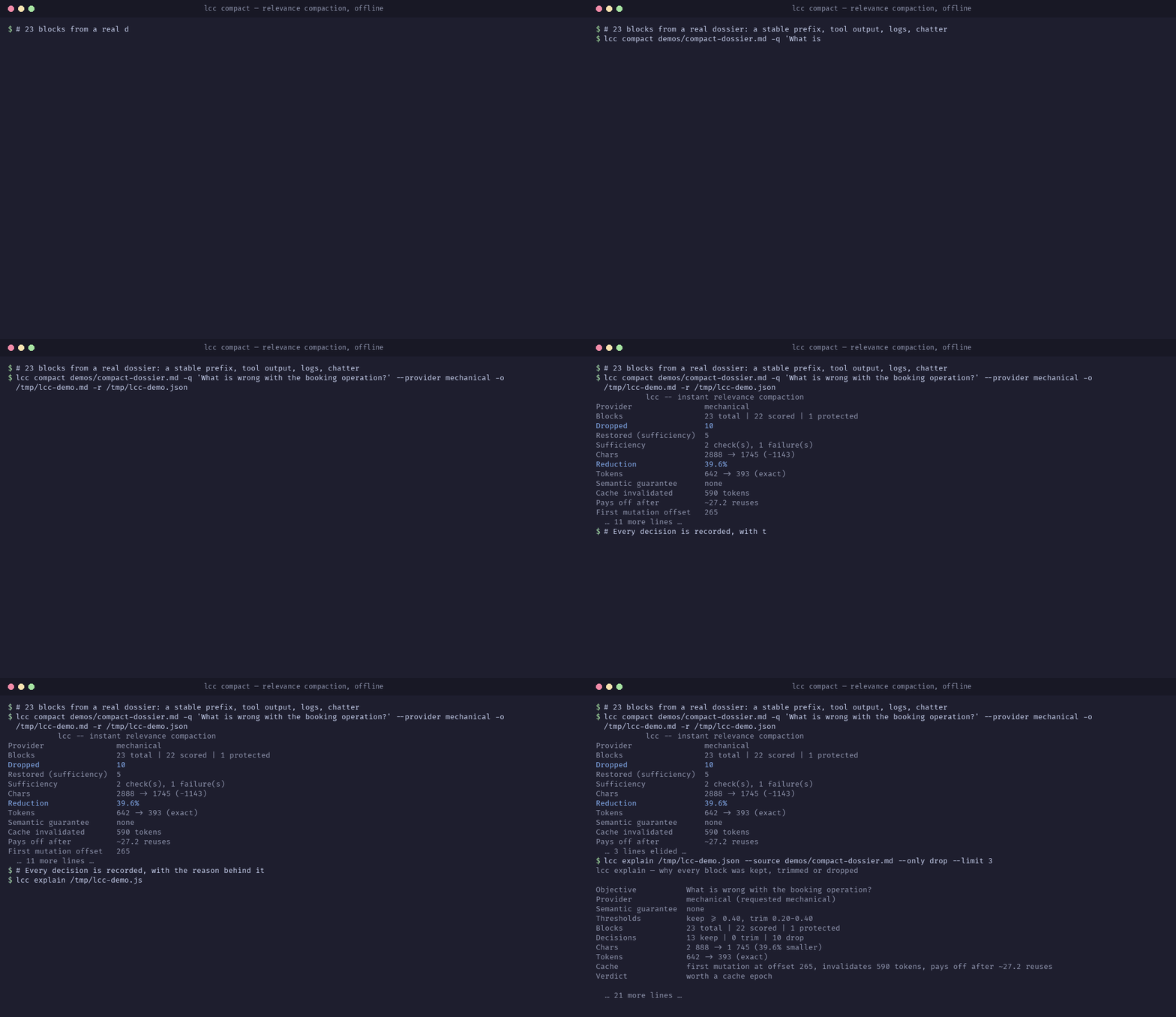
lcc prepares text for model calls: clean duplicates and boilerplate, select
context for an explicit objective, and record what was kept, trimmed or omitted.
Selected spans stay verbatim (no LLM rewriting), the default path runs
offline with no API key, and every pass writes a JSON report you can audit.
| Measured on | Before → after | What was kept |
|---|---|---|
| A real Claude Code session (192 messages, 75 tool calls) | 55,411 → 18,761 tokens (−66.1%) | all 42 user/assistant texts, byte for byte |
| A real 337-message agent session (187 tool calls) | 199,717 → 36,645 tokens (−81.7%) | all 58 user/assistant texts, byte for byte |
The demo dossier above, offline mechanical provider |
642 → 393 tokens (−39.6%) | 13 of 23 blocks, plus a reason for every drop |
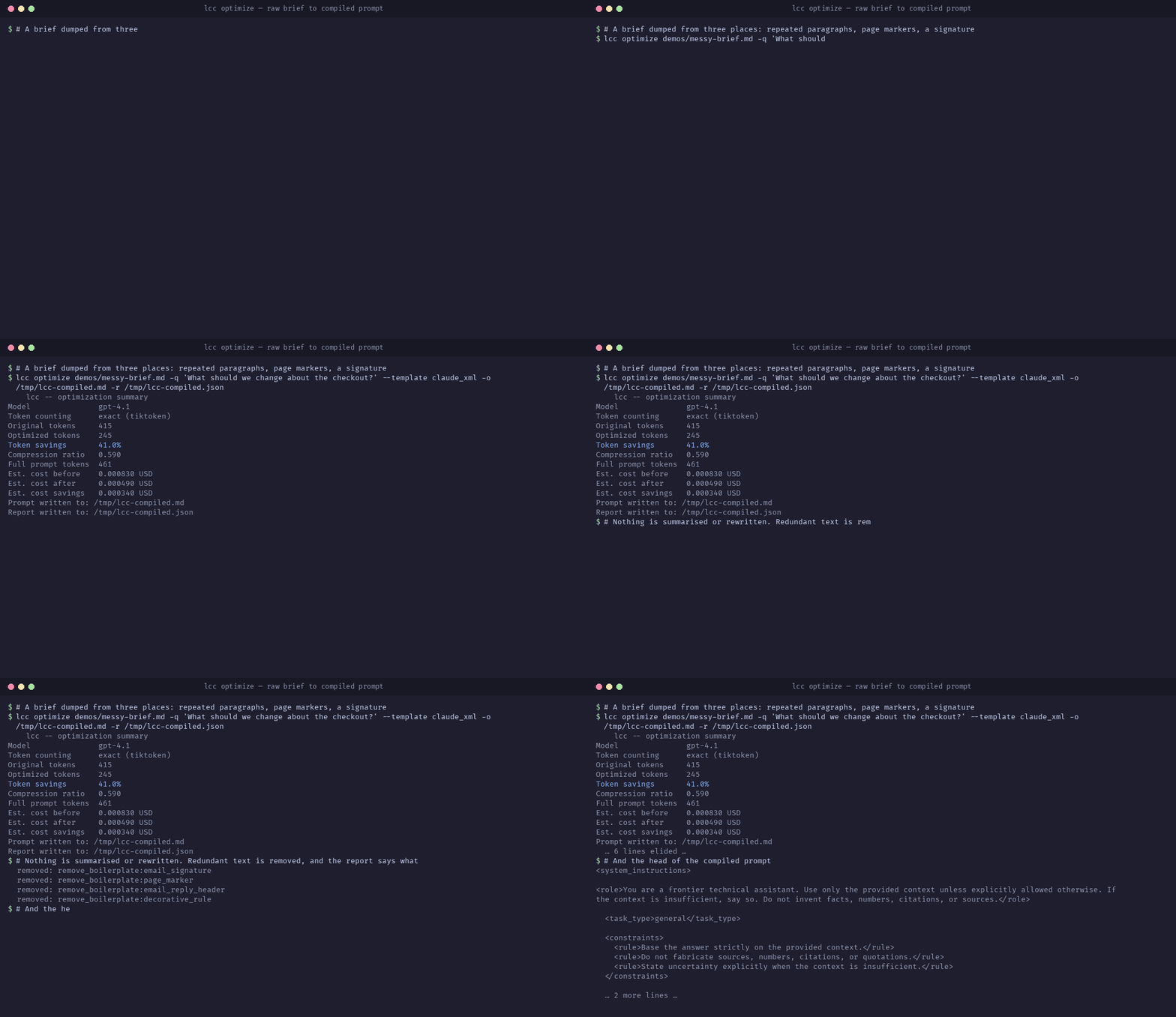
A messy brief compiled by lcc optimize |
415 → 245 tokens (−41.0%) | deduplicated content in a structured prompt |
The session rows use tool-call mode with the Jev judge; source, commands and limits are in
real-session measurements. The demo rows are reproducible
with the commands in the GIFs (exact tiktoken counts). Your reduction depends on how much of
your context is actually noise; below a 25% gain, lcc tells you it is not worth it.
Quick start
pip install "local-context-compiler[tiktoken]"   # the CLI is `lcc`

lcc compact notes.md -q "what is wrong with the booking flow?" \
  --provider mechanical -o compacted.md -r report.json
lcc explain report.json --source notes.md        # why every block was kept or dropped
Use it from any MCP client (Claude Code, Cursor, Claude Desktop…):
{"mcpServers": {"lcc": {"command": "lcc", "args": ["mcp"]}}}
Or replace Claude Code's lossy /compact summary with verbatim tool-call compaction:
claude plugin marketplace add lucasmartins-ai/lcc
claude plugin install lcc@lcc
The plugin needs the early-access function-hooks flag and a judge (a TypeSafe key for Jev, or
provider: laya for fully local); without one it falls back to the built-in summary. See the
Claude Code plugin guide.
Where it fits in a token-saving stack
| Tool | Shrinks | How |
|---|---|---|
| RTK | command output (git, ls, test runners) |
CLI proxy that filters what a shell prints |
| caveman | the model's answers | prompt style that makes replies terse |
| lcc | the context itself (docs, logs, transcripts, tool calls) | objective-driven verbatim selection with an audit report |
They compose: RTK and caveman cut what flows in and out per turn; lcc cuts what accumulates.
More demos: lcc optimize compiling a messy brief into a structured prompt
What it does not do
A structural PASS does not establish that a model will answer correctly.
Cleaning and prompt templates are separate transformations; compaction may add omission markers.
The default offline workflow uses lexical scoring and structural checks. Optional semantic
providers run locally (Laya) or remotely (Jev). No RAG, embeddings or vector store is implemented.
Project status
The checkout declares Python and Node package version 1.0.0 and Python 3.11+. MSI sprints 1–10 have PASS reports; the research release is complete. The software is classified Beta in package metadata.
The 2026-10-03 audit findings R1–R3 are
resolved in Sprint 10: all-attempt cost accounting, shared paired bootstrap,
and full-payload drift checks are active in MSI-Bench. Frozen contracts,
the architecture paper, prior-art review,
limitations and research agenda, version manifest,
and master results are published.
Install from source
From a local checkout:
python3 -m venv .venv
. .venv/bin/activate
python -m pip install .
lcc --version
Runtime dependencies are Typer, Rich and PyYAML. This path requires no model
or API key. Installation may download Python dependencies; the workflows
below run offline. To install the registry package, use
pip install local-context-compiler; its contents may differ from this checkout.
The executable is lcc. The unrelated PyPI package named lcc is not this project.
Optional extras:
python -m pip install '.[tiktoken]'  # exact counts when encoding assets are available
python -m pip install '.[laya]'      # local semantic provider; stages model dependencies
Tiktoken installed without cached encoding assets can still yield estimates.
Read token_count_method, tokenizer_id and is_estimate in the report;
use --require-exact-tokens on supported commands to reject estimated counts.
See tokenizer boundaries.
Copyable offline workflow
Create the input before invoking the CLI:
cat > dossier.md <<'EOF'
The mobile booking form erased patient input at step two.

The mobile booking form erased patient input at step two.

LOG: worker heartbeat ok in 554ms.
EOF

lcc optimize dossier.md -o prompt.md -r clean.json
lcc inspect dossier.md -r inspect.json
lcc compact dossier.md -q 'reduce mobile booking friction' \
  --provider mechanical -o compacted.md -r report.json
lcc explain report.json --source dossier.md
lcc diff dossier.md compacted.md
optimize removes boilerplate/duplicates and formats a prompt. inspect
reads without modifying the source. compact selects context for the objective;
short or protected inputs may remain unchanged. explain audits the report
without scoring again. diff prints a comparison and exits 0 even when files
are different. Human summaries go to stderr; requested text/JSON files carry
machine-readable output. See the quickstart.
Python: compile context with an audit receipt
from pathlib import Path
from lcc.msi import compile

result = compile(
    'reduce mobile booking friction',
    Path('dossier.md').read_text(encoding='utf-8'),
    task_id='booking-01',
)
print(result.context)
print(result.sufficiency)
print(result.receipt.to_spec_dict())
compile() uses planner-1.0, mechanical compaction and bounded structural
restoration. It makes no inference call. Its plan describes a route;
it does not execute that model. The wrapper fixes risk to low, so use the
planner API explicitly for higher-risk tasks.
A receipt's zero API cost means no remote call, excluding CPU and energy.
Same inputs produce the same context bytes; receipt clocks may differ.
Empty tasks/context and negative restoration budgets raise ValueError.
The API contract documents msi-api-1.0 and its limits.
For full execution/verification chains, use the separate
verification and escalation APIs.
Providers and failure handling
| Provider | Execution | Setup | What the report establishes |
|---|---|---|---|
mechanical |
Offline lexical scoring | Base install | semantic_guarantee: none; no semantic judgment |
laya |
Local semantic scoring | Extra and model assets; setup may download weights | Named model, budget and fallback state |
jev |
Remote typed decisions | TYPESAFE_API_KEY and network |
Semantic judgment or explicit degradation; sends the objective and context blocks |
lcc compact dossier.md -q 'reduce mobile booking friction' --provider jev \
  -o compacted.md -r report.json
Jev's optional path evaluates typed relevance questions instead of generating
summaries. Its decisions do not prove downstream answer quality. See Jev
and Laya for limits and fallback contracts.
LCC_DISABLE_NETWORK=1 disables the Jev path. Explicit unavailable Jev keeps
context and reports degradation; unavailable Laya uses a named mechanical fallback.
Check provider_used, degraded, degradation_reason, sufficiency failures
and review flags before using the output.
compact writes a relevance-compaction-1.2 report. Optional IR is
context-ir/0.1; the Python MSI receipt is inference-receipt/0.1.
Read the artifact's version before interpreting its fields.
The pipeline applies selection, deterministic protection, bounded restoration and structural checks. Optional semantic verification is a separate single pass. The safety model, IR and restoration limits explain where evidence can still be lost. Preservation is not a security verdict.
Agents, MCP and Node
{"mcpServers": {"lcc": {"command": "lcc", "args": ["mcp"]}}}
The stdio MCP server exposes compact, compact_transcript, inspect,
prepare, explain and intake. compact defaults to mechanical scoring.
Tool-call transcripts use a semantic provider; user/assistant messages remain
pinned. See MCP, tool-call mode and
Claude Code integration. Plugin transport and live model
execution were not exercised by the offline usability benchmark.
The Node API supports deterministic cleaning, prompt templates and intake; it has no Python MSI/IR/planner parity. Node token counts are heuristic. From this checkout:
const { LccCompressor } = require('./index.js');
const result = new LccCompressor().compress('context text');
console.log(result.compressedText);
agent and route are separate optional execution paths requiring configured
backends. semantic-retrieval reports a disabled/blocked boundary: no retrieval
adapter is implemented. Command requirements are listed in the
quickstart matrix.
Evidence and usability
The workflow benchmark installs a wheel into
a fresh base-only venv and runs outside the source directory. On macOS ARM64,
Python 3.12.14, at code commit 310ab9e:
| Measurement | Result | Scope |
|---|---|---|
| First offline compile, including venv creation and wheel install | 3.14 s | N=1; existing pip cache, scripted execution |
| CLI/API/MCP workflows, including invalid-input diagnostics | 36/36 checks passed | 12 curated scenarios × 3 repetitions; synthetic text |
Times include process startup. This is executable workflow coverage, not a human usability score or a guarantee for other machines. Full stdout/stderr, package versions, input/runner/wheel hashes and commands are in results.json.
Existing quality evidence is reported separately:
| Track | Paired quality | Context accounting | Limit |
|---|---|---|---|
| Sprint 9 REPLAYED: 10 pytest windows from 7 local sessions | Public API 10/10; full context 10/10 | 122 vs 174 estimated retained tokens; neither makes API calls | Summary retention only; correlated historical observations |
| Sprint 9 CURATED: 10 probes × 6 arms | Oracle-protected arm 8/10; full 7/10 | 302 vs 469 estimated retained tokens; modeled chain costs $3.992 vs $16.032 | Label-assisted selector and constructed executor; 25/60 terminal failures published |
Source, exact commits, reproduction and all failures:
real-world integration.
The oracle arm is not lcc.msi.compile. No result above establishes live-agent
success, inference latency, actual billing savings or production transfer.
The sprint-7 pilot has 12 curated tasks and
72 arm runs. In Sprint 10, audit findings R1–R3 were resolved: full-chain attempt
costs are accounted for, bootstrap sampling is paired across arms, and --check
asserts complete payload stability. Historical semantic-provider experiments live in
research status,
transcript A/B and
real-session measurements.
They were not rerun with live providers in this audit.
External feedback exists: one contributor reported Laya weight reloads (#19) and network-guard thread interference (#18). Both issues are closed and have offline regression tests. Their historical timing/incident reports are user observations, not new benchmark measurements.
Reproduce and validate
From the repository root, with Python 3.11 or 3.12:
python -m pip install -e '.[dev,tiktoken]'
mypy
ruff check src tests benchmarks/usability/run.py
pytest -q
npm test
python examples/msi_quickstart.py
PYTHONPATH=src:benchmarks/msi-bench python benchmarks/msi-bench/run.py --check
PYTHONPATH=src:benchmarks/msi-bench:benchmarks/msi-replay \
  python benchmarks/msi-replay/session_replay.py --check
PYTHONPATH=src:benchmarks/msi-bench:benchmarks/msi-replay \
  python benchmarks/msi-replay/replay.py --check
The CI enforces Python tests, lint and configured-package mypy on Python 3.11/3.12, plus Node 20 unit and hook tests. Optional live Laya/Jev tests and uncached exact-token tests may skip; a green suite does not validate them. See audit evidence for commands and results.
To rerun the usability harness against a packaged artifact:
python -m build --outdir /tmp/lcc-dist
python benchmarks/usability/run.py \
  --wheel /tmp/lcc-dist/local_context_compiler-1.0.0-py3-none-any.whl \
  --output /tmp/lcc-usability.json --repeats 3
Benchmark reproduction needs a repository checkout, including frozen datasets; a runtime wheel alone is not the research archive.
Architecture and license
The deterministic core is cleaning, token_budget, prompt_builder,
reporting, pipeline, inspection and benchmarking. Relevance providers,
MSI composition and model execution live outside it. See
ADR 0010,
architecture and the ADR index.
LCC uses the MIT license. The optional Laya integration has Apache-2.0 attribution in NOTICE, included with packaged license files. Maintained by LookADev.
1 maintainer

Metadata
1 maintainer
Release files for local-context-compiler 1.0.0
For a detailed explanation of source distributions (sdists) and built distributions (wheels), please see the package formats documentation.
Source distribution (sdist)
| File | Size | Uploaded | |
|---|---|---|---|
| local_context_compiler-1.0.0.tar.gz | 556.7 kB | Details |
Built distribution (wheel)
| File | Interpreter | ABI | Platform | Reset |
|---|---|---|---|---|
| local_context_compiler-1.0.0-py3-none-any.whl | Python 3 | none | any | Details |
Total release size: 791.8 kB
Release files / local_context_compiler-1.0.0.tar.gz
| Download URL | local_context_compiler-1.0.0.tar.gz |
|---|---|
| Size | 556.7 kB |
| Tags | Source |
|
SHA-256 checksum How to use checksums |
acabc4d421ec65f1b490abfe147971867eafccabfba280a54a839b64afe5b724
|
|
BLAKE2b-256 checksum How to use checksums |
e5a57851df0fa9f6af2c4badaa85545d634e7658db058ba34822fa70b0a9b525
|
| Upload date | |
|
Uploaded using Trusted Publishing? What is trusted publishing? |
Yes |
| Uploaded via |
twine/7.0.0 CPython/3.13.14
|
Provenance
Provenance describes where a file came from. On PyPI, provenance is shared via attestations, which provide a verifiable record of the build or publishing details. View details, limitations and caveats.


PyPI Publish Attestation
PyPI verified that this artifact, at this checksum, originated from the publisher listed below.
Signed by GitHub Actions, verified by PyPI on Oct 7, 2026.
Transparency logRelease files / local_context_compiler-1.0.0-py3-none-any.whl
| Download URL | local_context_compiler-1.0.0-py3-none-any.whl |
|---|---|
| Size | 235.2 kB |
| Tags | Python 3 |
|
SHA-256 checksum How to use checksums |
b31107ca1d96f1c1f8fc89f4ed450f530ff953458f4824ea173aa5c116d12bb5
|
|
BLAKE2b-256 checksum How to use checksums |
68e19a4e886fbb8070f1c7f67e191986cb4a688af7e770d0e1bbaf442a415f2f
|
| Upload date | |
|
Uploaded using Trusted Publishing? What is trusted publishing? |
Yes |
| Uploaded via |
twine/7.0.0 CPython/3.13.14
|
Provenance
Provenance describes where a file came from. On PyPI, provenance is shared via attestations, which provide a verifiable record of the build or publishing details. View details, limitations and caveats.
PyPI Publish Attestation
PyPI verified that this artifact, at this checksum, originated from the publisher listed below.
Signed by GitHub Actions, verified by PyPI on Oct 7, 2026.
Transparency log













