
LocalAgentBrowser
An autonomous web agent powered by a local LLM. Give it an objective; it searches, reads, takes notes and decides when it's done, on your own computer, with a local model or, if you choose, a cloud one. It gives an answer you can check, or says honestly what it couldn't find.
L.A.B. for short, and it wears a LAB COAT: Citations Over Assumed Truth. Every claim in an answer points to the page it came from, and code checks it is there, because the project's principle is Verification Over Trust.
New in 1.67: Clean Room, a private edition. The same agent with the cloud option not just off but gone: the code for it is removed before the edition is built, and the build fails if any is left. It talks to a model only on your own PC or network. In 1.66: sturdier cloud runs, more of every answer checked in code, and the console and browser side by side on Windows. In 1.65: a Windows installer with a choice of tested models, and optional cloud models through OpenRouter for fast answers.






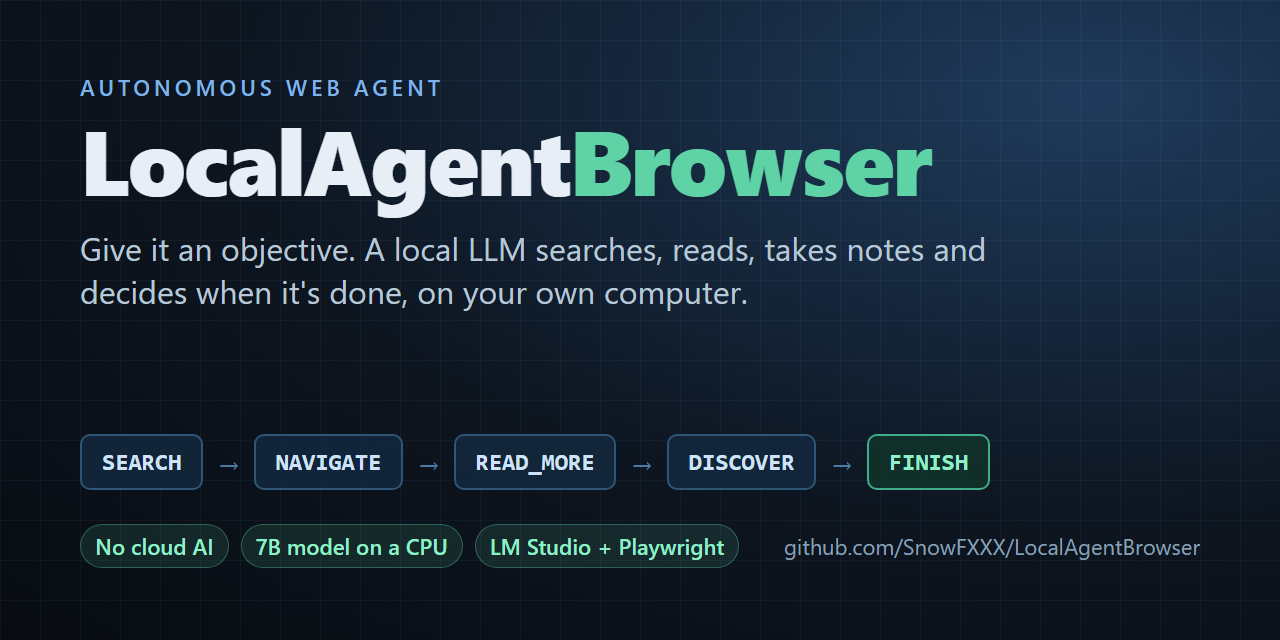
A language model decides what to do next, and Playwright carries it out in a Chromium window you can watch. By default the model runs in LM Studio on your own computer, and the agent is built to work even with a small model on an ordinary CPU, no GPU required; if you want speed, it can use a cloud model instead. Every claim in its answer points to the page it came from.
- 🔒 Local by default, cloud if you choose. By default the model runs in your own LM Studio, with no API key, and your objective and report stay on your computer (searches go to DuckDuckGo and pages load like in any browser). Cloud models through OpenRouter are an option you turn on yourself, with your own key: much faster, but your prompts and the pages read leave your computer. Or choose Clean Room, the private edition, which has no cloud option at all (see Two editions).
- ✅ Checks instead of trust. Findings must be copied from the page shown, commands must appear on the page exactly, and numbers no finding gives are cut. What it can't find is listed as not found, not filled in.
- 🧭 Unattended. It searches, opens pages, reads long pages part by part, records what's relevant and finishes when every part of the objective is covered.
- 📝 A report every time. The final result with numbered citations and every finding with its source, written however the run ends.
- 🪟 Easy on Windows. An installer with its own Python, a choice of tested models during setup, Start-menu shortcuts, and the report opening by itself when a run ends.
📖 Project site · Article: We Can Do Better: A Small AI That Can't Cover Up · Paper: Verification over Trust · Example reports
Contents
Two editions · Tested on four models · Install · First run · What a run looks like · How it works · Settings · FAQ · Limitations · Roadmap · Testing · Contributing
Two editions
LocalAgentBrowser comes in two editions, built from the same code and released together. Both run the same agent with the same checks: every finding copied from the page it came from, every claim cited, and what wasn't found reported as not found.
| Standard edition | Clean Room, a private edition | |
|---|---|---|
| Model | LM Studio on your PC by default; cloud models through OpenRouter if you turn them on | LM Studio on your PC or your local network, only |
| Cloud option | Off unless you turn it on, with your own key | Not there: removed before the edition is built |
| Speed | Your hardware's, or a few minutes a run in the cloud | Your hardware's |
| Cost | Free locally; cents a run in the cloud | Free |
| What leaves your computer | Searches and page visits; with cloud models on, your prompts and the pages read too | Searches and page visits |
| Windows installer | LocalAgentBrowser-<version>-setup.exe |
LocalAgentBrowser-CleanRoom-<version>-setup.exe |
| pip | pip install localagentbrowser |
pip install localagentbrowser-cleanroom |
| Best for | Everyday research, quick answers when time matters, comparing models | Sensitive topics, strict data policies, shared PCs |
Both install side by side on Windows, each with its own folder and shortcuts, and both block the browser's own calls to Google (account checks, push-message check-ins, component updates and autofill lookups).
Standard edition: local models, with optional cloud models
The full LocalAgentBrowser. It runs on a model in LM Studio on your own computer, and when you want speed it can use a cloud model through your own OpenRouter account instead.
Local models, by default
- No GPU, no API key, no account. Built and tested on an ordinary 6-core CPU with small models; the installer offers the four tested models and downloads the one you pick through LM Studio.
- Free to run, as often as you like. A run takes about 10 to 60 minutes on a CPU, so start it and let it work.
- Your objective and report stay on your computer. Only the searches and page visits go out, as when you browse.
Cloud models, if you turn them on
- Answers in minutes. The whole seven-task suite took 4 to 24 minutes on cloud models, against hours on a CPU.
- Cents, not dollars. $0.04 to $0.14 for the whole suite on 1.66; Phi-4, the cloud default, answered 170 of the standard 200 SimpleQA questions (85%) for $0.58.
- Bigger models without the hardware. Any model OpenRouter lists, with the same checks holding it to the pages.
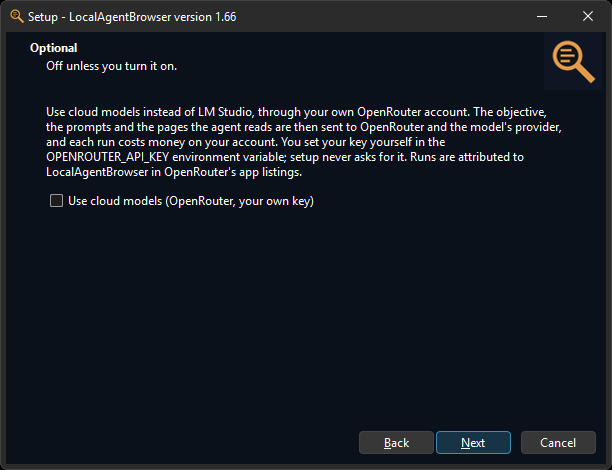
- Your key, your account, your choice. Off unless you tick it in setup; you set the key yourself and setup never asks for it. The agent asks providers not to store or train on your prompts. With cloud models on, your prompts and the pages read go to OpenRouter and the model's provider.
Use it for
- Everyday research on your own PC: facts, lists with conditions, comparisons, how-tos, explanations.
- Quick answers when you can't wait an hour: turn on cloud models for the day.
- Trying models: the same tasks on a local model and a cloud one, side by side; the test suite runs either.
- Developers and researchers measuring how small models behave as agents.
Clean Room, a private edition
LocalAgentBrowser with the cloud option taken out. Not switched off: the cloud code is removed before the edition is built, and the build reads every file and fails if any of it is left. The whole test suite runs on the stripped copy, so Clean Room is tested on every change, the same as the standard edition.
What makes it private
- No cloud code at all. No OpenRouter settings, no keys, no cloud option in setup, and nothing in the program that could send your prompts to an online AI service. There is nothing to switch on by mistake.
- Your model, your network. It only uses a model server on your own PC or your local network (a home or office
address), whatever
LMSTUDIO_BASE_URLsays. Point it anywhere else and it refuses to start. - The browser keeps to itself. Chromium's own calls to Google are blocked, as in the standard edition.
- Its own install. Its own folder, shortcuts and uninstaller, beside the standard edition if you have both, and its own short README that says exactly what it connects to.
- Easy to audit. The editions differ only in marked lines of code, and
tools/clean_room.pyshows exactly what is removed.
What it connects to: LM Studio (on this PC or your network), the search engine (DuckDuckGo) and the pages the agent reads. During setup only, the Chromium download and the model you pick. Nothing else.
Use it for
- Sensitive research: health, legal and money questions, family matters, anything you'd rather no AI company saw.
- Work under a data policy: client work, confidential projects, or an employer that doesn't allow sending data to AI services.
- Shared and managed PCs: schools, libraries, offices and family computers, where nobody should be able to turn on a paid cloud option.
- A GPU box on your network: run LM Studio on your most powerful machine and Clean Room on any PC in the house or office.
- Peace of mind: for anyone who wants a research agent that can't send their work to the cloud, by design.
What it isn't: anonymous browsing. Searches still go to DuckDuckGo and pages are fetched from the web, so those sites see a visit from your connection, as they would if you browsed yourself. And it runs at your own hardware's speed.
Get it: LocalAgentBrowser-CleanRoom-1.67-setup.exe, or from the
latest release (see
the installer; the steps are the same, without the cloud page), or
pip install localagentbrowser-cleanroom (install one edition or the other in a given environment, not both).
Tested on four models
Releases that change how the agent works are measured on the same seven tasks, one of each kind it's built for: a fact, a list with conditions, a comparison with a recommendation, a how-to, an explanation, views from several sources, and a lookup in official documentation. In 1.64, four local models ran them with identical code, 90 minutes per task, on an ordinary 6-core PC with no GPU (Intel i5-9500). 1.66 and 1.67 change the agent for every model, local ones included: the default 7B ran the suite again on 1.67, and the other three local results are 1.64's:
| Model (Q4_K_M) | Download | RAM | Tasks finished | Model time | Gaps filled from its own knowledge |
|---|---|---|---|---|---|
| Qwen2.5-7B-Instruct (default), on 1.67 | 4.7 GB | 8 GB | 7 of 7 | 291 min | 0 |
| Llama-3.1-8B-Instruct | 4.9 GB | 8 GB | 7 of 7 | 303 min | 0 |
| Qwen2.5-14B-Instruct | 9.0 GB | 16 GB | 5 of 7 | 565 min | 0 |
| Qwen2.5-3B-Instruct | 1.9 GB | 4 GB | 3 of 7 | 490 min | 0 |
- No finished result filled a gap from the model's own knowledge, on any model.
- Llama finished every task. Read by hand, its results contain no invented facts; its mistakes lean cautious (a "not found" for something its findings do give).
- The 14B is about 2.5 times slower on a CPU; its two time-outs came while a correct answer was being checked.
- The 3B fits small PCs. It finished 3 tasks (none on 1.63), and one of them has a claim the checks missed.
- On 1.63 the same models finished 6, 2, 2 and 0 of 7. Every step and run is in the regression history.
The 7B on 1.67 finished all seven tasks (November 18, 2026, 90 minutes per task as before), in 291 model minutes against 361 on 1.64, which finished 6. No finished result filled a gap from its own knowledge. Read by hand, three results have mistakes no check caught: the documentation answer puts the create command under "activate on Windows"; the comparison recommends PostgreSQL for a small hobby project, though its own first finding favours SQLite; and the opinion answer draws on one website, which its report says. An earlier 1.67 run, started by mistake with the suite's shorter built-in limits, isn't counted.
Cloud models run the same code much faster, through your own OpenRouter account. On 1.67 the suite ran once on each of four cloud models (November 17, 2026), one model at a time; every one finished all seven tasks, and no finished result filled a gap from the model's own knowledge, by the suite's measures:
| Cloud model | Tasks finished | Model time | Uncited lines (1.66 → 1.67) | Expected words missing (1.66 → 1.67) | Cost of the suite |
|---|---|---|---|---|---|
microsoft/phi-4 (the cloud default) |
7 of 7 | 4.9 min | 1 → 3 | 0 → 0 | about $0.03 |
openai/gpt-4o-mini |
7 of 7 | 5.6 min | 1 → 1 | 0 → 1 | about $0.10 |
meta-llama/llama-3.1-8b-instruct |
7 of 7 | 3.0 min | 3 → 1 | 1 → 3 | about $0.01 |
google/gemma-3-4b-it |
7 of 7 | 6.8 min (23.6 on 1.66) | 5 → 2 | 3 → 3 | about $0.02 |
anthropic/claude-opus-5.5 |
7 of 7 | 22.6 min | 3 | 0 | $5.47 |
The four smaller models cost $0.23 together (per-model costs are estimated from their token counts). Opus 5.5 ran once on the 1.67 code before its last two output fixes. It gave the most thorough answers of any model, with about one citation every 16 words, and labelled its own weakest source ("from reader comments only, not authoritative"). The same checks held every model to the pages, from a 4B model to Opus.
One run each, scored by the suite's word checks, and read by hand. What the checks didn't catch:
- Gemma wrote the same sentence under three parts of the explanation, and its cold brew has no real steps.
- Llama's cold brew has no steps, though no line says they weren't found, and its explanation lists carbon dioxide as an output.
- GPT-4o-mini repeated a stale page's claim that SQLite lacks triggers and check constraints.
- Phi-4 named PhotoCraft, an early-stage editor, as the third Photoshop alternative.
Measured earlier on 1.65.1: Gemini 3.8 Flash 7 of 7 (6.1 min, 0 uncited lines, $0.24), GPT-5.6 Terra 7 of 7 (4.9 min, 2 uncited, $0.47), Qwen 2.5 72B 7 of 7 (on 1.65, 13.4 min, 17 uncited, $0.14).
Fifty SimpleQA questions (a public benchmark of short, hard facts) on Phi-4, the same 50 each time: alone, with no browsing, it answered 1 correctly; with LocalAgentBrowser 1.65.1, 38 and 39; with 1.66, 45 (90%), 4 wrong and 1 not answered, in 28.6 minutes, for $0.13. Graded by Claude against SimpleQA's reference answers, judgement calls reviewed by the author. Every question, answer, source and grade is in benchmarks/simpleqa, along with a local run on a CPU (Qwen2.5-7B on 1.64: 35 of 50).
200 SimpleQA questions, the standard subset OpenAI's simple-evals runs with --examples 200, on 1.66 with
Phi-4 (November 16, 2026): 170 correct (85%; likely range 79 to 89%), 11 wrong, 19 not attempted, F-score 0.892, in 142 minutes for
$0.58. When it answered, it was right 94% of the time. 19 times it said it couldn't verify an answer rather than
guess; 11 answers were wrong. OpenAI's own grader (GPT-4.1, simple-evals' prompt) counts 171 correct and gives the same grade on 194 of
the 200. Every answer, its sources and both grades are also a Hugging Face dataset:
SnowFX/localagentbrowser-simpleqa.
Phi-4 is the cloud default for its clean results; 1.65 named qwen/qwen-2.5-7b-instruct, which no OpenRouter
provider serves now.
Which to pick: the 7B for most PCs, Llama if you have the same 8 GB and want it to finish more often, the 3B for a PC with little memory. Any instruction-tuned model LM Studio serves should work.
Install
Windows: the installer (recommended)
- Install LM Studio (free). You don't need to download a model in it yet. (Not needed if you'll only use cloud models.)
- Download
LocalAgentBrowser-1.67-setup.exeand run it (all downloads and release notes: the latest release).- Windows may say "Windows protected your PC", because the installer isn't code-signed yet. Click More info → Run anyway.
- It installs for your Windows account only, with no administrator rights, and brings its own Python.
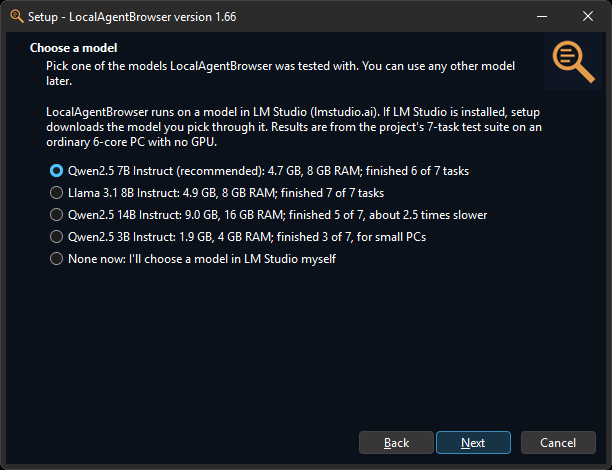
- Setup asks what to install (LocalAgentBrowser, and optionally the test suite), which of the five tested models to download through LM Studio, and whether to use cloud models (off unless you tick it). It then downloads the Chromium browser the agent uses (about 150 MB, once).
- Open LocalAgentBrowser from the Start menu or the desktop. If you turned on cloud models, setup also adds LocalAgentBrowser (cloud). The plain shortcut always uses the model in LM Studio; only the (cloud) one sends your runs to OpenRouter.
To remove it: Start menu → LocalAgentBrowser → Uninstall LocalAgentBrowser, or Windows Settings → Apps. Your reports in Documents are kept.
Windows: the Clean Room installer
For Clean Room, a private edition, download
LocalAgentBrowser-CleanRoom-1.67-setup.exe (or from the
latest release) and follow the steps above: setup is
the same, without the cloud page. It installs beside the standard edition, with its own folder and shortcuts, and opens
as LocalAgentBrowser Clean Room. With pip: pip install localagentbrowser-cleanroom.
Any system: pip
You need Python 3.10 or later, and LM Studio (free) to run the model, unless you use cloud models.
python -m venv venv
venv\Scripts\activate
pip install localagentbrowser
python -m playwright install chromium
On macOS or Linux, activate with source venv/bin/activate instead.
From source
git clone https://github.com/SnowFXXX/LocalAgentBrowser.git
cd LocalAgentBrowser
python -m venv venv
venv\Scripts\activate
pip install -r requirements.txt
python -m playwright install chromium
Run it with python agent_browser.py.
Windows shortcuts from a clone
The installer adds these for you. From a clone (above), with its packages installed in a venv folder inside it:
powershell -ExecutionPolicy Bypass -File tools\windows\make_shortcuts.ps1
This adds LocalAgentBrowser to the Start menu and the desktop. The launcher checks that LM Studio is answering (or, with cloud models on, that your key is set), runs each objective in its own folder under Documents\LocalAgentBrowser runs, and opens the report as a page in your browser when the run ends.
First run
- In LM Studio, load your model with a context length of 8192 (the agent's default; LM Studio's own default may
differ) and start the local server (Developer tab → Start Server). With cloud models turned on, skip this step and
set your OpenRouter key in the
OPENROUTER_API_KEYenvironment variable instead (without the installer, see the FAQ for the other settings). - Start LocalAgentBrowser: the Start-menu shortcut on Windows (LocalAgentBrowser (cloud) for cloud models), or
localagentbrowserin a terminal. - Type your objective, for example What is the tallest mountain in Africa, and how tall is it in meters and in
feet? A Chromium window opens and the agent starts working. The first step takes a minute or two on a CPU. On
Windows (1.66), the console and the browser sit side by side, the console on the left and the browser on the
right, so you can watch both without switching windows (
LAB_SIDE_BY_SIDE=0turns this off). - When it finishes, the report opens in your browser (on the right, on Windows), or read
research_report.mdin the folder you ran it from. Runs from the shortcut each get their own folder under Documents\LocalAgentBrowser runs. - On Windows, the console then asks for another objective, so you can run one after another in the same window; press Enter on an empty line to close it.
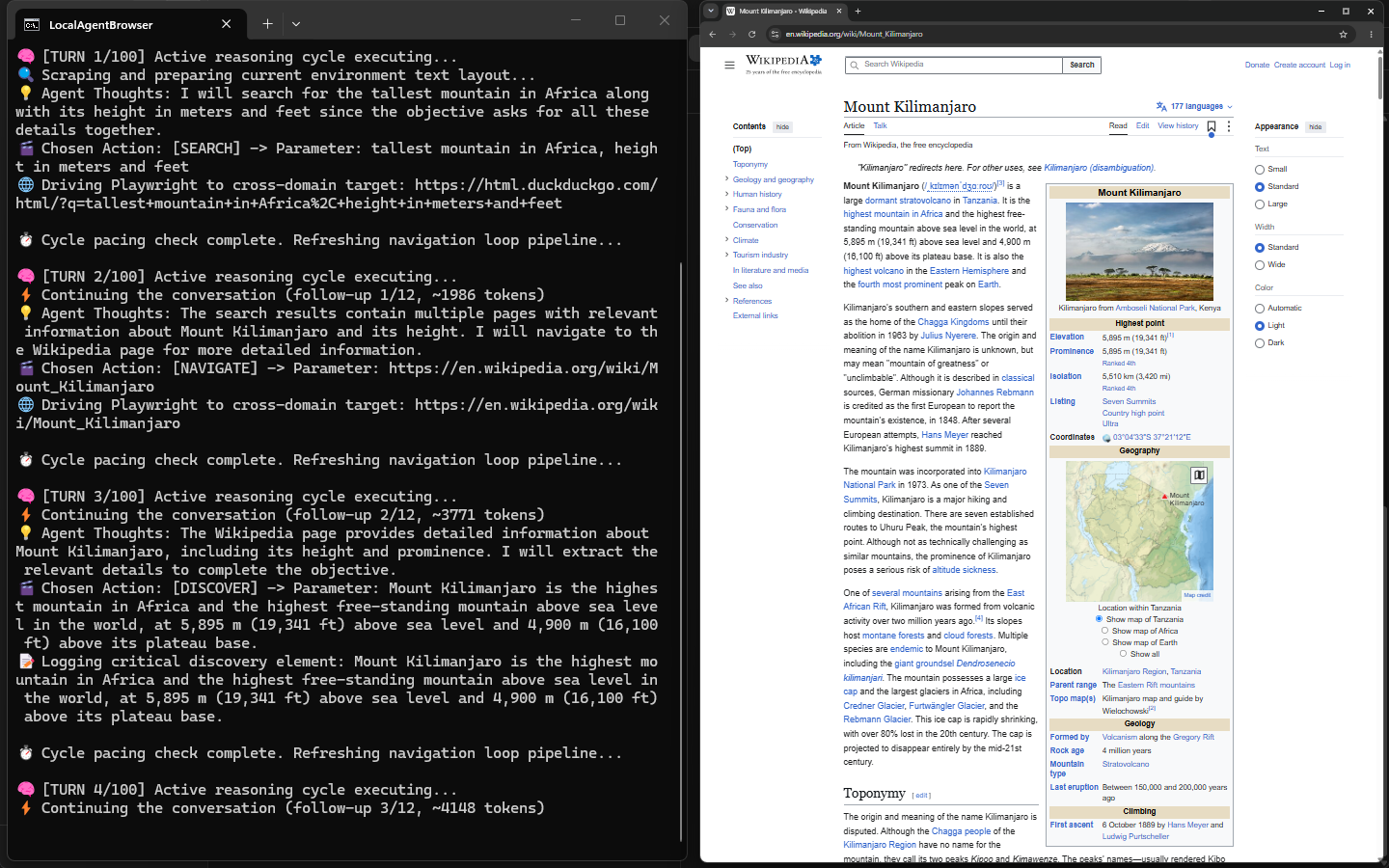
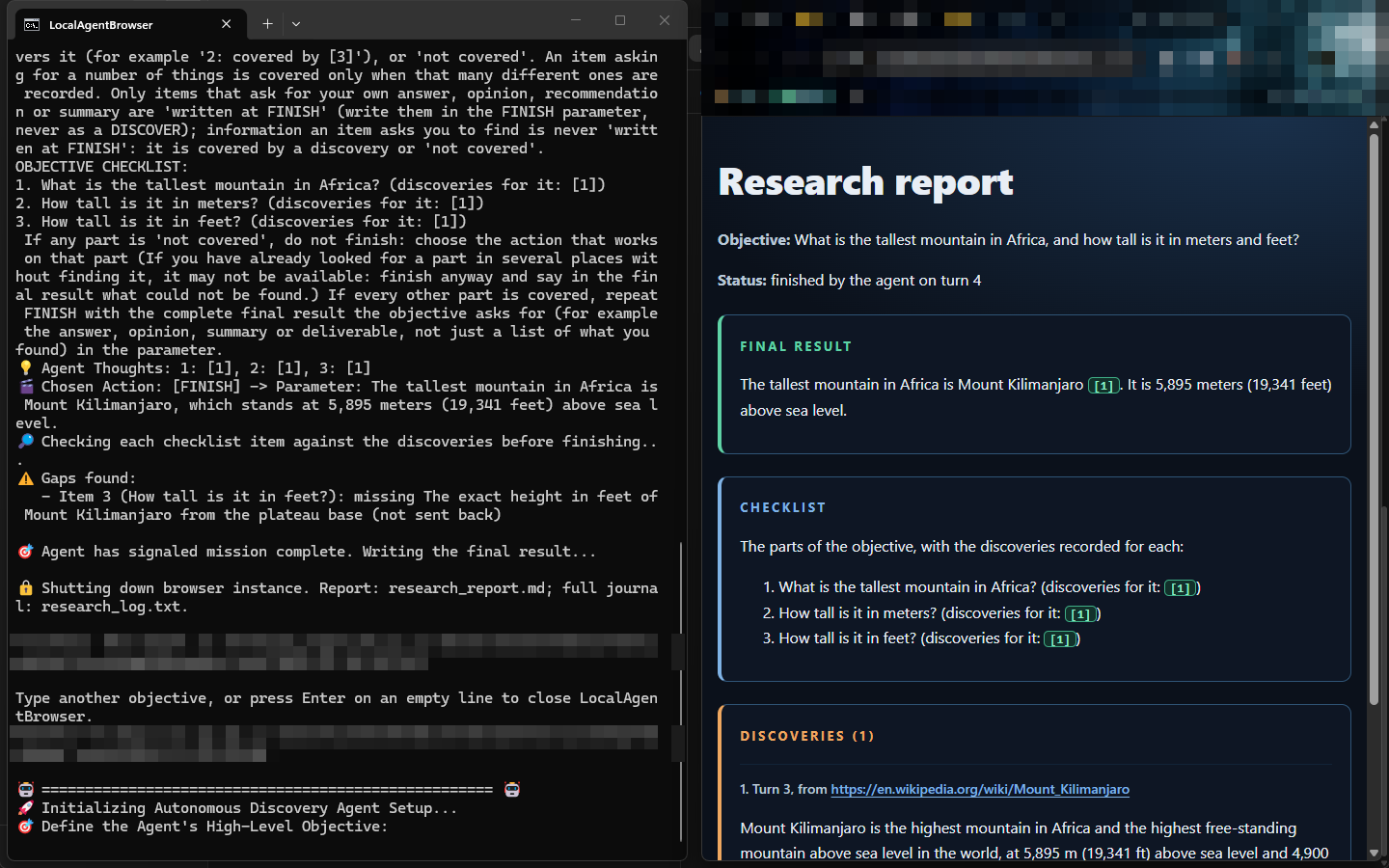
1.66 with Qwen2.5-7B on a CPU: the run, then its report. The file paths in the second shot are blurred.
A run takes about 10 to 60 minutes on a CPU, and a few minutes with a cloud model. Press Ctrl+C at any time to stop; the report is still written with everything found so far.
Good objectives are questions you'd research by reading pages: a fact, a list with conditions ("three free, open-source alternatives to Photoshop"), a comparison, a how-to, an explanation, or what several sources say. Not yet: anything behind a login, a form or a button (it reads pages; it doesn't click or type into them).
What a run looks like
A real run of 1.64 with the default model on a CPU (with the timing lines the test runner adds; repetitive lines left out). Objective: "What is the tallest mountain in Africa, and how tall is it in meters and in feet?"
📋 Splitting the objective into a checklist...
   (model call 117.4s, prompt=778 tok, completion=30 tok)
📋 Objective checklist:
1. What is the tallest mountain in Africa? (discoveries for it: none yet)
2. How tall is it in meters? (discoveries for it: none yet)
3. How tall is it in feet? (discoveries for it: none yet)

🧠 [TURN 1/100] Active reasoning cycle executing...
   (model call 59.5s, prompt=926 tok, completion=78 tok)
🎬 Chosen Action: [SEARCH] -> Parameter: tallest mountain in Africa height in meters and feet

🧠 [TURN 2/100] Active reasoning cycle executing...
♻️ Cheap retry 1/2: [DISCOVER] refused. That is the search results page: its short descriptions are summaries
   written to be clicked, not sources. NAVIGATE to the result that looks right and DISCOVER from the page itself.
🎬 Chosen Action: [NAVIGATE] -> Parameter: https://en.wikipedia.org/wiki/Mount_Kilimanjaro

🧠 [TURN 3/100] Active reasoning cycle executing...
🎬 Chosen Action: [DISCOVER] -> Parameter: Mount Kilimanjaro is the highest mountain in Africa, rising to
   5,895 m (19,341 ft) at Uhuru Peak.

🧠 [TURN 4/100] Active reasoning cycle executing...
♻️ Cheap retry 1/2: [FINISH] refused. Your only discovery comes from
   https://en.wikipedia.org/wiki/Mount_Kilimanjaro. Consider whether the objective needs more. ...
   Before finishing, go through the OBJECTIVE CHECKLIST below ... and in thought_process write each item's
   number followed by the number of the discovery that covers it ...
💡 Agent Thoughts: 1: [1], 2: [1], 3: [1]
🎬 Chosen Action: [FINISH] -> Parameter: The tallest mountain in Africa is Mount Kilimanjaro, which stands at
   5,895 meters (19,341 feet) tall.
🔎 Checking each checklist item against the discoveries before finishing...
🎯 Agent has signaled mission complete. Writing the final result...
Four turns and 17.2 minutes of model time. The report it wrote:
Final result: The tallest mountain in Africa is Mount Kilimanjaro [1]. It rises to 5,895 m (19,341 ft) at Uhuru Peak. The height in feet was found to be 19,341 ft [1].
Checklist
- What is the tallest mountain in Africa? (discoveries for it: [1])
- How tall is it in meters? (discoveries for it: [1])
- How tall is it in feet? (discoveries for it: [1])
Discoveries (1)
- Turn 3, from https://en.wikipedia.org/wiki/Mount_Kilimanjaro: Mount Kilimanjaro is the highest mountain in Africa, rising to 5,895 m (19,341 ft) at Uhuru Peak.
The answer is right and every fact in it is in the finding, but it isn't polished: the second sentence has no citation mark, and the third repeats the height. We show the run as it came out. Small writing slips like these are on the list; invented facts are what the checks are there to stop.
How it works
Each turn, the model sees the objective, what it has found so far, its recent actions and the current page, and answers with one JSON action:
| Action | What it does |
|---|---|
SEARCH |
Searches DuckDuckGo and shows the results with their real addresses |
NAVIGATE |
Opens an address from the results or the current page's links |
READ_MORE |
Shows the next part of a long page (pages are read in parts of about 2,500 characters), or the unread part whose outline label names an item still missing |
DISCOVER |
Records something from the current page as a finding |
FINISH |
Ends the run, after each part of the objective is checked; the answer is then written in a separate step |
Objective --> prompt --> model (LM Studio or cloud) --> one JSON action --> checks in code
                ^          ^                                                      |
                |          +--- refused: a cheap retry ---------------------------+
                |                                                                 |
                +--- page text, links <--- Playwright (Chromium) <--- accepted ---+
                                                                                  |
                                                        the report <--- FINISH ---+
The model proposes; code checks before anything is accepted:
- A fixed checklist of the objective's parts, made once at the start, that every later check uses.
- Findings must come from the page: they're compared with the page text shown, and commands must appear on the page exactly.
- Finishing is checked part by part, and the agent is sent back only for gaps the code can confirm: a part nothing answers, fewer things than asked for, missing amounts, a concrete missing term such as "O2".
- The answer is written separately, from the findings only. Names, numbers and commands no finding gives are cut and named, and parts nothing answers are listed as "Not found in the pages read".
- Made to run on a CPU: it reuses LM Studio's prompt cache, so most turns only process what changed.
The full details, code layout, timings and known limits: docs/how-it-works.md.
Settings
| Environment variable | Default | Meaning |
|---|---|---|
LMSTUDIO_BASE_URL |
http://localhost:1234/v1 |
Address of the OpenAI-compatible server |
LMSTUDIO_MODEL |
qwen2.5-7b-instruct |
Model identifier as the server lists it |
LMSTUDIO_API_KEY |
lm-studio |
API key, if your server requires one |
LMSTUDIO_CONTEXT_LENGTH |
8192 |
Context length the model is loaded with; the conversation budget follows it |
LMSTUDIO_EXTRA_BODY |
none | Extra JSON fields sent with every request, for other servers |
LMSTUDIO_EXTRA_HEADERS |
none | Extra HTTP headers sent with every request, as JSON |
OPENROUTER_API_KEY |
none | Your OpenRouter key for cloud models, read by the Windows launcher and the test suite's --cloud |
LAB_RUNS_DIR |
regression_runs/ |
Where the test suite puts its run folders |
LAB_SIDE_BY_SIDE |
on | On Windows, 0 keeps the console and the browser from being placed side by side |
The Windows installer writes the model you chose, and the cloud setting if you turned it on, to small files in its
settings folder. Behaviour limits are named constants in localagentbrowser/config.py, each with a comment.
FAQ
Does it need a GPU? No. It was developed and tested entirely on a CPU. A GPU makes each turn faster. With cloud models turned on, the model runs on the provider's computers instead of yours.
Why does a turn take minutes on a CPU? On a CPU the model reads the prompt slowly (about 8 tokens a second on the development PC), so a turn that brings in a new page takes a few minutes. Most other turns reuse LM Studio's cache. With cloud models turned on, a turn takes seconds.
Is anything sent to the internet? By default no AI service is involved and nothing about your run is uploaded. The agent does browse the real web: searches, written from your objective, go to DuckDuckGo, and pages load normally. If you turn on cloud models, the objective, the prompts and the pages read go to OpenRouter and the model's provider. If you want that option not to exist at all, use Clean Room.
What is Clean Room? A private edition of LocalAgentBrowser, released with every version from 1.67: the same agent and checks, with the cloud code removed before it is built, and a model server allowed only on your own PC or network. See Clean Room, a private edition.
What are cloud models? An option, off unless you turn it on, for people with an
OpenRouter account: the agent then uses a model in the cloud instead of LM Studio. It's much
faster, but it costs money on your account, and your prompts and the pages read leave your computer (the agent asks
providers not to store or train on them). You set your own key in the OPENROUTER_API_KEY environment variable; the
installer never asks for it. Cloud runs are listed under LocalAgentBrowser in OpenRouter's app rankings (no request
content is shared); to turn that off, delete the LMSTUDIO_EXTRA_HEADERS line in the installer's
settings\cloud.cmd.
How do I switch between local and cloud models? With cloud models turned on in setup, you get two shortcuts (from 1.67): LocalAgentBrowser always uses the model in LM Studio, and LocalAgentBrowser (cloud) uses the cloud model through OpenRouter. Open whichever you want for that run; nothing else changes. To add or remove the cloud shortcut, run setup again and tick or untick cloud models: your reports are kept. (Up to 1.66, turning on cloud models made the one shortcut use the cloud; after updating, that shortcut uses LM Studio.)
How do I turn on cloud models without the installer? Set your key in OPENROUTER_API_KEY, then these, in
the same window before you start the agent. In Windows' command prompt:
set "LMSTUDIO_BASE_URL=https://openrouter.ai/api/v1"
set "LMSTUDIO_MODEL=microsoft/phi-4"
set "LMSTUDIO_API_KEY=%OPENROUTER_API_KEY%"
set "LMSTUDIO_EXTRA_BODY={"provider": {"require_parameters": true, "data_collection": "deny"}}"
On macOS or Linux:
export LMSTUDIO_BASE_URL=https://openrouter.ai/api/v1
export LMSTUDIO_MODEL=microsoft/phi-4
export LMSTUDIO_API_KEY="$OPENROUTER_API_KEY"
export LMSTUDIO_EXTRA_BODY='{"provider": {"require_parameters": true, "data_collection": "deny"}}'
The last line asks providers not to store or train on your prompts and to honour the JSON format. Any model
OpenRouter lists can go in LMSTUDIO_MODEL; this one is the cloud version of the default.
Can I use another OpenAI-compatible server? Probably: point LMSTUDIO_BASE_URL at it. The speed tricks rely
on the server reusing cached prompt prefixes (llama.cpp-based servers do).
Where are the results? When a run started from the Windows shortcut or the installed app ends, the report opens
in your browser by itself. The files are research_report.md (the answer and every finding with its source) and
research_log.txt (every action and reason), in the run's folder.
Limitations
- Whether a finding really answers a part is judged by the model, and it can be wrong. The model can credit a finding about the right topic to the wrong part (a "create" command for "activate"; on 1.66, Gemma 3 4B gave a glacier's elevation on Kilimanjaro's page as the mountain's height), or put the wrong number on a citation. Check claims against the listed findings.
- Reading only: it doesn't click, fill in forms or sign in, and some sites refuse automated browsers.
- Web pages go into the prompt, so a page could try to manipulate the model (prompt injection); treat findings as unverified. See SECURITY.md.
- Seven kinds of task so far. Others may expose new problems; reports are welcome.
More in docs/how-it-works.md.
Roadmap
- A fixed checklist, a coverage check verified in code, and every change measured on a regression suite (1.53–1.61)
- Exact-text command checks, and four models measured on identical code (1.63)
- Parts of the objective no longer dropped silently as often; the Windows launcher (1.64)
- A Windows installer with its own Python and a choice of tested models, and optional cloud models (1.65)
- Sturdier cloud runs, more of each answer checked in code, and the console and browser side by side (1.66)
- Clean Room (1.67): a privacy edition with the cloud code removed entirely, released alongside every standard version from then on
- Count silent omissions in the regression suite, so issue #11 can close on a number
- Decide in code, not by asking the model, whether a finding answers the part it's credited to
- Refuse a finding that changes one of the page's key words (1.66's SimpleQA run recorded "men's foil" from a page that says "épée")
- A tray app on Windows: new research, progress, a notification when done
- Rewind dead ends: return to a saved point instead of carrying an unused page in every later prompt
- Interacting with pages (clicking, forms) for tasks beyond reading
Ideas and requests are welcome in issues.
Testing
The test suite runs in a few seconds with no model or browser: both are replaced by scripted fakes.
pip install -r requirements-dev.txt
python -m pytest
python -m ruff check .
To try the real agent with a fixed objective and a time limit, logging every model call:
python tools/live_test.py "Your objective here" --minutes 25
To measure a change on all seven kinds of task (several hours on a CPU), on any model you load into LM Studio:
python tools/regression.py --model qwen2.5-7b-instruct --baseline regression_runs/<earlier run>/summary.json
With --cloud --model microsoft/phi-4 the same suite runs on OpenRouter, with your key in
OPENROUTER_API_KEY (those runs are listed under LocalAgentBrowser in OpenRouter's app rankings).
Each run gets a folder in regression_runs/ (or in the folder LAB_RUNS_DIR names; the installer's "Run the test
suite" shortcut uses Documents\LocalAgentBrowser test-suite runs) with every task's report, journal and prompt
trace, a summary.md
with honesty measures for each result, and run_info.json naming the PC and the exact code it ran. Results by kind
of task are in docs/task-results.md,
and every step since 1.53 in
docs/regression-history.md.
Contributing
Contributions are welcome! See CONTRIBUTING.md and the Code of Conduct. Security issues: SECURITY.md.
Project history
Every released version is a tagged commit, and CHANGELOG.md says what changed and why, with the measurements behind each decision.
Acknowledgements
Versions 1.13 onwards were developed together with Claude (Anthropic), working in Claude Code; those commits list Claude as co-author. Built on LM Studio, Playwright, the OpenAI Python library, OpenRouter for the optional cloud models and, for the Windows installer, Inno Setup.
License
MIT © 2026 SnowFX
1 maintainer

Metadata
1 maintainer
Release files for localagentbrowser 1.67.2
For a detailed explanation of source distributions (sdists) and built distributions (wheels), please see the package formats documentation.
Source distribution (sdist)
| File | Size | Uploaded | Provenance | Actions |
|---|---|---|---|---|
| localagentbrowser-1.67.2.tar.gz | 270.0 kB | With provenance | Details for localagentbrowser-1.67.2.tar.gz |
Built distribution (wheel)
| File | Interpreter | ABI | Platform | Actions Reset |
|---|---|---|---|---|
| localagentbrowser-1.67.2-py3-none-any.whl | Python 3 | none | any | Details for localagentbrowser-1.67.2-py3-none-any.whl |
Total release size: 389.2 kB
Release files / localagentbrowser-1.67.2.tar.gz
| Download URL | localagentbrowser-1.67.2.tar.gz |
|---|---|
| Size | 270.0 kB |
| Tags | Source |
|
SHA-256 checksum How to use checksums |
cc3516b55b0697156c7c0b6c4e4aa3483e1724f15575421cbfa399e539481781
|
|
BLAKE2b-256 checksum How to use checksums |
44064529b8fe4edea7137e6ed2b996a4fdbe424c252c79bf07a9926533f16a8c
|
| Upload date | |
|
Uploaded using Trusted Publishing? What is trusted publishing? |
Yes |
| Uploaded via |
twine/7.0.0 CPython/3.13.16
|
Provenance
Provenance describes where a file came from. On PyPI, provenance is shared via attestations, which provide a verifiable record of the build or publishing details. View details, limitations and caveats.


PyPI Publish Attestation
PyPI verified that this artifact, at this checksum, originated from the publisher listed below.
Signed by GitHub Actions, verified by PyPI on Nov 18, 2026.
Transparency logRelease files / localagentbrowser-1.67.2-py3-none-any.whl
| Download URL | localagentbrowser-1.67.2-py3-none-any.whl |
|---|---|
| Size | 119.2 kB |
| Tags | Python 3 |
|
SHA-256 checksum How to use checksums |
83e54f2259e5b2e0c45ffa94edfd86d484b0821623da3363c9670dfeed4a6fd3
|
|
BLAKE2b-256 checksum How to use checksums |
817cf10a72d2d2a6323587e72e486e648b1c1bfbb1390b5ceb4b02f855d64f3b
|
| Upload date | |
|
Uploaded using Trusted Publishing? What is trusted publishing? |
Yes |
| Uploaded via |
twine/7.0.0 CPython/3.13.16
|
Provenance
Provenance describes where a file came from. On PyPI, provenance is shared via attestations, which provide a verifiable record of the build or publishing details. View details, limitations and caveats.
PyPI Publish Attestation
PyPI verified that this artifact, at this checksum, originated from the publisher listed below.
Signed by GitHub Actions, verified by PyPI on Nov 18, 2026.
Transparency logSecurity for localagentbrowser 1.67.2
Provenance
Provenance describes where a file came from. On PyPI, provenance is shared via attestations, which provide a verifiable record of the build or publishing details. View details, limitations and caveats.
Full provenance
Both files in this release have been uploaded with provenance metadata.
Attestation for localagentbrowser-1.67.2.tar.gz
PyPI Publish Attestation
PyPI verified that this artifact, at this checksum, originated from the publisher listed below.
Signed by GitHub Actions, verified by PyPI on Nov 18, 2026.
Transparency logA note on package security
PyPI is a repository for distributing packages, not a service for auditing them. While third-party security researchers and our staff do their best to detect and remove malicious packages, PyPI cannot guarantee the quality, security or suitability of any given package.
To learn more about protecting yourself from malicious actors, visit our package security documentation.














