
LocalMask
Find and mask secrets in your code — 100% locally. Nothing ever leaves your machine.
LocalMask scans a repository for credentials, keys, tokens, and PII, and replaces
each one with a stable placeholder like ~[DATABASE_PASSWORD_0]~. You get a masked
copy you can safely paste into an AI tool, share in a ticket, or publish — while
keeping a local map back to the real values.
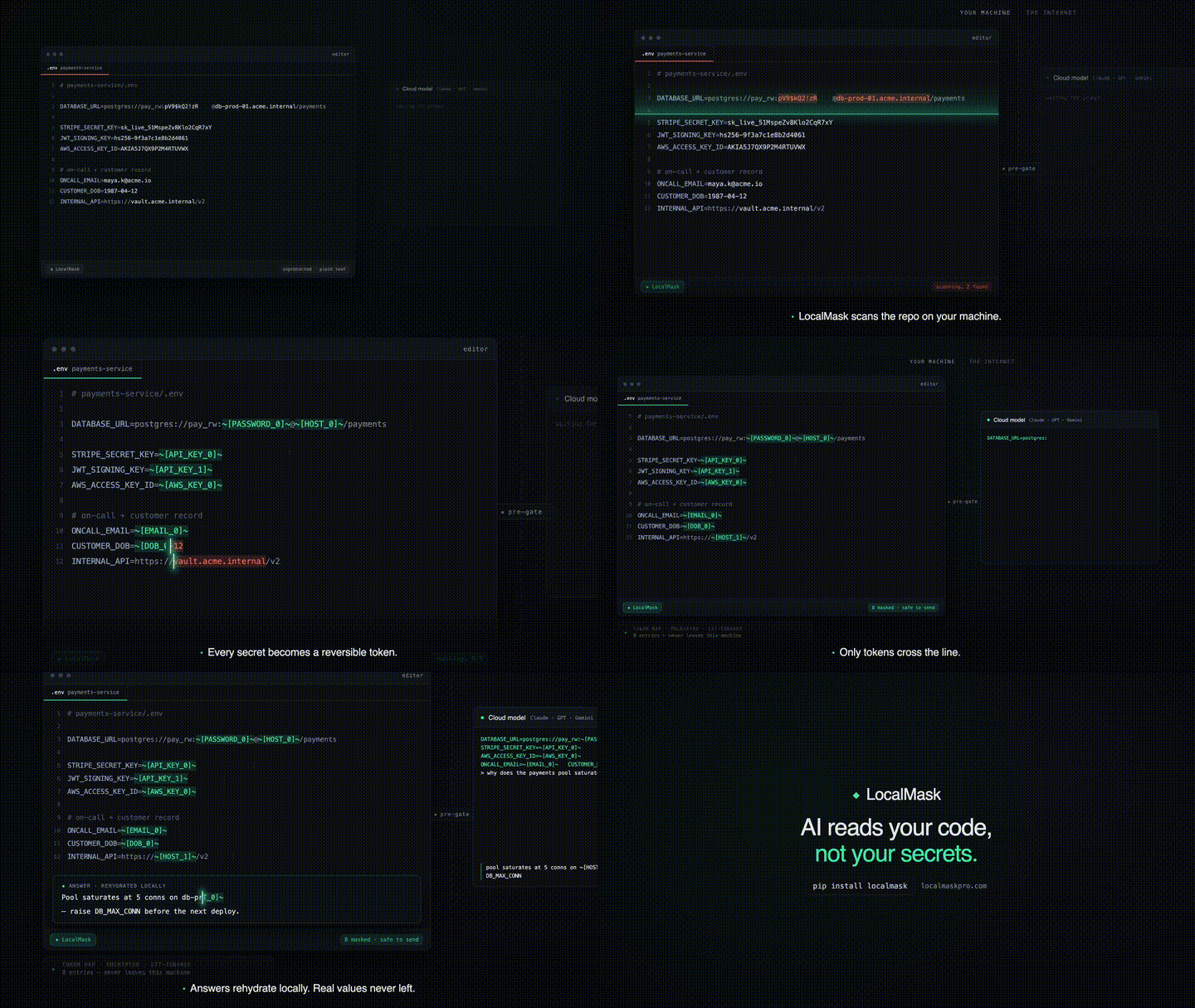
The free edition is open source and runs entirely offline: 350+ detection patterns across a regex engine + entropy detection, masking + rehydrate, a publishable masked repo, git sync, and a CLI + MCP server. No AI model, no cloud, no account.
Want an AI model that catches what patterns miss and learns from your corrections, a web dashboard, the AI proxy — a masking stage in front of your AI (or your company's AI gateway), so compliance sees clean prompts and stops blocking developers, and a team-shared vault so everyone gets consistent tokens? See LocalMask Pro.
Install
pip install localmask          # from PyPI
# or from source:
pip install .
Requires Python 3.10+. No ML dependencies.
Scan a repo
localmask scan ./my-project
You'll see every detected secret, its type, and its placeholder. A masked copy is kept in the session; publish it or read it back whenever you want.
Sensitivity levels:
localmask scan ./my-project --sensitivity minimal    # only high-confidence secrets
localmask scan ./my-project --sensitivity standard    # default
localmask scan ./my-project --sensitivity strict      # also flags PII, hostnames, IPs
Edit detections (you're in control)
The engine is a starting point, not the final word. You can correct it — and these edits are free, no model required:
# Ignore a false positive (stop masking this value)
localmask review            # interactive: mark detections keep / ignore

# Teach a secret the patterns MISSED (always mask this value)
localmask teach <scan_id> "the-exact-missed-value" --subtype API_KEY
localmask teach <scan_id> "a-false-positive" --allow      # or: never mask it

# …or do it inside the review UI: press [T] to teach a missed value,
# and it re-scans in place so you see it masked immediately.
Ignoring and teaching update a persistent local lexicon (stored encrypted next to the vault, keyed by repo), so they apply automatically on every future scan and sync of that repo — even in a fresh process. On a Team/Enterprise shared vault, taught values propagate to the whole team.
Publish a masked copy
localmask publish <scan_id> https://github.com/you/my-project-masked.git
Only masked content is pushed. Real values never leave your machine.
Security review — a second approval
Masking is the first line; a second, human approval stands between a scan
and anything leaving the machine. The developer reviews and edits detections;
then security signs off — nothing publishes unapproved, and a sync that
finds new secrets automatically un-approves until re-reviewed. Auto-approve
keeps this scalable: scans where every detection clears your confidence bar
(default 95%) flow through automatically; anything uncertain waits for a
human. Every approve/reject decision also teaches the Pro classifier.
Approve either way:
localmask review <scan_id>        # decide each detection; approves when none are left pending
localmask approve-all <scan_id>   # approve everything in one step
localmask publish <scan_id> <url> # now allowed
New secrets found on a later sync un-approve the scan and hold the mirror
until you review them again. Prefer no gate (auto-approve + auto-publish on every
change)? Switch the policy:
localmask config                        # show current settings
localmask config publish-policy auto    # auto-approve + auto-republish
localmask config publish-policy review  # back to manual gate (default)
localmask publish <scan> <url> --force  # one-off override of the gate
Let your AI read the masked code (two ways)
The masked copy has only ~[TOKEN]~ placeholders — no real secrets — so the AI
can read it safely. LocalMask never hands the AI any git credentials. Pick
whichever fits:
A) The AI reads the published masked git mirror. Keep the masked repo private
and give the AI its own read access — LocalMask never shares your git token.
The AI clones/pulls that repo (a copy on its side, separate from your real
code) and authenticates as itself. To get the updated version after you change
code: localmask sync <scan> re-masks and re-pushes the mirror (once approved),
and the AI runs git pull. (Because it's masked you could also make the mirror
public and skip auth — no secrets are in it.)
Grant that access in one step — pick how much (if anything) is handed over:
# Nothing transferred — the mirror is masked, so just make it public:
localmask grant-ai <scan_id> --public
#   → any AI clones it with NO credential at all.

# Nothing transferred — the AI uses its OWN account:
localmask grant-ai <scan_id> --collaborator <the-ai-bot-username>
#   → grants that account read-only on this repo; the AI signs in as itself.

# A dedicated, throwaway key IS handed to the AI (its own, not yours):
localmask grant-ai <scan_id>
#   → creates a read-only, single-repo SSH deploy key and prints the AI's
#     private key + clone command.
What is and isn't transferred: LocalMask never shares your git token, SSH
key, or account. --public and --collaborator transfer nothing to the AI.
The default deploy-key mode hands the AI a new, dedicated credential that is
read-only and scoped to only that one repo (a GitHub deploy key can't access
any other repo or your account) — revoke it anytime with gh repo deploy-key delete. If the AI runs on your machine (Claude Code, Cursor), it can just use
the git you already have and you don't need grant-ai at all.
B) The AI reads live from LocalMask — nothing published. In your AI editor's
MCP config, the assistant calls the get_detections and get_file_masked tools.
No git repo, no push, no git pull — LocalMask serves the current masked
content on each call (run localmask sync <scan> after code changes so the next
read is fresh). Use this when you don't want a mirror at all.
Which to use: (A) the AI holds its own git copy and pulls to update — good
for agents/CI that clone a repo; (B) LocalMask streams the masked files live,
always current, no repo. Either way the AI only ever sees ~[TOKEN]~ placeholders
and signs in with its own identity — LocalMask stays out of its authentication.
Keep the masked copy in sync
localmask sync <scan_id>        # re-scan after code changes; tokens stay stable
localmask hook <scan_id>        # install a git hook to auto-sync on commit
Unchanged secrets keep the same placeholder across syncs; new secrets get new ones.
Stop secrets before they land — CI & pre-commit
localmask scan . --fail-on-detection exits non-zero when it finds a secret, so
it drops straight into any gate.
Pre-commit — add to .pre-commit-config.yaml (spreads across a team with one line):
repos:
  - repo: https://github.com/sgury/localmask
    rev: v0.9.7
    hooks:
      - id: localmask
GitHub Action — fail a PR that introduces a secret (.github/workflows/localmask.yml):
name: LocalMask
on: [pull_request]
jobs:
  secret-scan:
    runs-on: ubuntu-latest
    steps:
      - uses: actions/checkout@v4
      - uses: sgury/localmask@v0.9.7
Both run 100% locally on the runner — nothing leaves it.
Route your AI tool through the masking proxy (Pro)
One command points Claude Code / Cursor at the local proxy, so prompts are masked on your machine before anything is sent to the AI (or to your org's AI gateway):
localmask proxy setup claude-code   # or: cursor · codex · env
localmask proxy                     # start it (Pro)
Git integrations — all the ways
| Integration | Command | What it does |
|---|---|---|
| Scan a local folder | localmask scan ./repo |
mask secrets on disk |
| Scan a remote repo | localmask scan https://github.com/org/repo.git |
clone → mask (never stored unmasked) |
| Publish a masked mirror | localmask publish <scan> <remote-url> |
push a masked copy to any git remote |
| Keep it synced | localmask sync <scan> |
re-scan on change, tokens stay stable |
| Auto-sync on commit | localmask hook <scan> |
installs a git post-commit / pre-push hook |
| Drive it from your AI editor | MCP (below) | assistant calls scan/publish for you |
The remote can be GitHub, GitLab, Bitbucket, a self-hosted git server, or
Google Secure Source Manager — any https://, ssh://, git@, or file://
remote.
Private repos (tokens)
For a private source or a private masked mirror, give LocalMask a token:
localmask store-token                        # prompts for the token HIDDEN,
                                             # stores it encrypted, returns a credential_id
localmask scan https://github.com/org/private.git -c <credential_id>
localmask publish <scan> https://github.com/org/masked.git -c <credential_id>
The token is stored encrypted in a local 0600 SQLite file and only a random
credential_id is ever passed on the command line — so your token never lands
in your shell history or in ps. Don't pass the token as an argument
(store-token ghp_…): that does leak into shell history. You can also rely on
the git credentials already on your machine (e.g. gh auth login), or pass
--token for a throwaway one-off.
You don't need to create the masked repo yourself. If it doesn't exist,
publishoffers to create it for you (private by default) — via a stored token or yourghCLI login — after asking. Use--yesto skip the prompt,--publicto make it public. Use a PAT withreposcope (orgh auth).
How the git integration stays secure
- Tokens never touch the URL, process arguments, or
.git/config. LocalMask authenticates viaGIT_ASKPASS, so your token isn't visible inps, shell history, or the cloned repo's config. - Git URLs are validated against an allowlist (
https/ssh/git@/file), and a--separator is placed before them — this blocks argument-injection tricks like--upload-pack=<cmd>and theext::transport that could run commands. - The git username is passed via an environment variable, never interpolated into a shell script — so a hostile username can't inject commands.
- Only masked content is ever pushed. The published mirror contains
~[TOKEN]~placeholders; the real values stay in your local vault. - Tokens can be stored short-lived and encrypted (
store-token), or not stored at all (--tokenper command).
Finance Mode — AI analysis of financials without the figures
Teams that won't paste salaries, prices or revenues into an AI get no AI help on exactly the data that matters most. Finance Mode fixes that.
Three modes (set via LOCALMASK_MONEY_MODE):
| Mode | What the AI sees | Use when |
|---|---|---|
token |
~[AMOUNT_0]~ |
full opacity — AI can't see any relationship |
bucket |
~[AMOUNT_5D_USD_0]~ |
order of magnitude only (5-digit USD amount) |
relative |
(1.15*R_AMOUNT) |
AI can compare and compute ratios |
Relative mode — how it works:
- LocalMask generates a secret random base
Ron your machine (stored in~/.localmask/money_keys.json, 0600, never uploaded). - Every amount becomes a ratio to that base:
$42,000→(0.42*R_AMOUNT). - The AI can compare and compute ("Dana earns 20% more than John") but never sees the real figures, currency, or scale.
LOCALMASK_MONEY_MODE=relative localmask scan .
| What's on disk | What the AI sees |
|---|---|
salary Dana: $42,000 |
salary Dana: (1.20*R_AMOUNT) |
salary John: $35,000 |
salary John: (1.00*R_AMOUNT) |
revenue: $8,500,000 |
revenue: (242.86*R_AMOUNT) |
What's hidden: the amounts, the currency, the scale. What's visible: ratios between amounts — that's the analysis you asked for. R: generated with a CSPRNG on your machine, stored locally, never uploaded.
Only currency-anchored or finance-keyword-anchored numbers are touched — bare
numbers (ports, versions, IDs) never are. The vocabulary is editable in
regex_patterns.json (add your own domain terms, no code). Full details and
the honest threat model: FINANCE.md.
Finance Mode is free and open source. Locking the mode org-wide is Pro / Team.
Multilingual detection — 9 language packs
Secrets and PII don't only hide in English. LocalMask ships keyword patterns for Romanian, Hebrew, Russian, Arabic, Spanish, French, German, Italian, and Hindi:
// CNP: 1850301401008             ← Romanian CNP, checksum-validated
# parola: Bucur3sti!9x            ← password labeled in Romanian
# ת"ז של הלקוח: 234569176        ← Israeli ID, check-digit validated
# пароль: S3cur3!Pass74           ← password labeled in Russian
; DNI: 12345678Z                  ← Spanish DNI, control-letter validated
// كلمة المرور: Xk9$mPl2Qw        ← password labeled in Arabic
National IDs are checksum-validated (a random 13-digit number near "CNP"
does NOT match), and every pattern is word-boundary guarded so digits inside
a longer key or hash never fire. Pick packs with LOCALMASK_LANGS=he
(default: none — opt in to avoid unexpected FPs from languages you don't use).
Edition note: Hebrew (he) is free. All other language packs
(ro, ru, es, ar, de, fr, it, hi) require LocalMask Pro.
A clear upgrade notice is printed if a gated pack is loaded without a license;
detection falls back to free packs automatically. Adding a language is a JSON
block in regex_patterns.json — no code.
Using AI with LocalMask (free)
Masking and rehydration are 100% local and deterministic — they're just a vault lookup, so they need no AI and no API key and are always exact. That means the free edition works with any AI.
Ask any AI with your own key
# Save your key once (typed hidden, stored encrypted locally) — then just ask:
localmask set-key anthropic            # prompts hidden; also openai/gemini/grok/groq/…
localmask ask <scan_id> "What are the top risks?" --provider anthropic

# …or pass the key per call:
localmask ask <scan_id> "What are the top risks?" --provider openai   --api-key sk-...
localmask ask <scan_id> "..." --provider anthropic --api-key sk-ant-...
localmask ask <scan_id> "..." --provider gemini    --api-key ...
localmask ask <scan_id> "..." --provider grok      --api-key xai-...
localmask ask <scan_id> "..." --provider groq      --api-key ...    # Meta/Llama
localmask ask <scan_id> "..." --provider openrouter --base-url https://... --api-key ...
This default (--source memory) masks the repo + your question locally and
sends only ~[TOKEN]~ placeholders to the provider you chose with your
key, then rehydrates the answer locally. Keys can also come from env
(OPENAI_API_KEY, ANTHROPIC_API_KEY, GEMINI_API_KEY, XAI_API_KEY, or
LOCALMASK_AI_KEY). Works with OpenAI, Anthropic, Google Gemini, xAI/Grok,
Meta/Llama (via Groq/Together), OpenRouter, and any OpenAI-compatible endpoint.
Let the AI read the masked git itself — don't ship the repo (--source git)
If the AI/agent already has its own read access to the published masked mirror, you don't need to send it the code at all:
localmask ask <scan_id> "Why does <a secret in your question> fail?" --source git
#   --git-url <url>   (defaults to the scan's published mirror)
LocalMask masks only your question (by the found-secret vault — any real
secret you type becomes a token), sends just that masked question plus the repo
URL to your AI, and the AI reads the private masked repo itself with its own
grant. The answer is rehydrated locally. No repo content and no git credentials
leave your machine — only the masked question. (Best with agent/tool-capable
AIs that can clone a repo. For the MCP/agent flow, the same thing is exposed as
the mask_prompt and rehydrate_answer tools.)
Or do it by hand — LocalMask never has to call anything
localmask export <scan_id> ./masked          # write the masked repo to a folder…
#   → point your AI tool / agent at ./masked. No keys, no repo permissions, no secrets.
echo "the AI's answer with ~[Token]~s" | localmask rehydrate <scan_id>   # local, exact
cat prompt.txt | localmask mask-text <scan_id>                          # mask before pasting
The published/exported masked copy contains no real secrets — only tokens — so it's safe to make the masked mirror public, and any AI can read it with no credentials. Real values only ever exist in your local vault.
Pro adds the convenience layer: a built-in interactive Ask-AI, the automatic AI proxy (scrub live prompts with zero manual steps), and a local model so you need no external AI at all — see localmaskpro.com.
Use it inside your AI editor (MCP)
LocalMask ships an MCP server so assistants (Claude, etc.) can scan and mask on
your behalf. Add to your .mcp.json:
{
  "mcpServers": {
    "localmask": {
      "command": "~/.localmask/venv/bin/python",
      "args": ["~/.localmask/mcp_server.py"]
    }
  }
}
Then your assistant can call scan_repo, get_detections, review_detection,
teach_value, publish_masked_repo, and more — all locally.
Cloudflare Agents SDK
LocalMask works with Cloudflare Workers in two modes:
Local development (stdio) — agent and LocalMask on the same machine:
import { Client } from "@modelcontextprotocol/sdk/client/index.js";
import { StdioClientTransport } from "@modelcontextprotocol/sdk/client/stdio.js";

const transport = new StdioClientTransport({
  command: "python3",
  args: ["-m", "mcp_server"],
});
const client = new Client({ name: "my-agent", version: "1.0.0" });
await client.connect(transport);

const { tools } = await client.listTools();     // 22 tools
const result = await client.callTool({
  name: "read_file_masked",
  arguments: { path: "./src/config.ts" },
});
// result contains masked content — secrets replaced with ~[TOKEN]~
Remote MCP server (Cloudflare Worker + tunnel) — team members connect from anywhere, no install needed:
Team member's laptop → Cloudflare Worker (edge) → cloudflared tunnel → LocalMask (your server)
The Worker exposes LocalMask tools over Streamable HTTP. Anyone with the URL can scan repos, read masked code, and get AI reviews — without installing Python or LocalMask. Secrets never leave your server.
Team members just add the URL to their MCP client config:
{
  "mcpServers": {
    "localmask": {
      "url": "https://your-worker.workers.dev/mcp"
    }
  }
}
See examples/cloudflare-agent/ for setup,
security model, and a ready-to-run demo.
AI Gateway integration (Pro): Route AI calls through
Cloudflare AI Gateway for
DLP, caching, rate limiting, and analytics — a second safety net on top of
LocalMask's masking. See examples/cloudflare-ai-gateway/.
How it works
your repo ──▶ regex + entropy detection ──▶ mask to ~[TOKEN]~ ──▶ masked copy
                                               │
                                               └── local vault maps tokens ⇄ real values
Everything is local. There is no telemetry and no network call in the free edition.
What's in Free vs Pro
| Free (this repo) | Pro | Team / Enterprise | |
|---|---|---|---|
| Regex + entropy engine, 350+ patterns | ✓ | ✓ | ✓ |
| SQL query value masking | ✓ | ✓ | ✓ |
Editable pattern rules (regex_patterns.json) |
✓ | ✓ | ✓ |
| Mask / rehydrate | ✓ | ✓ | ✓ |
| Persistent local vault (stable tokens, encrypted) | ✓ | ✓ | ✓ |
| Edit detections (ignore / teach) | ✓ | ✓ | ✓ |
| Publish masked repo + git sync | ✓ | ✓ | ✓ |
| Finance Mode (token / bucket / relative) | ✓ | ✓ | ✓ |
| CLI + MCP server | ✓ | ✓ | ✓ |
| LLM classifier (catches what regex misses, learns from corrections) | — | ✓ | ✓ |
| Comment scanner (finds PII inside code comments via LLM) | — | ✓ | ✓ |
| Web dashboard | — | ✓ | ✓ |
| AI proxy — masking before your AI / gateway | — | ✓ | ✓ |
| Team-shared vault (consistent tokens across machines) | — | — | ✓ |
| Org shared rules · LDAP/AD · SSO | — | — | ✓ |
Detection accuracy
Benchmarked against real-world datasets:
- CredData (Samsung, 297 repos, 4,583 labeled credentials): F1 42% — ahead of gitleaks (33%), truffleHog3 (24%), detect-secrets (21%) on the same corpus.
- AI4Privacy (2,000 validation samples, 17 PII types): F1 61.6% — 100% precision on email, phone, credit card; recall gaps on international ID formats.
Full methodology and per-category breakdowns: BENCHMARK-REAL-CORPUS.md.
Feedback
Found a false positive, a missed secret, or have a feature request? Email feedback@localmaskpro.com or open an issue at https://github.com/sgury/localmask/issues — we read everything.
License
Free edition released under the MIT license. See LICENSE.
1 maintainer

Download files
Download the file for your platform. If you're not sure which to choose, learn more about installing packages.
Source Distribution
Built Distribution
Filter files by name, interpreter, ABI, and platform.
If you're not sure about the file name format, learn more about wheel file names.
Copy a direct link to the current filters
File details
Details for the file localmask-0.9.12.tar.gz.
File metadata
- Download URL: localmask-0.9.12.tar.gz
- Upload date:
- Size: 227.0 kB
- Tags: Source
- Uploaded using Trusted Publishing? No
- Uploaded via:
twine/6.2.0 CPython/3.14.6
File hashes
| Algorithm | Hash digest | |
|---|---|---|
| SHA256 |
bc59c0ee1e0fc4b2be30018b4f28e3f96a6c859ffac0c9fb493d67961a24c52b
|
|
| MD5 |
8754c2e19b8ac650645604af54ffd2b8
|
|
| BLAKE2b-256 |
9010a8651cbf543277cc674b9ebb8cbe3365ff1ac53d5dd9d717628a79986f2a
|
File details
Details for the file localmask-0.9.12-py3-none-any.whl.
File metadata
- Download URL: localmask-0.9.12-py3-none-any.whl
- Upload date:
- Size: 231.7 kB
- Tags: Python 3
- Uploaded using Trusted Publishing? No
- Uploaded via:
twine/6.2.0 CPython/3.14.6
File hashes
| Algorithm | Hash digest | |
|---|---|---|
| SHA256 |
d40fa56e43bbdb2903b7fd44fd33344dd7dabc0711066d421d9e35b4b7aadcbe
|
|
| MD5 |
ab1205f55e94a2661d4e78742eb0849c
|
|
| BLAKE2b-256 |
39497f3db9dacb51d6bea6f31b881cad786900583d02b12cb4b5c00c5128a764
|














